Ramp Careers: The Engineers Behind a $44B Finance Platform
By Samara Garcia

Ramp careers put engineers on problems where a wrong number has real consequences: card authorizations decided in milliseconds, ledgers that have to reconcile, and fraud caught while the cardholder is still at checkout. Finance teams still lose hours to expense reports, receipt matching, bill payments, and month-end close. Ramp automates those workflows with corporate cards, AI agents, and real-time spend controls.
In its June 2026 funding announcement, Ramp reported processing $200 billion in annualized purchase volume for more than 70,000 customers. A Ramp software engineer may build payment systems or fraud controls, while a Ramp applied AI engineer develops production AI applications and a Ramp forward deployed engineer tackles complex enterprise customer problems.
Key Takeaways
- Ramp’s engineering problems are high-stakes and data-dense: real-time fraud models inside card authorizations, an LLM gateway routing trillions of tokens, and security agents patching vulnerabilities across a financial platform.
- Ramp is hiring senior engineers across Applied AI, Forward Deployed Engineering, Product Engineering, Platform and Infrastructure, and Security. Salary ranges for the roles on Fonzi run from $143,200 to $374,900 depending on team.
- The Ramp interview process favors practical, fintech-grounded problems and evidence of ownership. Ramp says it hires for “slope over intercept,” weighing how fast an engineer grows over where they start.
What Does Ramp Do?
Ramp is a finance automation platform that combines corporate cards, expense management, bill pay, accounting integrations, and AI agents to manage how businesses handle every dollar they spend. The platform processes card authorizations, invoices, reimbursements, and vendor payments. It then uses automation to classify transactions, enforce policy controls, and sync with accounting platforms such as NetSuite and QuickBooks. Ramp reports that its median customer saves 5% on spend and grows revenue 16% in its first year on the platform. Ramp’s customers include Visa, Uber, Shopify, Anduril, Figma, Notion, and Cursor.
Ramp applies AI agents in two distinct places:
- Customer-facing finance features: agentic accounting and risk operations, including Ramp Stack, an agentic accounting assistant that Ramp has written about benchmarking on its Builders blog.
- Internal engineering tools: OCA, Ramp’s AI on-call assistant, investigates incidents, recommends next steps, answers follow-up questions in Slack, and prepares code fixes. Ramp Research, an internal agentic data analyst, answers employees’ data questions directly in Slack, and Ramp says the tool has no access to personally identifiable information. Both are internal platforms, not customer products.
The core product surface includes web applications, mobile apps, and APIs that finance teams and employees use daily. This breadth shapes what a Ramp software engineer works on across frontend, backend systems, and platform.
Ramp Funding, Offices, and Engineering Culture
Ramp was founded in 2019 by Eric Glyman, Karim Atiyeh, and Gene Lee and is headquartered in New York City. Glyman and Atiyeh have been co-CEOs since June 25, 2026, when Rahul Sengottuvelu, previously Ramp’s head of Applied AI, became CTO. On June 4, 2026, Ramp announced a $750 million Series F at a $44 billion valuation, led by ICONIQ, GIC, and Ontario Teachers’ Pension Plan. Ramp reports over $1 billion in annualized revenue and positive free cash flow.
Ramp lists engineering offices in New York City and San Francisco. Engineering roles follow a hybrid policy tied to these hubs, with some listings also open to candidates elsewhere in the US.
Ramp’s engineering culture emphasizes speed with long-term reliability. Its engineering blog includes posts like “Moving Fast by Moving Slow: How We Built Payments at Ramp” and a write-up on just-in-time access to cloud resources. Both show how teams balance shipping velocity with the auditability and correctness that financial infrastructure demands.
Ramp’s job postings state that the company looks for slope over intercept. Ramp says it cares less about where candidates trained and more about what they have built, and that everyone at Ramp is a builder who owns problems end to end and makes consequential decisions.
Benefits include:
- a One Medical annual membership
- flexible PTO
- parental leave
- unlimited AI token usage
- pet insurance
- a health and wellness stipend
- a 401(k) with employer match
Some roles also offer relocation support to New York City or San Francisco.
What a Ramp Software Engineer Works On
Ramp describes its own engineering problems as high-stakes, data-dense, and unforgiving. The constraints are real:
- financial correctness in ledgers and accounting
- low latency in payment flows
- fraud detection in real time
- multi-tenant data isolation across tens of thousands of customers
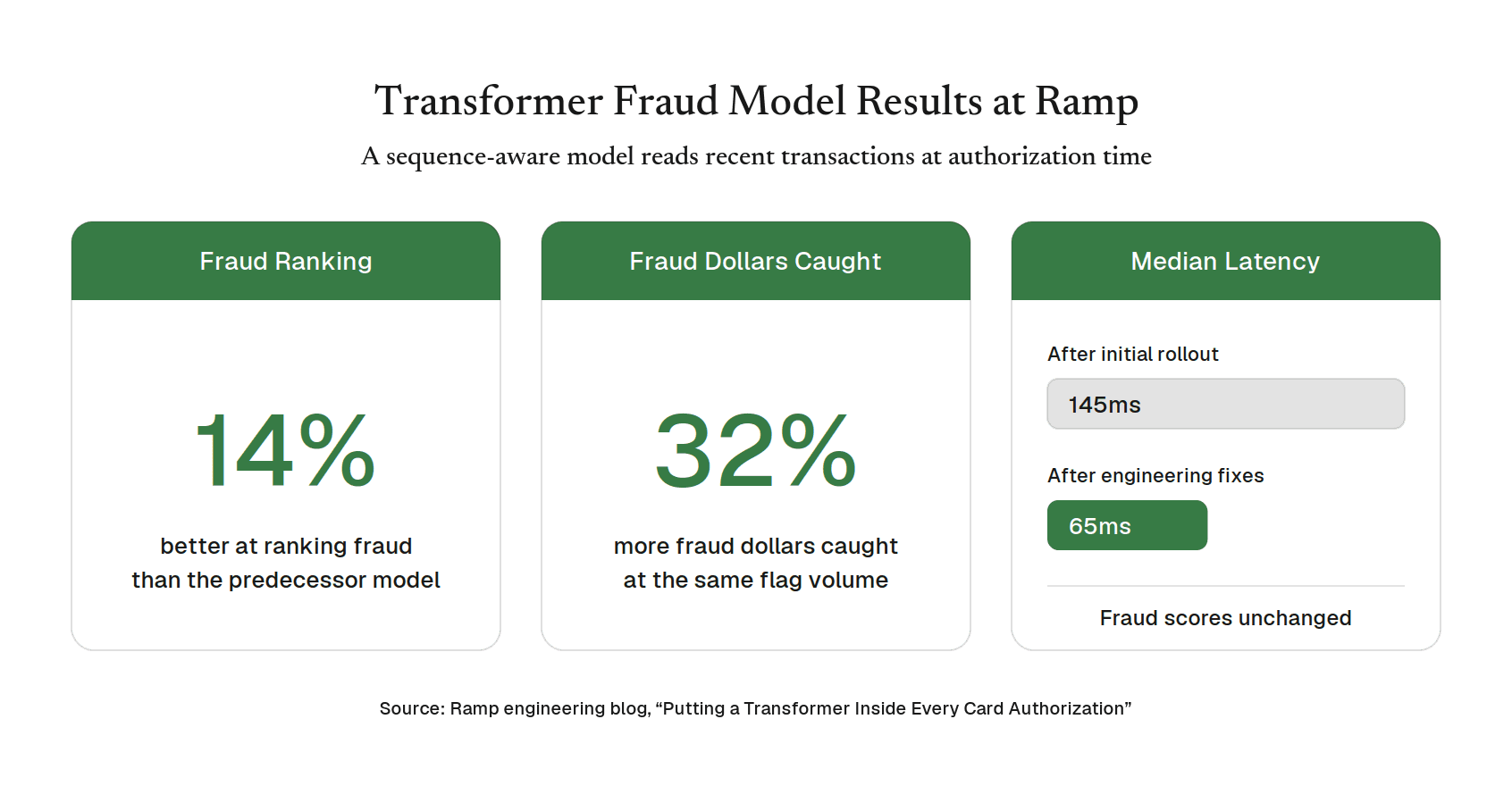
Low-latency authorization pipelines. Ramp published “Putting a Transformer Inside Every Card Authorization,” describing a sequence-aware model that reads a cardholder’s recent transactions at authorization time to evaluate fraud. The model ranks fraud 14% better than its predecessor and caught 32% more fraud dollars while flagging the same number of transactions. After an initial rollout doubled scoring time, engineering fixes cut median latency from 145ms to 65ms without changing any scores.
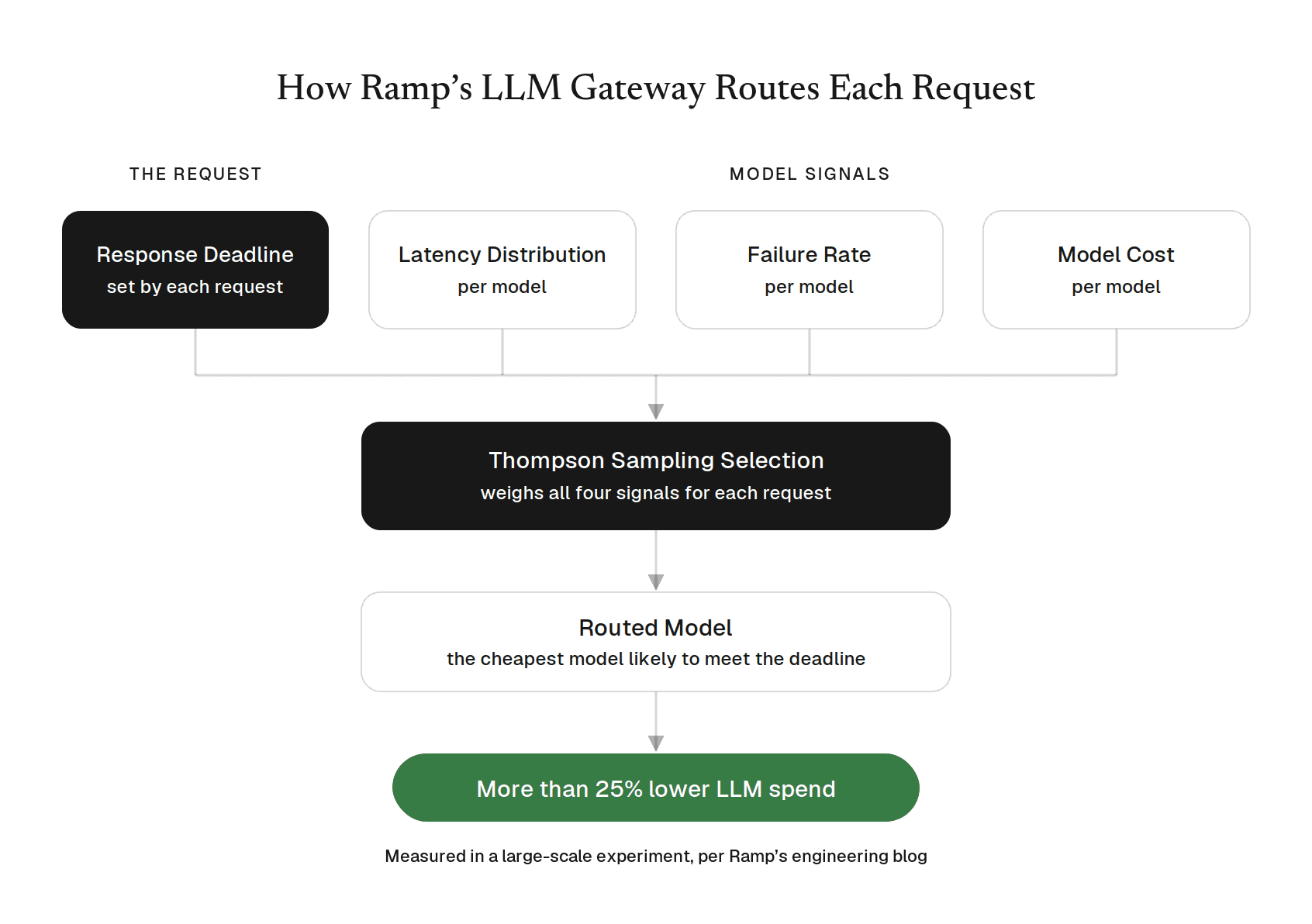
Data and AI infrastructure. Ramp’s AI infrastructure supports production-level inference across several documented projects. An online learning system for cost-efficient LLM routing uses Thompson Sampling over latency distributions, combined with failure rates and model cost, to pick the cheapest model likely to meet each request’s deadline. Apache Arrow pipelines cut Snowflake fetch memory growth by up to 79% for ML training. Ramp’s internal LLM gateway processes trillions of tokens per day, and its cost-aware routing system reduced spending by more than 25% in a large-scale experiment, with a separate implementation achieving 30% savings for Ramp Inspect.
Applied AI and agent systems. Ramp engineers work on large language models for agentic risk operations, agentic accounting assistants, and LLM routing.
Infrastructure and security. Cloud infrastructure work includes just-in-time access to AWS resources, automated vulnerability patching with agents, and strict auditability requirements for customers that treat Ramp as core financial infrastructure.
Daily work. Engineers own services that handle production card swipes, vendor invoice pipelines, and bill payments. They debug distributed systems under regulatory constraints and ship features that affect how finance teams close their books at month-end.
Ramp Careers: Open Engineering Roles
Ramp careers span senior engineering opportunities across five areas: Applied AI, Forward Deployed Engineering, Product Engineering, Platform and Infrastructure, and Security. All are senior positions grouped into the five areas below. They are hybrid in New York City or San Francisco, with some also open elsewhere in the US, except Software Engineer, Security, Stablecoin, which is remote. Salary ranges span $143,200 to $374,900.
Ramp Applied AI Engineer
Ramp’s Applied AI Engineer and Applied AI Engineer, Fullstack roles build and ship production machine learning and LLM features. Ramp’s published work on agentic accounting and risk operations illustrates the applied AI team’s scope. Ramp seeks strong full-stack engineers for AI projects that span training data pipelines, retrieval systems, LLM orchestration, evaluation, and data UX surfaces. For a broader look at the discipline, see Fonzi’s overview of the Applied AI Engineer role.
Both Applied AI roles list a salary range of $204,400 to $352,000 on Fonzi. Experience reasoning about model quality and supporting production-level inference, latency, and cost matters most. That experience connects to Ramp’s AI work on token spend tracking and LLM routing.
Ramp Forward Deployed Engineer
Ramp’s Forward Deployed Engineering area covers four roles on Fonzi:
- Software Engineer, Forward Deployed
- Software Engineer, Enterprise Product
- Software Engineer, Forward Deployed AI
- Security Engineer, Product
The first two sit in Ramp’s Core FDE org, an agent-first, customer-facing team that solves the problems standing between Ramp and its largest, most complex customers.
Core FDE engineers at Ramp deliver software end to end: understanding customer pain points, scoping product specs, and building agents that autonomously implement solutions. They work closely with Sales, Solutions, Customer Success, and Account Management, and each engineer specializes in a core product area and decides when to build a custom solution versus accelerate a broader initiative. The work differs from pure backend development because it means handling ambiguity, customer constraints, and production reliability at once, and it calls for extensive experience building with and for AI agents and comfort being customer-facing.
Software Engineer, Forward Deployed AI sits on Ramp’s AI Solutions team, where the engineer co-leads customer engagements with an AI Solutions Strategist and owns technical discovery, solution design, prototyping, implementation, and production readiness. LLM systems experience (retrieval-augmented generation, AI agents, monitoring, and evals) is required, with travel of up to about 50%.
Security Engineer, Product builds security-focused application primitives, designs platform-level mitigations, leads vulnerability remediation, and champions security tooling across Ramp’s stack. It requires at least 5 years of software experience, including 2 years in platform, infrastructure, or security.
Forward Deployed roles list salary ranges from $189,000 to $354,600 on Fonzi. For broader market context, see Fonzi’s forward deployed engineer salary analysis, and prepare with these forward deployed engineer interview questions.
Product Engineering
Product engineering at Ramp spans Core Product, Onboarding, Bill Pay and Procurement, Credit, Growth, Fraud and Identity, Developer API, Ops Engineering, and Frontend. Engineers here own end-user features from card issuance flows and bill payment to credit decisioning tools and fraud controls. Public case studies like “Bill Pay from 0 to N” and “Moving Fast by Moving Slow” document the backend systems and trade-offs involved.
Product engineering roles list salary ranges from $143,200 to $330,000 on Fonzi. Frontend engineers build complex, data-heavy interfaces in React for finance teams and employees, and Ramp has published work on bootstrapping a UI component library to standardize these surfaces. Product engineering connects directly to customer outcomes: reducing manual accounting work, improving visibility into spend, and helping businesses close their books faster.
Platform and Infrastructure
Data Platform, Engineering Platform, and Production Engineering form Ramp’s cloud infrastructure backbone. They are responsible for data pipelines, CI/CD, observability, reliability, and the platform other engineering teams build on. Data Platform engineers build infrastructure including Apache Arrow-based pipelines, cost-efficient Snowflake usage, and unified token spend tracking for AI workloads, all documented on Ramp’s engineering blog.
Engineering Platform focuses on developer productivity, workflows, and internal tooling. Ramp describes the team as helping 300+ Ramp engineers move faster without breaking things. Production Engineering focuses on runtime reliability, scalability, and production infrastructure. Posts on “Faster Pull Request Merges,” “Faster Python Tests,” and just-in-time AWS access illustrate CI improvements, developer efficiency, and secure access work. Platform and Infrastructure roles list annual base salary ranges of $168,000 to $339,500 across Ramp’s published postings, depending on the position, location, and level.
Security Engineering
Ramp’s Security roles on Fonzi cover Privacy and Stablecoin (Security Engineer, Product is covered in the Forward Deployed section above). Software Engineer, Security, Stablecoin is remote, listed for New York City, San Francisco, and “In the US.” Security Engineer, Privacy is hybrid and also lists “In the US” as a location.
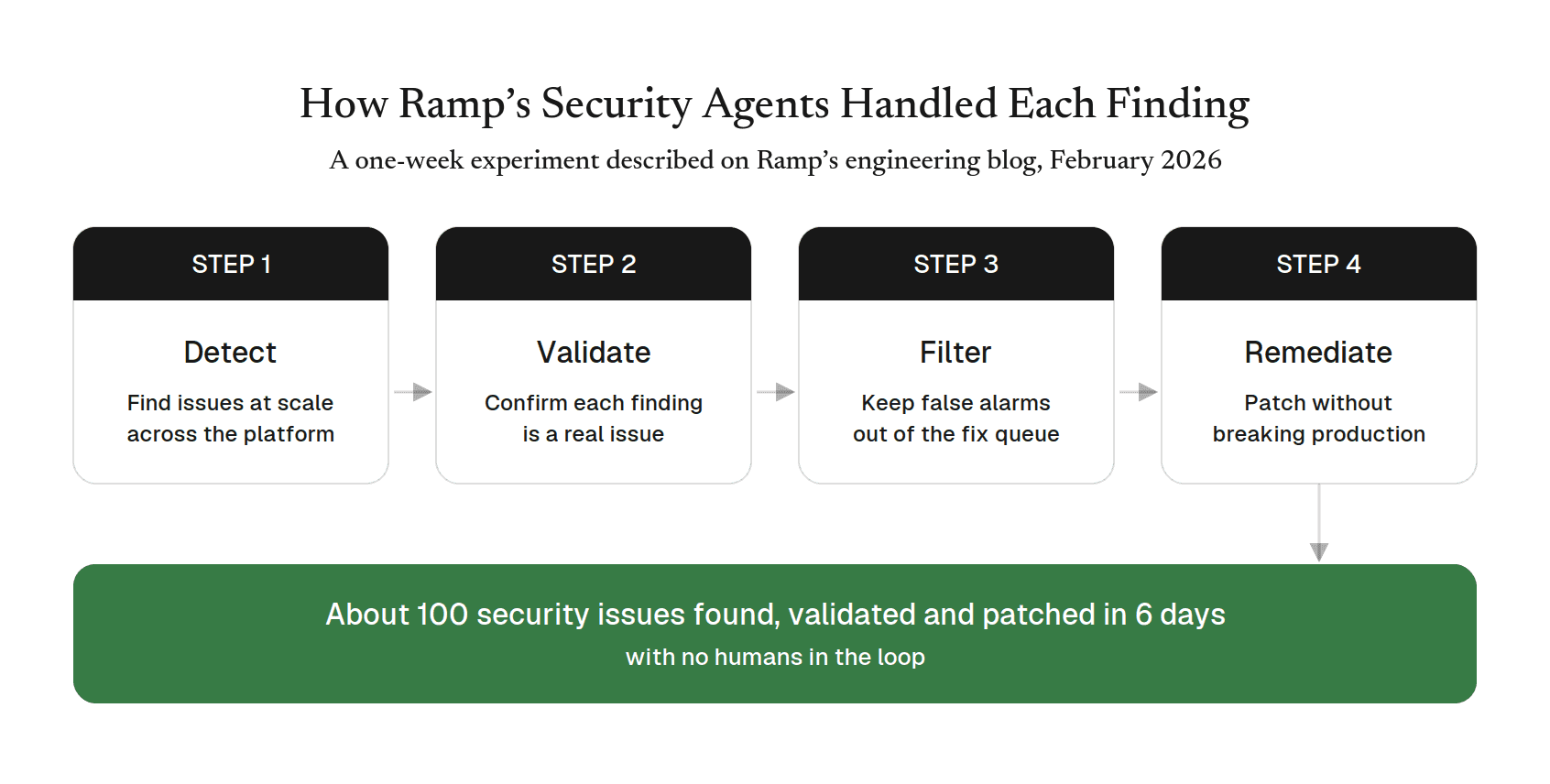
Security Engineer, Privacy focuses on privacy-focused application design and data controls, protecting sensitive personal information across Ramp’s systems. Software Engineer, Security, Stablecoin works on stablecoin payment and treasury infrastructure. In an engineering post published on February 20, 2026, titled “We proactively fixed ~100 security issues in 6 days with 0 humans,” Ramp described how internally built agents found, validated, and patched roughly 100 security issues during a one-week experiment. Building such a system is demanding because it requires detection at scale, validation, false-positive control, and safe remediation.
Security Engineering roles list annual base salary ranges of $184,800 to $374,900 across Ramp’s published postings, depending on the position, location, and level. Security engineers at Ramp influence both infrastructure and product, and their work is especially relevant for regulated customers and high-value transactions.
Ramp Engineer Salary Ranges and Locations
The table below recaps the salary ranges listed on Fonzi and on Ramp’s job postings at jobs.ashbyhq.com/ramp. Ranges vary by location and level, and Ramp’s postings note that these roles also offer equity. All roles are hybrid in New York City and San Francisco, with some listings also including “In the US” as a location. The exception is Software Engineer, Security, Stablecoin, which is remote.
Area | Example Roles | Salary Range |
Applied AI | Applied AI Engineer, Applied AI Engineer Fullstack | $204,400 – $352,000 |
Forward Deployed | Software Engineer Forward Deployed, Enterprise Product, Forward Deployed AI, Security Engineer Product | $189,000 – $354,600 |
Product Engineering | Core Product, Onboarding, Bill Pay, Credit, Growth, Fraud, Developer API, Ops, Frontend | $143,200 – $330,000 |
Platform & Infrastructure | Data Platform, Engineering Platform, Production Engineering | $168,000 – $339,500 |
Security | Privacy, Stablecoin | $184,800 – $374,900 |
Ramp Interview Process for Senior Engineers
The Ramp interview process reflects the culture its job postings describe: high agency, high urgency, and slope over intercept. Ramp’s interviews for senior engineers focus on practical, real-world problem-solving and cross-functional collaboration.
For the Ramp interview process, senior software engineering candidates can prepare by practicing system design scenarios involving payments, transaction processing, and accounting workflows. These exercises reflect Ramp’s products but are not confirmed interview questions. Candidates should also review coding fundamentals, practice explaining technical trade-offs, and ask their recruiter which assessments apply to their specific role.
Senior candidates should prepare examples of:
- complex systems they have owned
- hard technical trade-offs they have made
- problems they have solved in high-agency environments
This aligns with Ramp’s stated emphasis on building and ownership.
How Fonzi Can Help You Land a Ramp Engineering Role
Ramp’s engineering roles span five areas with different salary bands, location rules, and day-to-day work, and the public job board doesn’t tell you which team’s problems fit your background.
Fonzi is a curated AI engineering hiring marketplace that connects companies with pre-vetted AI and software engineers. Ramp careers in all five engineering areas above are open through Fonzi. Engineers can apply once to be matched with Ramp and other AI startups and tech companies through Match Day, where companies send salary-backed interview requests directly to engineers. After that, the Fonzi team handles curated introductions, interview coordination, and support through each stage of Ramp’s process.
Apply for the next Match Day to get access to Ramp’s open roles.
Ramp Careers at a Glance
Ramp careers center on engineering work where correctness and speed both matter. Examples include a transformer inside every card authorization that caught 32% more fraud dollars at a median latency of 65ms, an internal LLM gateway processing trillions of tokens per day, and agents that found and patched roughly 100 security issues in six days. Ramp is hiring senior engineers across Applied AI, Forward Deployed Engineering, Product Engineering, Platform and Infrastructure, and Security, with salary ranges on Fonzi from $143,200 to $374,900.
The Ramp interview process rewards practical, fintech-grounded problem solving and a track record of owning systems end to end. Candidates who prepare concrete examples of what they have built, and who can reason about latency, correctness, and trade-offs in financial systems, match what Ramp says it looks for. A Ramp software engineer on a product team owns features every customer uses, while a Ramp forward deployed engineer builds agents for the largest customers and a Ramp applied AI engineer ships production LLM features.
FAQ
Does Ramp support remote work, or do engineers need to be in New York City or San Francisco?
Mostly, engineers need to be near a hub. Ramp’s engineering roles on Fonzi are hybrid in New York City and San Francisco, and some listings also include “In the US” as a location option. The only fully remote engineering role listed is Software Engineer, Security, Stablecoin.
How does a Ramp software engineer in product teams differ from a Ramp forward deployed engineer?
A Ramp software engineer on a product team builds features used by every Ramp customer, such as card issuance, bill pay, and fraud controls. A Ramp forward deployed engineer works directly with Ramp’s largest customers, builds agents that implement solutions for them, and specializes in one core product area. Forward Deployed roles combine full-stack development with customer-facing work, and some involve travel.
Can Ramp engineers move between Applied AI, Product, and Platform teams?
Ramp has not published a formal internal transfer policy. Engineers interested in moving later, for example from Product Engineering into a Ramp applied AI engineer role, should ask a Ramp recruiter about internal mobility during the Ramp interview process.
How do I apply for Ramp careers in engineering?
Engineers can apply for Ramp careers through Fonzi and get access to Ramp’s open engineering roles on Match Day. Apply once, and the Fonzi team coordinates introductions and interviews with Ramp.
Is “ramp engineering” the same as airport ramp operations?
No. In aviation, “ramp” refers to the airport apron where aircraft are parked, loaded, and serviced, so ramp roles there cover ground handling and equipment work. At Ramp, the fintech company, engineering roles focus on building financial software and infrastructure for corporate cards, expense management, bill payments, and accounting automation.