Forward Deployed Engineer Interview Questions by Company
By
Samara Garcia
•

Forward deployed engineer interview questions vary by company because each employer tests a different mix of technical depth, customer judgment, and deployment skills. Palantir's loop centers on decomposition and ambiguous problem-solving; OpenAI leans on evaluation pipelines and RAG debugging; Salesforce and C3 AI care more about SSO and legacy data migration than model internals. A candidate who preps for "the FDE interview" as if it were one generic process walks into the wrong room, no matter how strong their coding is.
Key Takeaways
Prepare for the employer's specific loop rather than treating all FDE interview questions as interchangeable.
The decomposition case study, an open-ended problem with no single correct answer, is the round most candidates are least prepared for and often the deciding factor in the loop.
Frontier AI labs like OpenAI and Anthropic test production LLM systems: retrieval quality, evaluation frameworks, and agent architecture. Palantir and enterprise vendors weight data integration and customer reasoning more heavily.
Coding rounds across all of these employers favor practical engineering over algorithmic puzzles.
Palantir Forward Deployed Software Engineer (FDSE) Interview: Overview
Palantir is covered first because it originated the Forward Deployed Software Engineer title and has directly influenced how other companies structure their own loops. Palantir says it pioneered the Forward Deployed Software Engineer position, embedding engineers directly with customers to tackle high-stakes operational problems, and a forward-deployed engineer at Palantir still works directly with enterprise customers in sectors like government, infrastructure, and defense, often independently or in small teams far from headquarters.
The typical Palantir FDSE interview process runs 5 to 6 rounds over roughly 4 to 6 weeks, making it one of the longer loops in the industry. The process starts with a recruiter screen and typically ends with onsite decomposition and system design rounds. Palantir labels the role FDSE, but the responsibilities align closely with the broader forward deployed engineer role used by OpenAI, Anthropic, and other employers. Palantir's current New York FDSE posting for candidates with 1+ years of relevant post-college experience lists an estimated salary range of $135,000 to $200,000 per year; total compensation may also include RSUs, a sign-on bonus, and other incentives. Pay varies by role and location: a current Honolulu US Government posting lists $125,000 to $200,000. Palantir's current New York new-grad FDSE posting lists an estimated salary range of $135,000 to $145,000 per year, with RSUs, a sign-on bonus, and other potential incentives separate from that estimate.
Palantir places outsized weight on the decomposition case study and customer reasoning. The loop tests technical depth alongside the ability to structure ambiguous customer problems and communicate decisions clearly.
Palantir FDSE Interview Rounds and What They Screen For
Each stage of the Palantir loop is designed to capture a distinct signal.
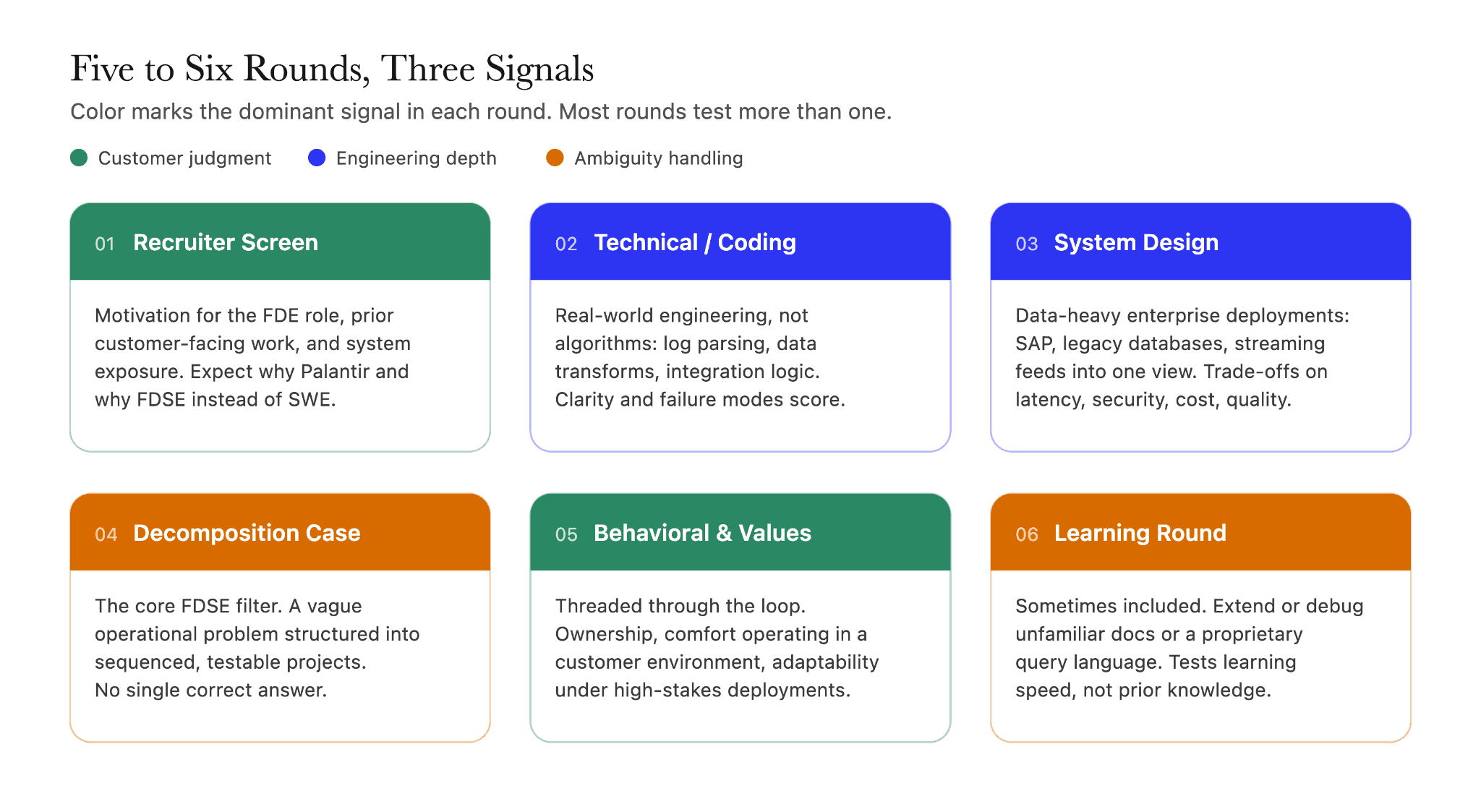
Recruiter screen. A 30 to 45 minute conversation focused on motivation for the forward deployed engineer role, prior customer-facing work, and high-level system exposure. Recruiters use this call to check whether you understand why Palantir specifically appeals to you and whether you gravitate toward customer-facing technical work rather than pure backend engineering. Expect questions like "why Palantir" and "why FDSE instead of SWE."
Technical / coding round. This round focuses on real-world engineering problems, not algorithms. Typical tasks include parsing logs, data transformations, lightweight data structures, or integration logic. Palantir's current FDSE posting lists proficiency in one or more programming languages such as Python, Java, C++, and TypeScript/JavaScript. Interviewers evaluate code clarity, communication skills, and whether you surface failure modes in your solution.
System design round. Oriented around data-heavy enterprise deployments, such as integrating SAP data, legacy databases, and streaming feeds into a unified view within a customer's environment. The interviewer tests your ability to ship a minimal viable architecture while discussing trade-offs around latency, security, cost, and data quality. Cloud infrastructure familiarity is expected.
Decomposition / open-ended case study. This is the core FDSE filter. You receive a vague operational problem (for example, reducing 911 response times for a city) and are expected to structure it into sequenced, testable projects. The decomposition round is open-ended and tests how you structure an ambiguous problem rather than whether you reach one predetermined answer. There is no single correct answer. Interviewers score your process: clarifying questions, stakeholder mapping, phased delivery, and explicit trade-offs.
Behavioral and values questions. Threaded throughout the loop, these assess ownership, comfort operating inside a customer's environment, and adaptability under high-stakes deployments. STAR-structured answers work well here. Prepare a small set of stories you can adapt rather than a script for each likely question.
Learning round. Palantir sometimes includes a round where the candidate is given unfamiliar documentation or a proprietary query language and asked to extend or debug functionality. This tests learning speed and adaptability, not prior knowledge.
Palantir Forward Deployed Engineer Interview Questions and Answer Expectations
The following are representative questions grouped by theme. For each, note what a strong answer demonstrates.
Decomposition
"A city wants to reduce 911 response times. You have call logs, traffic data, and ambulance GPS data. How do you approach this?"
Strong answers decompose the response-time interval (call latency versus dispatch time versus drive time), define success metrics (mean versus tail versus geographic equity), surface constraints (GPS noise, data latency, legal access), and propose a phased plan. Start with historical analysis, then simulate, then build live. Candidates who jump straight to a routing algorithm fail.
System Design
"Design a data pipeline that stitches together operational SAP data with free-text incident reports inside a secure VPC."
This tests your ability to handle schema drift, late data (up to 7 days), and compliance constraints while maintaining data lineage and monitoring.
"Architect a resilient data ingestion system from multiple enterprise sources (CRM, ERP, streaming sensors) with per-tenant isolation in a private cloud account."
Interviewers look for versioned schemas, idempotency, null handling, backfill strategies, and observability.
"Design a minimal dashboard system that surfaces anomalies from heterogeneous data for a government operations center."
Tests your ability to reason about data freshness, alerting thresholds, and user workflows.
Data Wrangling and Coding
"You have task assignments to agents distributed geographically. Match tasks to agents minimizing latency subject to capacity constraints."
Unlike pure LeetCode, this requires articulating domain assumptions and discussing how messy real-world data (incomplete agent locations, variable capacity) changes your approach.
Customer Communication
"A customer executive insists on a feature that conflicts with data governance policy. How do you handle it?"
Tests stakeholder management, transparent trade-offs, and your ability to practice explaining technical concepts to business stakeholders without hedging or deferring.
OpenAI Forward Deployed Engineer Interview: Role and Loop Structure
OpenAI's forward deployed engineer role centers on production LLM systems: retrieval-augmented generation (RAG), evaluation frameworks, agent workflows, prompt engineering, and customer integrations on top of core models. The work involves deploying AI systems into enterprise customers, handling latency and reliability constraints, and communicating risks like hallucination, bias, and privacy to non-technical stakeholders.
OpenAI does not publish a fixed FDE stage count or end-to-end timeline; its interview guide says the process varies by team and can include introductory conversations, one or more skills-based assessments, and final interviews. Stages include a recruiter screen, a take-home or live build with OpenAI's APIs, a technical deep dive, customer scenario rounds, and system design specific to LLM deployment. OpenAI says its skills-based assessments vary by team and may include pair coding, take-home projects, or technical tests, so candidates should expect the exact FDE interview format to vary.
OpenAI Forward Deployed Engineer Interview Questions: AI Systems and Customer Scenarios
These questions reflect the technical concepts and customer judgment that OpenAI's loop is designed to surface.
Technical Deep Dive
"How would you build an evaluation pipeline to continuously measure model drift, hallucination rates, and task-specific accuracy in a live enterprise deployment?"
Tests your ability to define automated metrics, build infrastructure, and think about guardrails, including human-in-the-loop review, statistical thresholds, and alerting.
"How would you debug high latency in a RAG pipeline that uses vector databases plus a frontier LLM for a healthcare client?"
Break the problem into stages: data ingestion, retrieval (chunking strategy, embedding quality), ranking, model inference, tokenization, and batching, then propose metrics, fallback strategies, caching, and privacy constraints.
"Design a secure caching layer for LLM responses that invalidates based on underlying data updates."
Tests engineering at the system edge: freshness, response consistency, and how you handle stale data.
"How would you expose a customer's internal systems to an LLM through an MCP server and constrain which operations the agent is permitted to call?"
This tests tool-use and agent architecture: scoping permissions, authentication, logging, and safety boundaries for third-party API access.
Customer Scenarios
"A strategic customer insists on custom model fine-tuning when prompt engineering plus RAG might work. How do you guide them?"
Tests stakeholder communication and cost-versus-performance trade-offs. Strong answers show customer empathy while anchoring in technical reality.
"Explain a hallucination issue to a non-technical executive who is worried about regulatory exposure."
Tests clarity, honesty, and your ability to propose concrete guardrails (policy layers, human review, rate limiting) rather than hand-waving. OpenAI's interview guide says candidates are evaluated on communication and collaboration and should give interviewers insight into how they consider and solve problems.
Anthropic Forward Deployed Engineer Interview: Role Overview, Questions, and Signals
Anthropic's forward deployed engineers sit on the Applied AI team and embed with strategic enterprise customers to ship production applications built on Claude models. The postings describe delivering technical artifacts such as MCP servers, sub-agents, and agent skills for production workflows, alongside white-glove deployment support in enterprise environments and frequent travel to customer sites. Experience requirements vary by opening, running from 4+ years in a technical customer-facing role on the US and London listings to 8+ years on the Munich one, and Anthropic names former technical founders as a fit.
Safe Deployment
"How would you design an AI assistant for a healthcare client without exposing PHI to external services?"
Evaluates data privacy architecture: model hosting, encryption at rest and in transit, network isolation, and audit trails.
"A regulated customer wants to deploy Claude for internal document search, but their compliance team requires full auditability of every model output. Design the system."
Tests logging infrastructure, retention policies, and how you surface failure modes to compliance stakeholders.
Capability vs. Safety Trade-Offs
"A customer wants Claude to auto-approve loan applications, but your evaluation shows a meaningful error rate on edge cases. How do you navigate this?"
Interviewers expect you to reason explicitly about the trade-off: propose human review for flagged cases, define acceptable thresholds, and communicate the technical reality to business stakeholders without over-promising.
Model Evaluation and Incident Response
"How would you respond if a deployed Claude instance generated harmful content in a customer-facing application?"
Tests incident response: immediate mitigation (rate limiting, content filtering), root cause analysis, customer communication, and system-level guardrails.
"How would you build an eval suite for a customer-facing assistant before launch, and what would you gate the release on?"
Tests whether you define automated metrics (task accuracy, safety violations, latency) alongside human evaluation (red-teaming, edge case review), and how you set go or no-go thresholds.
Judgment Under Safety Pressure
"Tell me about a time you declined or reshaped a risky feature request."
Interviewers look for ownership, clear reasoning, and the ability to communicate transparent trade-offs to business stakeholders. Vague answers about "caring about safety" do not pass. Interviewers want specific actions, measurable outcomes, and a clear account of how you kept the customer relationship intact.
Strong answers across Anthropic's rounds show familiarity with practical safety mitigations, such as policy layers, human review workflows, rate limiting, and abuse detection, not only theoretical alignment concepts. Anthropic's current U.S. Forward Deployed Engineer posting lists production experience with LLMs, including agent development, evaluation frameworks, and deployment at scale, as a relevant qualification.
FDE Interview Questions at Google, Salesforce, and C3 AI
"Design an agentic workflow that handles automated shipment rerouting for a logistics customer, incorporating real-time signals and fallback to human operators."
Tests whether you can design for latency, reliability, failure handling, and human fallback in production.
"Design an ML system that predicts customer churn and surfaces interventions to account managers, deployed across multiple regions with data residency requirements."
Tests cross-regional architecture, data pipelines, and compliance constraints.
Salesforce
"A customer needs to sync their Snowflake data warehouse with a Salesforce-based AI assistant, with per-tenant isolation and SSO integration. Design the data flow."
Tests understanding of multi-tenant SaaS, auth flows, and data engineering under enterprise constraints.
"How would you migrate a customer's legacy CRM data into a new AI-enabled platform without disrupting their daily operations?"
Tests change management, rollback planning, and client communication.
C3 AI
"Configure an AI application on the C3 AI platform to ingest messy industrial IoT data from multiple sensor types with inconsistent schemas."
Tests schema normalization, data quality handling, and deployment end-to-end on a proprietary platform.
"Sync a customer's SAP data into C3 AI's data model while handling late-arriving records and schema drift."
Tests data ingestion resilience, backfill logic, and monitoring.
Across Google, Salesforce, and C3 AI, current FDE job descriptions combine hands-on engineering with customer deployment work, but the companies do not publicly document a uniform interview structure or separate scoring rubric for those skills.
Forward Deployed Engineer Decomposition Interview: What It Tests
The forward deployed engineer decomposition interview is a round where you are handed a vague operational problem and asked to structure it into sequenced, testable projects. It goes by several names, including the open-ended case, the deployment scenario, and the ambiguous case. Palantir pioneered this format, and OpenAI, Anthropic, and multiple enterprise vendors now use variations of it to test how candidates break down messy, real-world enterprise problems.
Typical prompts include reducing operational costs for a logistics network, onboarding a healthcare client with strict compliance requirements, or consolidating disparate data sources into a unified view. Decomposition is the most distinctive Palantir FDSE interview format, testing skills that conventional coding preparation may not cover. Interviewers score process (clarifying questions, stakeholder mapping, data and system constraints, phased delivery, and explicit trade-offs) rather than looking for a single correct answer, and it's the round that tests technical depth, customer judgment, and ambiguity handling all at once.
How to Approach FDE Decomposition Case Studies Step by Step
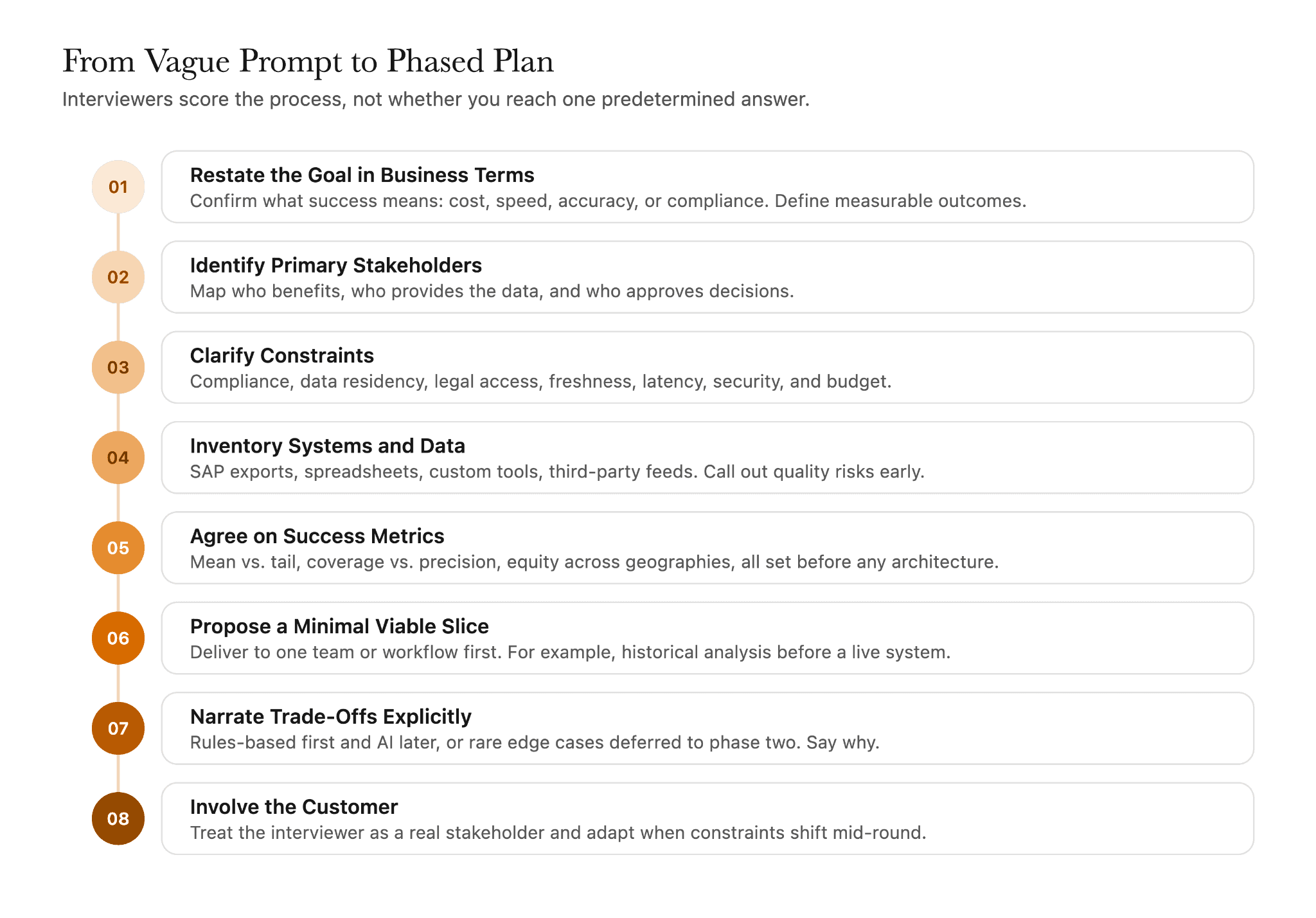
Here is a repeatable framework for tackling decomposition rounds, applicable across Palantir, OpenAI, Anthropic, and enterprise vendors.
Restate the goal in business terms. Before touching any technical concept, confirm what success looks like for the customer: cost reduction, faster response, higher accuracy, or regulatory compliance. Define measurable outcomes.
Identify primary stakeholders. Map who benefits, who provides data, and who approves decisions.
Clarify constraints. Ask about compliance (data residency, legal access), data freshness, latency requirements, security, and budget.
Inventory existing systems and the customer's data. Ask about messy SAP data, spreadsheets, custom tools, and third-party sources, and call out data quality risks early.
Agree on success metrics. Define what you'll measure (mean vs. tail, coverage vs. precision, equity across geographies) before proposing any architecture.
Propose a staged plan starting with a minimal viable slice. Deliver value to a single team or workflow before expanding, for example, starting with historical data analysis before building a real-time system.
Narrate trade-offs explicitly. Decide to ship a rule-based system first and add AI later, or defer rare edge cases to phase two.
Involve the customer. Ask what they care about most and integrate that into prioritization. Strong candidates treat the interviewer as a real stakeholder and adapt when constraints shift mid-round.
For the forward deployed engineer decomposition interview, focus on clarifying the problem, structuring the work, and explaining your trade-offs clearly.
System Design for Forward Deployed Engineers: Integration and Constraints
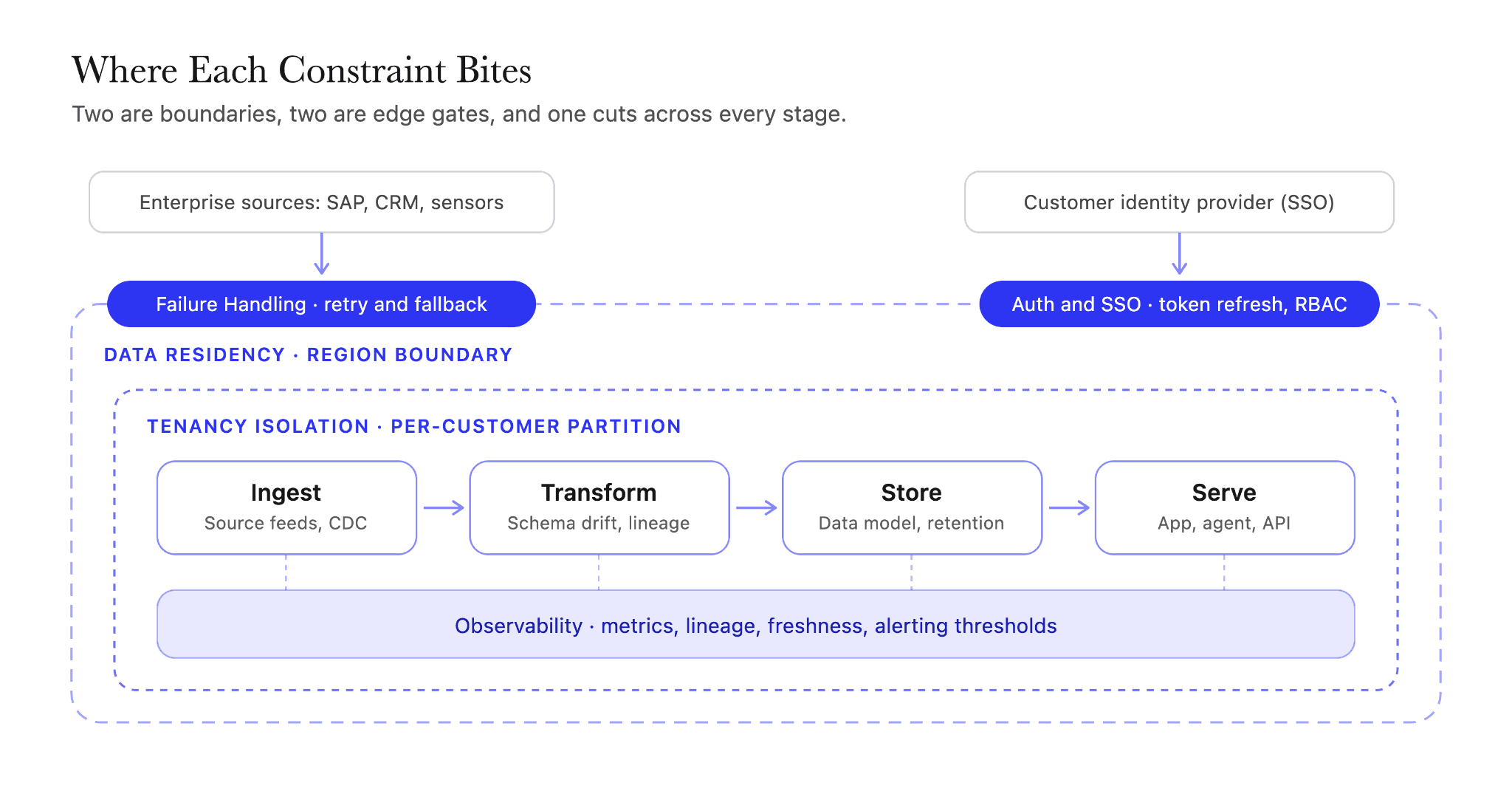
FDE system design differs from generic backend design interviews. The emphasis is on integration across heterogeneous systems, security models, and real customer constraints.
Every FDE system design round comes back to the same five constraints, whichever company is asking.
Auth and SSO integration. How does the customer authenticate? How do you handle token refresh and role-based access?
Data residency. Where does data live? What crosses network boundaries?
Tenancy isolation. How do you prevent data leakage in a multi-tenant system?
Observability. What do you monitor? How do you detect and surface failure modes?
Failure handling. What happens when a data source goes down, a schema changes, or a third-party API rate-limits you?
Interviewers reward explicit discussion of trade-offs, such as latency versus cost or complexity versus maintainability, in addition to correctness of the architecture.
Comparing FDE Interview Emphasis by Company
The following table summarizes what each employer emphasizes in its FDE loop. Use it to adjust your preparation company by company.
Company | Primary Technical Focus | Key Unique Emphasis | Typical Loop |
Palantir | Data engineering, problem decomposition, enterprise integration | Decomposition case study, learning round, customer reasoning | 5-6 rounds, 4-6 weeks |
OpenAI | LLM production systems, RAG, evaluation, prompt engineering | AI systems depth, take-home build, customer demos | 4-6 stages, 3-5 weeks |
Anthropic | Production LLM systems, evaluation frameworks, agent development | Safety, reliability, customer-facing deployment | Not publicly specified |
SWE fundamentals + domain-specific ML/agentic design | Balanced coding + deployment scenario | 5-6 rounds, 4-6 weeks | |
Salesforce | Integration, CRM workflows, multi-tenant architecture | Enterprise software, SSO, identity | 4-5 rounds, 3-5 weeks |
C3 AI | Platform configuration, industrial data, IoT | Proprietary platform, messy data | 4-5 rounds, 3-4 weeks |
AI Startups | Speed, pragmatic builds, observability | Founder interviews, practical builds, shipping fast | 3-4 rounds, 2-3 weeks |
A few patterns hold across the table: AI labs like OpenAI and Anthropic weight LLM depth, evaluation, and safety far more heavily than enterprise vendors, while enterprise companies like Salesforce, C3 AI, and Google place more emphasis on integration, change management, and prior enterprise software experience. AI startups test speed, prioritization, and comfort with incomplete infrastructure. Debugging and integrating complex systems is table stakes everywhere; what separates employers is where they add depth.
How Fonzi Helps Engineers Find Forward Deployed Engineer Roles
Fonzi is a curated AI engineering hiring marketplace that connects pre-vetted engineers with AI startups and high-growth technology companies. Its marketplace includes forward deployed engineer roles as well as related applied AI positions involving production LLM systems, customer integrations, and customer-facing technical work.
Fonzi also runs Match Day, where participating companies send interview requests to engineers in the candidate pool, and candidates see the role and compensation before deciding which requests to accept. Getting started takes a text. Engineers who reach out go through a short screening conversation over text, and accepted candidates join the pool for the next Match Day.
FDE Interview Preparation by Company
Forward deployed engineer (FDE) interviews share a practical, customer-facing core, but the balance of coding, system design, AI depth, and deployment judgment varies by employer. The forward deployed engineer decomposition interview is where that difference shows up most, and it is the format candidates are least likely to have practiced.
Tailor your preparation to the employer: emphasize LLM evaluation and safety for frontier AI labs, enterprise integration and data engineering for vendors such as Salesforce and C3 AI, and speed and prioritization for startups.
FAQ
How much should I customize my FDE interview prep for each company?
Do forward deployed engineer interviews still include LeetCode-style coding questions?
What is the most effective way to practice for the decomposition case study?
Can I transition into an FDE role without prior customer-facing experience?
How important is deep AI knowledge for FDE roles outside OpenAI and Anthropic?