How to Make $300K as a Software Engineer and Who Pays It
By
Samara Garcia
•

Making $300K as a software engineer means reaching the top of a senior compensation band, and which band you land in depends on employer type, role, location, and specialization far more than on years of experience. How much of the package arrives as base salary rather than equity or bonus changes the risk as much as the total does. The path looks different at a large tech company, an AI startup, or a hedge fund, and some employers reach $300K through a high base and liquid equity while others rely on bonuses or startup equity to produce the same headline total.
Key Takeaways
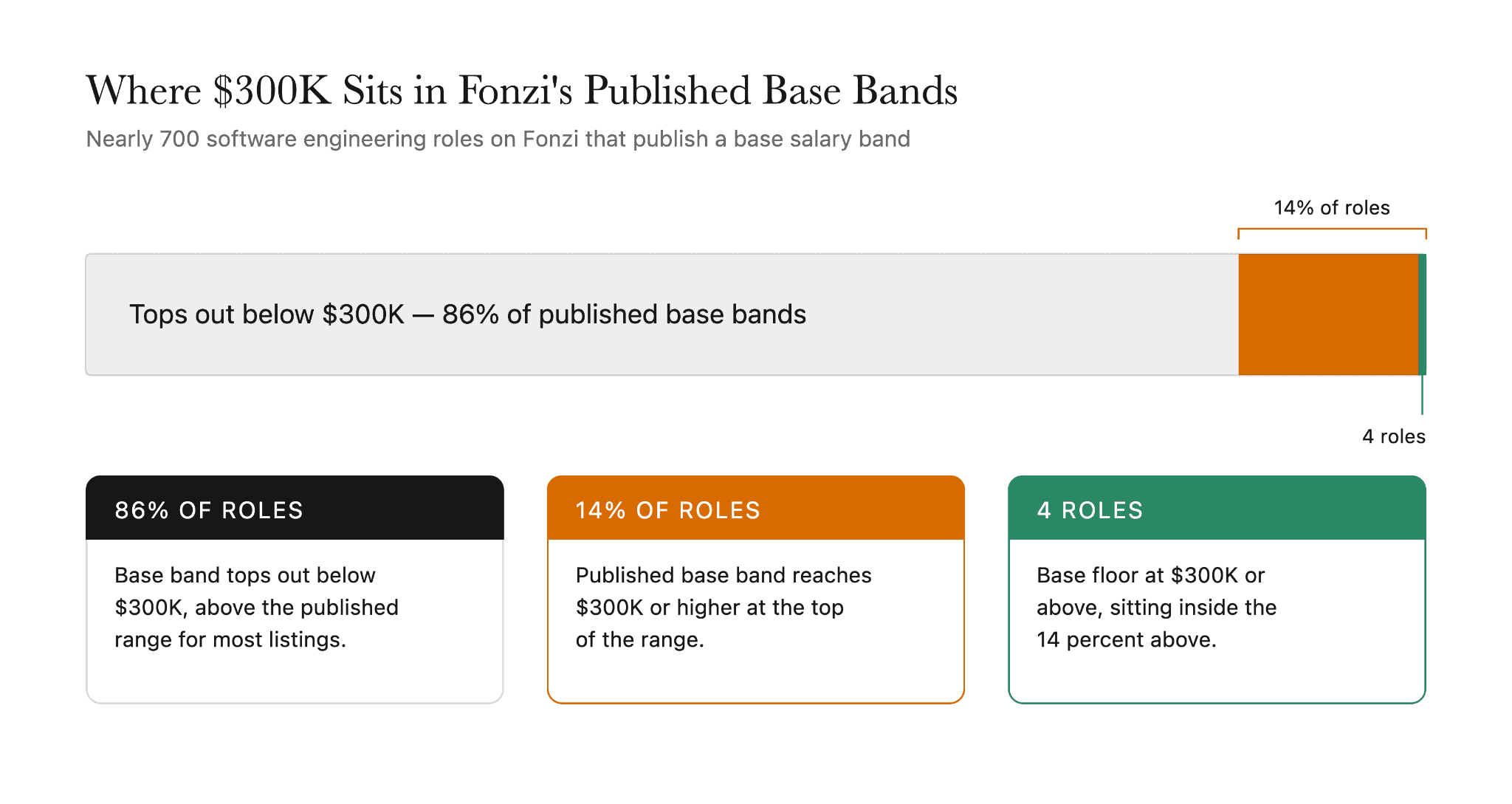
Of the nearly 700 software engineering roles on Fonzi that publish a base salary band, roughly 14 percent reach $300K or higher at the top of the range. Four set a floor at or above $300K, which makes $300K a ceiling you negotiate toward.
Reaching the top of a band takes the right role, the right location, and demonstrably stronger scope and impact than peers at the same level, not just time served.
The tradeoffs differ sharply by employer type: hedge funds and quant firms pay with long hours and stress, early startups pay with illiquid equity and real business risk, and large public companies pay with slower growth and more bureaucracy.
What a $300K Software Engineer Package Includes
Total compensation typically combines base salary with equity and a performance bonus, and the mix changes everything about the risk and real value of a $300K package.
How Do You Make $300K as a Senior Software Engineer?
The market for senior software engineers is concentrated in a handful of US metros. San Francisco, the broader Bay Area, Seattle, and New York remain the hubs where salaries and equity grants run highest, and remote roles frequently apply location-based adjustments that pull the ceiling lower.
Among the nearly 700 software engineering roles on Fonzi that publish a base salary band, roughly 14 percent top out at or above $300K, and four also set a floor at or above $300K. Wide bands are common at this level: ranges like $150K to $300K and $125K to $300K appear routinely.
Senior Software Engineer titles are not equivalent across companies. Different employers map titles to different levels and scopes, so a senior title at one company can correspond to a mid-level engineer at another, and total compensation ends up shaped by the company and role type as much as the title on the offer letter.
How Compensation Bands Work at $300K+
Compensation bands exist because employers need to accommodate variance in experience, business impact, and competition with other offers. A band like $200K to $300K base, which currently appears on both AI engineering and staff mobile roles on Fonzi, can translate into very different total compensation depending on level, location, and performance rating. Add equity and a modest bonus, and the same band can produce outcomes ranging from $250K to well above $400K.
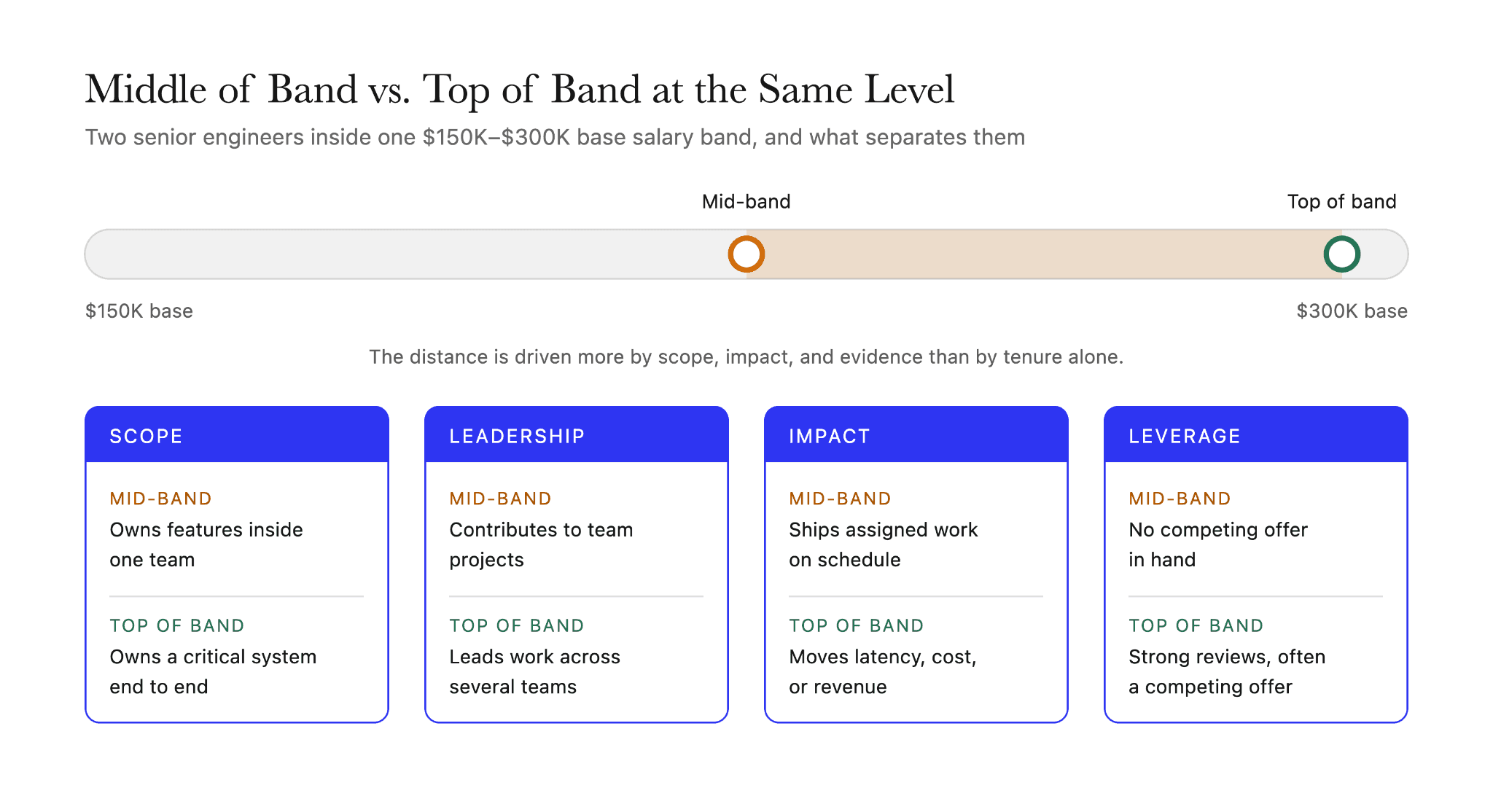
What typically moves an engineer toward the top of a band is a combination of factors: proven ownership of critical systems, cross-team leadership, strong performance reviews, and competing offers from other employers. Taking on more responsibility, in practice rather than in title alone, is the key differentiator. Being "senior" on paper is not enough. You need to be operating at a staff or tech lead impact level even if the formal title has not caught up. Demonstrating measurable impact, such as lower latency, reduced costs, or increased revenue, can strengthen the case for compensation near the top of a band.
Which Employers Actually Pay $300K
The headline number of $300K can represent a very different financial reality depending on whether it is mostly base salary, mostly equity, or heavily bonus-driven.
Breaking Down $300K: Base, Equity, and Bonus Compared by Employer Type
Component | Public Big Tech | Funded Startup (Series B+) | Hedge Fund / Quant Firm |
Base Salary | $200K to $270K (Google L5 averages about $233K) | $150K to $300K (wide bands; top requires staff-level impact) | Varies widely by firm and role; current postings include $150K to $300K at Citadel and $300K base at Jane Street, before discretionary incentive compensation. |
Equity / Stock | RSUs vesting over 4 years; a large and growing share of total comp at senior levels and above | Illiquid options or RSUs; value highly uncertain; upside depends on exit | Less common as RSUs; sometimes profit share or carried interest |
Cash Bonus | 10% to 25% of base; performance multipliers possible | Modest or nonexistent; sometimes sign-on or refresh grants | Often discretionary and firm-specific; public engineering postings generally do not disclose a standard bonus percentage. |
Risk Profile | Stable and liquid; lower upside | High upside, low liquidity, company failure risk | High pay but variable year to year; intense culture |
Figures for public big tech draw on Levels.fyi, which skews toward top-of-market submissions. Funded startup bands come from structured listing data on base salary on Fonzi. Hedge fund and quant figures draw on Wall Street Oasis's hedge fund compensation guide.
Public companies trade volatility for stability. Startups trade liquidity for upside, and equity that pays off can push total compensation past what a traditional employer would ever offer. Hedge funds trade predictable hours for pay tied to profit and loss (P&L), and the proportions of salary, bonus, and equity matter as much as the headline sum.
Big Tech: The Most Predictable Path to $300K
L5 and L6 individual contributor roles at large public tech companies are the most predictable route to $300K in total compensation. Levels.fyi data shows senior engineers at companies like Google, Meta, Amazon, and Microsoft regularly clearing $300K at this level. Reported senior and staff software engineer compensation at the largest technology companies can exceed $500K, particularly once annualized equity is included.
As of September 2026, Levels.fyi reports average annual compensation for Google L5 Senior Software Engineers in the United States at roughly $233K in base salary, $170K in stock, and $33K in bonus. L5 typically requires five or more years of experience.
To be a credible candidate, an engineer usually needs one or more promotion cycles behind them and evidence of owning complex systems rather than feature work. These roles screen for system design depth, coding ability, cross-team collaboration, and a track record of shipping under real constraints. A strong engineering manager can also clear $300K at these companies, though the individual contributor track remains the more common path. Remote roles sometimes carry location-adjusted bands, so $300K may only be on the table if you're based in a hub metro like San Francisco or New York.
Funded Startups and AI Companies: When $300K Depends on Equity
Well-funded AI and infrastructure startups can offer $300K bands, but a significant share of that number may be illiquid equity. In startup settings, the gap between notional total comp and cash in your account can be wide.
Many Series B and later startups advertise bands like $150K to $300K, where reaching the top requires staff-level impact, startup experience, or niche skills in AI, ML, or distributed systems. Startups at this level screen for broad ownership, ability to ship independently, comfort with ambiguity, and experience building zero-to-one systems. The tradeoff between current cash and future upside is real. Vesting schedules, liquidation preferences, and dilution mean that most options do not become life-changing money. Software engineers who develop high-leverage skills in areas like agent workflows, LLM evaluation, or inference serving are in the highest demand at these companies. Evaluate the cash floor carefully before counting on equity upside.
Hedge Fund Software Engineer Roles: How $300K Compensation Works
At some hedge funds and quant firms, a senior software engineer or quant developer can clear $300K on base plus bonus alone, with expectations and lifestyle that differ sharply from product engineering. Current official postings show a wide range: Citadel lists experienced software engineers at $150K to $300K base, while Jane Street lists NYC software engineers at $300K base, with discretionary incentive compensation available on top. Bonus structures for engineering roles at hedge funds are far less publicly documented than they are for front-office trading and research roles, so treat any specific bonus multiplier you hear quoted with some skepticism until you see it in an actual offer.
Quant developer and low-latency engineering roles in these environments focus on ultra-low latency, market data pipelines, and risk systems with direct impact on the fund's P&L. High-frequency trading demands genuine low-latency coding skill, and C++ remains central to latency-critical work. Engineers here build simulations to gauge potential losses and often work with proprietary trading and risk platforms, and while strong coding and systems skills matter most, firms typically teach the finance-specific domain knowledge on the job.
The tradeoffs are real: long hours around market events, high-pressure culture on the trading floor, limited tolerance for mistakes, and constant adaptation to new trading strategies. Compensation can swing meaningfully year to year, since bonus pools shrink in bad years even for strong performers. What these firms reward most is depth in algorithms, data structures, concurrent and distributed systems, and the ability to deliver working code under real-time pressure.
What Moves a Software Engineer to the Top of a $300K Band
The difference between earning $250K and $300K is rarely about putting in more hours. It is about how a hiring committee reads your resume and what specific business outcome they can point to.
What You Need to Change to Become a $300K Candidate
The shift is from being a strong implementer to being someone a hiring committee can tie to a specific, measurable result. Promotions to senior, staff, or principal engineer can push compensation past $300K on their own, and targeting a specialized high-value domain can command a premium for the business impact it carries.
Specific skill upgrades that matter:
Deeper system design expertise, going beyond whiteboard exercises to real production architecture
Fluency in at least one high-demand area: distributed systems, AI/ML infrastructure, security, or developer tools
Evidence of leading complex projects end-to-end, not just contributing to them
For hedge fund or quant developer roles, extra depth in probability, statistics, and low-level performance engineering
Signaling credibility matters too. Open-source leadership, speaking at recognized conferences, or demonstrable impact on revenue or cost savings at a previous employer all carry weight. When you present your impact, frame it in terms managers and executives care about: latency reduced by a specific percentage, cost savings in the millions, incidents reduced, or customers affected. The technologies you used are supporting detail, not the headline.
Changing companies periodically tends to move compensation faster than waiting on an internal promotion cycle. In August 2026, ADP reported median year-over-year gross-pay growth of 7.3% for job changers versus 4.4% for job stayers, although that gap should not be interpreted as the guaranteed raise from changing employers. Fast-growing tech and AI companies can pay meaningfully more than that to win a strong candidate, though there's no single reliable industry-wide figure for software engineers specifically.
Negotiating to the Top of the Band Without Burning Bridges
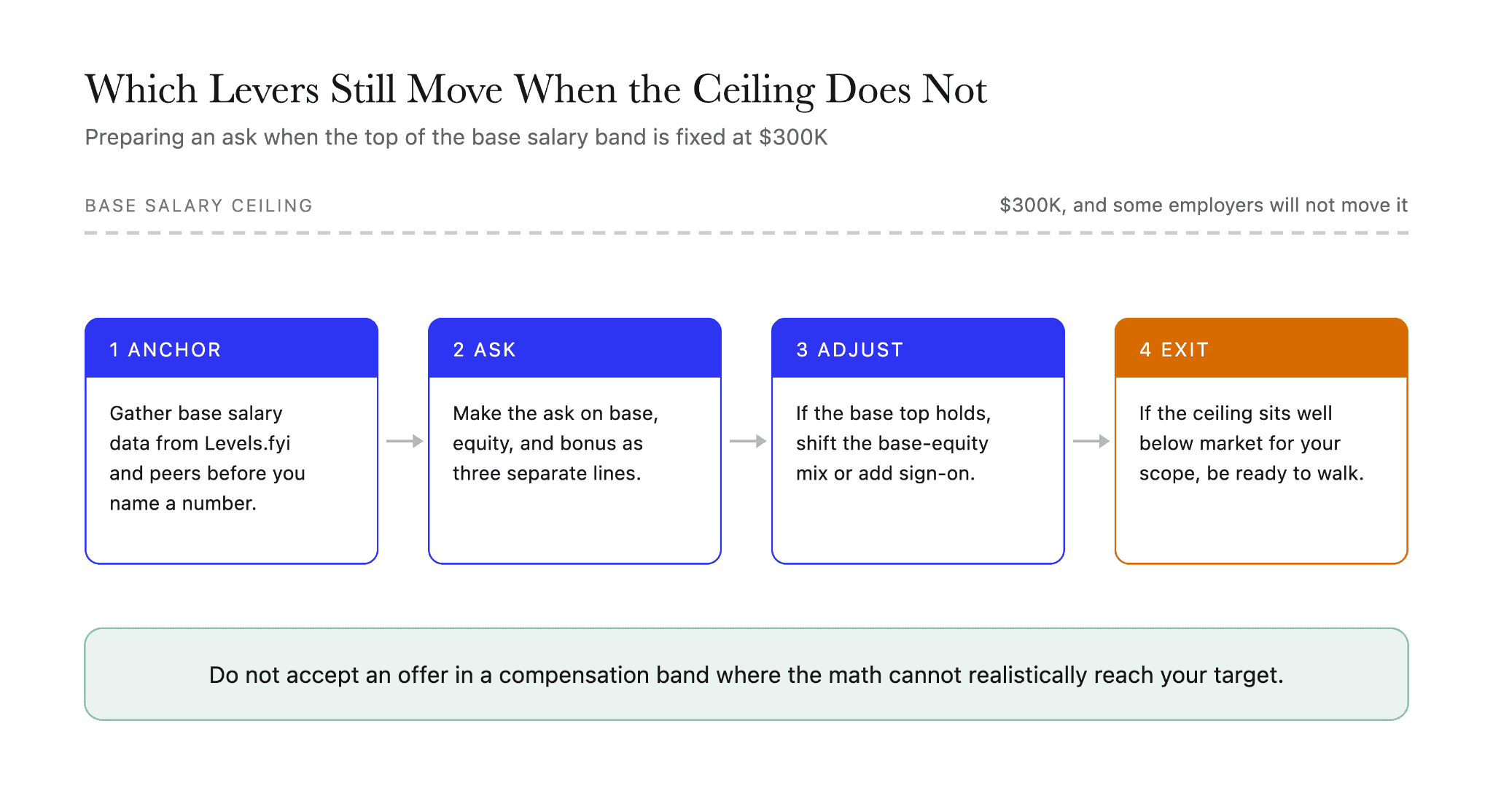
At this level, negotiation means moving within a band rather than inventing a new number. That means treating base salary, equity, bonus, and sign-on compensation as separate levers rather than focusing only on the headline total.
Concrete preparation steps:
Gather compensation data from Levels.fyi and from peers, then construct a clear ask covering base, equity, and bonus separately
Use competing offers ethically to anchor toward the top of band, framing the conversation around long-term fit and impact rather than short-term cash only
Understand that some employers have strict base salary ceilings. If the base top is $300K, they may not move higher on base, but they can shift the base versus equity mix or add a sign-on bonus
Know when to walk away. If the band ceiling is well below market for the role, or if the leveling does not match your scope, it may be better to pursue roles where $300K is actually budgeted. Do not accept an offer in a compensation band where the math cannot realistically reach your target.
Tradeoffs and Burnout Risk: Which $300K Path Fits You
Two offers that both say "$300K total comp" can feel like entirely different jobs, and in practice they are. Roles at this level trade different currencies: time, stress, predictability, and upside. Senior engineers should be explicit about which costs they're willing to pay, and for how long.
At a large tech company, expect on-call rotations and some bureaucracy, but relatively stable hours, strong benefits, and liquid stock. At a hedge fund, expect intense sprints tied to market events, pressure for near-perfect reliability in your code, and scrutiny of your output. At an early-stage startup, expect long stretches of high uncertainty and blurred boundaries between tasks, with much of the value locked in illiquid equity.
Non-compensation factors matter just as much at senior levels: manager quality, the promotion path to staff or principal, autonomy over architecture decisions, and whether the company's mission fits your longer-term goals. Think in multi-year terms. A lower-cash, higher-equity role can be rational at one stage of your career, while a stable package at a large company can matter more during a period where predictability counts for something. Staying adaptable and deliberate about which path you pick tends to pay off more over time than chasing the single highest number on one offer.
How Fonzi Helps Engineers Target Roles That Actually Pay $300K
A listing that advertises "up to $300K" is hard to trust from the outside, since employers routinely publish the ceiling of a band while budgeting well below it, and there's rarely enough public information to tell which is which before you've already sunk weeks into a process. Fonzi is a curated AI engineering hiring marketplace that connects companies with pre-vetted AI and software engineers. Every Interview Request arrives with a specific base salary attached, not a range, so instead of guessing where in a $150K to $300K band you would land, you see the actual number before you agree to talk.
Fonzi's Match Day puts engineers in front of a batch of companies with published bands during the same scheduled window, which makes it easier to compare real offers against each other rather than negotiating one opaque number at a time.
Senior and Staff Software Engineer Salaries: What Reaching $300K Takes
Earning $300K as a software engineer is realistic for a subset of senior practitioners, but only when role, employer type, skills, and negotiation are all aligned within the same band. Roughly 14 percent of the nearly 700 software engineering roles on Fonzi that publish a base salary band top out at $300K or higher, and only four set a floor there, so $300K is usually a ceiling you negotiate toward rather than a number you are offered. Big tech, AI startups, and hedge funds each reach $300K differently: liquid RSUs at a public company, illiquid equity at a startup, discretionary bonus at a fund.
Audit your current skills and impact, then target roles where the published compensation structure makes $300K achievable rather than merely advertises it. Compare base salary, equity, and bonus separately instead of relying on the headline number.
FAQ
Is $300K realistically achievable for a remote senior software engineer role?
Which locations in the United States most commonly offer $300K total compensation for software engineers?
How long does it typically take to reach a $300K band as a software developer?
Do I need finance experience to move into a hedge fund software engineer role that pays $300K or more?
How risky is it to chase $300K at an early-stage startup compared to a large tech company?


