What Is a Staff Software Engineer? Role, Level, and Scope
By
Samara Garcia
•

Staff software engineers are now central to complex AI, ML, and infrastructure initiatives where coordination across multiple teams is required. In 2026, fast-moving AI and LLM adoption has increased demand for staff engineers who can translate research, infra, and product needs into coherent technical direction. This article is written for experienced software engineers, ML researchers, and infra specialists who want a precise view of the staff engineer role, not a generic career overview. The focus is on scope, responsibilities, and practical career path insights rather than company-specific promotion systems.
Key Takeaways
A staff software engineer is a senior individual contributor whose scope extends beyond a single team to influence multiple teams, systems, and architectural decisions across a platform or product area.
The staff engineer role sits above senior software engineer on the career ladder and below principal engineer and distinguished engineer, with differences rooted in breadth of influence and time horizon rather than years alone.
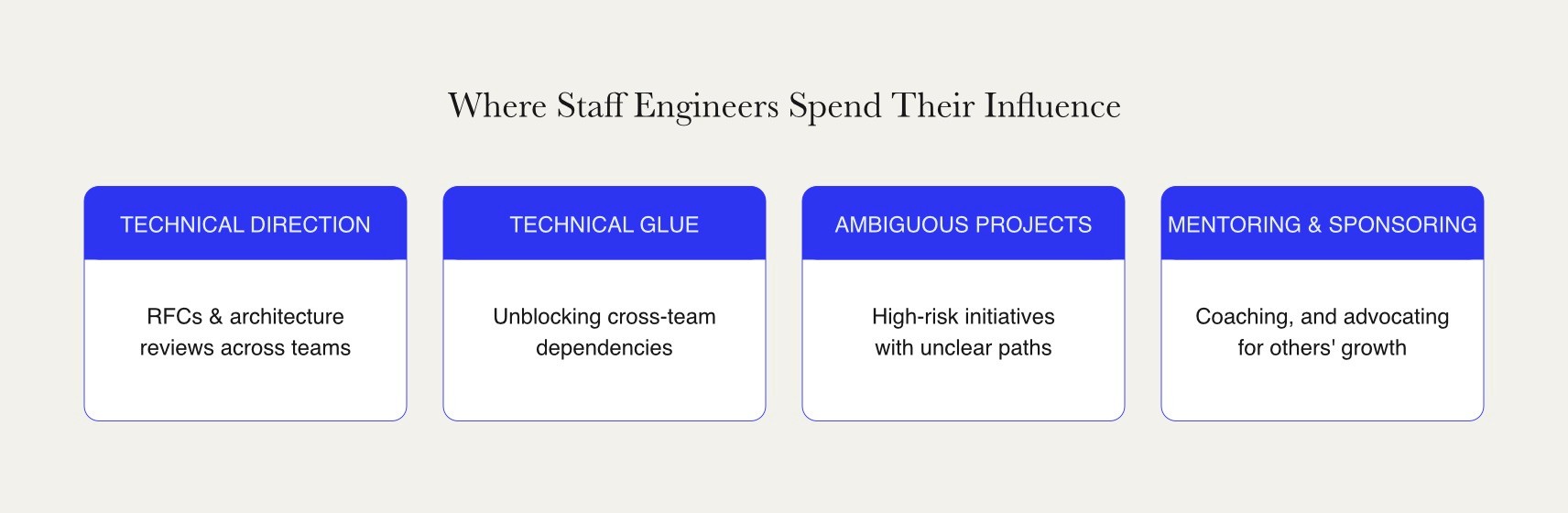
Core responsibilities include setting technical direction, acting as cross-team glue, leading ambiguous projects, and mentoring junior engineers and senior developers alike.
AI, LLMs, and structured hiring models are reshaping how companies evaluate and hire staff software engineers, particularly for roles in AI infrastructure and model serving.
Staff Software Engineer Definition and Place in the Career Ladder
A staff software engineer is a senior individual contributor who owns cross-team technical outcomes rather than a single codebase or feature. Staff engineers sit above senior software engineers in scope, typically influencing several squads or a platform area instead of one team. They are responsible for the architectural integrity and long-term sustainability of the systems they oversee. Extensive experience in software development is typically expected, and many staff engineers hold a bachelor's degree in computer science or a related field. A postgraduate degree may be preferred for some specialized research or AI roles but is not a standard requirement.
The common career ladder in modern software engineering follows this progression: junior software engineer, software engineer, senior software developer, staff engineer, senior staff engineer, principal engineer, and distinguished engineer. The career path typically starts as a junior engineer and advances through demonstrated scope and impact. Titles vary by company, but scope patterns are consistent. Staff engineers are usually at or around level 5 or 6 in large tech ladders like Google, Meta, or Stripe. They remain primarily technical, distinct from engineering managers, although they often partner closely with EMs and product leaders to guide teams in implementing business strategies and technical processes.
How Staff Engineers Differ From Senior, Principal, and Distinguished Engineers
Staff, principal, and distinguished engineer roles are all senior IC levels, but they differ in breadth of influence and expected impact over time. Senior engineers typically lead execution within a team and usually require 8 to 10 years of experience. Senior engineers typically manage one or two teams. Staff engineers are expected to set direction and unblock work across multiple teams or domains, and staff engineers often oversee multiple engineering teams. Staff engineers often report to principal engineers or directors.
A principal engineer focuses on company-wide architecture over years, unlike staff engineers. Principal engineers own multi-organization or entire company strategy, often working with VPs and directors on long-term bets. A distinguished engineer is a rare, industry-recognized technical leader who shapes company and sometimes ecosystem direction, such as leading foundational infra or AI platform strategy. The table below makes these differences immediately visible.
Senior vs Staff vs Principal vs Distinguished
Level | Typical Title | Scope of Impact | Time Horizon | Primary Focus |
Senior Engineer | Senior SWE | Single team, one product or service | 3 to 9 months | Team-level feature delivery, code quality, mentoring within team |
Staff Engineer | Staff SWE | Multiple teams, platform domain | 1 to 2+ years | Cross-team architecture, standardization, system health, sponsorship |
Senior Staff Engineer | Senior Staff SWE | Between staff and principal scope | 1 to 3 years | Bridging team-level and org-wide concerns, leading critical initiatives |
Principal Engineer | Principal SWE | Organization-wide systems | 2 to 5 years | Company-wide technical strategy, high-risk bets, business alignment |
Distinguished Engineer | Distinguished / Fellow | Company or industry-scale | 3 to 10+ years | Defining industry standards, macro-level technical vision |
The shift from senior to staff is mostly about scope, ambiguity, and influence, not just years of experience or number of programming languages known.
Core Responsibilities and Scope of a Staff Software Engineer
Staff engineers still care deeply about software development, but their daily work blends architecture, coordination, and technical leadership. In AI-heavy organizations, staff engineers often sit at the intersection of research, infra, and product, ensuring that models, data pipelines, and serving layers work together reliably. Responsibilities vary by company size: at early-stage startups, a staff engineer may be very hands-on in code, while at large companies, they spend more time on design, reviews, and strategy. Staff engineers define technical strategy and set long-term vision for systems.
Setting Technical Direction Across Teams
Staff engineers define the technical direction for a domain, such as model serving, data platform, or developer productivity, and align several engineering teams on consistent patterns and APIs. This includes writing design docs (RFCs), leading architecture reviews, and making explicit tradeoffs across latency, reliability, and cost for major software components. In AI-focused work, this may mean deciding how inference traffic is routed, how prompt templates evolve, or how evaluation frameworks integrate into CI pipelines. Technical leadership includes designing large-scale system architectures and guiding technical strategy. They balance short-term shipping pressure with multi-year platform evolution, often in collaboration with a principal engineer.
Acting as Technical Glue Between Other Teams
Staff engineers perform essential "glue work": unblocking cross-team dependencies, clarifying ownership boundaries, and ensuring interfaces between services or models are stable. For example, they might coordinate between ML research teams and infra teams on GPU scheduling, feature store design, and observability of production models. Staff engineers ensure that various teams align and improve productivity. This work is often invisible on a sprint board but is critical to predictable delivery and production reliability. Other teams trust effective staff engineers because they listen, reduce friction, and help others succeed.
Leading High-Risk or Ambiguous Projects
Staff engineers are frequently assigned projects where the problem is ambiguous, such as cutting inference costs by a large percentage or enabling multi-region failover for core APIs. They establish technical milestones, explore multiple approaches, run experiments, and converge on viable software solutions with stakeholders. In the context of LLM and ML systems, this might involve introducing retrieval-augmented generation or designing a new feature pipeline to support online learning. Staff engineers design scalable, resilient, and complex distributed systems as part of architectural design. Outcome ownership matters more than line-by-line coding, although staff engineers often write critical or exploratory code paths in early phases.
Mentoring, Sponsoring, and Raising the Bar
Staff engineers mentor senior and junior engineers, reviewing design documents, pairing on tricky debugging sessions, and modeling how to reason about tradeoffs. Staff engineers mentor junior engineers and promote collaborative environments. They differentiate between mentoring (advice and coaching) and sponsoring (using their influence to get others staffed on important projects or put forward for promotion). In AI organizations, this often includes helping colleagues grow skills in distributed systems, ML productionization, prompt engineering, structured output design, and multi-agent coordination. They analyze trends and introduce new tools and technologies to teams.
Skills and Experience Needed to Reach Staff Engineer Level
Reaching staff engineer depends primarily on demonstrated technical scope and cross-team impact. Many staff engineers reach the level after roughly 8 to 15 years of experience, although exceptional candidates may progress faster depending on their responsibilities and achievements. AI and infra-heavy environments raise the bar on distributed systems literacy, data understanding, and operational excellence.
Technical Depth, Architecture, and Programming Languages
Staff engineers are expected to be experts in at least one major technical area, such as large-scale backend systems, ML platforms, or low-latency infrastructure. Mastery of one or more programming languages is essential, and staff engineers should know multiple programming languages and their best practices. For ML systems, fluency in Python and C++ is common; for infra, Go and Rust are valued. A staff engineer should have a solid understanding of database design, including SQL and NoSQL. Architecture skills include understanding microservices, event-driven systems, data modeling, and tradeoffs between consistency and availability. Familiarity with cloud platforms (AWS, GCP, Azure), containerization, and observability tooling is typically assumed.
System Design, Reliability, and Security Thinking
Staff engineers are evaluated heavily on system design, including the ability to design scalable APIs, streaming data pipelines, and multi-tenant platforms. Documented success in architecting and deploying complex distributed systems is essential. Reliability skills matter: designing for graceful degradation, rate limiting, SLOs, and on-call practices for critical AI services. Security awareness includes performing security verification, secrets management, least-privilege access, safe data handling for training sets, and secure coding against common vulnerabilities.
Understanding of cloud computing platforms is essential for staff engineers. Security service considerations also extend to reviewing threat models for new ML features, ensuring compliance with data regulations in model training, and protecting against malicious bots or unauthorized access. Staff engineers ensure compliance with industry standards in software development.
Leadership Without Direct Management Authority
Influencing technical strategy without direct management responsibility is a key responsibility. Staff engineers lead primarily through influence, not headcount, so they must evaluate options, align other teams, and persuade peers rather than issuing directives. This includes proposing clear technical RFCs, facilitating contentious discussions, and balancing different team constraints fairly. Strong staff engineers help other teams succeed by clarifying interfaces, documenting decisions, and anticipating integration issues before they become production outages. These leadership skills are especially important where principal and distinguished engineers are few.
Communication, Documentation, and Working With Other Teams
Effective communication skills are crucial for staff engineers. Clear written communication, especially in design docs and project updates, is a core skill set because so much work spans other teams and time zones. Experience in writing detailed technical documentation is expected. They tailor communication to different audiences: going deep with infra engineers but summarizing tradeoffs for product managers or executives. Strong interpersonal skills for collaboration and communication with non-technical stakeholders are required. Documenting decisions for long-lived systems, including rationales, rejected alternatives, and risk mitigations, is standard practice. The ability to align software development projects with long-term company goals is critical.
Hiring Trends: How AI Is Changing the Staff Engineer Job Market
Over the last few years leading into 2026, hiring for senior and staff software engineers has shifted due to LLM adoption, AI tooling, and new evaluation methods. Companies are not just looking for raw coding skill. They prioritize engineers who can design reliable AI-enabled systems, reason about data, and collaborate with research and infra teams. 90% of engineering teams now report using AI coding tools, and 78% of ICT roles include AI technical skills. Human judgment remains central, with AI used to reduce noise and surface stronger matches.
How Companies Evaluate Staff Engineers Today
Interviews for staff engineers typically include deep system design sessions, architecture reviews of past work, and scenario-based discussions about cross-team technical decisions. For AI and ML-focused roles, companies add interviews about productionizing models, managing data quality, evaluation frameworks, and incident response for AI failures. Past impact, documented in design docs, public talks, or open source projects, often matters more than whiteboard puzzle performance. Prepare by curating a small portfolio of systems you have owned, with diagrams, metrics, and lessons learned.
Staff software engineers earn an average salary of $160,755. Entry-level staff software engineers start at $100,000 per year, and salaries for staff software engineers can reach up to $315,000. Location significantly influences staff software engineer salaries, and experience level affects salary, with higher pay for more years. Work-life balance considerations also vary significantly by company and position.

Use of AI in Hiring and Structured Marketplaces
Recruiters and hiring managers increasingly use AI tools to parse resumes, cluster candidate profiles, and highlight engineers who appear to match specific staff-level requirements. Structured marketplaces, including platforms like Fonzi, combine human curation with AI-based matching to reduce spam, uncover qualified candidates who might otherwise be overlooked, and connect staff engineers with relevant AI, ML, or infrastructure roles more quickly.
When used responsibly, AI can also reduce bias by evaluating candidates more consistently and prioritizing skills over pedigree. In well-run hiring processes, AI assists by ranking and summarizing candidates, but final interview and hiring decisions remain with experienced humans. Maintain clear, machine-readable resumes that highlight staff-level impact, such as cross-team projects and system ownership, so AI tools capture the strongest signals.
Fonzi Match Day for Staff Software Engineers
For staff software engineers, the biggest challenge is rarely finding open roles. It is finding opportunities where the scope, technical challenges, and level of ownership actually match their experience. Traditional job boards often generate high application volume but make it difficult for experienced engineers to connect with teams hiring for platform architecture, AI infrastructure, or cross-functional technical leadership.
Fonzi addresses this through AI-assisted matching and recurring Match Day hiring events. Instead of applying to dozens of roles, staff engineers create a structured profile highlighting architectural ownership, cross-team impact, AI or infrastructure expertise, and technical leadership. During Match Day, companies actively hiring for senior individual contributor roles review a curated pool of pre-vetted candidates at the same time, allowing experienced engineers to receive multiple interview requests from organizations specifically looking for staff-level talent. This structured approach reduces noise, shortens hiring timelines, and helps both companies and candidates focus on role fit rather than keyword matching alone.
Summary
Staff software engineers are senior individual contributors who lead technical direction across multiple teams, driving architecture, solving complex cross-functional problems, and mentoring engineers without managing people directly. As AI, ML, and cloud infrastructure continue to grow, companies increasingly seek staff engineers who combine deep technical expertise with strong communication, system design, and leadership skills.
Reaching the staff level requires demonstrating broad impact rather than simply years of experience. Success depends on owning large-scale systems, influencing technical strategy, collaborating across teams, and adapting to AI-assisted hiring processes that prioritize measurable architectural leadership and long-term business impact.
FAQ
How many years of experience are typically required to become a staff software engineer?
Can staff software engineers work fully remote on high-impact systems?
Do staff engineers still write code daily, or is the role mostly meetings?
How does compensation for a staff engineer compare to a senior software engineer in 2026?
Is it possible to move from staff engineer into principal or distinguished engineer roles later?


