Career Progression for Software Engineers (Definition, Plan, and Path)
By
Samara Garcia
•

Career progression for software engineers in 2026 looks different for AI engineers, ML researchers, infra engineers, and LLM specialists than it did a decade ago. Traditional linear career paths, such as junior-to-senior-to-manager, now coexist with staff-plus-IC tracks, research roles, and hybrid tech-lead positions. Companies also use AI and structured hiring to evaluate candidates, which changes how engineers should present experience, skills, and a career development plan.
Key Takeaways
Career progression for software engineering roles now spans IC architecture, research, engineering management, and hybrid technical leadership.
A practical career development plan combines goal setting, skill development, measurable impact, and deliberate project selection.
Hiring processes in 2026 increasingly rely on AI-assisted screening and structured interviewing, so engineers need clear evidence of outcomes.
Senior AI and infra engineers accelerate career advancement by treating interviews as design discussions about constraints, tradeoffs, and business success.
Defining Career Progression and Career Paths for Software Engineers
Career progression means sustained growth in scope, impact, and responsibility, not just a new title, higher pay, or a managerial position. While it often leads to higher salaries and new opportunities, the stronger signal is ownership of critical systems, influence over architecture, mentorship, and decisions that improve the organization.
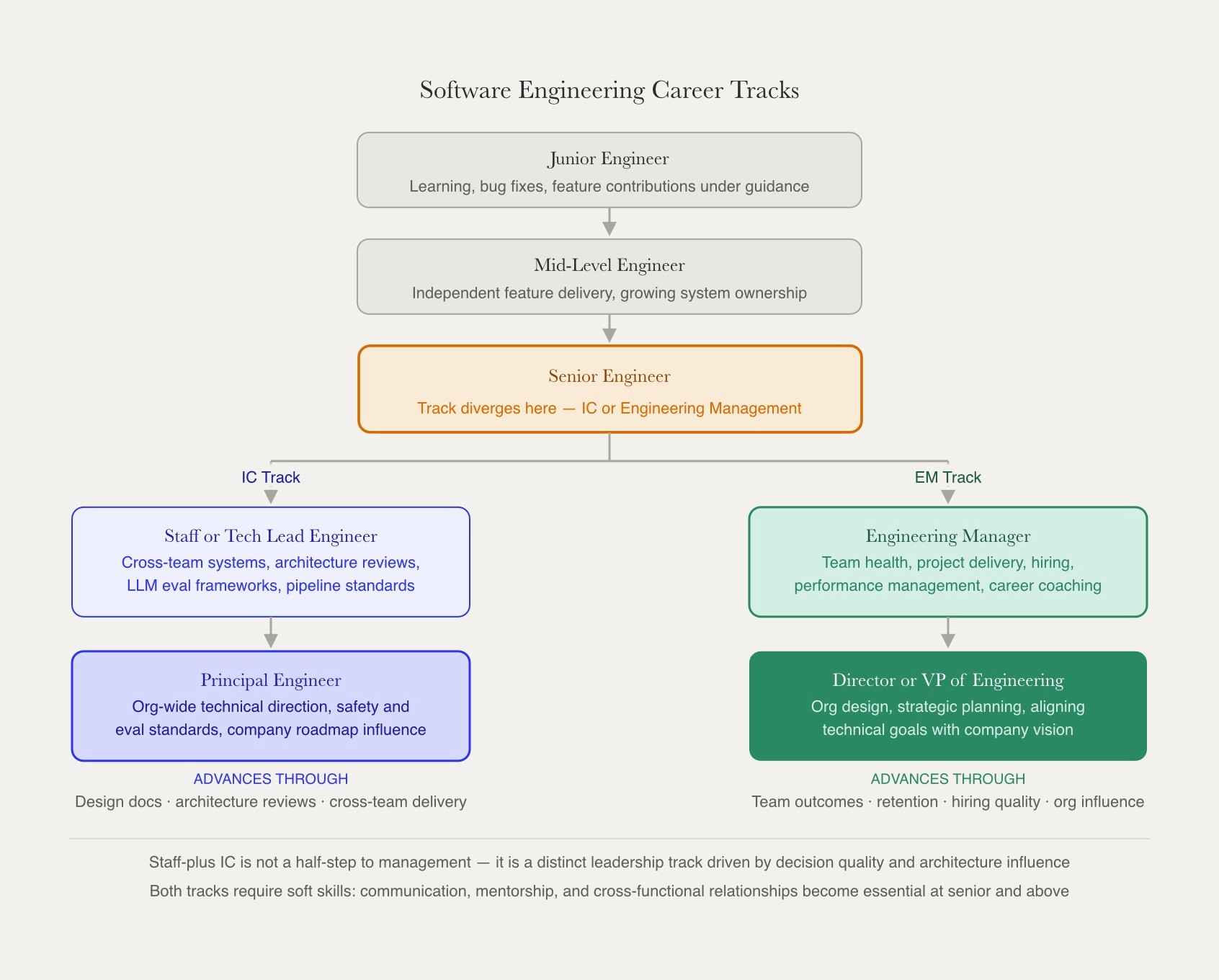
Software engineering careers typically follow a dual-track structure: Individual Contributor and Engineering Management. Progression moves from Junior Engineers focused on learning and bug fixes, to Mid-Level Engineers handling features independently, to Senior Engineers owning complex systems and mentoring others, and finally to Staff or Principal Engineers responsible for system design and technical strategy.
Career growth refers to long-term direction, while career development is the ongoing work that drives it. Continuous learning is essential in a fast-changing field where skills must stay current.
Progression timelines vary by company type. AI-first startups often accelerate advancement due to high ownership of critical systems, while larger enterprises follow more structured promotion cycles tied to formal reviews and leveling systems.
Career pathing also matters to employers, as companies with effective career pathing see 34% higher retention rates. Lack of clear growth opportunities is one of the top reasons employees leave organizations. When employees have defined progression paths, they report higher job satisfaction and are more likely to stay long term, with structured growth linked to 81% job satisfaction.
Designing a Senior-Level Career Development Plan in AI and Infrastructure
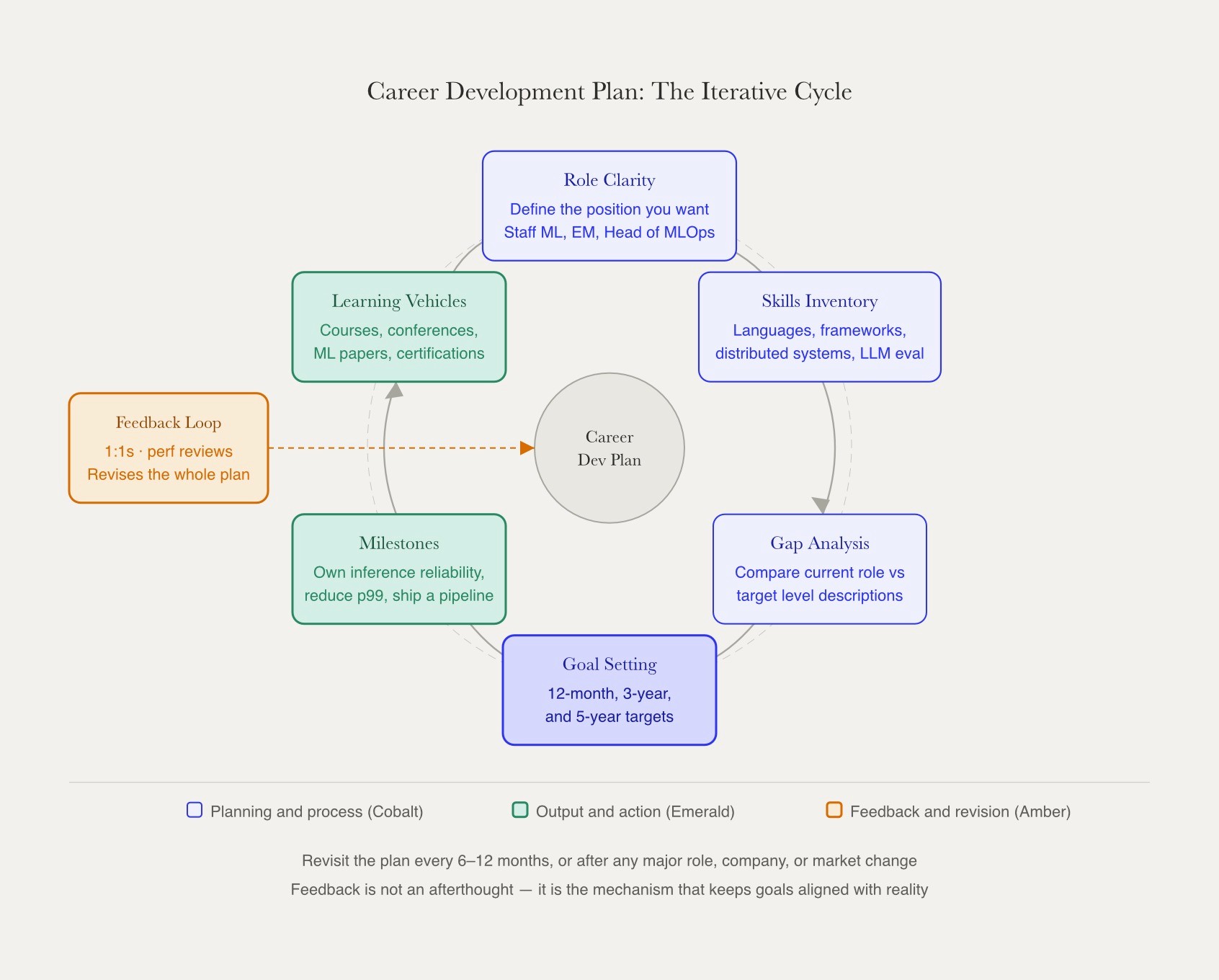
A career development plan is a living document that connects long-term goals with concrete project choices, training, and feedback loops. Regularly evaluating your career development plan is essential because the industry, your current role, and your career aspirations will change.
Core Components of an Effective Career Development Plan
A strong plan helps you determine where you are, where you want to go, and which specific skills must improve.
Role clarity: define the position you want, such as staff ML engineer, research scientist, engineering manager, or head of MLOps.
Skills inventory: document languages, frameworks, research methods, distributed systems expertise, LLM evaluation, observability, and security.
Gap analysis: compare your current role with public descriptions from 2024 to 2026 for target technical roles, then identify missing ownership or leadership skills.
Goal setting: create 12-month, 3-year, and 5-year goals. Setting short-term goals helps achieve long-term career objectives.
Milestones: by Q4 2026, you might own reliability for a core inference service, reduce p99 latency, or drive adoption of a retrieval pipeline across teams.
Learning vehicles: include training courses, peer reading groups for 2025 to 2026 ML papers, conferences, certifications, and other learning opportunities.
Feedback is part of the plan, not an afterthought. Use regular 1:1s, performance reviews, peer reviews, and structured positive feedback to create evidence for promotion. Positive feedback from peers and partners can also help secure strong professional references. Employees who feel valued are 4.6 times more likely to perform their best work, which makes feedback important for both well-being and success.
Companies have strong incentives to invest in employee development. Insufficient training can be costly, while employee retention helps reduce the expense of recruiting and onboarding new talent. Replacing experienced employees, particularly managers, can cost up to 200% of their annual salary. At the same time, many organizations are concerned about meeting employees' career growth expectations, making development and progression programs an increasingly important part of talent retention strategies.
Sample Career Progression Table for Senior Software Engineers
Use this table as a practical example to map your current state and decide where to focus next.
Career Level | Typical Title | Scope of Impact | Key Responsibilities | Common Growth Focus |
Mid-level | Software Engineer II, Backend Developer, Frontend Developer, AI Application Engineer | Feature, component, or smaller service ownership | Build user-facing interfaces, client-side applications, server-side logic, database management, LLM API integrations, and tests | Reliability, code quality, collaboration, and domain depth |
Senior | Senior Engineer, ML Engineer, DevOps Engineer, AI Infra Engineer | Multiple components or a critical service | Automate deployment, manage infrastructure, own complex features, mentor juniors, and manage incidents | System design, mentorship, uptime, latency, and cost reduction |
Staff or Tech Lead | Staff Engineer, Lead ML Engineer, Principal Infra Engineer | Cross-team systems and platform domains | Tech Leads split time between coding and leading a development team, standardizing pipelines, reviewing designs, and owning LLM evaluation frameworks | Influence, written strategy, architecture, and institutional knowledge |
Principal or Head-level | Principal Engineer, Head of ML Infra, Director or VP of Engineering | Organization-wide domains and company roadmap | The Director or VP of Engineering manages multiple teams and aligns technical goals with the company's vision | Organizational design, strategic planning, governance, and business alignment |
Modern Career Paths for AI, ML, and Infra Engineers
Career paths have diversified, especially in AI-first companies between 2021 and 2026. Engineers can now choose among deep IC leadership, people leadership, research or applied science, and hybrid roles.
Staff-Plus and Principal Engineering as a Distinct Career Path
Staff-plus engineering is not a half-step to management. It is a distinct leadership track where career progression comes from leveraging decision quality, architecture reviews, design documents, and decision-making frameworks.
In AI infrastructure, this can mean setting technical direction for inference platforms, standardizing training pipelines, modernizing deployment infrastructure, or creating safety and evaluation standards. Readiness usually shows through repeated delivery of large cross-team projects and the ability to mentor multiple senior engineers.
Engineering Management and Technical Leadership Roles
Engineering Managers focus on team health and project delivery. They require conflict resolution and project management skills, plus enough technical literacy to evaluate model deployment, reliability, and security proposals.
New responsibilities include hiring decisions, performance management, career coaching, staffing, and coordination with product and research leadership. Directors of Engineering need organizational design and strategic planning skills. Technical skills get entry-level roles; soft skills help promotion, and effective software engineers develop soft skills like communication and mentorship.
Research and Applied Science Career Paths
For ML researchers and LLM specialists, advancement often depends on publications, deployed models, open-source contributions, and novel techniques that work in production. A common path moves from model integration to owning retrieval-augmented generation systems, then to orchestrating agentic workflows and multi-agent infrastructure, and finally to platform-level responsibility.
The best research career path combines scientific rigor with product judgment and infrastructure constraints. This matters in the long run because evaluation, reproducibility, reliability, and safety now shape whether research creates real benefits for the company.
Navigating the AI-Driven Hiring Landscape for Career Advancement
Since around 2022, companies have adopted AI tools for resume screening, skill inference, and candidate matching, evolving by 2026 into LLM-based evaluation agents capable of summarizing candidate histories and inferring fit. AI in hiring works best when it helps recruiters focus on people, not when it replaces human judgment.
Preparing Your Profile and Portfolio for AI-Assisted Screening
A senior profile should make the impact easy to parse. Include quantifiable outcomes, such as latency improvements, reliability gains, throughput increases, cost savings, model accuracy improvements, or lower cost per inference.
Label technologies, domains, and scale clearly. For example, include RAG, model serving, vector databases, Kubernetes, PyTorch, observability, recommendation systems, LLM tooling, traffic volume, model size, and data volume. Add selected open-source work, technical blogs, talks, and conference material if they prove expertise.
Internal hiring is notably more efficient and effective than external hiring sources, so do not ignore internal vacancies at your current employer. Equal access to internal vacancies can reveal lateral moves, new challenges, and growth opportunities that external candidates never see.
Practical Strategies to Progress in Your Software Engineering Career
Advancement in software engineering requires a mix of great technical skill and strong leadership. To progress, take on new responsibilities in ambiguous problem spaces, own cross-team initiatives, write clear design documents, and build relationships with product, data, security, and infra teams.
Mentorship and sponsorship matter. Mentors advise you, while sponsors advocate for you in promotion, staffing, and leadership discussions. 80% of professionals consider networking important for career success, so professional development should include both internal relationships and external market awareness.
Choose projects that align with your career aspirations, not only your desire for interesting technology. A high-leverage project might involve owning reliability for a core API, leading a model rollout, reducing inference cost, or modernizing a legacy platform. Say no carefully to low-leverage support work when it blocks more responsibility and career advancement.
Keep an eye on the broader job market. Speak with peers, review compensation data, explore other opportunities, and consider selective marketplaces like Fonzi when you want higher-signal matches. Some engineers eventually start their own business, but even then, a strong work ethic, leadership, institutional knowledge, and professional habits remain central to career success.
Fonzi and Career Progression for Software Engineers
Career progression is often influenced by the opportunities you're exposed to. As engineers move from senior to staff, principal, management, or specialized AI and infrastructure roles, finding positions that align with their experience and long-term goals becomes increasingly important as they advance.
Fonzi helps software engineers discover high-signal opportunities by matching candidates with companies seeking specific technical expertise. Through AI-assisted matching and Match Day events, engineers can connect directly with employers hiring for senior engineering, AI, ML, and infrastructure roles, making it easier to find opportunities that support the next stage of career growth.
Summary
Modern career progression for software and AI engineers depends on aligning clear goals with the right projects, skills, and environments. Structured plans, deliberate goal setting, and thoughtful navigation of AI-driven hiring help senior engineers sustain career growth over the next decade. Review your current career development plan, update it for the 2026-2028 market, and consider high-signal channels, including curated marketplaces, to access better-aligned roles.
FAQ
How often should I update my career development plan as a senior software engineer?
What is the best way to show impact for AI or ML roles on my resume?
Is moving into management necessary for long-term career progression in engineering?
How can I tell if a company offers real growth opportunities for senior engineers?
Do curated talent marketplaces help with career progression for experienced engineers?


