What Does a Design Engineer Do?
By
Samara Garcia
•

Design engineers sit at the intersection of design and engineering, translating requirements, constraints, and stakeholder input into detailed, buildable systems. Their work is critical across fields ranging from the construction industry and embedded hardware to AI-driven software products. In recent years, rapid product cycles, complex technology stacks, and rising user expectations have made engineers who can own both problem framing and solution implementation more essential than ever. This article unpacks what design engineers do day-to-day, how the role differs from product engineering and adjacent functions, what technical skills and soft skills matter most, and how hiring for these roles is evolving in an AI-driven market.
Key Takeaways
A design engineer owns the translation from concept to working system, bridging design intent and technical implementation across hardware, software, and infrastructure contexts.
Design engineers operate across the full product development process, from early discovery and prototyping to production hardening and lifecycle iteration.
The role differs from product engineering, UX design, and ML research in its emphasis on interaction quality, design systems, and ensuring that design concepts survive implementation.
A mix of technical skills (computer-aided design, front-end code, systems thinking) and soft skills (communication, collaboration, problem solving) makes design engineers valuable in high-demand engineering industries.
AI, LLMs, and structured hiring models are changing how design engineers are evaluated, with growing focus on real-world work samples, portfolios, and cross-functional impact.
What Is A Design Engineer?
A design engineer is responsible for turning functional requirements and constraints into detailed, buildable designs. This function spans mechanical engineering, civil engineering, software engineering, and hybrid disciplines. Design engineers develop functional designs for various products, from turbine assemblies and bridge structures to interactive software interfaces.
In traditional sectors such as aerospace, automotive, and commercial construction, design engineers specify geometry, materials, tolerances, and interfaces using CAD and CAE software. They work in mechanical, electrical, and structural engineering industries, and they work across various fields including aerospace and automotive. In software and AI products, the same function appears under titles like UX engineer, UI engineer, or design technologist. These engineers implement interactive user interfaces, build design systems, and maintain front-end architectures that serve millions of users.
Across domains, the common thread is systems thinking: understanding how components interact in a larger design system, whether that means load paths through a steel frame or data flows through a component library and its API contracts. Design engineering is a function, not just a title. Many senior engineers perform design engineering work even if they carry titles like staff software engineer or lead mechanical engineer.
What Does A Design Engineer Do Day To Day?
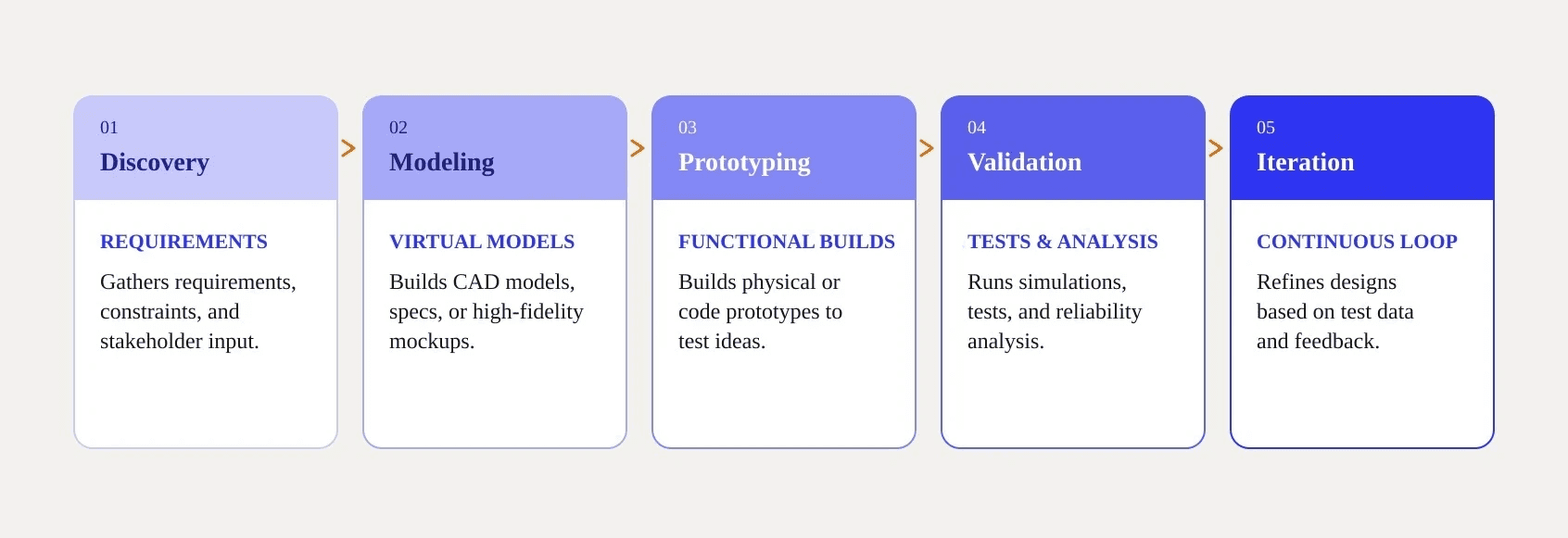
The day-to-day work of a design engineer spans discovery, modeling, prototyping, validation, and iteration, often in tight feedback loops with product, research, and production teams.
In physical product contexts, design engineers create virtual models using computer software such as SolidWorks, Siemens NX, or CATIA. They run finite element analysis on turbine hubs or bridge components, produce drawings with technical specifications for fabrication, and iterate based on test data. Design engineers conduct virtual simulations to test designs under stress, and they conduct analyses to ensure product reliability. They also perform root cause failure analysis on products when field failures arise, and they modify existing designs to improve efficiency or resolve issues. Building and evaluating physical prototypes and functional prototypes is a regular part of the design process.
In software engineering contexts, the work involves building high-fidelity prototypes in React, SwiftUI, or Flutter, integrating design tokens, refining motion and layout, and translating Figma specs into production-ready code. For AI and machine learning products, design engineers help create interfaces for model configuration, monitoring, and evaluation, collaborating with ML researchers to surface complex capabilities in usable flows.
Design engineers conduct research and feasibility studies for new projects and often consult with various specialists during complex projects. They own design reviews, write specification documents, and manage design changes across the product development lifecycle. Documentation is essential for design engineers and includes design specifications, change logs, and tradeoff records. Throughout this work, they balance constraints like cost, safety, functionality, and aesthetics, resolving tradeoffs between reliability, latency, accessibility, and long-term maintainability.
Design Engineering Across Industries: From Construction To Software
The core responsibilities of a design engineer are consistent, but the artifacts, tools, and constraints differ significantly across industries.
In the construction industry, design engineers handle structural layout, code compliance, and coordination with architects, MEP disciplines, and contractors. They produce buildable drawings and BIM models, and design engineers are in high demand in civil and commercial construction. Design engineers ensure compliance with industry standards and safety regulations, a requirement that carries significant weight when public safety is involved. Collaboration helps design engineers ensure product designs are manufacturable, and they collaborate with manufacturing engineers for cost-effective production across sectors.
In manufacturing and hardware, the focus shifts to DFM and DFA work, tolerance stacks, PCB and enclosure integration, and close collaboration with supply chain, test engineering, and manufacturing engineering teams. Design engineers work closely with production teams to ensure seamless integration between design output and the manufacturing process. Complex projects in medical devices or autonomous systems add regulatory, safety, and ML considerations.
In the software industry, design engineers implement UI and interaction patterns, maintain a design system, integrate with backend and data pipelines, and ensure design intent survives implementation. Seamless integration between design tools and code is a growing priority.
In recent years, trends like AI-assisted CAD and generative UI tools have been reshaping workflows. Design engineers steward these tools, evaluating AI outputs against engineering constraints rather than being replaced by them.
Key Technical Skills For Modern Design Engineers
For AI and infra-focused readers, the relevant skills extend well beyond graphics or CAD software. They span modeling, simulation, code, and systems thinking.
Physical Product Skills
Core technical skills for physical product design engineers include strength of materials, fluid dynamics, thermodynamics, and familiarity with manufacturing methods such as machining, injection molding, and additive manufacturing. Proficiency with computer-aided design (CAD) tools (SolidWorks, Creo, NX, CATIA) and computer-aided engineering platforms (ANSYS, COMSOL) is standard. CAD software helps visualize technical aspects of designs, while advanced engineering software enables complex calculations for stress, vibration, and thermal loading. Design engineers use CAD and CAE software for design development and conduct testing to ensure product reliability. A solid understanding of GD&T, tolerance analysis, and BOM management is expected.
Software and AI Product Skills
Software-focused design engineers need strong HTML, CSS, and JavaScript or TypeScript fundamentals, modern front-end frameworks (React, Vue, Angular, SwiftUI), accessibility standards such as WCAG, performance profiling, and testing strategies for UI and interaction flows. Design systems literacy is essential: understanding tokens, theming, component APIs, and documentation that multiple cross-functional teams rely on. Advanced software tools optimize product design and testing processes in both domains.
For AI-heavy products, comfort with inference APIs, prompt design, latency budgets, and fallback strategies matters. Design engineers often need proficiency in CAD software or equivalent tooling for their domain. Senior design engineers frequently build internal component libraries, script simulation pipelines, or automate repetitive workflows, materially increasing team leverage. A deep understanding of how tools interconnect across the stack separates competent practitioners from exceptional ones.
Soft Skills That Differentiate Great Design Engineers
In roles that bridge design and engineering, soft skills are just as important as technical expertise. Design engineers communicate across UX, engineering, and business teams, translating complex ideas, explaining technical tradeoffs, and writing clear documentation that keeps projects aligned.
Collaboration and problem-solving are equally important. Design engineers work closely with cross-functional teams, lead design and technical reviews, resolve disagreements through prototypes and data, and break complex problems into practical solutions. They also mentor teammates, advocate for accessibility and usability, and identify architectural risks early to help ensure products are scalable, reliable, and user-friendly.
Design Engineering vs Product Engineering And Other Adjacent Roles
Many AI and infra engineers already perform product engineering, so it is useful to clarify how design engineering differs rather than treating it as a separate career ladder.
Product engineers own end-to-end feature delivery and system behavior. Design engineers focus more on interaction quality, implementation of design systems, and the integrity of the user-facing or operator-facing surface area. This is where the definition of design engineer gets clearer in practice: the distinction between these roles is well understood in larger organizations, even if the boundaries blur in smaller teams.
UX or product designers focus on research, information architecture, visual design, and conceptual design. They shape visual appeal and user flows but usually do not carry deep responsibility for production code or detailed physical specifications. Design engineers take those design concepts and turn them into the final product.
ML and research engineers are primarily responsible for model behavior, evaluation, and experimentation. Design engineers focus on how those capabilities are exposed to users or integrated into workflows, developing innovative solutions that make complex model outputs understandable and actionable
Comparison Of Design Engineer And Related Roles
Role | Primary Focus | Typical Deliverables | Example In Practice |
Design Engineer | Interaction quality, design system implementation, ensuring design intent survives build | UI components, structural drawings, design specs, functional prototypes | Implementing a load-bearing connection detail for a steel frame; building an LLM prompt configuration panel in React |
Product Engineer | End-to-end feature delivery, system architecture, scalability | APIs, backend services, deployment pipelines, feature releases | Shipping a new inference endpoint with monitoring; building a data ingestion pipeline |
UX / Product Designer | User research, information architecture, visual and interaction design | Wireframes, prototypes, user flows, usability reports | Conducting user interviews for an ML evaluation dashboard; designing navigation for a construction project portal |
ML / Research Engineer | Model design, training, evaluation, experimentation | Trained models, experiment logs, research papers, evaluation scripts | Fine-tuning a language model for code generation; running ablation studies on retrieval architectures |
How AI And LLMs Are Changing Design Engineering Work
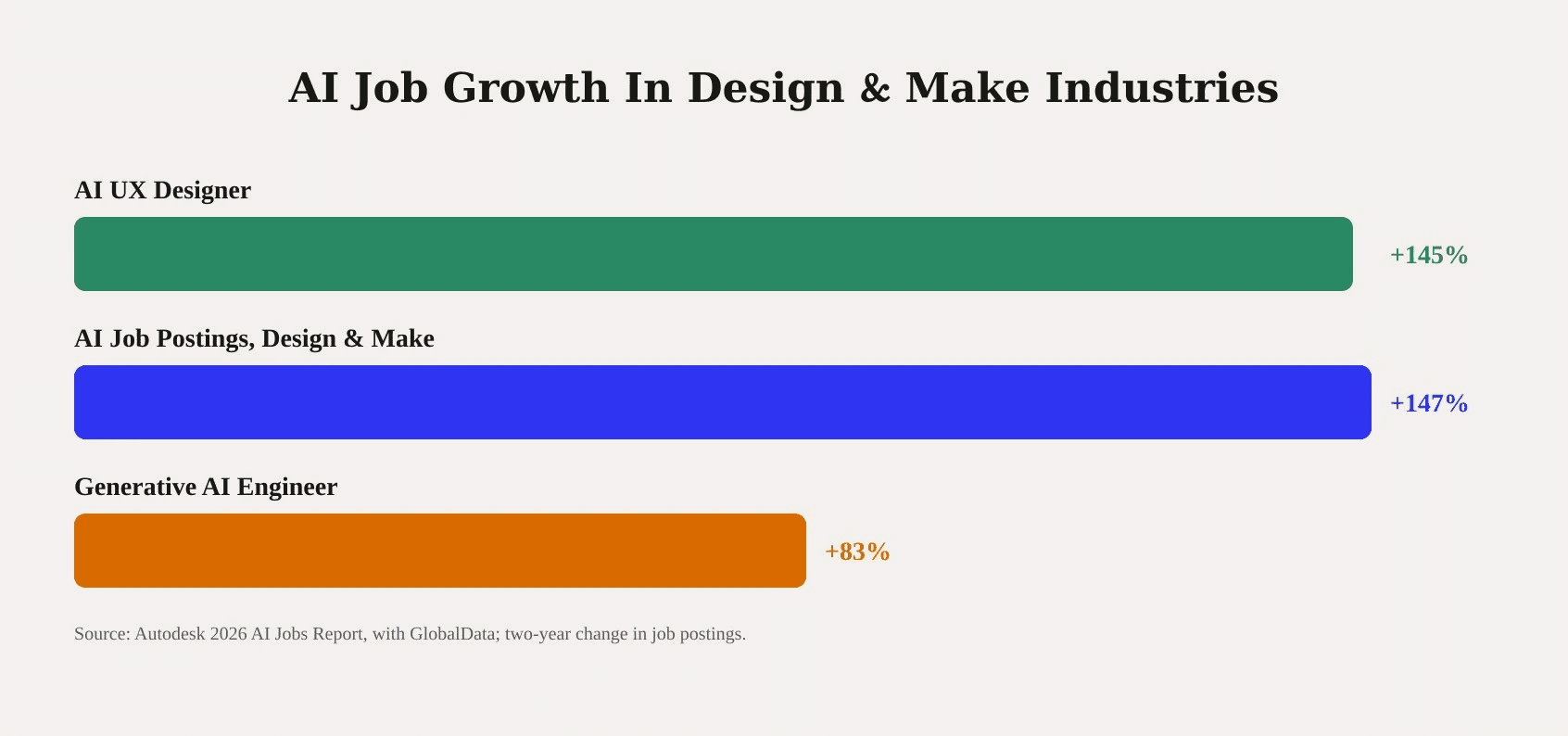
Recent advances in generative AI and LLM tooling have materially changed both design work and the expectations placed on design engineers. AI-related job listings in design and manufacturing industries more than doubled over two years, with titles like AI UX Designer growing 145% and Generative AI Engineer growing 83%.
Practical use cases include AI-assisted CAD feature suggestions, automated drawing generation, code completion and UI scaffold generation, and analytics summarization that informs design decisions. Design engineers now need to understand how to evaluate AI-assisted outputs, enforce constraints, and integrate AI capabilities safely into workflows instead of treating models as black boxes. They develop solutions that combine human judgment with machine learning capabilities.
In AI-native products, design engineers work closely with ML researchers to design innovative design solutions such as prompt configuration panels, uncertainty visualization, and human-in-the-loop review flows. Hiring teams increasingly assess candidates on their ability to use AI productively, for example, leveraging Copilot-like tools without losing code quality, and to reason about failure modes in AI-powered experiences.
AI augments the role rather than replaces it. Human judgment around tradeoffs, risk, and user experience remains central. The engineers who can direct and evaluate AI assistance, rather than passively consuming its outputs, will hold the strongest positions.
How Companies Hire Design Engineers In An AI-Driven Market
Since 2023, hiring for design engineers has placed greater emphasis on practical skills, cross-functional collaboration, and portfolio quality. Typical interviews include a recruiter screen, portfolio review, hands-on design or coding exercise, and conversations with designers and engineers to evaluate both technical execution and teamwork.
AI is increasingly used for resume screening and candidate matching, but hiring decisions still rely on human evaluation. Some platforms, including Fonzi, use curated or match-based models that pre-vet engineers on technical and communication skills before introducing them to employers. To stand out, showcase your design process, explain key tradeoffs, quantify results where possible, and demonstrate how you collaborate across disciplines to solve real user and business problems
Finding Design Engineer Jobs Through Curated Hiring Platforms
As hiring for design engineers becomes more competitive, many companies are moving beyond keyword-based resume screening and looking for candidates who can demonstrate technical execution, collaboration, and design thinking. Portfolios, practical assessments, and cross-functional interviews now carry more weight than resumes alone, especially for roles that combine engineering with product or UX work.
For engineers exploring new opportunities, curated hiring platforms like Fonzi can make that process more efficient. Instead of submitting applications to dozens of companies, candidates can participate in Match Day, where pre-vetted engineers are introduced to AI startups and technology companies actively hiring. Because companies have already reviewed technical qualifications, interviews tend to focus more on portfolio quality, design decisions, and cross-functional impact. For design engineers whose value lies in translating concepts into production-ready systems, this creates an opportunity to spend less time on applications and more time connecting with teams that need their specific blend of design and engineering expertise.
Summary
Design engineers provide the connective tissue between concept and implementation, blending technical skills, design sensitivity, and collaborative problem solving. In an AI-heavy landscape, the ability to steward design systems, leverage modern tools, and communicate across disciplines makes design engineers especially valuable, not less so.
If you already do cross-functional work in AI, infra, or product engineering, evaluate which aspects of design engineering you enjoy most and deliberately cultivate those skills. Explore roles, build a portfolio that shows your reasoning process, and consider curated marketplaces that match your preferred mix of design and engineering responsibility.
FAQ
How is a design engineer role different from a typical senior software engineer role?
Can an AI or ML engineer transition into a design engineering role?
What is the best way to showcase design engineering skills in a portfolio?
Do design engineers need formal design training, or is an engineering background enough?
How will AI tools affect the long-term career prospects of design engineers?


