Founding Engineer: What the Role Means at a Startup
By
Samara Garcia
•

In 2026, the founding engineer role has become one of the most attractive paths for senior engineers who want more ownership than a traditional big tech position. But the title can mean very different things depending on the startup's stage, technical challenges, funding, and expectations.
This guide breaks down what founding engineers actually do, how the role differs from a typical engineering position, what compensation and equity structures look like, and how to evaluate whether the opportunity is worth the risk.
Key Takeaways
A founding engineer is an early technical leader, not just an early coder. The role typically involves owning architecture, product decisions, infrastructure, and execution while helping a startup find product-market fit.
The role trades structure for ownership and upside. Founding engineers often accept lower cash compensation than big tech in exchange for meaningful equity, broader responsibilities, and the chance to shape the company from the beginning.
Success requires adaptability beyond technical skills. The strongest founding engineers combine engineering depth with product sense, communication, customer empathy, and the ability to make decisions in uncertain environments.
Defining the Founding Engineer Role in an Early Stage Startup
A founding engineer is one of the first technical hires at a startup, typically joining between pre-seed and Series A, usually before clear product-market fit is established. These are employees number one through three on the engineering side, hired after the company concept exists but before there is a proven, repeatable business model.
The founding engineer role mixes senior IC responsibilities (designing systems, choosing the tech stack, and writing code daily) with proto-lead responsibilities such as setting process, running early hiring loops, and shaping the product roadmap directly with the founding team. Founding engineers shape the technical culture and codebase of the company from scratch, and they are responsible for making critical architecture decisions that persist for years.
How It Differs from Co-Founder and Early Employee
A co-founder holds governance rights, founder stock, and a role in company formation. A founding engineer joins after that formation, receives option grants rather than founder shares, and typically takes a higher salary but less equity. An early employee who joins at the 20 to 50 person stage has a narrower surface area, lower execution risk, and less involvement in market validation or finding product-market fit. Founding engineers have broader responsibilities than standard early employees, including owning technical decisions, data model choices, and version control workflows that define how the dev team operates.
Dimension | Founding Engineer | Co-Founder | Senior Engineer (30+ employees) |
Equity range | ≈1.5% median for hire #1, declining sharply by Series A | 10% to 50% | 0.01% to 0.25% |
Salary (USD) | $160K to $340K | Often below market or deferred | $200K to $350K |
Typical join timing | Pre-seed to Series A | Company formation | Series A or later |
Decision rights | Architecture, stack, early roadmap | Strategy, fundraising, governance | Scoped to team or project |
Titles like first engineer, founding AI engineer, or founding platform engineer carry overlapping expectations even if labels differ across companies. What matters is whether the person holds the scope and risk profile described above.
What a Founding Engineer Actually Does Day to Day
The founding engineer role is about building the company's executable core, including systems, processes, and culture, not simply shipping tickets from a backlog. The role is characterized by a high level of ambiguity and fast-paced work, with priorities shifting as the startup learns from users and data.
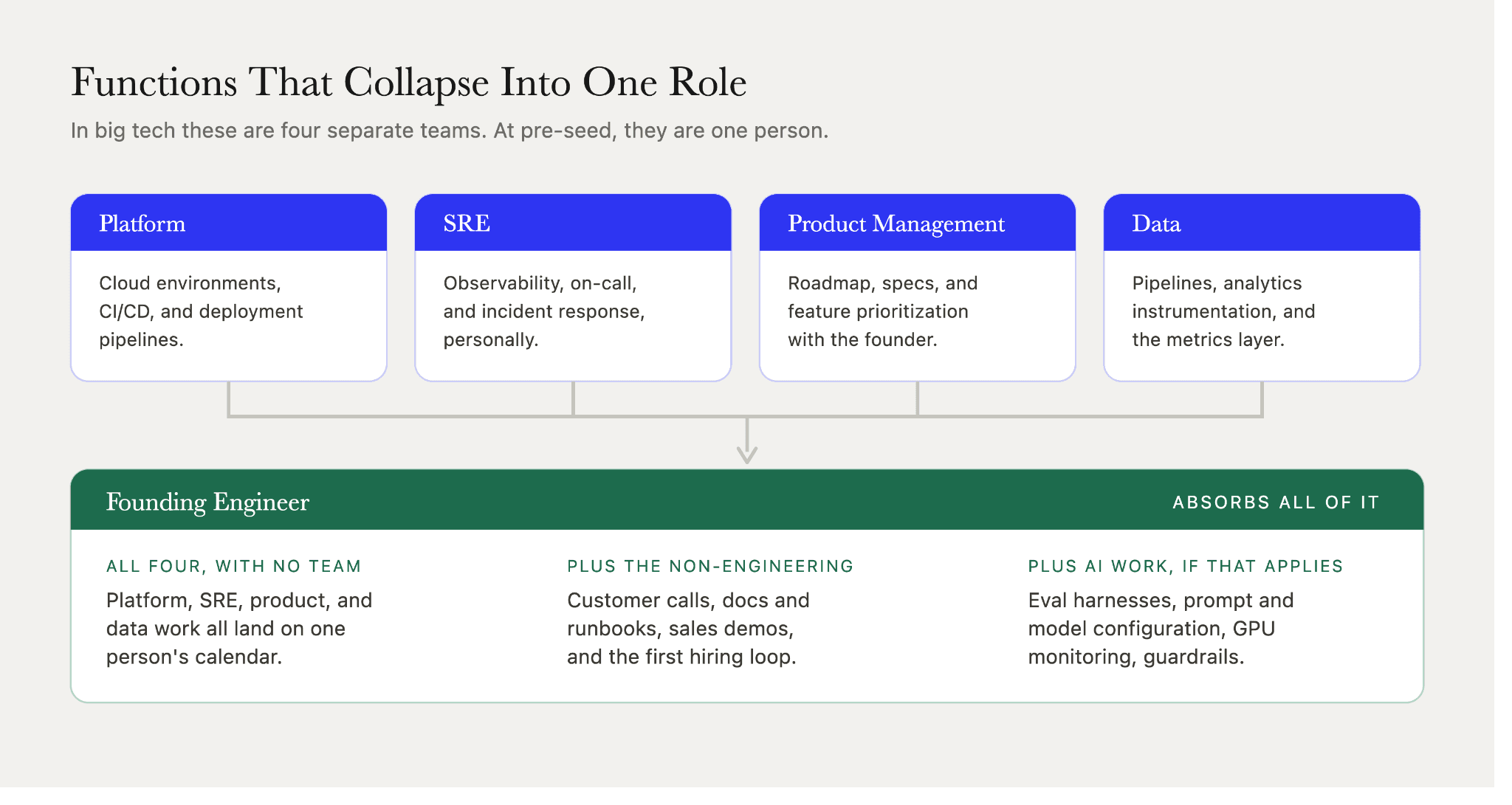
Across the stack, a founding engineer is responsible for standing up the first infra tooling in 2026: cloud environments, observability, CI/CD, deployment pipelines. They build APIs, backend services, and often wire up frontends or demos. On-call and incident response typically rest with them personally, because there is no SRE team yet.
Product and Customer Proximity
Founding engineers work directly with the founder and early users, turning vague problem statements into concrete milestones. They decide which features to ship first. A founding engineer works directly with customers to gather feedback, prioritizing rapid iteration and minimum viable products over polished specs to validate hypotheses quickly.
Non-Engineering Work
The role extends well beyond code. Founding engineers often juggle multiple roles, including technical PM and recruiter. They run customer calls, write early documentation and runbooks, support sales with demos, own analytics instrumentation, and sometimes run the first hiring loop for other engineers. Founding engineers must balance short-term features with long-term goals, and they balance technical debt based on project needs and timelines.
For AI and LLM-focused startups, additional responsibilities include setting up data pipelines, evaluation harnesses, prompt or model configuration, GPU utilization monitoring, and safety or guardrail layers. In big tech, separate platform, SRE, product management, and data teams handle these functions. In an early startup, the founding engineer absorbs them all.
Founding Engineer vs Big Tech and Later-Stage Roles
Many founding engineers in 2026 come from big tech or large companies and need to recalibrate expectations around scope, support, and benchmarks for success. The transition is not simply about working harder. It requires a fundamentally different operating model.
In big tech, a software engineer works with polished specs, centralized platform teams, dedicated product manager support, and long planning cycles. A founding engineer operates without most of those layers. Iteration cycles are shorter, feedback loops are tighter, and there is more risk of wasted effort because the startup is still trying to find product-market fit. Founding engineers are evaluated on their ability to reduce uncertainty and iterate fast, not on optimizing a single subsystem at massive scale.
For AI and infra specialists, this means prioritizing simple, robust LLM pipelines over complex in-house infra, or preferring managed services to speed up experimentation. The goal is engineering velocity toward the next milestone, not architectural elegance. The trade-offs between brand, stability, and compensation in large companies versus equity, autonomy, and broad learning as an early employee are real but deeply personal.
Before pursuing founding engineer roles, consider whether you thrive in a chaotic environment with high ownership or prefer deep work within mature systems. Mismatched expectations are the most common reason strong engineers leave early-stage startups within the first year.
Key Skills and Signals for a Strong Founding Engineer
The best founding engineers are not necessarily the strongest algorithm competitors. They combine strong engineering fundamentals with product sense and judgment under ambiguity. Founding engineers need strong product instincts and the ability to handle ambiguity, and they should have experience building complete systems end to end.
Core technical signals that many founders look for include:
History of greenfield projects or 0-to-1 product building where you defined the technical foundation
End-to-end ownership of deployments, production operations, and monitoring
Technical skills that include full-stack range across backend, infra, and at least one user-facing surface
Product and execution signals matter equally: evidence of shipping quickly, running experiments, cutting scope intelligently, and incorporating user feedback without being overly attached to original designs. For AI and ML roles, hiring teams look for experience shipping models to production under real constraints, implementing evaluation frameworks, and balancing research prototypes with production needs.
Communication skills are essential for founding engineers to explain technical concepts to non-technical stakeholders, including a non-technical founder. Interpersonal and leadership traits, such as willingness to disagree with the founder when needed and the ability to create light process without over-bureaucratizing early teams, separate good candidates from great ones. Many founders look for engineers who have operated as tech leads, staff-level ICs, or who have demonstrable side projects that mimic early startup conditions.
Compensation, Equity, and Risk for Founding Engineers
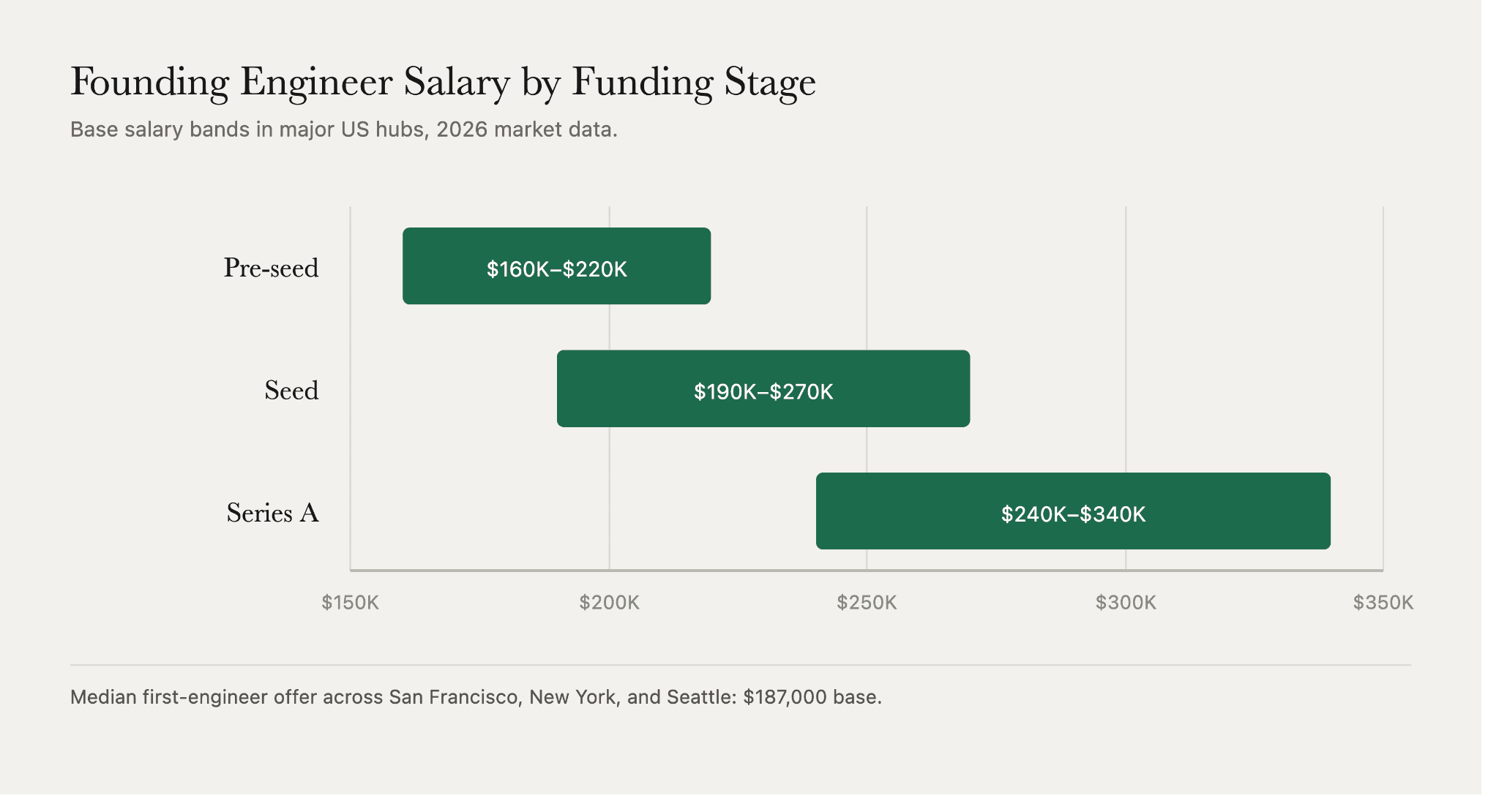
Founding engineer compensation in 2026 is a negotiated balance between below big tech salary, meaningful equity, and the actual risk profile of the company stage and funding. A founding software engineer typically accepts less cash in exchange for more ownership. In San Francisco, New York, and Seattle, a median first-engineer offer runs about $187,000 base with 0.33% equity, rising to $235,000 and 1.24% at the 90th percentile. Founders often make that tradeoff explicit with a sliding scale between salary and equity, which is the real decision for anyone leaving an established company.
Typical base salary bands in USD for major hubs like San Francisco and New York: pre-seed founding engineers earn roughly $160,000 to $220,000, seed stage roles range from $190,000 to $270,000, and Series A roles can reach $240,000 to $340,000 according to 2026 market data. Founding engineers are typically among the first technical hires, and the pay reflects a deliberate trade between lower salary now and more equity upside.
Founding engineer equity depends more on when you join than on your résumé. The first engineering hire at a pre-product seed company gets a median 1.5% fully diluted, with a spread from roughly 0.5% to 4%. Hire #2 drops to about 0.85% and hire #3 to 0.50%, so being first is worth more than any raise you negotiate later.
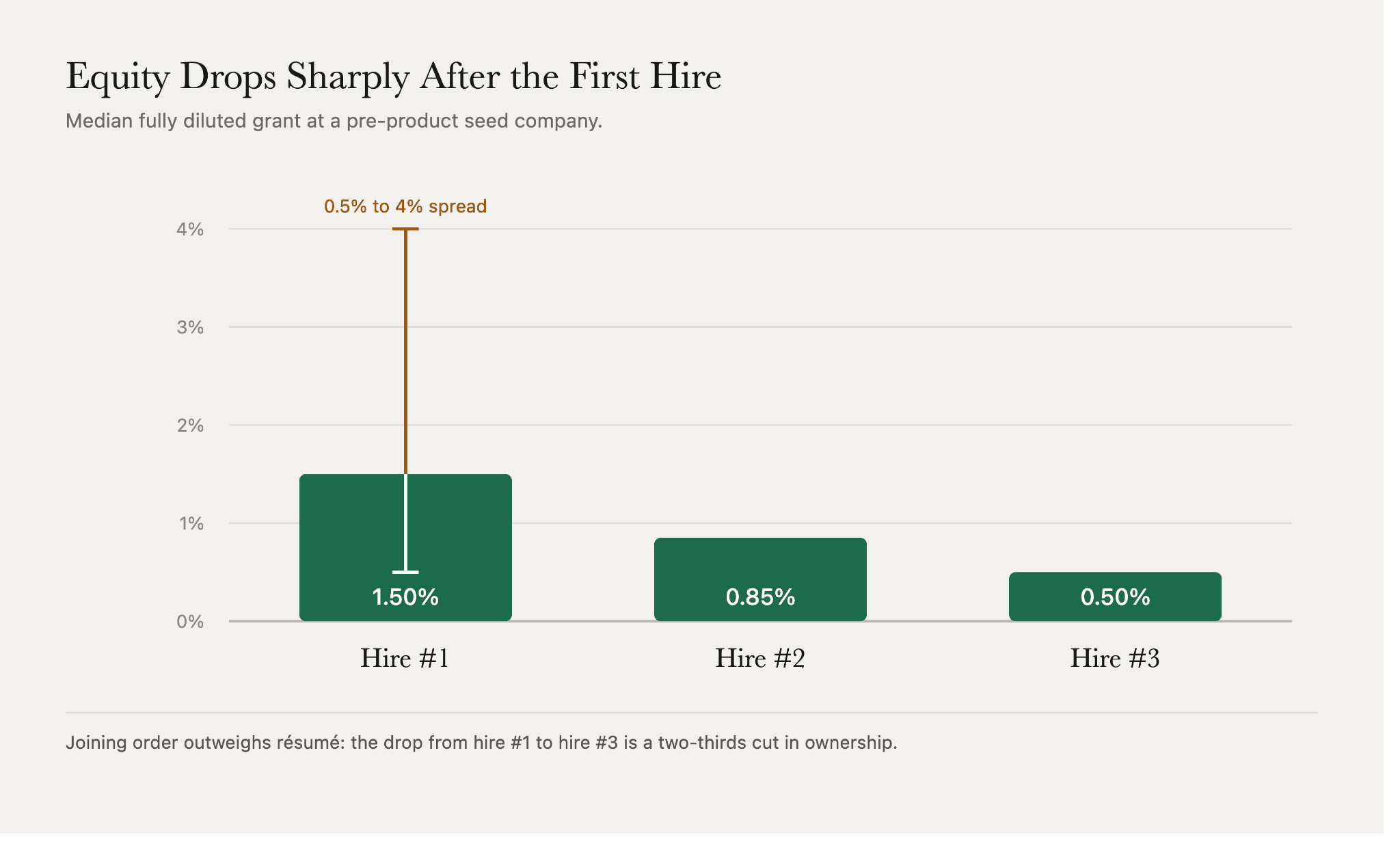
Pre-seed founding engineers typically receive more equity because they take on greater risk and join when the company is still in its earliest stages. As the startup grows and more engineers are hired, equity grants usually become smaller to reflect the reduced risk and increased stability. Later-stage hires may receive less ownership because they are joining a more established company.
Understanding Vesting, Dilution, and Real Upside
Founding engineers typically have a four-year vesting schedule for equity with a one-year cliff. Acceleration terms (single or double trigger) are becoming more common in 2026 to compete with big tech retention packages. The mechanics that determine real upside include option strike price, exercise window, and modeled dilution across future fundraises.
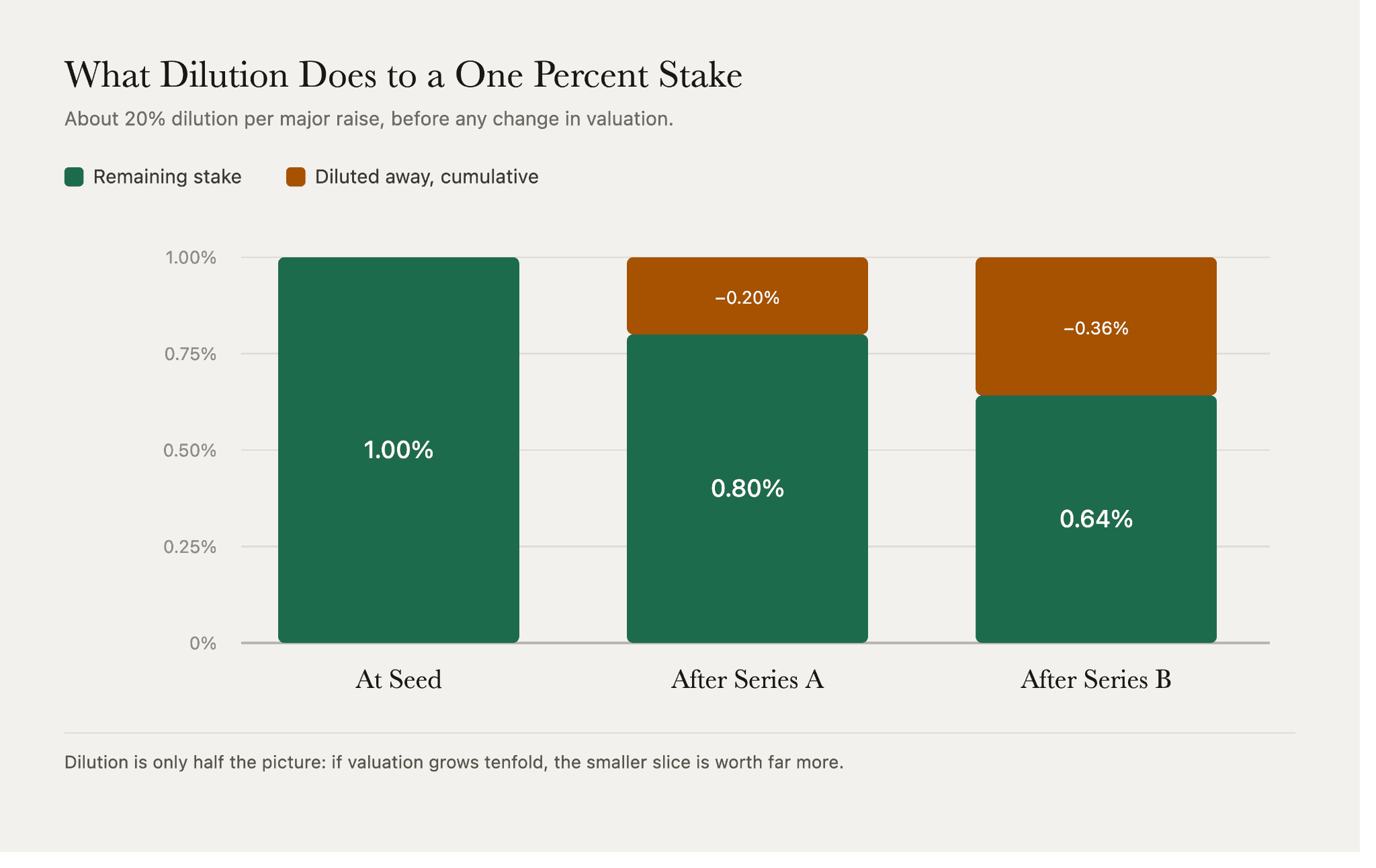
For example, if a founding engineer receives 1% equity at seed, standard dilution across subsequent fundraising rounds, typically around 20% per major raise, would reduce that stake to roughly 0.8% after Series A and around 0.64% after Series B. But if valuation grows tenfold, that remaining slice can still represent substantial value.
Candidates should treat offer reviews as partnership discussions about risk and contribution, and seek legal or experienced-operator advice when evaluating complex equity terms.
Evaluating a Founding Engineer Offer and Environment
The biggest mistakes experienced engineers make when evaluating founding engineer roles are focusing too much on the product idea and not enough on the execution environment, decision rights, and clarity of expectations. Given that roughly 90% of startups fail, the execution environment and team dynamic matter far more than the initial pitch deck.
Critical questions to ask the founder:
What is the current runway and burn rate? How many months until the company needs to raise again?
What are the specific 6 to 12 month milestones, and how do you define success for the first engineer?
What responsibilities do you expect beyond coding? Will I operate autonomously on technical decisions?
How will future technical hires change my scope and title?
Hiring a founding engineer should follow problem validation, meaning the startup should have completed at least basic market validation before bringing on its earliest technical hires. Probe for technical depth on the founding team, presence of advisors, and how decisions are made about architecture and product roadmap when experiments fail.
How AI Is Shaping Founding Engineer Hiring in 2026
Artificial intelligence is changing both founding engineering work and hiring. Startups increasingly expect founding engineers to use AI for coding, testing, and observability while maintaining quality and reliability.
Hiring teams also use AI to screen resumes, rank candidates, and draft outreach, making clear, high-signal portfolios more important. Engineers should structure their experience so it is easy for both AI systems and hiring managers to understand.
The best hiring processes use AI to reduce repetitive screening while keeping final decisions human. Platforms like Fonzi can use AI to match engineers with early-stage startup roles based on skills and fit, while founders focus on deeper technical conversations.
Finding Founding Engineers Through Fonzi
Hiring a founding engineer is different from filling a standard software engineering role. Startups need someone who can work across the stack, make architecture decisions, move quickly, and operate with limited structure. That makes it especially important to evaluate technical depth, adaptability, and experience building products from the ground up.
Fonzi is a curated AI engineering hiring marketplace that connects companies with pre-vetted engineers across AI, ML, software, and infrastructure roles. For startups looking to find engineers who can take on broad ownership, Match Day provides recurring hiring windows where companies can meet batches of vetted technical candidates and move from evaluation to conversations more efficiently.
Summary
A founding software engineer typically takes less cash than an established company would pay, with base salaries running roughly $160,000 to $340,000 depending on stage, in exchange for equity worth only what the company eventually becomes. The engineers who do this well have usually built systems end to end, shipped without specs, and made architecture calls they had to live with. That makes runway, six-to-twelve-month milestones, decision rights, and what happens to your scope once the team grows more important than the product pitch.
FAQ
How many engineers usually qualify as "founding engineers" at a startup?
Can a founding engineer work fully remote, or is in-person strongly preferred?
Is it realistic to transition from a research-focused role into a founding engineer position?
Should I expect a formal title like "Staff Engineer" or "VP Engineering" when I join as a founding engineer?
How long should I plan to stay in a founding engineer role to see meaningful outcomes?


