What to Expect in an AI Coding Agent Interview
By
Samara Garcia
•

AI coding agent interviews now test far more than whether you know how to use an LLM. Companies want engineers who can design, evaluate, and deploy agentic systems that plan multi-step workflows, use external tools, and work reliably with production codebases.
That means the interview process is shifting toward system design, agent evaluation, debugging, and real-world problem solving alongside traditional coding skills. This guide breaks down the questions and skills that matter most, what interviewers are actually evaluating, and how to prepare for AI coding agent roles.
Key Takeaways
AI coding agent interviews test more than coding, focusing on agent architecture, tool use, evaluation, debugging, and production reliability.
Expect live coding with AI agents, system design, and safety questions covering agent orchestration, RAG, model routing, MCP, guardrails, and human review.
Strong candidates show judgment, not just prompt skills, by explaining what they delegate, validating outputs, handling failures, and measuring agent performance.
Interview Format: How Companies Assess AI Coding Agent Skills
AI coding interview stages typically include technical screening and machine learning concepts, followed by rounds that probe agentic system design. Questions skew practical rather than theoretical, centering on whether you can build reliable systems around LLMs. Expect to walk through your own AI-assisted coding workflow, plus behavioral questions about past project challenges and team dynamics.
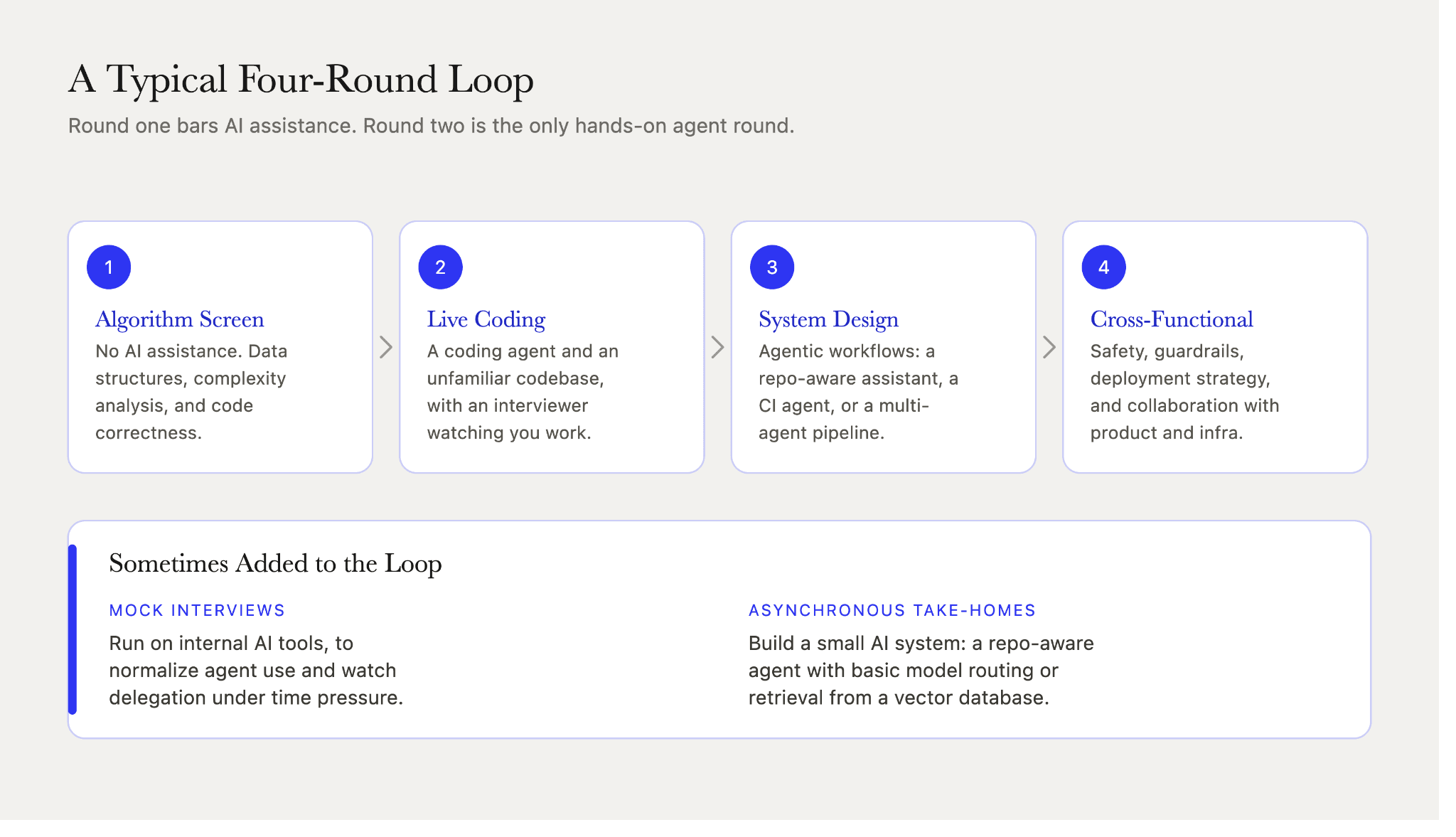
A common loop unfolds in four stages:
Round 1: Algorithm and coding challenge without AI assistance. Traditional data structures, complexity analysis, and code correctness.
Round 2: Live coding with an AI agent. The candidate receives access to a coding agent and an unfamiliar codebase, then works through a task while the interviewer observes delegation, verification, and error handling.
Round 3: System design discussion focused on agentic workflows: building a repo-aware coding assistant, a multi-agent collaboration pipeline, or a CI agent that suggests fixes.
Round 4: Cross-functional or product discussion covering safety, guardrails, deployment strategy, and collaboration with product and infrastructure teams.
Some teams integrate mock interviews powered by internal AI tools to normalize agent usage and observe how candidates delegate, verify, and refactor outputs under time pressure. Asynchronous take-home tasks may involve building a small AI system, for example, a repo-aware coding agent with basic model routing or retrieval from a vector database.
Core Technical Topics: What AI Coding Agent Interviews Actually Test
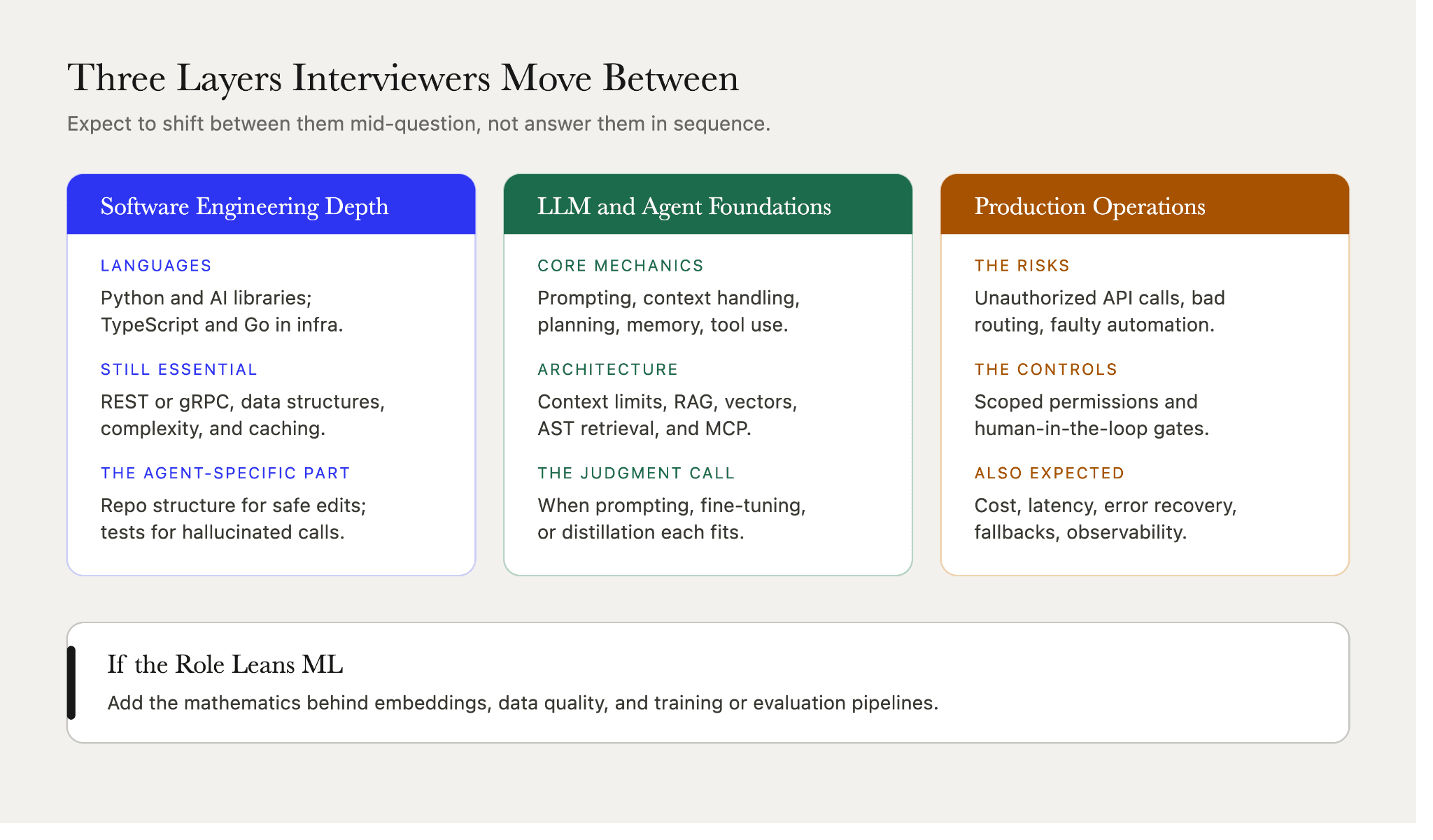
AI/ML job interviews cover software engineering and machine learning concepts in overlapping layers. Companies in 2026 test three areas: traditional software engineering depth, applied LLM and agent foundations (including retrieval-augmented generation (RAG) pipelines and tool integration), and production-grade operations such as observability, safety, and cost control. Candidates are expected to move fluidly between low-level code, high-level architecture, and detailed reasoning about failure modes of an AI agent operating in a real codebase.
Traditional Software Engineering Depth
Interviewers expect fluency in at least one systems language. Familiarity with Python and AI libraries is beneficial for candidates, though TypeScript and Go are also common in agent infrastructure roles. Solid understanding of REST or gRPC APIs, data structures, algorithmic complexity, and caching remains essential. For roles with a stronger ML focus, candidates should also prepare for questions about the mathematics behind embeddings, data quality, and training or evaluation pipelines.
Many questions revolve around how to structure repositories for safe AI edits: clear module boundaries so a specialized agent can reason about small units rather than monolithic files, dependency graphs that limit blast radius, and unit tests designed to catch agent-specific regressions. Designing a test suite that detects hallucinated API calls or unintended side effects is a frequent topic.
LLM, RAG, and Agent Foundations
AI agent interviews test prompt engineering, context management, planning, memory, and tool use. Candidates should understand how agents maintain state, break tasks into steps, call external tools, and adjust based on feedback.
Interviewers may also ask about context limits, RAG, vector databases, AST-based retrieval, MCP, and single-agent vs. multi-agent architectures. Be prepared to explain when prompting, fine-tuning, or distillation makes the most sense.
Production-Grade Agentic System Topics
Autonomous execution introduces risks such as unauthorized API calls, incorrect routing, and faulty automation decisions. Candidates should explain how safety controls, scoped permissions, and human-in-the-loop checkpoints can limit high-risk actions.
Production-ready agents also require cost and latency optimization, error recovery, and fallback logic when tools fail. Interviewers may ask about monitoring, evals, and observability to detect issues such as hallucinated APIs, destructive changes, or performance regressions.
Live Coding With AI Agents: How This Round Actually Works
The typical setup uses a shared IDE, a coding agent, and an unfamiliar codebase. Interviewers assess how you use the agent, make architectural decisions, and evaluate its output, not just your coding ability.
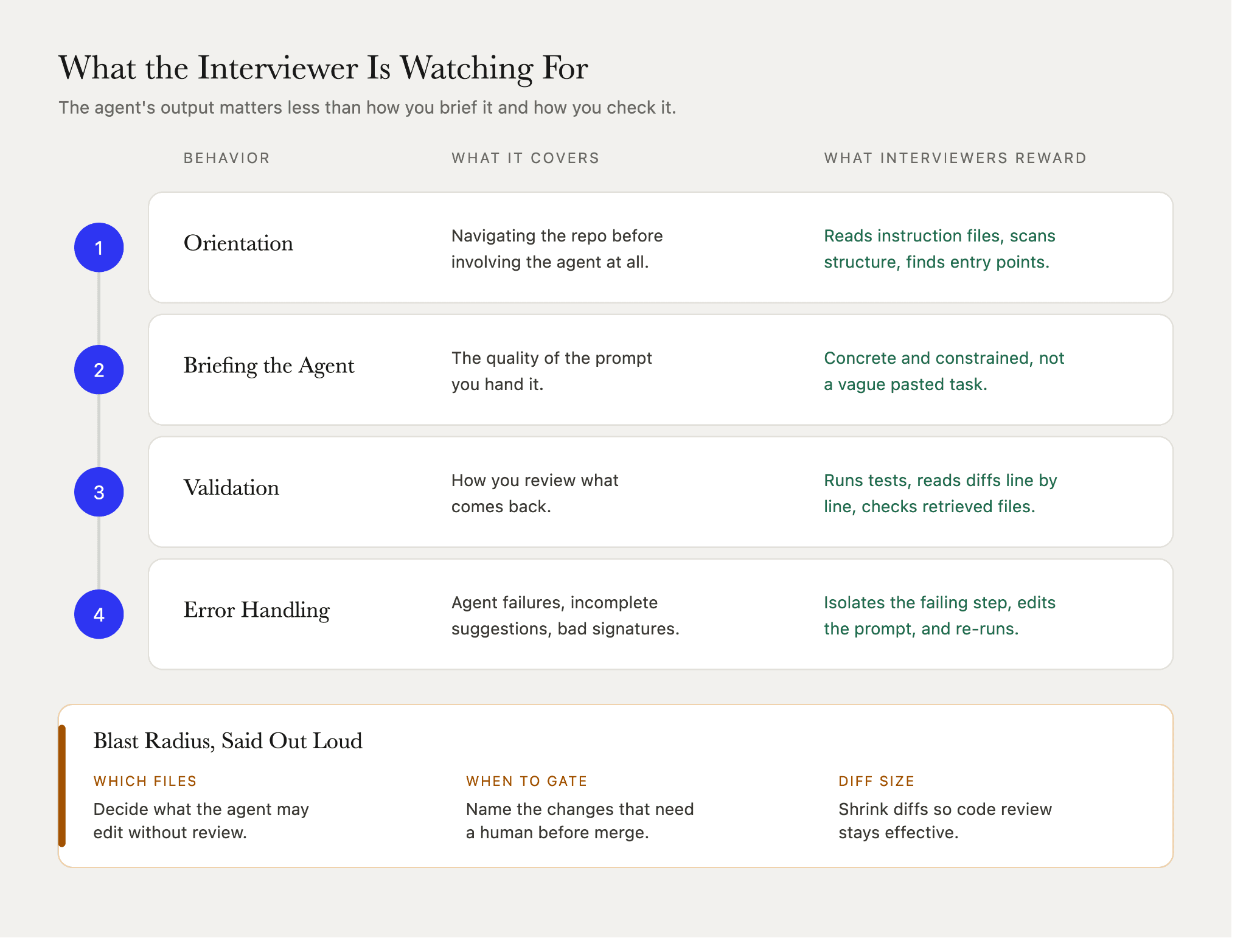
Interviewers observe four behaviors:
Orientation: How the candidate navigates the repo before involving the agent. Reading instruction files, scanning directory structure, identifying entry points.
Briefing the agent: Quality of prompts. A concrete example: "Summarize the responsibility and dependencies of this module, then list its public API surface." Avoid pasting vague tasks with no constraints.
Validation: How the candidate reviews generated code. Strong candidates run unit tests, check diffs line by line, and verify that the agent retrieves relevant information from the correct files.
Error handling: How they handle agent failures, incomplete suggestions, or hallucinated function signatures. Strong candidates implement error recovery by isolating the failing step, adjusting the prompt, and re-running.
Companies value explicit reasoning about blast radius. Candidates should decide which files are safe for agent edits, when to require human review, and how to shrink diffs so code review remains effective. The goal is to keep the environment interface between agent and codebase narrow and predictable.
System Design: Architecting an AI Coding Agent or Multi-Agent Dev Workflow
Common interview questions focus on planning, memory, and tool orchestration. Design prompts include building a repo-aware coding assistant, a CI agent that suggests fixes, or a multi-agent collaboration setup where planner, implementer, and reviewer agents cooperate on a feature. Candidates should also be prepared to discuss deployment processes, rollout stages, and CI/CD integration for autonomous coding agents.
Key design elements:
Component | What Interviewers Expect |
Code ingestion | Indexing a codebase into a vector database using an embedding model; AST-based retrieval for precise symbol lookup |
Model routing | Choosing between fast models for drafts and reasoning models for validation; explaining cost and latency trade-offs |
Agent routing | Routing tasks by type: a specialized agent handles front-end work while another handles database migrations |
State management | Representing agent memory and state across steps of a multi-step workflow |
Tool integration | Using model context protocol for tool and resource integration; candidates gain points by calling out benefits of standardized tool specs for long-term maintainability |
Candidates should be fluent in the metrics that apply to patch correctness, and able to explain why retrieval metrics like precision and recall answer a different question. Evaluation metrics for AI agents can include task success rate, safety compliance, regression rates, latency, cost per task, and human review scores. Candidates should discuss security (scoped tokens, RBAC for dangerous tools), observability (traces and spans across agent steps), and roll-out strategies such as starting in read-only or suggestion-only mode before enabling autonomous changes.
Evaluation, Observability, and Reliability in Agentic Coding Systems
Observability basics every candidate should discuss:
Logging every model call and tool invocation with trace IDs
Capturing diffs between pre-agent and post-agent code for later analysis
Correlating runs across the agent loop to reconstruct decision chains
Measuring token usage per task to track cost trends
Evaluation strategies include offline eval suites of representative refactors, regression tests that compare ASTs or behavior before and after agent changes, and periodic manual review samples that feed back into prompt design or model choice. Chain-of-thought logging helps diagnose why the agent chose a particular approach.
Reliability features to discuss: iteration limits that prevent infinite loops in the agent loop, structured fallbacks when external services fail, and canary deployments for new agent versions within a CI pipeline. Candidates differentiate themselves by discussing long-term maintenance: keeping prompts versioned alongside the codebase, updating evals as the codebase evolves, and establishing automated monitoring to detect system drift.
Example Question Types and How to Structure Your Answers
Conceptual question: "Explain how agentic AI differs from a standard autocomplete model."
A strong answer restates the distinction: a repo-aware coding agent maintains context, plans across files, and calls external tools, while autocomplete operates on local context without planning or memory. Discuss trade-offs in performance, cost, complexity, and safety.
Design prompt: "Design a system where multi-agent collaboration handles feature implementation and code review."
Constrain scope (which services, which repo structure), sketch architecture (planner agent, implementer agent, reviewer agent), specify tool calls needed and how agent routing is implemented between them, address security and human approval, and describe how to measure success using evaluation metrics.
Troubleshooting scenario: "Your agent introduces flaky tests. How do you diagnose and fix the pipeline?"
Restate the problem, collect data (test logs, reproducible minimal case), suspect causes (agent randomness, environment drift, dependency on external services), propose interventions (seeded randomness, mocked services, isolated test environments), and define follow-up monitoring.

Landing the AI Coding Agent Interview in the First Place
Agentic AI teams are usually small, and they post fewer roles than conventional software teams. A good share of their hiring moves through referral before anything reaches a job board. The work also resists résumé formatting. "Scoped agent permissions and built the eval suite" is accurate and tells a keyword filter almost nothing.
Curated marketplaces are one workaround. Fonzi is a curated AI engineering hiring marketplace that pre-vets AI and software engineers and matches them with companies hiring for agentic systems, AI infrastructure, and applied LLM work. Its recurring Match Day hiring event brings vetted engineers and hiring companies together inside scheduled windows, which means one process instead of a separate application for every company on your list.
That affects how many AI agent interviews you get, not what happens inside them. The AI coding agent interview questions are the same either way, and your AI agent interview prep still has to hold up once someone hands you an unfamiliar codebase and starts watching how you use the agent.
Summary
An AI coding agent interview tests whether you can design, evaluate, and operate agentic systems inside a real codebase. Fluency with prompting is assumed. The loop usually runs four rounds: an algorithm screen with no AI assistance, a live coding session on an unfamiliar repo with an agent, a system design discussion on agentic architecture, and a final round covering safety, guardrails, and deployment.
Most AI coding agent interview questions come back to judgment. What you delegate, how you verify what comes back, which files you let the agent touch without review, what you do when it invents a function signature. The AI coding agent concepts worth knowing going in cover retrieval and vector databases, model and agent routing, memory across multi-step workflows, MCP for tool integration, and the eval metrics that tell you whether a patch actually holds. The most useful AI agent interview prep is building one of these yourself.
FAQ
How much traditional algorithm practice is still necessary for an AI coding agent role?
Do companies expect hands-on experience with specific tools like Claude Code or Cursor?
How deeply do I need to understand protocols like Model Context Protocol (MCP)?
Is fine-tuning mandatory knowledge for AI coding agent interviews?
How can I signal that I take safety and human oversight seriously without sounding risk-averse?


