DevOps vs Platform Engineering: Is It Really Just a Rebrand?
By
Samara Garcia
•

Platform engineering and DevOps overlap heavily, but they solve different problems. DevOps focuses on how development and operations work together to deliver software, while platform engineering builds the internal systems and tools that make that process easier to repeat at scale.
The distinction matters when you're deciding how to structure engineering teams, invest in infrastructure, or improve developer experience. This guide breaks down platform engineering vs DevOps, where the approaches overlap, how they differ, and when each makes sense for your organization.
Key Takeaways
DevOps and platform engineering solve different problems: DevOps establishes collaboration, automation, and shared ownership, while platform engineering turns those practices into reusable self-service tools and workflows.
Platform engineering becomes valuable at scale: When teams face fragmented tooling, infrastructure bottlenecks, environment drift, or rising developer cognitive load, a dedicated platform can standardize workflows and reduce friction.
Build incrementally around outcomes: Strengthen DevOps practices first, then pilot one or two high-value platform workflows, measure developer experience and delivery improvements, and expand based on what works.
What Is DevOps? From the 2009 Movement to Platform Engineering
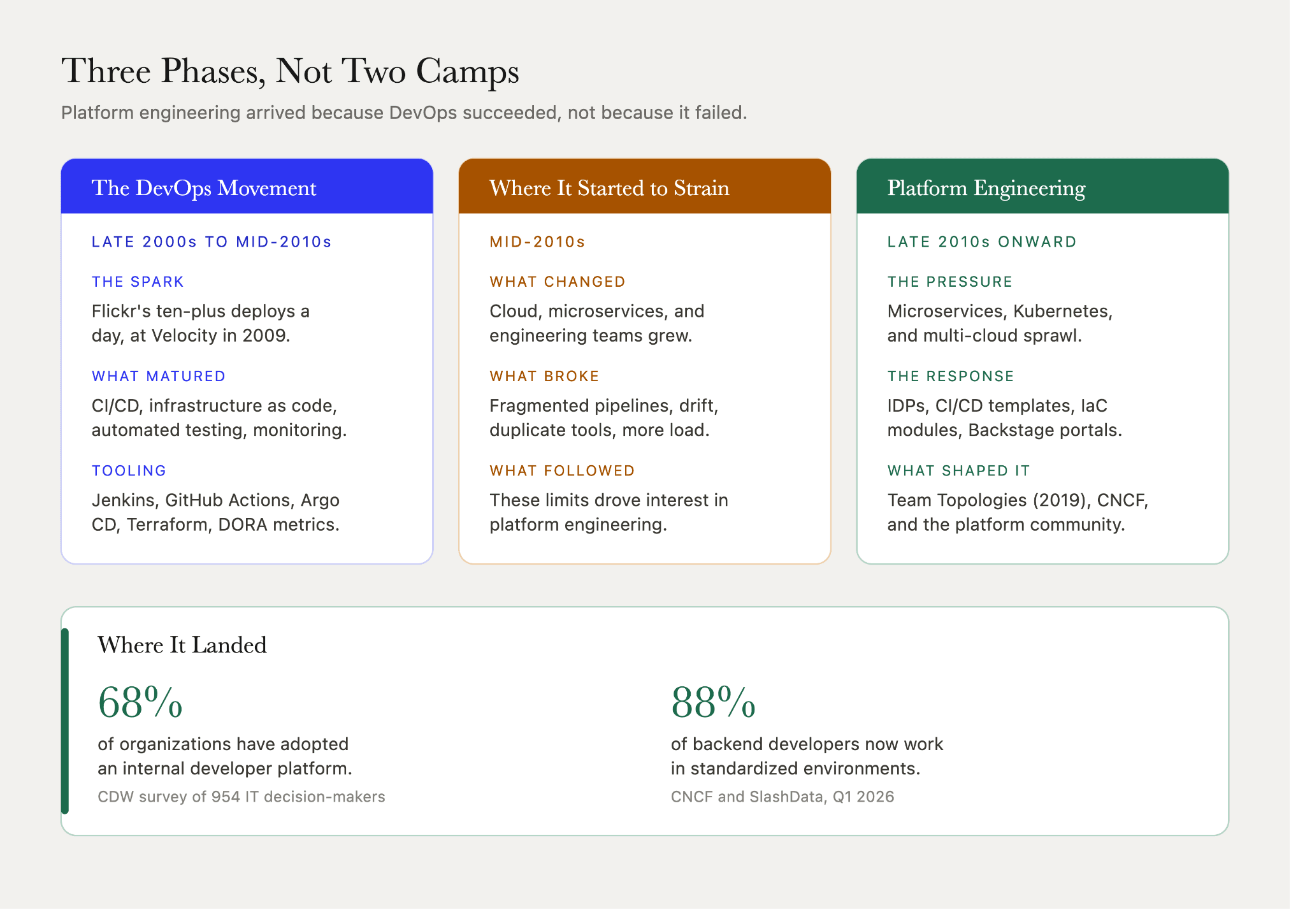
DevOps emerged in the late 2000s to break down silos between development and operations. It gained traction around 2009 when Flickr engineers presented "10+ Deploys per Day" at the O’Reilly Velocity Conference, showing how close collaboration could accelerate software delivery. DevOps became a broader culture of shared ownership, continuous delivery, and organizational change.
Over the following decade, DevOps practices matured around CI/CD, infrastructure as code, automated testing, and monitoring. Tools such as Jenkins, GitHub Actions, GitLab CI, Argo CD, and Terraform/OpenTofu helped automate build, test, deployment, and infrastructure workflows. DORA metrics also became widely used to measure software delivery performance.
By the mid-2010s, "DevOps engineer" had become a common job title, blurring the distinction between DevOps as a culture and a role. As cloud environments, microservices, and engineering teams grew, organizations faced new challenges, including fragmented pipelines, duplicated tooling, inconsistent environments, and rising developer cognitive load. These limitations helped drive interest in platform engineering.
What Is Platform Engineering and Why Did It Emerge?
Platform engineering focuses on building internal platforms that give developers reusable, self-service workflows and standardized "golden paths." By the late 2010s and early 2020s, the rise of microservices, Kubernetes, and multi-cloud environments made bespoke infrastructure harder to manage, pushing teams toward shared, reusable capabilities.
Platform teams treat developers as customers, abstracting infrastructure complexity through internal developer platforms (IDPs), CI/CD templates, and infrastructure-as-code modules. Tools such as Backstage support self-service portals for provisioning, deployments, documentation, and observability.
Real-world influences include the CNCF ecosystem, the Platform Engineering community, and the Team Topologies book (2019) that popularized the concept of enabling teams providing internal services to delivery teams. A CDW survey of 954 IT decision-makers found that 68% of organizations have adopted an internal developer platform. Platform engineering complements DevOps rather than replacing it, and usually arrives after an initial DevOps phase, once scale and infrastructure complexity start creating friction for developers.
Side-by-Side: DevOps vs Platform Engineering Compared
Evaluating platform engineering vs DevOps requires a direct, concrete comparison across key operational dimensions. The table below breaks down the key differences across dimensions that matter most for planning and hiring.
Dimension | DevOps | Platform Engineering |
Primary focus | Cultural and process change: collaboration, automation, shared responsibility across dev and ops teams | Building and operating internal platforms with self-service tools and paved paths for developers |
Scope | Team or cross-team workflows: CI/CD, monitoring, IaC, often service-by-service | Organization-wide shared infrastructure tools and standardization across all software teams |
Typical roles | DevOps engineers, developers with operations awareness, site reliability engineers (SREs) | Platform engineers, platform product managers, DevEx specialists |
Success metrics | DORA metrics: deployment frequency, lead time, change failure rate, MTTR | IDP adoption rate, developer satisfaction, onboarding time, golden path adherence |
Infrastructure management | Teams often manage their own pipelines and environments | Centralized ownership of clusters, shared IaC modules, secure and scalable infrastructure |
Impact on developer experience | Reduces bottlenecks when automation and shared ownership exist | Reduces cognitive load through standardization, defaults, and self-service capabilities |
Maturity trigger | Early to medium organizations improving delivery speed | Mid-to-large organizations with many services, complex compliance, or multi-cloud needs |
Roles, Skills, and Career Paths: DevOps Engineer vs Platform Engineer
DevOps and platform engineering overlap, but their focus differs. DevOps engineers typically own CI/CD, testing, observability, and release reliability, while platform engineers build internal developer platforms, reusable infrastructure, and self-service workflows.
DevOps emphasizes delivery and operations; platform engineering emphasizes infrastructure abstraction and developer experience. Larger organizations often have dedicated platform teams, while startups may combine both roles into one position. For early-stage startups, a versatile engineer who can cover both areas may be the most practical choice.
When Your Organization Needs Platform Engineering (Beyond DevOps)
Is platform engineering just a rebrand? The label is sometimes misused, but the underlying need is real when DevOps alone struggles at scale.
Concrete signals that a team is outgrowing pure DevOps practices include:
Dozens of microservices with heavily customized pipelines per team
Slow onboarding for new developers or new services
Frequent environment drift across development environments
Constant infrastructure tickets flowing to a few overloaded experts
Duplicated CI/CD configurations and inconsistent security and compliance policies
Platform engineering becomes valuable as infrastructure and service complexity grows. Small teams with a few services can often rely on strong DevOps practices, while organizations with dozens of services, multiple clouds, or strict compliance needs may benefit from a dedicated platform team.
A platform initiative usually starts by auditing existing tools, defining a few golden paths, and testing an internal developer platform with select teams. Security, compliance, development environments, and deployment workflows can then be standardized. You do not need to replace DevOps with platform engineering. By turning infrastructure into reusable, secure, and self-service capabilities, platform engineering enables growing organizations to expand their DevOps practices beyond ad hoc approaches.

Impact on Developer Productivity, Experience, and Feedback Loops
Both DevOps and platform engineering directly support developer productivity and experience. DevOps improves delivery through fast CI feedback, smaller releases, quick rollbacks, and better incident collaboration, while shared observability and ephemeral environments reduce development friction.
Internal developer platforms reduce cognitive load by standardizing infrastructure, documentation, and deployment workflows. According to the CNCF and SlashData State of Cloud Native Development Q1 2026 report, 88% of backend developers now work in standardized DevOps and platform environments.
Key outcomes include faster onboarding, more frequent deployments, fewer failed changes, and less manual infrastructure work. DevOps and platform engineering work best together: DevOps provides the practices, while platform engineering makes them easier to scale.
Practical Next Steps for Teams Evaluating DevOps and Platform Engineering
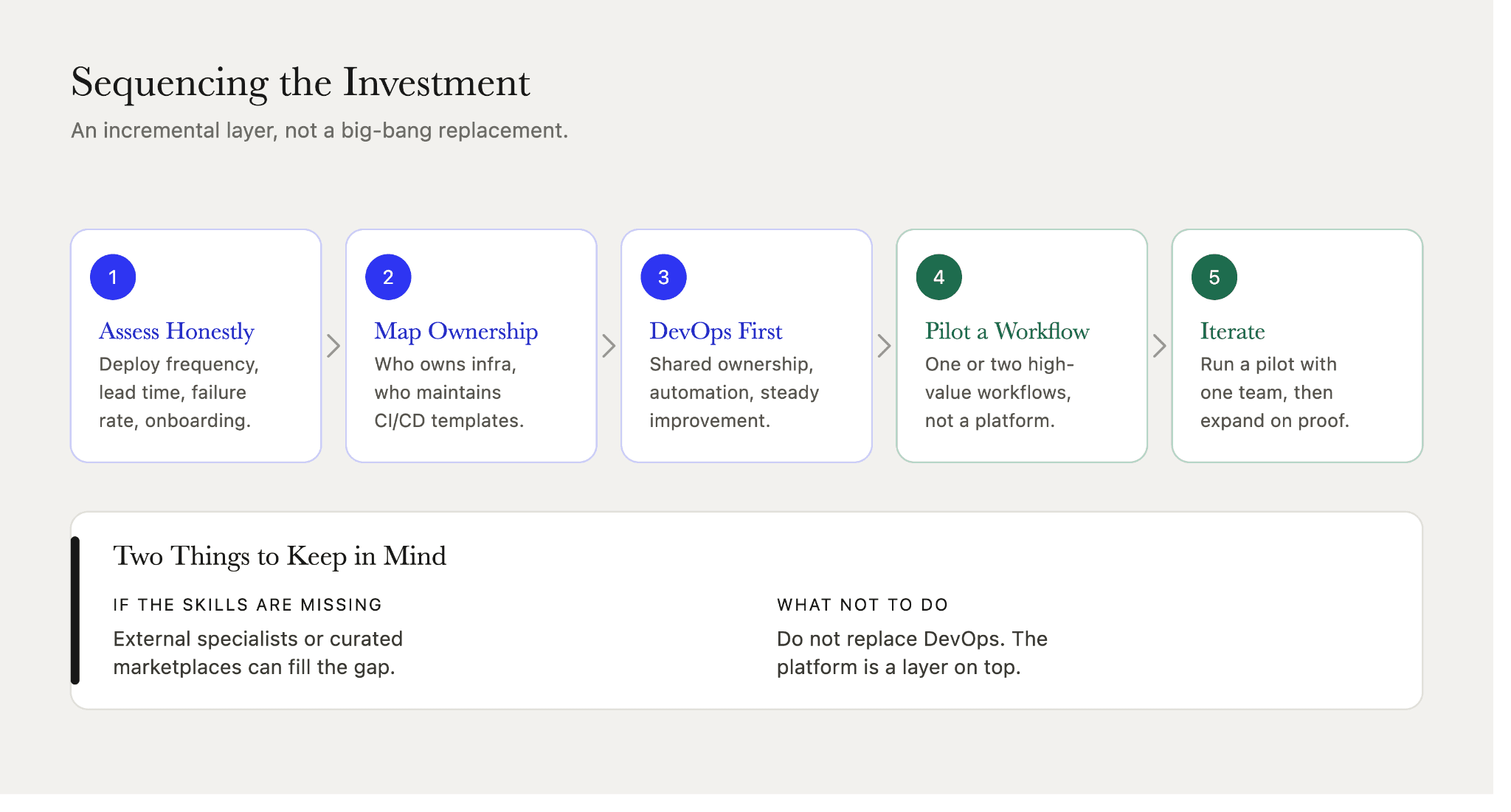
Start with an honest assessment. Collect metrics like deployment frequency, lead time for changes, change failure rate, and onboarding time for new developers. These numbers reveal whether your current software development process is healthy or strained.
Map responsibilities. Identify who owns infrastructure today, who maintains CI/CD templates, and where developer friction is highest. This reveals gaps that a platform team or stronger DevOps practices could address.
Sequence your investment. Strengthen DevOps culture first: shared responsibility, automation mindset, continuous improvement. Then introduce a small platform engineering initiative that builds one or two high-value workflows rather than an entire platform at once. The platform engineering approach works best as an incremental layer, not a big-bang replacement.
Bring in expertise if needed. Organizations without in-house skills can work with external specialists or curated marketplaces like Fonzi to bring in senior platform engineers or DevOps engineers on a project basis.
Iterate. Run a pilot with one product team, gather feedback, and expand the platform only when it clearly improves developer experience and delivery reliability.
Building the Right Engineering Team for DevOps and Platform Work
As organizations move from a few services to complex infrastructure, hiring engineers who understand both delivery workflows and internal platforms becomes increasingly important. The challenge is finding people with the right mix of DevOps experience, infrastructure knowledge, automation skills, and developer experience expertise rather than relying on job titles alone.
A curated AI engineering hiring marketplace like Fonzi can help companies find pre-vetted AI and software engineers, including talent with DevOps and platform engineering experience. For teams building or expanding a platform function, Fonzi's recurring Match Day hiring event provides a structured opportunity to meet batches of pre-vetted engineers during scheduled hiring windows. This can complement an existing recruiting process when companies need specialized engineering talent without treating platform engineering as a replacement for their broader DevOps organization.
Summary
While DevOps establishes the foundation for collaboration, automation, and shared ownership, platform engineering scales these practices through self-service internal developer platforms and standardized golden paths. Platform engineering builds the internal systems that make those practices repeatable, packaging them into self-service tools, reusable infrastructure, and golden paths that developers can follow without filing a ticket. The two are sequential rather than competing. Most organizations need strong DevOps practices before a platform is worth building.
The trigger for platform engineering is complexity, not headcount. Dozens of services with bespoke pipelines, environment drift, slow onboarding, and infrastructure tickets piling up on a few overloaded engineers are the signals that DevOps alone has stopped scaling. Start by measuring deployment frequency, lead time, change failure rate, and onboarding time, then build one or two golden paths rather than a full platform, and expand only where developer experience measurably improves.
FAQ
Is platform engineering just DevOps renamed?
Do small startups need a platform engineering team?
Can one team handle both DevOps and platform engineering?
How does platform engineering affect security and compliance?
What metrics show that a platform engineering investment is working?


