AI Infrastructure Engineer: Role, Skills, and Career Path
By
Samara Garcia
•

An AI infrastructure engineer builds and operates the compute, storage, and networking systems that large-scale training and inference workloads run on. The job is keeping those workloads reliable, cost-efficient, and secure across multi-cloud and on-premises environments, a role now concentrated in hubs such as San Francisco, Seattle, London, and Berlin. The work blends cloud infrastructure, machine learning systems, and platform engineering into a single discipline, which is why generalist infrastructure software engineering experience alone no longer covers senior infrastructure engineer jobs.
Key Takeaways
AI infrastructure engineering sits at the intersection of infrastructure engineering, machine learning, and platform reliability, and is becoming a core function in modern AI organizations.
Roles span from mid-level AI infrastructure engineers to principal AI infrastructure engineers who own large-scale cloud infrastructure, data platforms, and the reliability and security posture of AI workloads.
Candidates are evaluated less on buzzwords and more on concrete experience with MLOps, GPU scheduling, observability, and secure multi-tenant cloud infrastructure.
Hiring processes are shifting toward structured, signal-rich evaluations that include practical systems design, debugging, and collaboration exercises instead of only LeetCode style questions.
Curated, match based marketplaces such as Fonzi can reduce noise for both candidates and hiring teams by aligning skills, compensation, and role expectations before interviews begin.
What Does an AI Infrastructure Engineer Do?
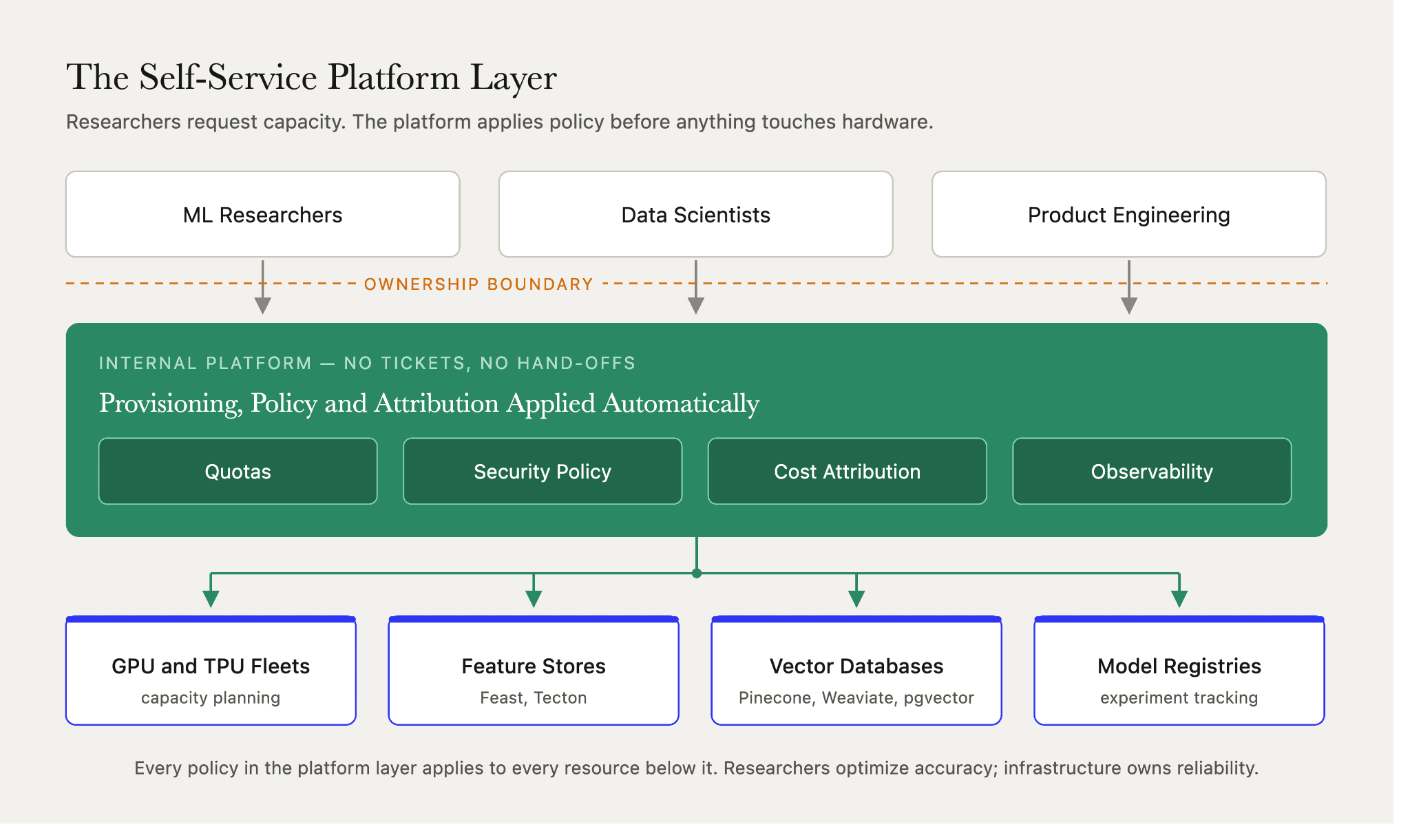
AI infrastructure engineering is a specialization of infrastructure engineering focused on training pipelines, inference services, and data-intensive infrastructure systems. An infrastructure engineer acts as the architect of foundational technology layers, and in AI contexts, these layers extend well beyond traditional compute, storage, and networking. Infrastructure engineers design, develop, and maintain infrastructure systems that now include GPU clusters, feature stores, vector databases, and model registries.
Much of the work is building internal platforms that let ML teams provision what they need without filing tickets: a researcher requests a training job or a serving endpoint and gets it, with quotas, security policy, and cost attribution already applied. Standardizing that layer is what separates AI infrastructure engineers from ML engineers or research scientists. Where researchers optimize model accuracy, AI infrastructure engineers own reliability, scalability, and developer experience for the teams building models.
Common ownership areas include cloud infrastructure design, capacity planning for GPU and TPU fleets, observability for model performance, and deployment pipelines for LLM and machine learning services. Typical environments range from Kubernetes based clusters and managed services on AWS, GCP, and Azure, to hybrid setups connecting on-premises data centers with public cloud technologies.
AI Infrastructure Engineer Levels and Salaries
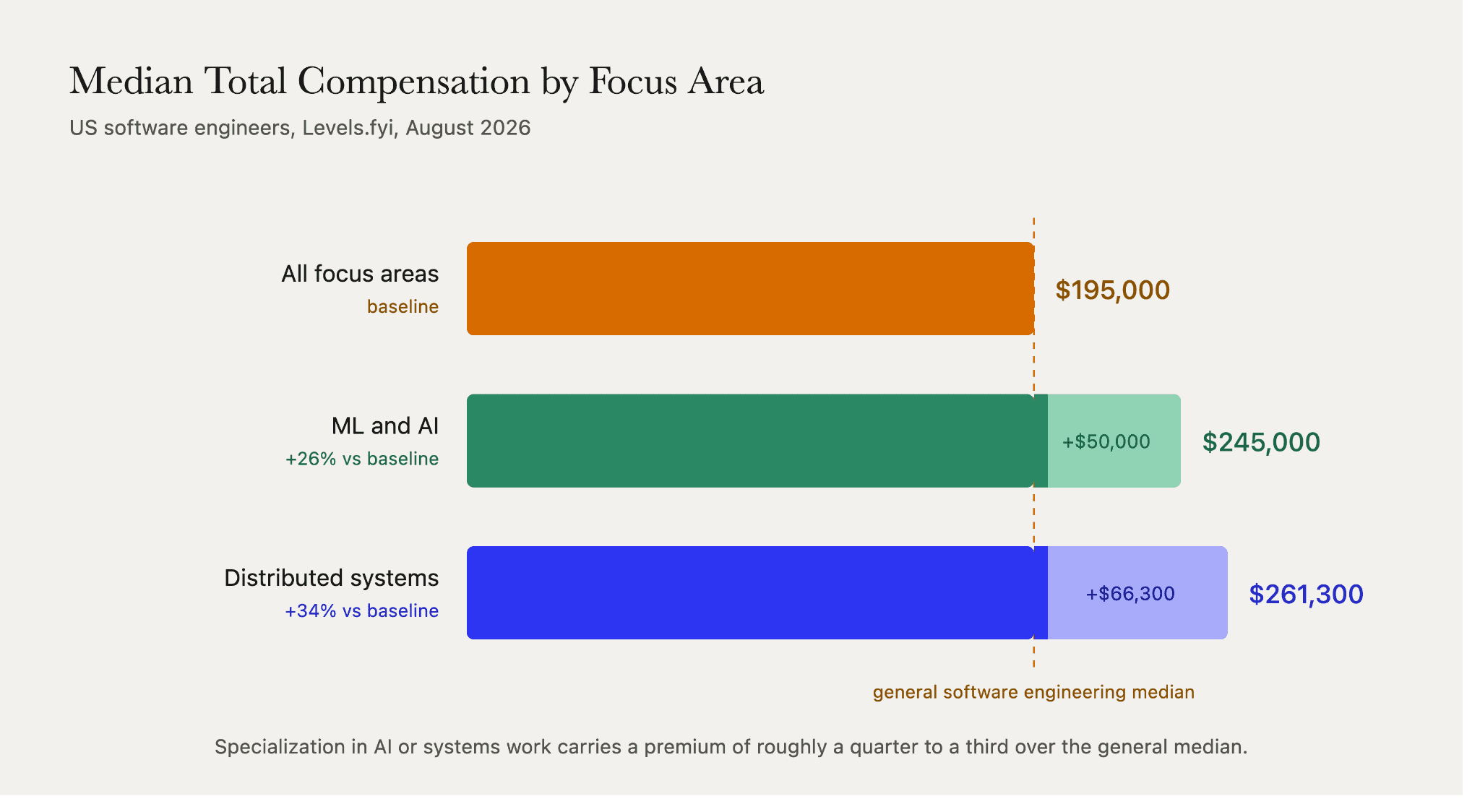
AI infrastructure engineer jobs mirror traditional infrastructure engineer hierarchies, but with stronger emphasis on ML tooling, data platforms, and AI workloads. Levels.fyi puts median total compensation for US software engineers in its ML/AI focus area at $245,000 and its distributed systems focus at $261,300, against $195,000 across all focus areas as of August 2026. Specialization in AI or systems work therefore carries a premium of roughly a quarter to a third over the general software engineering median. San Francisco leads on absolute compensation, with Seattle, London, and Berlin close behind, each with its own cost-of-living dynamics.
Role Level | Typical Experience | Primary Responsibilities | Key Technical Focus |
Mid-Level AI Infra Engineer | 3 to 5 years | Implement infrastructure as code, support ML pipelines, manage cloud resources, maintain CI/CD | Terraform, Kubernetes basics, cloud services, GPU scheduling fundamentals |
Senior AI Infra Engineer | 6 to 9 years | Own critical platform services, lead cross-team observability and reliability initiatives, mentor engineers | Distributed training, inference stacks, cost governance, solutions architecture |
Lead or Principal AI Infra Engineer | 10+ years | Set long term platform roadmaps, own multi-region architecture, manage vendor and budget decisions, ensure compliance | Technology strategy, multi-cloud or hybrid architecture, risk management, capacity planning and vendor architecture |
Use these distinctions to identify gaps in your experience and to frame conversations with recruiters around the level you are targeting.
What Skills Do AI Infrastructure Engineers Need?
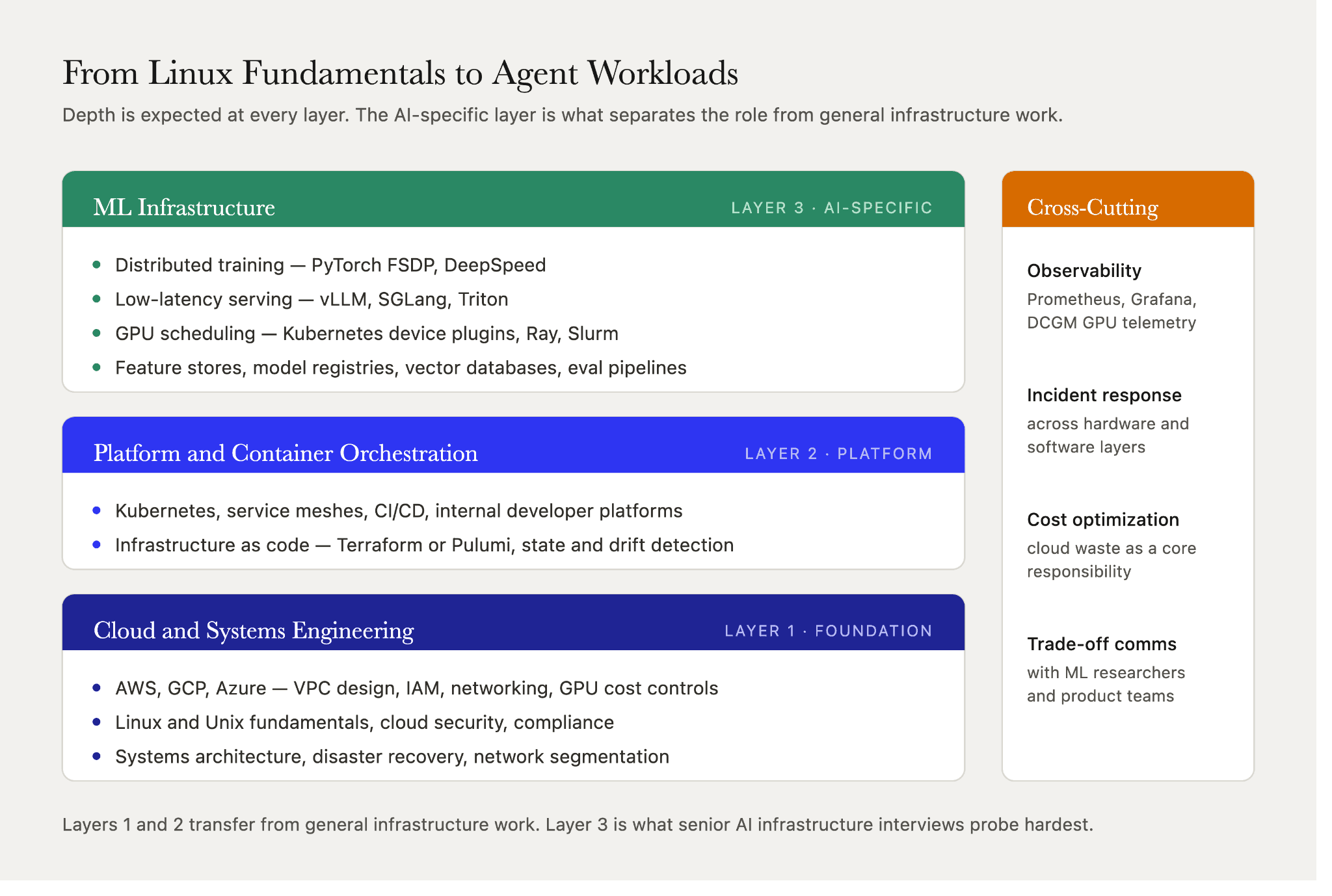
Hiring managers expect depth in infrastructure engineering fundamentals plus hands on experience with AI tooling and data-intensive workloads. Hiring managers expect depth in infrastructure engineering fundamentals plus hands-on experience with AI tooling and data-intensive workloads.
Cloud and Systems Engineering
Cloud infrastructure expertise across AWS, GCP, and Azure, including VPC design, IAM, networking, and cost controls for GPU-heavy clusters.
Deep knowledge of Linux and Unix, which remain foundational for managing cloud environments, cloud security, and compliance.
Systems architecture, disaster recovery planning, and network security design, including firewall and segmentation policy for multi-tenant clusters.
Platform and Container Orchestration
Kubernetes, service meshes, CI/CD pipelines, and internal developer platforms for ML workflows
Infrastructure as code with Terraform or Pulumi, including module design, state management, and drift detection across environments
ML Infrastructure
Feature stores (Feast, Tecton), distributed training frameworks (PyTorch FSDP, DeepSpeed), and model registries for experiment tracking.
Low-latency serving stacks including vLLM, SGLang, and Triton. GPU scheduling and orchestration with Kubernetes device plugins, Ray, or Slurm. NVIDIA runs Slinky, the Slurm on Kubernetes toolkit built by SchedMD (now part of NVIDIA), across production clusters exceeding 8,000 GPUs, with topology-aware scheduling for distributed training
Infrastructure required to run agent workloads and evaluation pipelines in production, including vector databases (Pinecone, Weaviate, pgvector).
Cross-Cutting Skills
Observability for AI workloads spans application logging, incident response alerting, and accelerator-level telemetry.
Observability tools like Prometheus and Grafana are important, along with GPU specific telemetry via DCGM for metrics like SM occupancy, VRAM usage, and power draw.
Infrastructure engineering roles require strong troubleshooting and incident-response capabilities across hardware and software layers.
Operational budgets are pushing companies to optimize performance and reduce cloud waste, making cost optimization a core responsibility rather than a nice to have.
How AI Infrastructure Hiring Processes Are Changing
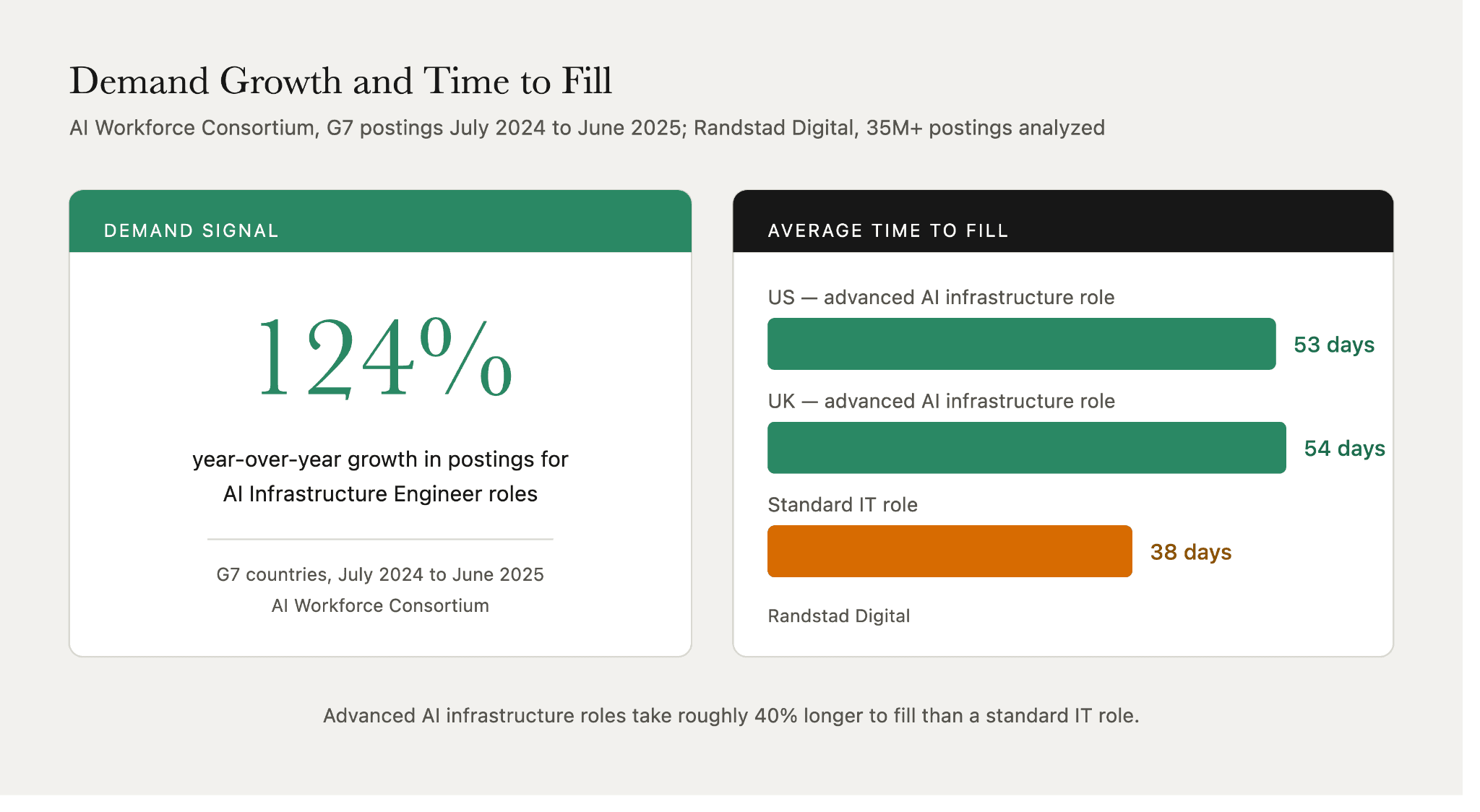
Companies are refining evaluation methods for AI infrastructure engineers to reduce noise and align interviews with real day to day work. The AI Workforce Consortium study, "ICT in Motion: The Next Wave of AI Integration," found 124% year-over-year growth in AI Infrastructure Engineer postings across G7 countries between July 2024 and June 2025. Randstad Digital's analysis of more than 35 million job postings puts average time to fill for advanced AI infrastructure roles at 53 days in the US and 54 days in the UK, against 38 days for a standard IT role.
Interviews now emphasize systems design for AI workloads (for example, designing a multi-tenant inference platform for LLMs) over generic microservice architecture questions. Common evaluation components include take home exercises with real performance metrics, on site debugging sessions on an existing ML pipeline, and live infrastructure as code reviews covering security, module boundaries, and cost tagging. Teams also partner with candidates on collaboration exercises that test how they communicate trade offs to ML researchers and product teams.
AI tools are used in recruiting for automated resume screening and project portfolio analysis, but final decisions remain human driven. Structured marketplaces and curated hiring models, such as Fonzi, pre-screen candidates on skills, compensation, and location before formal interviews. Referred candidates were roughly twice as likely to reach an interview in a Federal Reserve Bank of New York study of applicants at a large corporation, so trusted networks remain valuable alongside platform-based approaches
How Do You Prepare for an AI Infrastructure Interview?
Preparation should mirror the real responsibilities of AI infrastructure engineers, not just generic algorithm practice. Assemble a concrete portfolio of past work: public GitHub repositories, design documents, and incident postmortems related to cloud infrastructure and ML systems. These artifacts carry more signal than a polished resume alone.
Targeted review topics include distributed systems fundamentals, container networking, GPU scheduling, model deployment patterns, and security for data pipelines. Practice systems design focused on training pipelines, online prediction services, and observability for ML models, with clear trade-off discussions around performance, cost, and operational complexity.
Rehearse behavioral examples that demonstrate collaboration with data scientists, ML researchers, and product teams. Emphasize concrete impact: what resources you saved, what risk you reduced, how you aligned infrastructure initiatives with business goals.
A senior infrastructure engineer, for example, should be ready to discuss how they led a specific cross team initiative and what the outcome was, not just list the tools they have used. A lead infrastructure engineer should articulate how they influenced long term platform development and managed trade offs between cost, capabilities, and reliability.
Where Are AI Infrastructure Engineer Jobs Concentrated?
Demand for AI infrastructure engineers continues to accelerate. These roles appear across startups, large tech companies, and research organizations, with scope varying by company size.
At small AI startups, engineers wear many hats and may own everything from training cluster operations to office network configuration. At large enterprises, the position is more narrowly scoped but involves deeper specialization in areas like multi-tenant platform governance or compliance frameworks. When reading job descriptions, distinguish between roles that are mostly traditional infrastructure support and those with genuine AI platform ownership. Look for mentions of specific ML tooling, serving stacks, or GPU scheduling rather than vague references to "AI."
Curated platforms such as Fonzi, focused on matching software and infrastructure engineers with AI startups, help senior candidates avoid low signal inbound and misaligned roles. Prioritize teams with clear problem statements, documented infrastructure roadmaps, and evidence of investment in platform engineering. Relevant certifications in cloud technologies can help differentiate you, but demonstrated project work and open source contributions carry more weight at senior levels.
How Do You Build a Career in AI Infrastructure Engineering?
AI infrastructure engineering is now a central discipline for organizations deploying large-scale machine learning and LLM systems. The strongest candidates pair infrastructure engineering fundamentals with production experience in ML platforms and observability, plus a track record of working directly with ML researchers. Candidates targeting senior infrastructure engineer jobs should be able to point to design documents, incident postmortems, and production ML platform work rather than a tool list. Structured hiring channels that screen on skills and compensation before interviews cut the volume of misaligned outreach senior infrastructure engineers deal with.
FAQ
How different is an AI infrastructure engineer role from a traditional cloud infrastructure engineer role?
What is the best way for a systems or SRE engineer to transition into AI infrastructure work?
Which industries hire AI infrastructure engineers?
Do AI infrastructure engineers need formal machine learning expertise?
What signals indicate that an AI company has a healthy infrastructure and platform culture?


