How to Ask for More Money When Offered a Job
By
Samara Garcia
•

When you are offered a job, the standard counter is 10 to 20 percent above the initial base salary, and more when the offer sits below market. Getting an offer is not the end of the negotiation, and for senior engineers and AI specialists the first number is usually a starting point rather than a final one. A strong counteroffer rests on market data, total compensation, equity risk, and the specific value you bring, not a percentage pulled from a negotiation script. Negotiating a higher starting salary comes down to three numbers you calculate before you reply.
Key Takeaways
Set three numbers before negotiating: a walk-away minimum drawn from your own obligations, plus a realistic target and stretch counter drawn from current market data.
Compare the full compensation package by accounting for location, bonuses, benefits, job-related expenses, and the real value and risk of startup equity.
Justify your counteroffer with evidence, including market benchmarks, competing offers, and specific examples of the business impact and value you bring to the role.
How Much More Should You Ask For? Start With Three Numbers
Never negotiate salary with a single figure. Before responding to any job offer, define three numbers: a walk-away minimum, a realistic target, and a stretch ask. Negotiate compensation after receiving an official written job offer, not during the interview process. CareerBuilder research found that 73 percent of US employers would negotiate salary on an initial offer, while 55 percent of workers never ask.
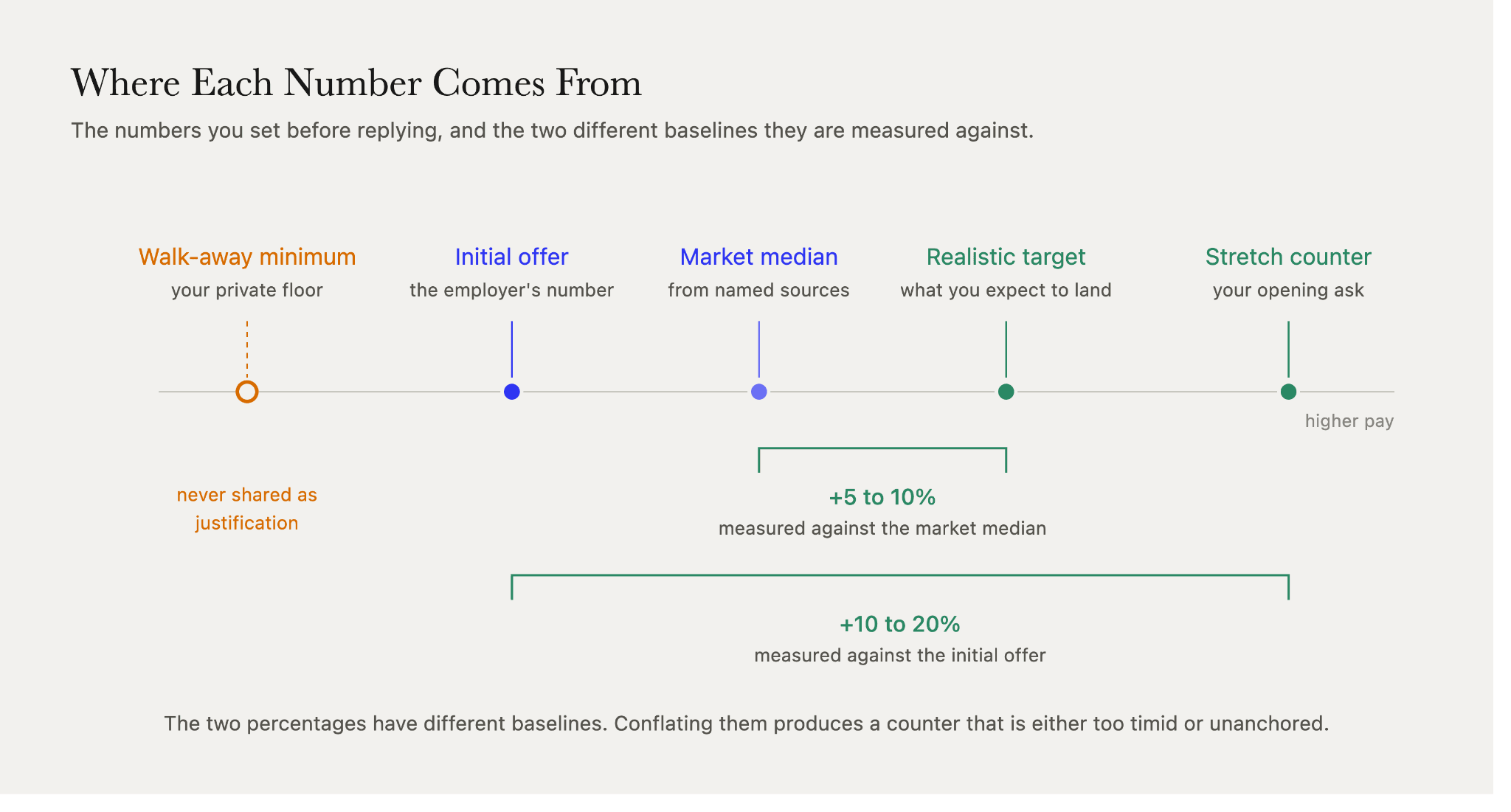
Your walk-away minimum is calculated from your cost of living, existing obligations, and your current job total compensation. It is a private guardrail representing your minimum salary requirement. Do not present it to a hiring manager as justification for your salary request.
Your realistic target should sit roughly 5 to 10 percent above the market rate for your niche. For example, if market data for a senior ML engineer in San Francisco shows base pay clustering between $224,714 and $342,780, per Glassdoor's 25th and 75th percentiles as of June 2026, your target might sit near the upper-middle of that band. Use data from Levels.fyi, salary ranges posted under state pay transparency laws, and published company bands where available. Anonymous forum data such as Blind is self-reported and skews toward high earners, so treat it as directional color, not a definitive benchmark.
Your stretch counter is the opening ask and sits 10 to 20 percent above the initial offer. The target is positioned between the stretch and the offer so the employer has room to negotiate down while still landing at your target. When the initial salary offer sits well below market, calculate the stretch from the market figure instead of the offer. In those cases, the resulting gap will exceed 20 percent. Confidence in negotiations can prevent overexplaining or apologizing, so know your numbers before you pick up the phone.
Recap:
Walk-away minimum: your base threshold, never shared as justification
Realistic target: market rate plus 5 to 10 percent, grounded in named data
Stretch counter: 10 to 20 percent above the initial offer (or above market if the offer is low)
How Do You Calculate a Defensible Counter Range?
Hiring managers negotiate based on internal bands and competitive intelligence. They expect you to use market data to support counteroffer discussions, referencing third-party data rather than personal financial need. Approaching this as a business negotiation produces better outcomes than anchoring on a desired salary driven by expenses.
Start by gathering role-specific data from at least three named sources. The Levels.fyi 2025 End of Year Pay Report, Carta's "State of Startup Compensation H2 2025" report, and the 2025 Stack Overflow Developer Survey each cover different slices of the market. Cross-check aggregator figures on Glassdoor or PayScale, which draw on self-reported data from a broader employer set than the tech-heavy sources above.
Pull employer-published salary ranges directly from job listings in states that require them, including California, Colorado, Hawaii, Illinois, Maryland, Massachusetts, Minnesota, New Jersey, New York, Vermont, and Washington, with Virginia and Maine joining in 2026. Verify current coverage before relying on it, since the list changes each legislative session. These posted bands serve as a free, employer-sourced benchmark that you can cross-check against aggregator data and the national average salary for your job title.
Arithmetic steps:
Pull base and total compensation for your level and city from two to three sources
Compute a market average salary (use the median, not the mean)
Set a realistic target at market plus 5 to 10 percent (this percentage is against market)
Set stretch counter at 10 to 20 percent above the initial offer (this percentage is against the offer)
These two percentages measure different things and should never be conflated.
How Do You Compare Offers Across Cities and Remote Roles?
AI and infra roles are increasingly remote or hybrid. Comparing offers across San Francisco, New York, London, and fully remote setups (converted to a USD equivalent) requires explicit normalization. A salary amount that looks identical in two cities can differ by 20 percent or more in purchasing power.
Use public cost-of-living calculators such as the MIT Living Wage Calculator or Numbeo indices to compute a location index. Then adjust both the initial offer and your market data to the same basis. Consider negotiating for flexible work hours or remote work options as part of discussing alternative compensation, since a fully remote arrangement can offset a lower nominal salary if you live in a mid-cost area.
Account for tax differences. California's top marginal state income tax rate reaches 13.3 percent, while Texas and Florida levy no state income tax. Even when the annual salary is the same, effective take-home pay can differ by tens of thousands of dollars. Some employers now use location-agnostic pay bands for critical AI talent. If you hold niche or technical skills in areas like LLM infrastructure or ML systems, you can justify placement at the top of a wide salary range regardless of your home city, because location-agnostic bands price the skill rather than the metro.
Normalization steps:
Pick a cost-of-living index and convert all figures to one reference city
Adjust for state and local taxes
Include recurring job-related expenses (commute, home office, relocation)
Compare the resulting figures on the same basis
Request a higher pay range or a signing bonus to close any gap that job-related expenses can justify as a salary increase request
How Much Is Startup Equity Actually Worth?
Many AI roles involve heavy equity components. Failing to discount illiquid startup equity leads to poor decisions about your starting salary and proposed compensation. You can negotiate stock options or extra vacation days as alternative compensation, but first you need an honest picture of how much value the equity actually holds.
RSUs at public companies vest on standard schedules (typically four years with a one-year cliff) and trade on public markets, which means liquidity risk is low. Stock price volatility can affect total compensation, but the shares are real and sellable. According to Carta's "State of Startup Compensation H2 2025" report, among AI and ML engineers, the median initial equity grant rose 31 percent between January 2024 and February 2026, against a 6.4 percent rise in median salary for individual contributors across all job functions.
Private company equity carries different risk. Stock options, 409A valuations, preferred versus common share differences, and expected dilution all reduce real-world value. As an illustrative rule of thumb, early-stage startup options might realistically be worth 20 to 40 percent of their theoretical value, while late-stage private equity sits higher but still below public RSU equivalents.
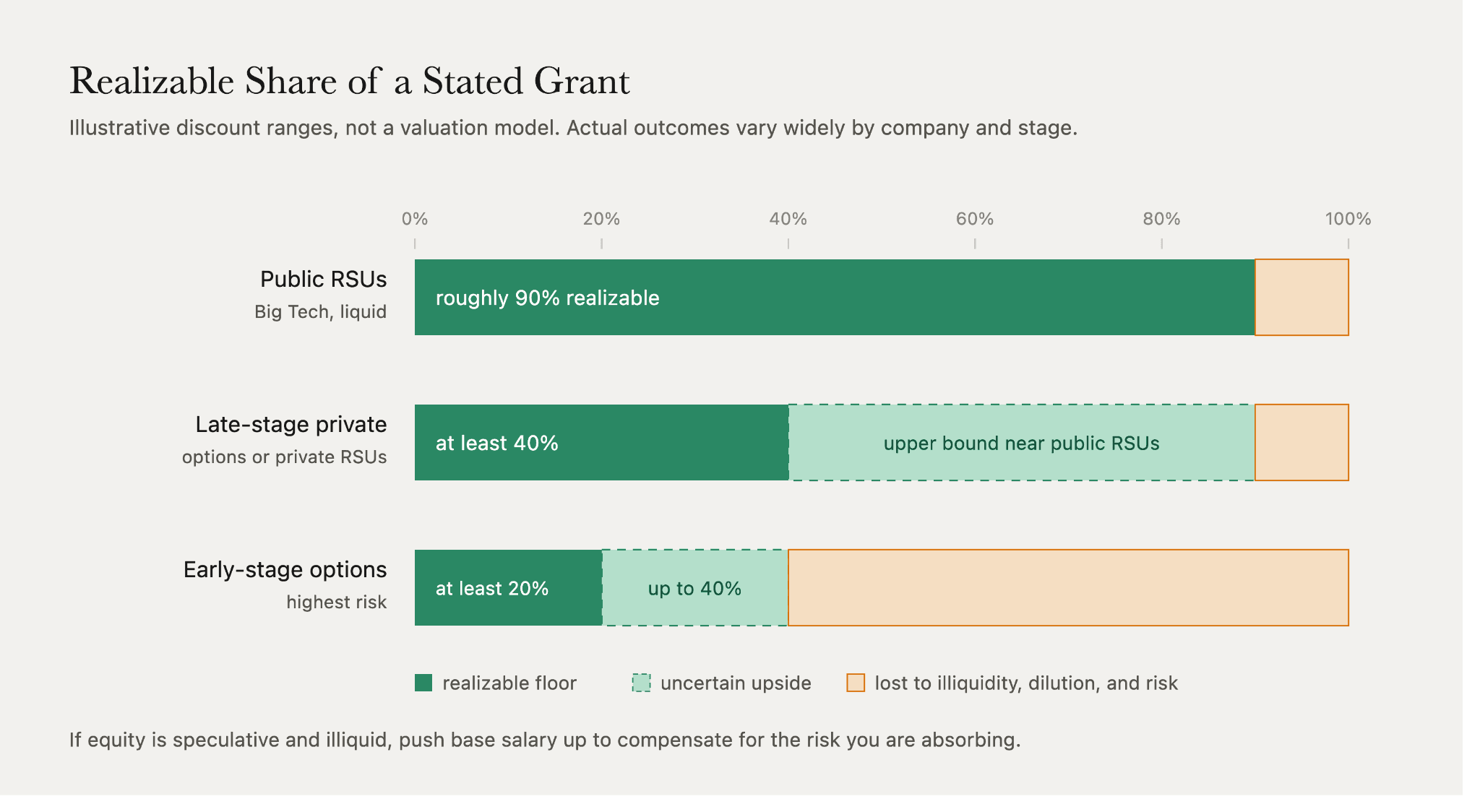
If equity is highly speculative and illiquid, push for a higher base salary to compensate. If the equity is relatively low risk and liquid (late-stage with imminent IPO), a slightly lower base may be acceptable.
Big Tech equity: public RSUs, transparent valuation, regular refreshers, low liquidity risk
Startup equity: options or private RSUs, uncertain exit and liquidity, high dilution and risk, potentially irregular refreshers
Big Tech vs AI Startup Offers: Which Has More Negotiating Room?
The same total compensation number can carry very different risk at a Big Tech company versus an AI startup, which changes the salary you should target after a job offer. Big Tech offers often have clearer promotion paths, more predictable equity refreshers, and increased performance-based bonuses tied to well-defined review cycles. AI startup offers may feature more negotiable equity and less defined salary bands, but the higher pay range comes with higher variance.
Aspect | Big Tech AI / Infra Role | AI Startup Role |
Type of equity | Public RSUs, standard 4-year vesting with 1-year cliff | Options or private RSUs, less standardized terms, common stock typical |
Liquidity risk | Low: shares trade publicly on major exchanges | High: long exit timelines, significant dilution risk, illiquid until IPO or acquisition |
Promotion clarity | Defined level ladders with published compensation bands and predictable refreshers | Ladder may be informal; salary bands and the salary negotiation process are often opaque |
Room to negotiate salary and equity | Base bands often tight; negotiation focused on equity refreshers or signing bonus | More flexibility in both base and equity; request greater compensation on either axis |
When equity risk is high at a startup, ask for more base to offset that risk. At a Big Tech firm where bands are tight, focus the negotiation process on equity quantity, signing bonus, or additional benefits rather than base alone. Frame counteroffers around unique value and specific skills rather than simply asking for a round number.
Worked Example: Calculating a Data-Backed Counteroffer
This example is illustrative only and is not a market benchmark. Specific numbers vary by year, location, and company.
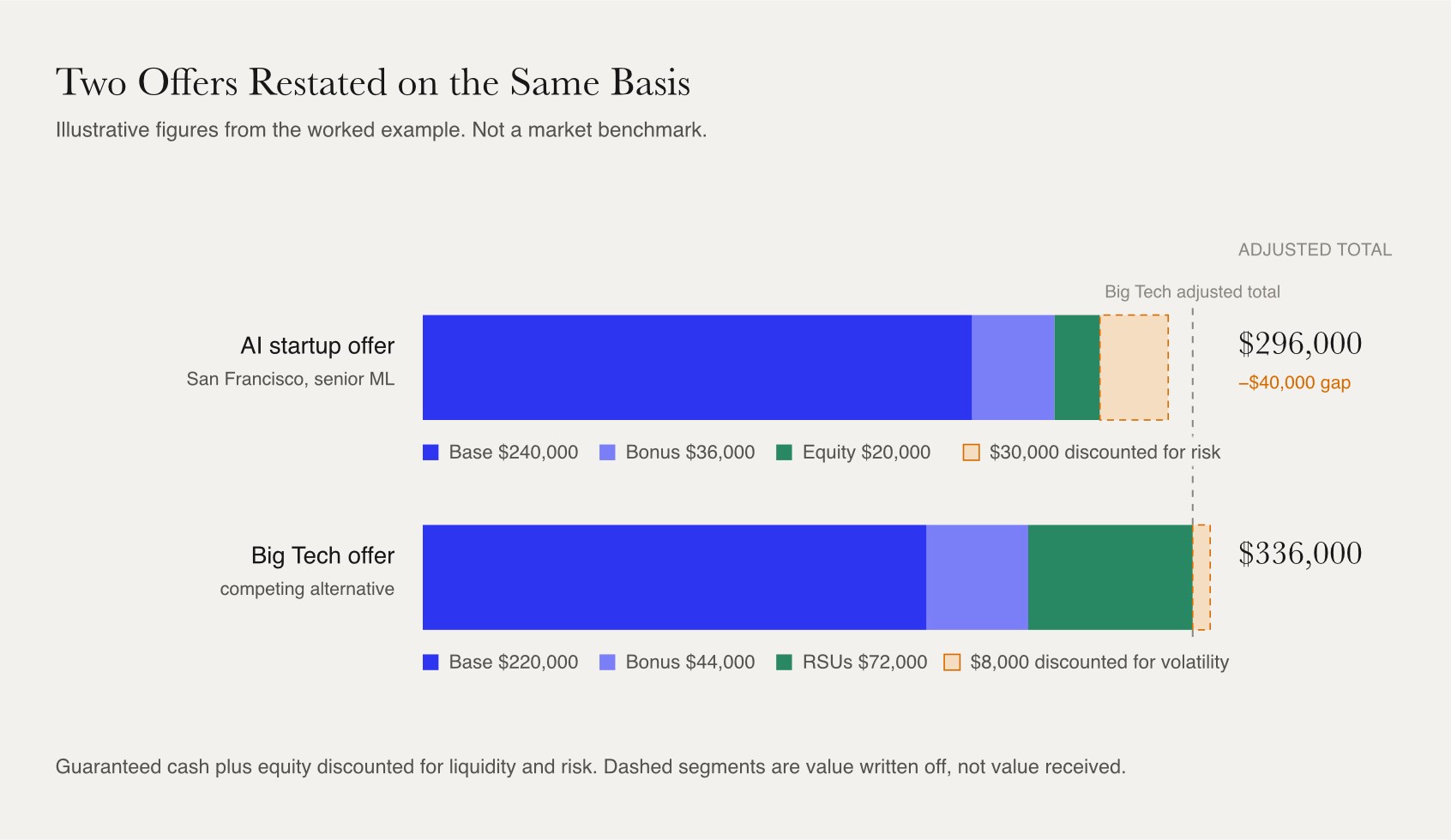
A senior ML engineer (L5 equivalent) receives a job offer in 2026 from a San Francisco AI startup. The job offer package includes a base salary of $240,000, an annual bonus target of 15 percent ($36,000), and a startup equity grant theoretically valued at $200,000 over four years with a one-year cliff.
Step 1: Annualize and discount equity. The theoretical annual equity value is $200,000 divided by 4, which equals $50,000 per year. Applying a 60 percent discount for illiquidity and risk brings the realistic annual equity value to $20,000.
Step 2: Compute adjusted total compensation. Base ($240,000) plus bonus ($36,000) plus discounted equity ($20,000) equals $296,000 adjusted total.
Step 3: Compare to a competing Big Tech offer. Suppose a Big Tech role offers base $220,000, bonus at 20 percent ($44,000), and public RSUs valued at $80,000 per year. At a 10 percent discount for stock volatility, the RSU real value is $72,000. Big Tech adjusted total: $336,000. The startup offer falls $40,000 short.
Step 4: Set counter numbers. Walk-away minimum: $235,000 base, the point below which the startup's adjusted total no longer clears your obligations. Realistic target: $260,000 base (market median of roughly $240,000 plus 8 percent). Stretch counter: $240,000 times 1.17 equals $280,800, rounded to $280,000.
This is how to ask for more money when offered a job: compute the real value of every component, compare it to a credible alternative, and set your requested salary accordingly.
How Do You Justify Negotiating a Higher Starting Salary?
Senior AI and infra candidates justify higher pay by tying their requested number to quantified past impact. Prepare specific talking points to justify your salary request, and prepare specific examples of your value before negotiating salary. The job description names the outcomes the role is expected to produce, so link your achievements directly to those outcomes.
Translate technical work into business metrics. Rather than citing years of experience, state measurable results: "Cut inference costs by 30 percent on a seven-figure annual cloud budget" or "Improved model throughput by 2x, enabling a product launch that added $10M in ARR." Each statement combines a metric with a magnitude, making it easy for the hiring manager to see how much value you deliver.
Citing external benchmarks strengthens your case. McKinsey's "The state of AI in 2025: Agents, innovation, and transformation" (November 2025) reports that 88 percent of organizations use AI regularly in at least one business function, yet only 39 percent report enterprise-level EBIT impact. McKinsey attributes that gap primarily to organizational factors rather than talent supply, but it is reasonable to argue in a negotiation that engineers who close it are doing scarce work. That scarcity is what lets you justify higher pay at the upper end of a salary range.
Example impact statements:
Reduced cloud spend by 25 percent on a $2M annual infrastructure budget through custom pipeline optimization
Improved model accuracy by 3 AUC points, driving a measurable retention uplift and incremental revenue
Architected a real-time inference system that cut latency by 50 percent, enabling a new product line
Led a five-person cross-functional team that shipped an ML feature on a two-quarter timeline, coordinating engineering, product, and data science
What Counts as Total Compensation Beyond Base Salary?
Base salary is only one part of a compensation package. When deciding how much more to ask for, compare the full value of the offer, including bonuses, health benefits, retirement contributions, equity, and job-related expenses. Annualize bonuses using the expected payout rather than the maximum, and account for recurring costs such as commuting, travel, or relocation.
Include in your comparison:
Bonus target and expected payout
Health insurance and retirement contributions
Equity and refreshers
Commute, travel, or home office costs
Signing, relocation, or equipment bonuses
If the employer cannot increase base salary, negotiate other components instead. Whatever you agree to, get the final terms in writing so you can compare the complete package accurately.
How Fonzi Can Help You Find Higher-Value Engineering Roles
For senior engineers and AI specialists, negotiating a stronger offer starts with having leverage, and that often means having access to multiple relevant opportunities. Fonzi is a curated AI engineering hiring marketplace that connects experienced engineers with companies hiring for technical roles through its Match Day hiring events.
Match Day can also give candidates more context for salary negotiations by exposing them to multiple companies rather than relying on a single offer. For engineers with specialized AI, ML, infrastructure, or software skills, comparing compensation, equity, responsibilities, and growth potential across roles can make it easier to determine whether an offer reflects their market value.
How to Ask for More Money From a Job Offer: The Short Version
Negotiating a higher starting salary starts with three numbers: a walk-away minimum from your own obligations, a realistic target at market rate plus 5 to 10 percent, and a stretch counter 10 to 20 percent above the offer. Offers across cities are only comparable once normalized for cost of living and state tax, and startup equity is only comparable to public RSUs once discounted for illiquidity and dilution. The strongest justification for a higher number is quantified past impact tied to the outcomes the role is expected to produce. Fonzi surfaces additional roles for comparison, which is useful leverage when you are negotiating a higher starting salary against a single offer.
FAQ
Is asking for 20% more than the initial job offer reasonable for a senior ML engineer?
How do I calculate a fair counter if the offer is 15% below my market data?
How much more base should I ask for to offset very risky startup equity?
Can I ask for more money if a remote offer is pegged to a lower-cost location?
How much more should I ask for when I have a stronger competing offer?


