Palantir Decomposition Interview: Examples and How to Prep
By Samara Garcia

The Palantir decomposition interview has no single right answer, and that is what makes it hard to prepare for. Public candidate reports from Forward Deployed Software Engineer (FDSE) and Deployment Strategist loops describe the round, often called the "decomp," as one where candidates structure an ambiguous, real-world problem that touches data, systems, and end-user workflows rather than write production code.
Palantir's own "Navigating Open-Ended Questions" guidance describes problems with several possible solutions and different trade-offs, and asks candidates to reach a concrete approach rather than an exhaustive one. A public Palantir decomposition interview example, halving emergency dispatch times in a city, starts with choosing which part of the dispatch timeline to target and what data to use.
Key Takeaways
- The decomposition round focuses on breaking down an open-ended problem, making assumptions explicit, and reasoning through trade-offs out loud rather than reaching a single right answer.
- Candidate reports suggest the format differs between Forward Deployed Software Engineer and Deployment Strategist interviews in the depth of technical detail and type of scenario.
- Effective preparation focuses on practicing structured reasoning out loud with public example prompts and mock interviews rather than memorizing specific questions.
What Does the Palantir Decomposition Interview Test?
The core skill assessed is problem decomposition under ambiguity. Candidates must take a vague problem and transform it into a structured plan by speaking through their logic in real time. Interviewers evaluate candidates based on their thought process and structured framework, not on whether they arrive at a textbook answer.
Palantir's own guidance and candidate reports consistently highlight several behaviors that score well: asking clarifying questions, stating assumptions explicitly, mapping inputs (data, systems, users), identifying trade-offs, and naming success metrics early.
The format resembles a system design interview or case interview but focuses more heavily on reasoning and structure than on a polished architecture or numeric answer. Exponent's guides describe little or no coding in the FDSE decomposition round, while Deployment Strategist candidates may need to define tables and write a query against them. Evaluators look for movement toward a workable plan, and they expect candidates to revise their approach as new information emerges from follow-up questions. According to Exponent's decomposition interview guide, the decomposition interview typically lasts 45 to 60 minutes, and Exponent's Deployment Strategist guide reports rounds of up to 90 minutes for that track.
Palantir's interview process includes a recruiter screen and technical screen. According to candidate reports compiled in Exponent's Palantir FDE interview guide, onsite interviews consist of three rounds drawn from various types, with the decomposition round being one of the most discussed in candidate accounts.
Palantir Decomposition Interview for Different Roles
The decomposition interview appears in several Palantir roles, especially Forward Deployed Software Engineer (FDSE) and Deployment Strategist, and public candidate accounts and job descriptions suggest it varies in technical depth and business framing.
All versions involve open-ended questions, but FDSE rounds usually emphasize data models, APIs, and engineering execution, while Deployment Strategist rounds emphasize operational context, metrics, and stakeholder trade-offs. Readers should use this as a role-specific lens rather than a definitive process description, since Palantir does not publish a single fixed FDSE or Deployment Strategist interview loop and candidate reports indicate the format can vary by role and candidate.
Palantir Decomposition Interview for FDSE Candidates
FDSEs embed with customers to deliver end-to-end solutions on platforms like Foundry, Gotham, or AIP, as Palantir describes in A Day in the Life of a Palantir Forward Deployed Software Engineer. In the Palantir decomposition interview, the FDSE round reflects this deployment focus by starting from a real-world scenario and moving toward a high-level system or data design that could be implemented on Palantir tooling.
Candidate accounts report that interviewers probe for concrete engineering decisions: data modeling choices, integration points, failure modes, and edge cases. Strong FDSE performance shows comfort connecting user or mission goals to technical plans while narrating trade-offs between speed, robustness, and complexity.
Palantir Deployment Strategist Decomposition Interview
In the Palantir Deployment Strategist interview, the decomposition round centers on a messy operational problem that the candidate breaks into metrics, data, and logic. Some candidates describe data, tables, or graphs appearing within or adjacent to the decomposition round, while others report a separate analytical or data case round. Prompts tend to involve a large organization or government context, with goals like improving throughput, reducing risk, or prioritizing resources across a complex system.
The focus is on problem framing, stakeholder mapping, impact metrics, and narrative clarity. Engineering details are kept at the level of capabilities rather than specific APIs. A Deployment Strategist candidate on Exponent described the decomp as "the most distinctive and intimidating part" of their loop, noting that it was not like a consulting case and instead emphasized turning ambiguity into data-driven, logical steps.
Palantir decomposition interview example prompts from public sources
Prompts in decomposition interviews are deliberately vague and messy. Candidates must break down a vague, real-world problem using only the data and context provided. Where the prompt leaves gaps, interviewers expect you to state assumptions and explain your reasoning for filling them.
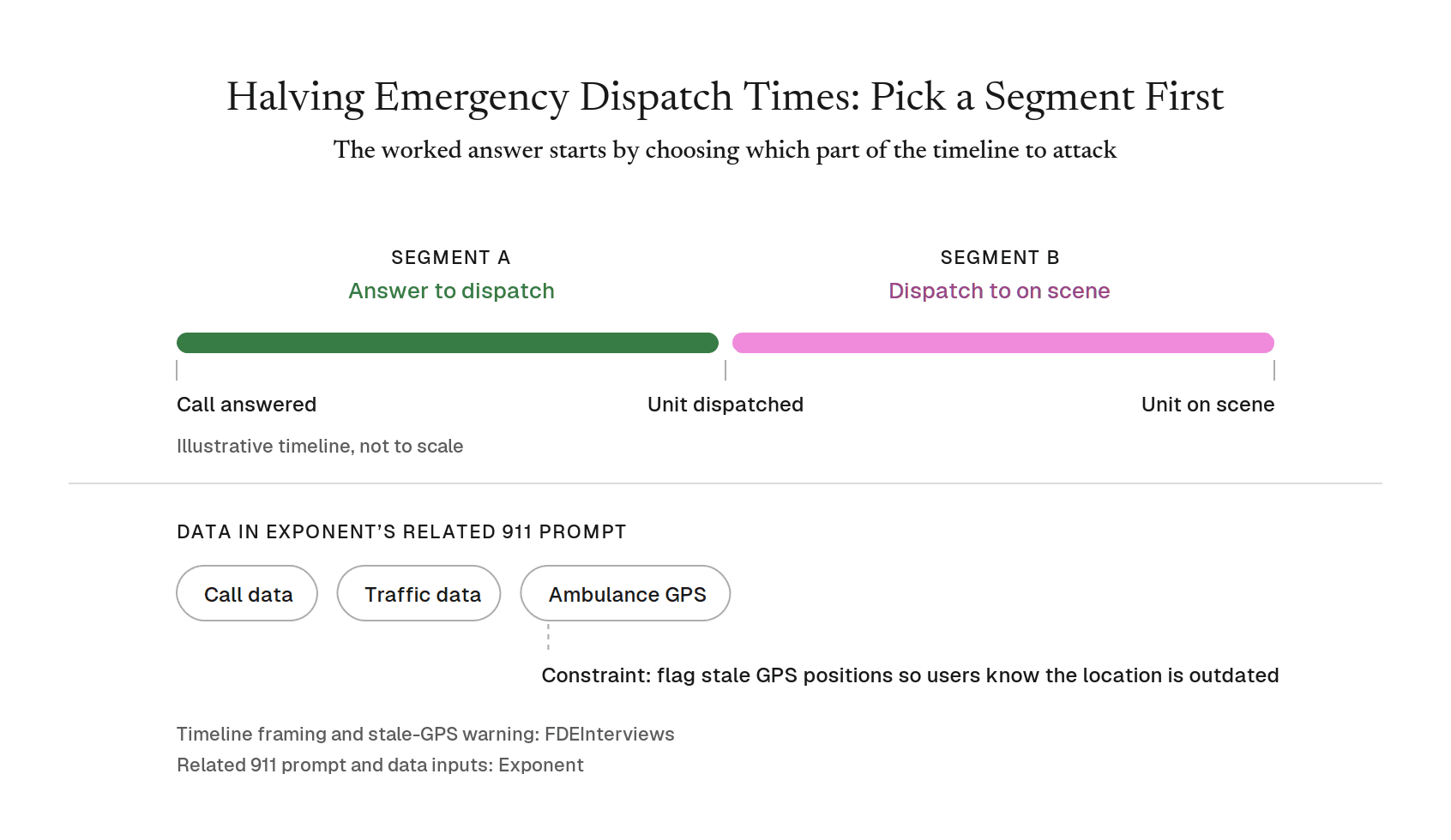
A prep guide on FDEInterviews uses the example of designing an application to halve emergency dispatch times in a city. The guide's worked answer asks which part of the dispatch timeline to target (call answer-to-dispatch versus dispatch-to-on-scene) and what data to use. Exponent's decomposition guide uses a similar prompt about reducing 911 response times with call, traffic, and ambulance GPS data, and the FDEInterviews answer flags stale GPS positions as a constraint the interface has to make visible. This is a strong Palantir decomposition interview example that illustrates how FDSE prompts ground technical decisions in real-world operational constraints.
How Palantir Describes Open-Ended Questions and Decomposition
Palantir publishes guidance on its careers site that is worth reading directly before any interview. The "Navigating Open-Ended Questions" resource describes problems that have no single optimal solution, where limited time and resources make a perfect answer unattainable. Palantir explicitly advises candidates to think in terms of alternative approaches with different constraints. Their phone interview tips page encourages candidates to do their research before the call: check out Palantir's website, read the interviewing tips, and perhaps watch a demo.
This guidance connects directly to the decomposition interview. Interviewers expect the same approach at the whiteboard: show why you made each choice, make trade-offs visible, and treat the conversation as collaborative.
How to Structure a Palantir Decomposition Interview Answer in Six Stages
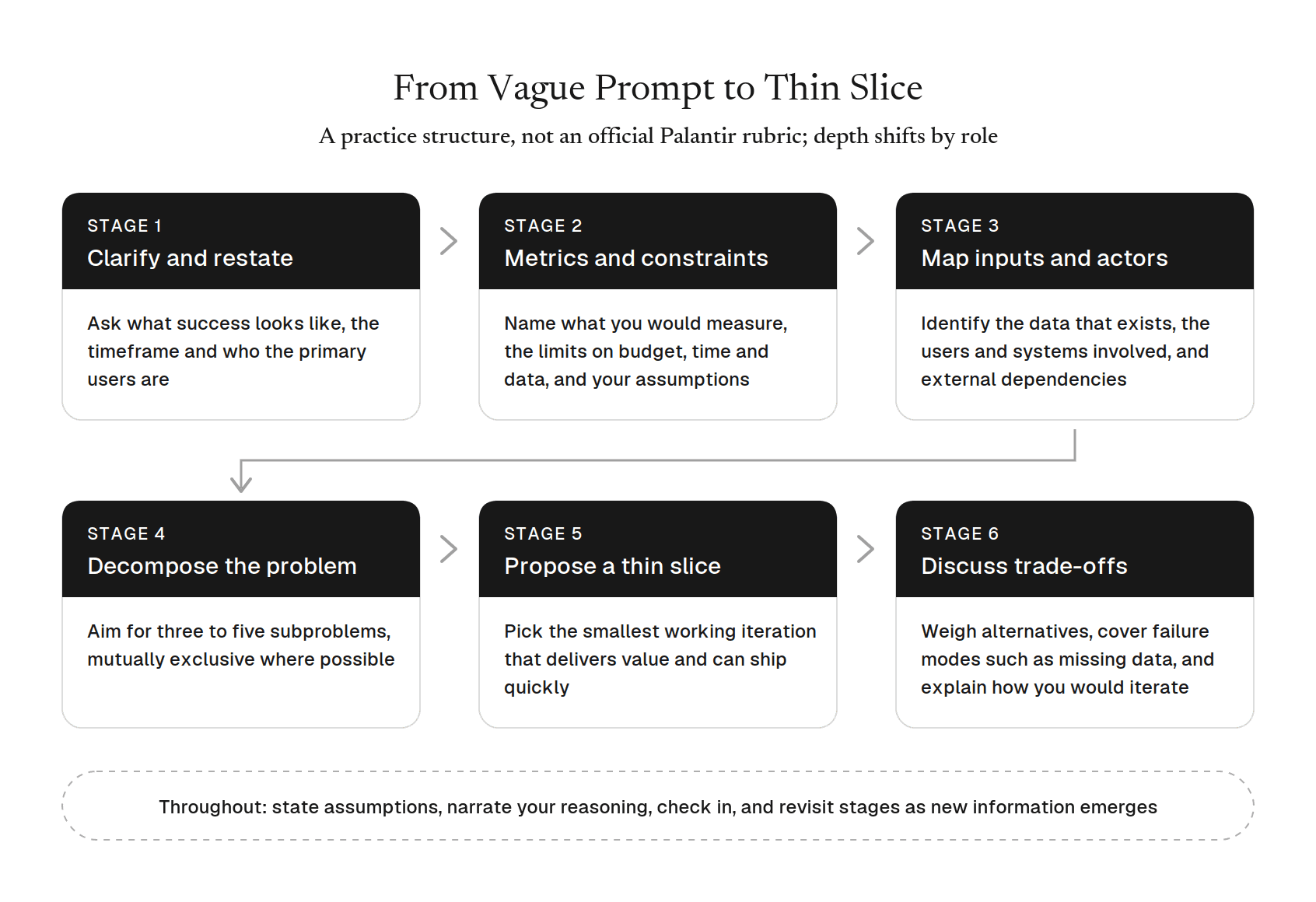
Strong candidates follow a staged structure that aligns with Palantir's own guidance and candidate descriptions of what works:
- Clarify the problem and restate it. Ask what success looks like, what the timeframe is, and who the primary users are.
- Define success metrics and constraints. Name what you would measure and what limits exist (budget, time, data availability). Make your assumptions explicit so the interviewer can redirect you if needed.
- Map inputs, actors, and systems. Candidates should define data needs and relationship structures early in the interview. Identify what data exists, which systems or users are involved, and where external dependencies live.
- Decompose into logical components. Use problem decomposition techniques to break the problem into three to five subproblems. These should be mutually exclusive and collectively exhaustive where possible, though do not force artificial structure. Logic trees can serve as a thinking aid here.
- Propose a thin slice or MVP. The goal is to arrive at the smallest functional product iteration that provides value. Pick the first piece that can be built and delivered quickly.
- Discuss trade-offs, failure modes, and iteration. Explain what happens if data is missing, what risks exist around adoption, and how the plan scales. Articulate trade-offs and assumptions throughout.
Interviewers value explicit articulation of assumptions, visible prioritization (which subproblem to go deep on), and continuous narration of reasoning. Strong candidates periodically check in with the interviewer, ask if the chosen direction fits the goal, and adjust when challenged. The same skeleton applies to both FDSE and Deployment Strategist rounds, but FDSE depth leans toward data and architecture while strategist depth leans toward metrics and stakeholder impact.
Common Mistakes and Edge Cases in the Decomposition Interview
Public candidate accounts and prep guides highlight several recurring failure patterns. Treating each one as a prompt for targeted practice can sharpen your readiness.
Rushing into solutions. Skipping clarifying questions and jumping to detailed design before establishing scope is one of the most common reasons for a poor score.
Failing to decompose sufficiently. A monolithic plan with no subproblems gives the interviewer no structured thinking to evaluate.
Opening with a memorized framework. Forcing one onto the prompt signals rigidity and loses the collaborative, exploratory quality that interviewers look for. A clean decomposition built from the prompt itself beats a structure imposed from memory.
Silence during problem solving. Explain your key decisions and assumptions aloud so the interviewer can follow your reasoning.
Weak communication. Long monologues, unexplained changes in direction, and skipped check-ins all undercut an otherwise sound plan.
Over-indexing on technical detail. Some candidates report over-indexing on low-level API design or scalability concerns without tying back to the mission or user outcome. In forward-deployed and strategist tracks, a clear plan grounded in the end-user context outweighs theoretical depth.
Ignoring edge cases. Failure modes, missing data, near-real-time constraints, or atypical users (like a logistics client with incomplete records) are fair game. Skipping them signals shallow thinking.
Palantir Decomposition Interview: FDSE vs. Deployment Strategist
The table below reflects candidate reports and public job descriptions, not an official Palantir rubric. It summarizes how the decomposition round differs across the two most commonly reported tracks.
Dimension | FDSE | Deployment Strategist |
Primary lens | Engineering execution, data integration, mission impact | Operational problem solving, stakeholder trade-offs, metrics |
Technical depth expected | Data models, API design, system inputs, data pipelines | Capabilities and workflows rather than specific APIs |
Common interviewer probes | What is your data model? How do systems fail? Speed versus correctness? | What metrics matter? How do you prioritize among stakeholders? What operational risks exist? |
How data is used | Candidate designs data flow and integration points | Candidate interprets existing data, diagnoses bottlenecks, defines measurement |
Behavioral emphasis | End-user empathy, engineering ownership | Stakeholder management, cross-functional communication |
The most notable difference is where the conversation bottoms out. FDSE interviews tend to push candidates toward concrete engineering decisions, while the Deployment Strategist loop stays at the level of impact, trade-off reasoning, and organizational constraints. Both require structured thinking and visible reasoning, but the domain of depth differs.
How to Prepare for the Palantir Decomposition Interview
A concrete, role-agnostic preparation sequence:
- Study Palantir's own guidance. Read Palantir's "Navigating Open-Ended Questions" and phone interview tips. Understand how the company frames ambiguity and trade-offs.
- Reverse-engineer public prompts. Take three to five published Palantir decomposition interview questions (such as the emergency dispatch prompt above) and decompose them into logic trees. Practice converting each vague problem into a set of subproblems, data needs, and a clear plan.
- Practice thinking out loud. Rehearse narrating your reasoning in real time during mock interviews so the interviewer can follow your decisions. Structured mock interviews help simulate the actual interview environment and test adaptability.
- Use existing projects. Experienced engineers and researchers can frame a past system, deployment, or research rollout as an interview-style open-ended problem and walk through their reasoning as if they were explaining it to a new stakeholder.
- Build a personal library. Create short inputs-process-outputs diagrams for recurring themes like data integration, alerting, or resource allocation. Do not force prebuilt templates in the live interview, but having mental models ready helps you start quickly.
- Timebox sessions. Simulate about 60 minutes (up to 90 for Deployment Strategist practice) and pace yourself across clarification, decomposition, and trade-off discussion.
Emphasize consistent practice with open-ended questions rather than memorizing specific Palantir decomposition interview questions, given the variability in prompts reported by candidates. Check Palantir job postings for the exact role you are targeting and align your practice domains accordingly.
Role-Specific Preparation: FDSE vs. Deployment Strategist
For FDSE preparation, focus on connecting user stories to data and API design. Review system design fundamentals and walk through past deployments where you had to iterate under evolving requirements. Practice identifying engineering constraints (speed, reliability, complexity) and explaining how you would handle them in a deployed product. If you have experience with near-real-time systems or data pipelines, prepare to discuss how those systems fail and how you managed edge cases.
For Deployment Strategist preparation, practice with data-heavy, operational scenarios. Use public datasets (logistics, healthcare, municipal operations) and narrate how you would diagnose bottlenecks, prioritize interventions, and define success metrics. Practice with messy tabular data to improve data handling skills. A Deployment Strategist often has to handle scenarios where the data is incomplete and the organizational context is politically complex, so practice framing problems from the stakeholder perspective.
Candidates for both roles should prepare a specific "Why Palantir" answer grounded in Palantir's mission. Candidate reports frequently mention motivation as a discussion point, and surface-level motivation (such as "I want to work on hard problems") is not enough. Prepare to explain how your background connects to domains like defense, public sector, or regulated industries. Align your practice with the exact job description from Palantir job postings, using language and domain examples that match that posting.
Behavioral Questions in the Palantir Decomposition Interview Loop
Candidate reports and interview prep publishers describe behavioral questions appearing within the decomposition round in some loops and as a standalone manager round or conversational round in others. Either way, be ready to move between structured stories and decomposition within the same onsite.
Practice answering prompts such as "tell me about a time you pushed back on a stakeholder" while also breaking down the underlying problem as if it were an open-ended case. Use concise STAR framing to anchor the narrative, then pivot into decomposition mode when the interviewer shifts to a fresh scenario. Interviewers in the recruiter screen and later rounds may also ask behavioral questions that test your reasoning about ambiguity, so be ready at every stage, not just the decomp.
Reflect on ethical and mission-related trade-offs in advance. Palantir's hiring material and candidate accounts suggest that questions about working in government or defense contexts do appear. Prepare an honest answer about why you want to work in these domains, grounding it in specific interests rather than generic enthusiasm. A generalist problem solver's mentality, combined with genuine engagement with Palantir's mission areas, comes across more credibly than rehearsed talking points.
How Fonzi Can Help Engineers Preparing for Forward Deployed Roles
Engineers preparing for loops like the Palantir decomposition interview face a familiar problem. A resume rarely shows how you reason through a messy customer problem, so each new process makes you prove it again from scratch.
Fonzi is a curated AI engineering hiring marketplace that connects companies with pre-vetted AI and software engineers. Match Day is how companies meet engineers from the marketplace. For engineers building decomposition skills for forward-deployed roles, Fonzi offers another route to teams hiring for similar positions, alongside applying to companies directly.
Palantir Decomposition Interview: Key Points to Remember
The Palantir decomposition interview is a distinctive, open-ended round that tests structured thinking under ambiguity, and Exponent reports it typically runs 45 to 60 minutes, with Deployment Strategist rounds of up to 90. FDSE candidates get pushed toward data models, integration points, and failure modes. Deployment Strategist candidates stay closer to metrics, stakeholder trade-offs, and operational risk. On either track, strong answers clarify the problem first, state assumptions out loud, break the prompt into three to five subproblems, and propose a thin first slice that could ship. Success depends less on memorizing Palantir decomposition interview questions and more on practicing clear reasoning, trade-off articulation, and alignment with Palantir's mission and domains.
Pick one public Palantir decomposition interview example this week, such as the emergency dispatch prompt, walk through a full decomposition aloud, and then schedule a realistic mock interview to stress-test your approach. After the mock interview, identify where your assumptions, priorities, or trade-offs were unclear, then repeat the exercise with those gaps in mind.
FAQ
How is the Palantir decomposition interview different from a system design interview?
The decomposition interview begins with far greater ambiguity and values mission or user framing, explicit assumptions, and trade-off reasoning more than a polished large-scale architecture. System design elements may appear, but they are judged in the context of utility and execution rather than theoretical scale, and little or no production code is typically required, although some Deployment Strategist candidates report writing a query.
Do all Palantir roles have a decomposition round?
Candidate accounts and prep guides most commonly mention the decomposition round for FDSE and Deployment Strategist loops. Prepfully's Palantir software engineer guide reports that SWE candidates typically get a decomposition round too, and the exact loop can vary by team, level, and location.
How should I practice logic trees for the decomposition interview?
Use logic trees as a thinking aid rather than a rigid template. Take a public prompt, break it into mutually exclusive and collectively exhaustive subproblems, and practice narrating why you chose each branch. The goal is to clarify your reasoning, not to impose artificial structure.
Can I use mock interviews to prepare for Palantir's decomposition round?
Structured mock interviews come closest to the live format of Palantir's decomposition round. They simulate the actual interview environment, let you rehearse thinking out loud, and help you practice handling follow-up questions and mid-round constraint shifts that the interviewer may introduce.
How much should I reference Palantir products in my answers?
Grounding your reasoning in product-level understanding of Palantir's ecosystem (such as Foundry, Gotham, or AIP) can strengthen your answer and show genuine engagement. Avoid generic statements. Instead, reference specific capabilities where they fit the scenario, drawing on public information from Palantir's website and your own research.