xAI Interview Process: Rounds, Questions and What They Test
By Samara Garcia
The xAI interview process for engineering roles has four published stages: application review (a CV and a statement of exceptional work), a screening interview, technical interviews, and an offer. That outline is short, so most of what you need to know comes from firsthand accounts of the xAI software engineer interview and the loops for infrastructure and research engineering roles. Those accounts describe coding rounds, system design discussions, project deep-dives, and hiring manager conversations that vary by role and over time. The xAI interview questions reported from 2025 and 2026 show how wide that range is: the xAI coding interview has appeared as a LeetCode-style simulation problem for one candidate and as iterator and transactional key-value store exercises for another.
Key Takeaways
- xAI’s careers page lists four steps for engineering hires. These include a CV review and statement of exceptional work, a screening interview, technical interviews, and an offer. More detailed round descriptions come from earlier xAI job postings and a limited set of firsthand candidate accounts, so formats vary by role and over time.
- Candidate accounts describe different combinations of algorithmic coding; practical implementation exercises such as iterators, caches, and transactional key-value stores; system or distributed systems design; and project deep-dives. Not all candidates complete the same sequence.
- Strong preparation means mapping your own experience to these stages, practicing applied coding and system design with mock interviews, and being ready to defend concrete technical decisions from your past work.
xAI Interview Process Overview for Engineering Roles
The xAI interview process for software engineer, Member of Technical Staff, and research engineer roles follows the four steps on xAI’s careers page. Reuters reported on February 2, 2026, that SpaceX had acquired xAI, and xAI’s careers pages now carry SpaceXAI branding.
xAI’s official careers guidance describes screening and technical interview stages. Candidate-reported formats include:
- engineer- or recruiter-led initial calls
- live coding or coding assessments
- system or distributed systems design
- project deep-dives
- team or behavioral conversations
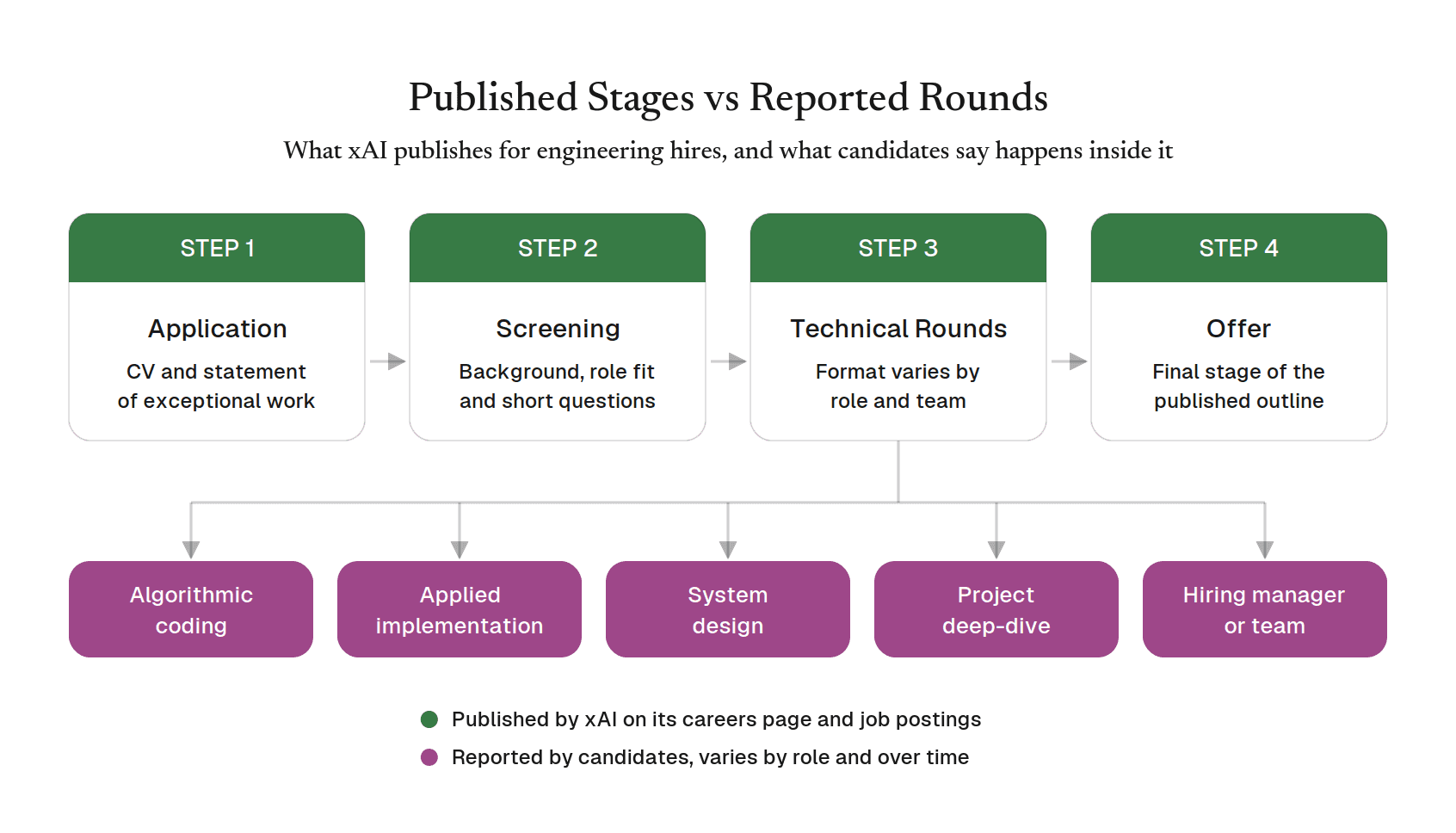
Earlier xAI job postings set a goal of finishing the main process within one week, while Exponent's xAI interview guide estimates two to three weeks in total. The following table summarizes documented possibilities, not a guaranteed sequence.
Stage | What It Tests | Prep Focus |
Screening interview | Background, role fit, genuine interest in xAI's mission, short technical questions | Prepare a concise summary of your resume highlights and a clear answer to "Why xAI?" |
Coding interviews (phone screen, assessment, or onsite) | Working code, data structures, algorithms, applied OOP and class design, edge cases | Practice implementing components like an LRU cache or transactional key-value store in your primary language |
System design | Real-world architectural thinking, fault tolerance, scalability, tradeoffs | Revisit a production system you built and practice explaining its constraints and evolution |
Project deep-dive / research discussion | Ownership, depth, technical constraints, failure modes, measured results | Select a challenging project and rehearse explaining technology choices and metrics |
Team or hiring manager conversation | Culture fit, motivation, collaboration, ambiguity tolerance | Prepare examples of independent decision-making and connect your skills to the role |
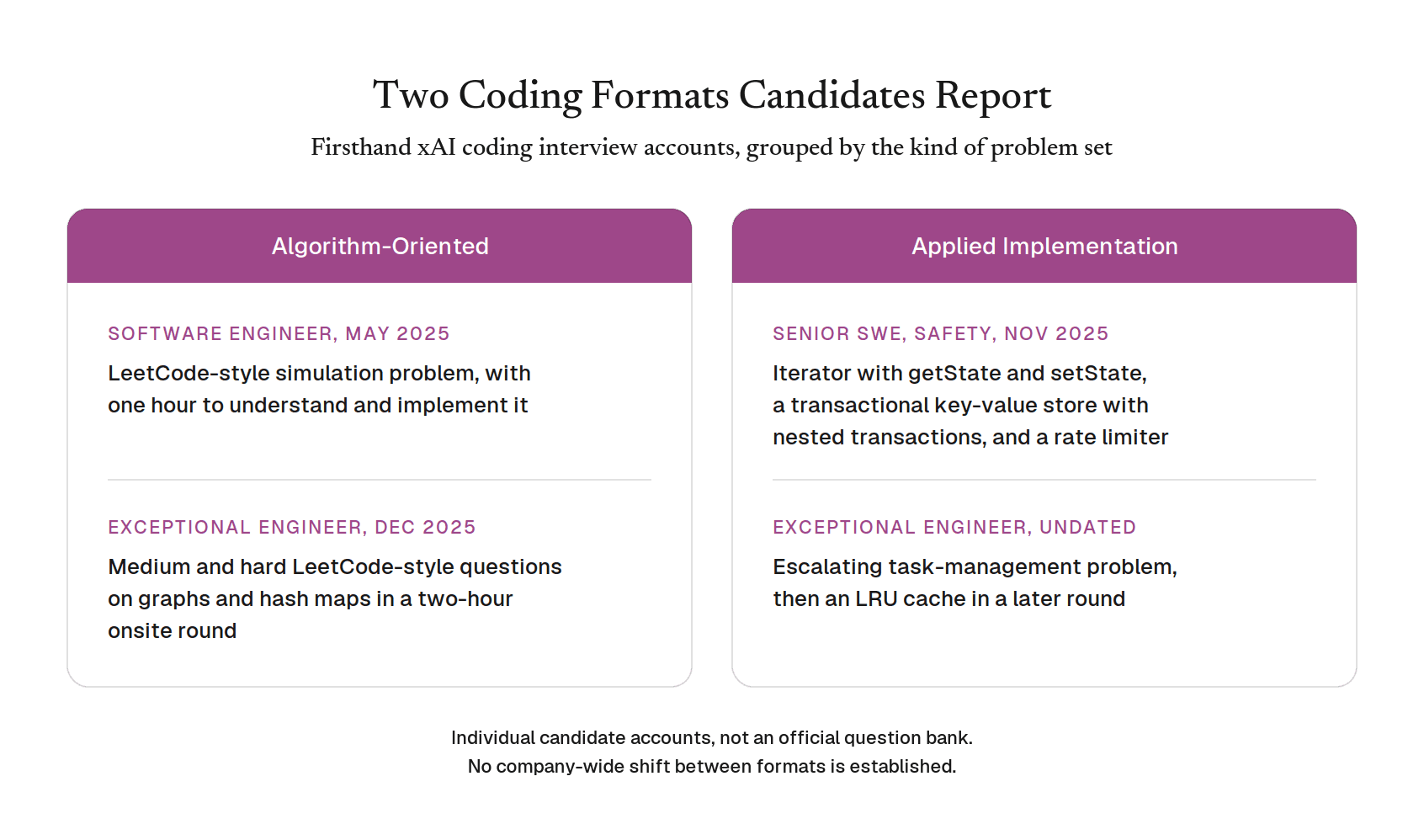
Candidate reports show how much coding formats vary. In a May 29, 2025 interview report, a software engineer in Japan described receiving an emailed LeetCode-style simulation assessment. A Senior Software Engineer, Safety report submitted to Exponent on April 13, 2026 (interview reported as November 2025) described iterator and transactional key-value-store implementation exercises. These different formats may reflect role-specific requirements, interviewer variation, or changes over time. The available evidence does not establish a company-wide shift from algorithms to applied coding. Candidates should use this overview as a map, not a guarantee of the exact loop they will see.
What Happens in the xAI Screening Interview?
xAI’s current careers page describes the screening interview as a short conversation covering the candidate’s background, role fit, and short technical questions. It also states that xAI generally does not use recruiters for assessments. Some candidates still describe an initial recruiter call before technical rounds.
Earlier xAI job postings described a 15-minute phone interview in which a team member asks basic questions. In a March 1, 2025 interview report, a software engineer described an initial 15-minute call focused on their previous experience. Exponent's xAI interview guide puts the initial engineer call at 15 to 30 minutes, though this should not be treated as universal.
Reported xAI Screening Interview Questions
An entry-level Member of Technical Staff account published on Exponent (interview reported as December 2025) documents these recruiter screen questions: “Can you walk me through your background and previous experience?” and “Why do you want to work at xAI, and what part of the company do you want to work on?”
xAI’s official careers page identifies a CV and statement of exceptional work as materials reviewed during application assessment. Candidates can prepare to discuss the technical contributions described in their statement during screening. One software engineer reported that the phone screen referenced the statement directly, though not every screening interviewer necessarily uses it as the basis of the conversation.
To prepare:
- Summarize your technical skills and past impact clearly.
- Identify your individual contributions and connect relevant experience to the position.
- Draft a concrete answer to “Why xAI now?” that references xAI’s stated mission on its careers pages rather than expressing generic AI enthusiasm.
- Prepare two to three precise clarifying questions about team scope, code ownership patterns, engineering workflows, or infrastructure scale. Use them when the interviewer opens the floor, but don’t assume the screening call reserves a fixed block of time for your questions.
xAI Coding Interview and Technical Phone Screen
Firsthand candidate reports document at least two formats in the xAI coding interview:
- algorithm-oriented assessments involving data structures, simulation, or problem-solving
- applied implementation exercises involving classes, iterators, key-value stores, or similar components
The May 29, 2025, software engineer account from Japan described an online assignment involving a difficult LeetCode-style simulation problem, with one hour available to understand and implement a solution. In a December 2025 Reddit post, an xAI Exceptional Software Engineer candidate reported completing a two-hour onsite coding interview involving medium- and hard-difficulty LeetCode-style questions focused primarily on graphs and hash maps.
Reported xAI Coding Interview Questions
A Senior Software Engineer, Safety account submitted April 13, 2026 (interview reported as November 2025) documents these applied coding exercises:
- An iterator class supporting next, hasNext, getState, and setState, then extending it to treat a list of iterators as one continuous iterator with a global index.
- An in-memory key-value store supporting set, begin, commit, and abort operations with nested transactions.
- A rate-limiter design prompt.
An Exceptional Engineer account published on Exponent describes an escalating task-management problem in which tasks break into subtasks, followed in a later round by a standard LRU cache implementation. A September 2025 software engineer account reports a CodeSignal coding interview requiring a camera, microphone, screen sharing, and government ID.
These tasks require implementing working solutions, reasoning through constraints, considering edge cases, and responding to follow-up questions when requirements change mid-problem. Strong communication and the ability to explain your thought process matter. xAI’s current public careers guidance does not provide a detailed coding-interview scoring rubric, so treat maintainability, testing, and invariants as sensible preparation priorities.
For interview prep, practice implementing real components (LRU cache, in-memory index, iterator abstractions) in your primary language under pressure. Use platforms like LeetCode for problem-solving speed, but do not assume xAI uses those exact questions. Candidates preparing for ML or research engineer roles at AI labs, including those comparing OpenAI interview questions, should also review coding patterns around data pipelines, batch processing, or GPU-adjacent tooling that appear in xAI job postings. They should also be ready to write production-adjacent Python or C++ code rather than only pseudo-code.
xAI System Design and Distributed Systems Interviews
Firsthand xAI engineering candidates have reported system design interviews, though the technical domain and format vary. A March 2025 software engineer report describes designing an existing system, followed by scalability questions. Candidates should prepare for distributed systems design questions.
What System Design Questions Does xAI Ask?
A separate firsthand Exceptional Engineer account describes an onsite prompt to design a file-upload system for an AI chat product. Follow-ups covered user experience, perceived latency, monetization, and production metrics. These accounts represent individual experiences, not a standardized prompt.
One firsthand account of the xAI software engineer interview, published on Gaijineer, describes a first-principles culture and a design round that rewarded practical, requirement-driven answers over textbook templates. Practice deriving architectures from concrete requirements for any system design interview, explaining tradeoffs, and adapting your designs when constraints change.
This stage tests three things:
- your capacity to reason about distributed systems under realistic constraints
- your understanding of bottlenecks like GPU allocation or storage throughput, as mentioned in xAI job descriptions
- your ability to make and defend explicit tradeoffs rather than chase an abstract “perfect” design
Prepare to discuss fault tolerance, consistency, and scaling for systems you have actually shipped. As a practice exercise, consider how you would design an LRU cache backed by a distributed store, or a request routing layer for model serving. These are practice themes, not confirmed xAI interview questions.
xAI Project Deep-Dive and Research-Oriented Interviews
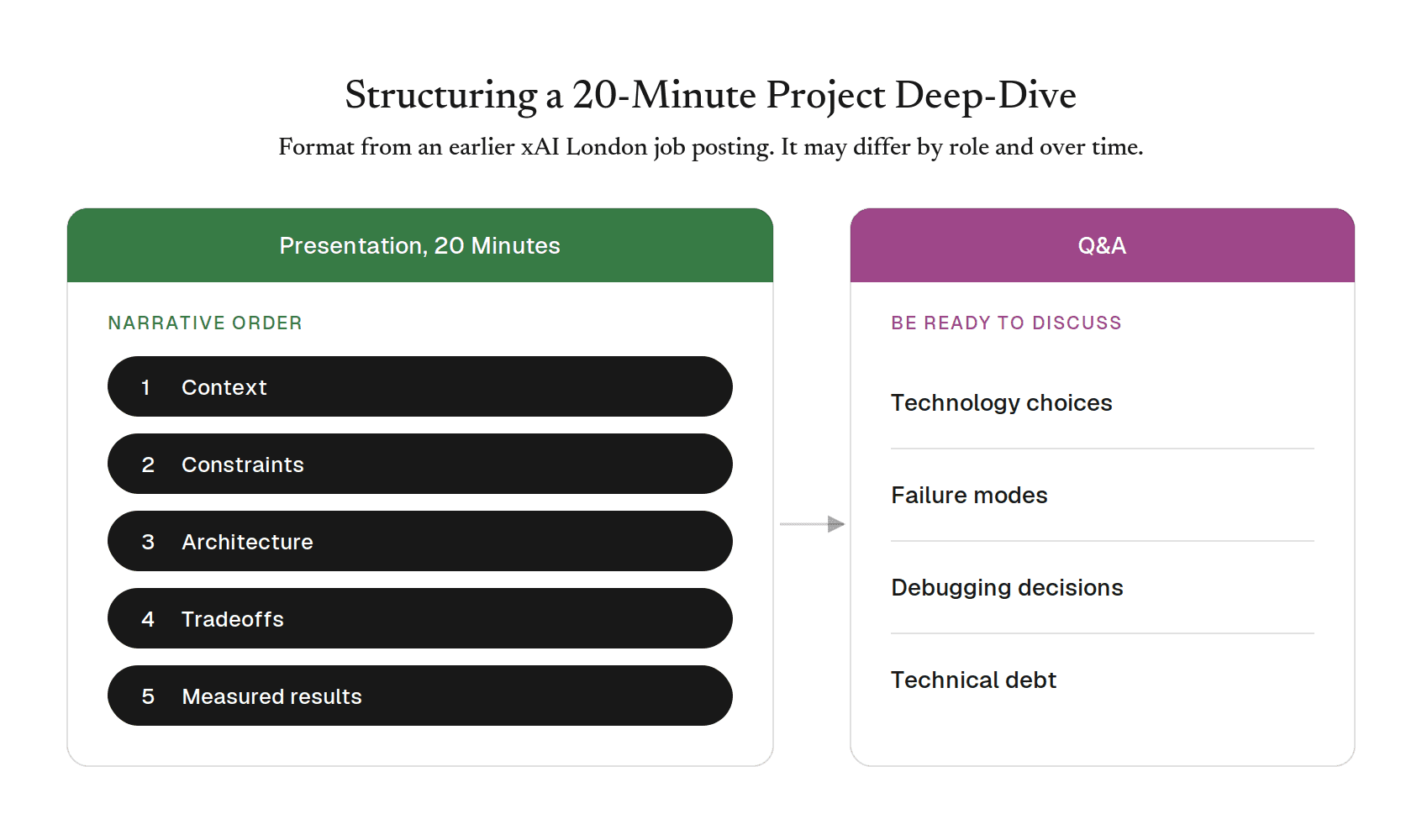
Earlier xAI job postings described a project deep-dive in which candidates present their past exceptional work to a small audience. One xAI London job posting asked candidates to give a 20-minute presentation about the most difficult technical problems they had solved, and one software engineer described the same format followed by Q&A. Use the presentation for a technical deep-dive into one challenging project, focusing on the decisions you made, the constraints you faced, and the results you achieved. Interviewers ask detailed questions about the technology choices used, and candidates should prepare metrics related to their project’s impact.
Reported Project Deep-Dive Questions
In a July 1, 2025 interview report, a software engineer described being asked about their most challenging recent project, followed by detailed questions about previous work. Other candidates describe similar in-depth conversations even without a formal presentation.
This round tests ownership, depth of technical reasoning, understanding of constraints and failures, and the ability to reflect on alternative approaches. Research engineering and ML-focused candidates should adapt their project preparation to the technical responsibilities in their specific xAI job postings. Where the posting identifies LLM training pipelines, optimization, or evaluation, prepare to discuss relevant experiments, implementation decisions, methodologies, and measured outcomes.
Select a technically challenging project where you can explain context, constraints, architecture, tradeoffs, and measured results. Rehearse both a concise and an extended narrative. Prepare to talk about failure modes, debugging decisions, and technical debt. Where appropriate, tie your deep-dive to xAI’s public mission statements by highlighting how your work improved performance, safety, or reliability in large-scale systems.
xAI Hiring Manager, Team, and Behavioral Interviews
Earlier xAI postings included a team-facing presentation, while later firsthand engineering accounts describe different formats for hiring manager, team, and behavioral conversations. Some candidates report a separate behavioral round. Others describe discussions of motivation, past work, or collaboration during technical interviews.
Reported Team and Behavioral Questions
An Exceptional Engineer candidate account reports a hiring manager conversation with questions such as “Why xAI?”, “What was your other project?”, and “What are you going to do at xAI?”
Themes across these accounts include first-principles thinking, comfort operating under high ambiguity and autonomy, and strong alignment with xAI’s engineering mission. In July 2025, Elon Musk posted that xAI would drop the “researcher” title, saying there are only engineers. Research-focused candidates should expect to be evaluated on engineering execution as well as research depth.
Prepare examples where you made an independent call under uncertainty, stories of debugging or firefighting production issues, and instances where you changed course based on new data. Structure these as Problem, Constraint, Action, Result. Review xAI’s current public careers statements about its mission, goals, execution pace, and approach to engineering work before interviewing. Show genuine interest in the company beyond generic AI enthusiasm, and demonstrate how your background aligns with a culture of ownership and accountability.
xAI Interview Questions: What Candidates Report
The xAI interview questions below come from traceable firsthand candidate accounts from 2025 and 2026. They are candidate-reported questions, not an official xAI question bank.
- Screening: “Can you walk me through your background and previous experience?”; “Why do you want to work at xAI, and what part of the company do you want to work on?” (Member of Technical Staff candidate, December 2025 interview)
- Algorithm-oriented coding: LeetCode-style simulation (May 2025 SWE), graph and hash-map problems (December 2025 Exceptional Engineer)
- Applied coding and class design: Iterators, transactional key-value stores, rate limiters (November 2025 Senior SWE, Safety); LRU cache and an escalating task-management system (Exceptional Engineer)
- System design: Existing system design with scalability follow-ups (March 2025 SWE), file-upload system for an AI chat product (Exceptional Engineer)
- Project deep-dive: “Most challenging recent project” with detailed follow-up questions (July 2025 SWE)
- Hiring manager: “Why xAI?”, “What was your other project?”, and “What are you going to do at xAI?” (Exceptional Engineer)
Some candidates experienced LeetCode-style assessments while others reported practical class-design exercises. Variation may reflect role, interviewer, or timing. Treat these as a sampling, not a checklist. The right preparation approach is to strengthen underlying skills in applied coding, system design, and explaining technical tradeoffs under time pressure rather than memorizing answers.
How to Prepare for the xAI Interview Process
Prepare for the xAI interview process by practicing applied coding, reviewing system design fundamentals, and rehearsing technical project discussions. Prioritize the exercises most relevant to your engineering role and confirmed interview schedule.
- Coding prep. Implement real components (LRU cache, in-memory index, iterator abstractions) in your primary language. Practice with live shared editors. Review core data structures and complexity. Write clean, compilable solutions rather than pseudo-code.
- System design prep. Revisit one or two production-grade systems you have built. Practice whiteboard sessions starting from user requirements. Incorporate constraints like latency, throughput, GPU utilization, or cost.
- xAI practice loop. Do mock interviews with peers that mimic engineer-led conversations. Rehearse your “exceptional work” narrative. Review xAI’s careers page and mission shortly before interviews.
How Fonzi Can Help Engineers Preparing for AI Lab Interviews
Engineers preparing for the xAI interview process often build skills that also apply to loops like the Scale AI interview, whether they choose an AI lab or an AI startup. The statement of exceptional work, the applied coding rounds, and the project deep-dive reward the same evidence many AI startups screen for. Yet each application usually starts from zero, with a new resume review and a new screen.
Fonzi is a curated AI engineering hiring marketplace that connects companies with pre-vetted AI and software engineers. Through Match Day, companies send salary-backed interview requests directly to engineers. Engineers can review available AI startup opportunities on Fonzi, including infrastructure, research engineering, or Member of Technical Staff roles where offered, and compare their responsibilities and compensation with opportunities they're pursuing at xAI.
xAI Interview Process at a Glance
The xAI interview process for engineering roles has four published stages: application review with a CV and statement of exceptional work, a screening interview, technical interviews, and an offer. Firsthand accounts of the xAI software engineer interview fill in the technical stage with different mixes of algorithmic coding, applied implementation exercises such as iterators and transactional key-value stores, system design, project deep-dives, and hiring manager conversations. Timelines for the xAI interview process vary: earlier company postings targeted one week for the main interview rounds, while Exponent estimates two to three weeks for the full process.
xAI reviews the statement of exceptional work during the application stage, and candidates should be prepared to discuss the technical achievements it describes if interviewers revisit them during screening or project discussions. The xAI interview questions candidates report range from “Why xAI?” in screening to iterator, LRU cache, and file-upload system design prompts, and none of them come from an official xAI question bank. If you practice applied coding in your primary language for the xAI coding interview, can derive a system design from requirements, and can defend the tradeoffs in your own past work, you are prepared for the formats candidates have reported.
FAQ
Is the xAI software engineer interview the same as the process for infrastructure and research engineers?
Not exactly. Public accounts describe overlapping stages (screening, coding, system design, project discussion) across these roles, but the emphasis shifts. Research-focused roles may involve deeper project discussions and ML-specific tasks, while infrastructure roles may see more distributed systems and concurrency questions. Expect the process to vary by team and job posting.
Should I prioritize LeetCode, applied coding, or system design for an xAI engineering interview?
Prioritize practical coding and implementation exercises, particularly for London roles, where xAI's official hiring FAQ says interviews involve live pair coding on real engineering problems rather than LeetCode-style questions. Review algorithms when your role or interview schedule calls for them, and add system design preparation for positions involving infrastructure, scalability, or distributed systems. Firsthand accounts describe both algorithm-oriented and practical implementation exercises, while system design expectations vary by role.
Are xAI engineering interviews remote or in person?
It depends on the role and stage. xAI’s careers page says the company prioritizes in-person work and hires across offices in Palo Alto, Seattle, Tennessee, and London. A firsthand Exceptional Engineer account reports being told mid-process that company policy required an onsite round. Ask your hiring contact which rounds require in-person attendance.
Can I reapply to xAI after being rejected?
Probably, but no universal waiting period could be confirmed from public sources. Check current application instructions or contact your hiring representative about eligibility, and address relevant skill gaps before reapplying.
Does xAI include behavioral or team-fit interviews for engineering roles?
Sometimes. Documented candidate experiences describe different formats, including separate hiring manager or behavioral conversations, and discussions of motivation, collaboration, or previous work during technical interviews. Prepare stories about ownership, ambiguity, and collaboration either way.