Data Structures and Algorithms Interview Questions You Need to Know
By
Samara Garcia
•

Data structures and algorithms remain a foundational part of technical interviews for AI, ML, software, and infrastructure roles. Today's interviews focus less on memorized solutions and more on applying core concepts to real engineering problems, performance tradeoffs, and scalable systems. This guide covers the most important DSA interview questions, patterns, and concepts candidates should know to succeed.
Key Takeaways
This guide covers the data structures and algorithms interview questions that senior AI, ML, and infra engineers actually encounter, not recycled beginner-level content.
Interviews increasingly test applied DSA skills on graphs, trees, and dynamic programming patterns relevant to large-scale systems and LLM infrastructure.
Candidates must move quickly from baseline solutions to optimized approaches, using patterns such as binary search, breadth-first search, DFS, and dynamic programming.
Curated, structured hiring processes (such as Fonzi-style marketplaces) are changing how often and how deeply candidates face raw DSA questions, but strong fundamentals remain non-negotiable.
Success now depends as much on communication, tradeoff reasoning, and real-world system intuition as on solving individual coding problems.
How Data Structures Interviews Are Evolving for AI Roles
Senior AI engineers and ML researchers face data structure interview questions in nearly every hiring loop. The difference is how those questions are framed. According to a Karat survey of roughly 400 engineering leaders globally, 71% report that assessing technical skills has gotten harder because AI tools force hiring teams to verify reasoning and adaptability, not just the correctness of code. Data structures organize data within a program, and understanding how to select and apply them under realistic constraints is now the core signal interviewers seek.
Companies building LLM infrastructure, retrieval systems, and machine learning platforms rely heavily on core data structures such as graphs, trees, hash maps, and linked lists to manage embeddings, indexes, and large-scale workflows. Interview formats have also shifted from pure puzzle-solving toward more applied algorithmic questions that test a candidate's ability to reason about memory usage, throughput, latency, and system trade-offs in realistic engineering environments. While hiring processes vary by company, candidates still need a strong grasp of DSA fundamentals to succeed in technical screens and interviews.
Core Data Structures Every AI Engineer Is Still Asked About
Classic data structures remain the foundation of AI infrastructure. Arrays underpin embedding matrices and feature vectors. Hash maps power deduplication layers and caching. Priority queues manage job schedulers. Understanding these structures, along with their time complexity and space complexity characteristics, is a prerequisite for any serious technical interview in this field.
Arrays and Array-Like Structures
An array stores elements of the same type in contiguous memory, offering O(1) random access and strong cache locality. Arrays offer excellent cache locality and minimal memory overhead compared to linked lists, as they eliminate the need to store individual node pointers alongside data. Common interview questions include finding a pair with a given sum (pair sum), maximum subarray via Kadane's algorithm, and finding the kth largest element using a heap or quickselect.
Expect tasks involving an input array that is either sorted or unsorted. For an unsorted array, you might be asked to find the missing number in an array of 1 to n, or to remove duplicates. Reversing an array or string is a common operation that appears as a warm-up. For a sorted array, binary search variants dominate. Interviewers may also present a two-dimensional array (matrix) and ask you to traverse or search it.
Linked Lists
A singly linked list is a sequence of nodes where each node points to the next node. A doubly linked list extends this so that each node also references the previous node, enabling bidirectional traversal at the cost of more memory per node. In a linked list class implementation, each node typically stores int data and a pointer, and the structure supports O(1) inserts and deletes at a given node when you hold a reference to it.
Reversing a linked list is a common interview question, tested in both iterative and recursive forms. Other frequent tasks include detecting cycles with Floyd's algorithm, merging sorted lists, and finding the middle element in one pass. Tradeoffs matter here: linked lists offer flexible insertion but poor cache performance compared to arrays.
Stacks, Queues, and Priority Queues
A stack follows Last In First Out (LIFO) order. A queue allows items to be added at the rear and removed from the front, following FIFO order. Stacks and queues follow LIFO and FIFO rules, respectively, and interview questions often ask you to implement one using the other.
A priority queue is typically backed by a heap structure. Heaps are complete binary trees used for priority queues, where a min heap surfaces the smallest element and a max heap surfaces the largest in constant time for peek operations. These appear in scheduler design problems, merge k sorted lists, and rate-limiting scenarios relevant to model inference serving.
Hash Maps and Hash Tables
A hash table (or hash map) provides average-case O(1) insert and lookup by mapping keys to buckets. A hashmap allows O(1) access time with a key, though worst-case performance depends on collision handling. Common collision strategies include chaining and open addressing (linear probing, quadratic probing, double hashing).
Using a hash map helps in frequency counting and detecting duplicates across all the elements in a collection. Implementing an LRU Cache is a common use case for hash maps: pair a hash map with a doubly linked list to achieve constant time get and put key operations. You can also solve problems like counting subarrays with a given sum using prefix sums combined with a hash table, or determine missing values in a sequence in one pass.
Trees, Graphs, and Search: Where Interviews Meet Real AI Systems
Tree and graph questions map directly to systems that AI engineers build daily: routing requests through load balancers, managing dependency DAGs in training pipelines, and constructing retrieval indexes for RAG systems. These are not abstract exercises. A strong answer demonstrates you understand both the data structure and its operational context.
Binary Trees and Binary Search Trees
A binary tree uses nodes with two children each. A binary search tree stores items in sorted order, with left children smaller and right children larger than the parent. Tree traversal methods include inorder, preorder, and postorder; BFS and DFS are the broader search strategies applied to both trees and graphs.
Key interview problems include connecting nodes at the same level (level-order traversal with next pointers), counting structurally unique binary trees using Catalan numbers (occasionally tested in algorithmic-heavy loops), serialization and deserialization, and merging two BSTs. Binary search trees store items in sorted order, making them useful for range queries in feature stores. A prefix tree (trie) is a related structure that can perform prefix searches efficiently in O(L) time, where L is the length of the search key.
Augmented and Balanced Trees
AVL trees are self-balancing binary search trees that guarantee logarithmic height through rotation operations. Red-Black trees offer a similar guarantee with slightly relaxed balancing. Segment trees are used for multiple range queries on arrays, supporting efficient updates over intervals. A B-tree can have multiple keys and children per node and can store multiple keys in a single node efficiently, making it the backbone of traditional tabular databases and filesystems. However, modern vector indexing models for embeddings often use graph-based structures like HNSW rather than B-trees, reflecting a shift in how similarity search is optimized.
Graphs, BFS, and DFS
A graph consists of nodes and edges connecting them. Graphs can be represented using adjacency matrices or adjacency lists; adjacency lists are preferred for sparse graphs, while matrices offer faster edge lookups for dense structures. Breadth-First Search (BFS) and Depth-First Search (DFS) are key graph algorithms. BFS explores nodes layer by layer, making it ideal for finding the shortest path in unweighted graphs. Dijkstra's algorithm finds the shortest path in weighted graphs. Graph algorithms are essential for solving network routing problems and graph problems in interviews alike.
Common DSA questions on graphs include cycle detection in an undirected graph using DFS or Union-Find, flood fill on a given matrix, number of islands, and topological sort for DAG-based scheduling. When working with a given matrix representing a grid, treat it as a two-dimensional array and apply BFS or DFS in the same manner you would on an explicit graph.
Structure Comparison
Data Structure | Key Operations | Typical Interview Questions | Relevant AI System Examples |
Binary Search Tree | insert, delete, search, tree traversal, range query | Merge two BSTs, validate BST, connect nodes at the same level | Feature store indexing, sorted log retrieval |
Segment Tree | range sum, range min, point update | Build a segment tree, answer range queries on the input array | Time-series aggregation, sliding window summaries |
Graph (Adjacency List) | add edge/node, BFS, DFS, shortest path, cycle detection | Number of islands, topological sort, Dijkstra on a weighted graph | Dependency DAGs, ANN index graphs (HNSW), knowledge graphs |
Trie (Prefix Tree) | insert, search, prefix match | Autocomplete, word search in a given matrix | Tokenizer vocabularies, lexicon lookup |
High-Value Algorithm Patterns: From Binary Search to Dynamic Programming
Senior candidates are evaluated on how quickly they map problems to known algorithmic patterns rather than on memorizing individual answers. Pattern fluency, not problem count, is what separates strong hires from average candidates. Big-O notation describes the upper bound of an algorithm's time and space complexity in terms of input growth rate, not actual execution time.

Binary Search
Binary Search works on sorted datasets only and can find an element in O(log n) time by repeatedly checking the middle element and discarding the remaining elements in the irrelevant half. Beyond searching a sorted array for a target or its first and last occurrence, binary search applies to searching monotonic function outputs, optimizing thresholds in model serving, and capacity planning, where you test whether a given value satisfies a constraint.
Sorting Algorithms
Sorting algorithms arrange elements in a specific order and remain foundational. Merge sort has a time complexity of O(n log n) in all cases. Quicksort has an average time complexity of O(n log n) but degrades to O(n squared) in the worst case, which is a special case worth noting. Quick Sort has an average case time complexity of O(n log n), making it practical for most workloads. Interviewers may ask you to explain when merge sort is preferred over quicksort (stability, guaranteed performance) or to count inversions using a modified merge sort.
Dynamic Programming
Dynamic programming solves problems by breaking them into subproblems. It avoids repeated computations by storing results of subproblems, making it effective for problems with overlapping subproblems and optimal substructure. Dynamic programming is used in problems like the Fibonacci sequence and can optimize time complexity from exponential to polynomial. Common DP interview problems include longest common subsequence, knapsack-style resource allocation, edit distance, and coin change. AI-focused interviews may use DP on sequences or graphs to model pipeline cost optimization or alignment scoring.
Other Patterns
Recursion is a technique where a function calls itself and continues until a base condition is reached. Recursive functions can have a time complexity of O(n) for linear recursion, and recursion uses additional space due to the call stack. Backtracking is a form of recursion that explores all solutions, useful for subset generation, permutations, and constraint satisfaction.
The two-pointer technique is useful for certain algorithmic problems, such as finding pairs with a given sum or detecting palindromes. The sliding window technique helps in finding maximum or minimum subarrays, and removing duplicates from an array or string is frequently required in these patterns. Greedy algorithms handle interval scheduling and activity selection. When you write code using these patterns, write pure functions where possible. Pure functions with clear inputs and outputs make your solutions easier to test and reason about.
LLM infra interviews standardize on a small set of patterns: BFS and DFS on grids, dynamic programming on strings and paths, and binary search on answer spaces. Optimization follow-ups are critical. Interviewers expect you to articulate how you move from brute force at O(n squared) to an optimized approach in linear time or O(n log n), and to create clear complexity comparisons.
System-Level DSA Questions for ML, LLM, and Infra Engineers
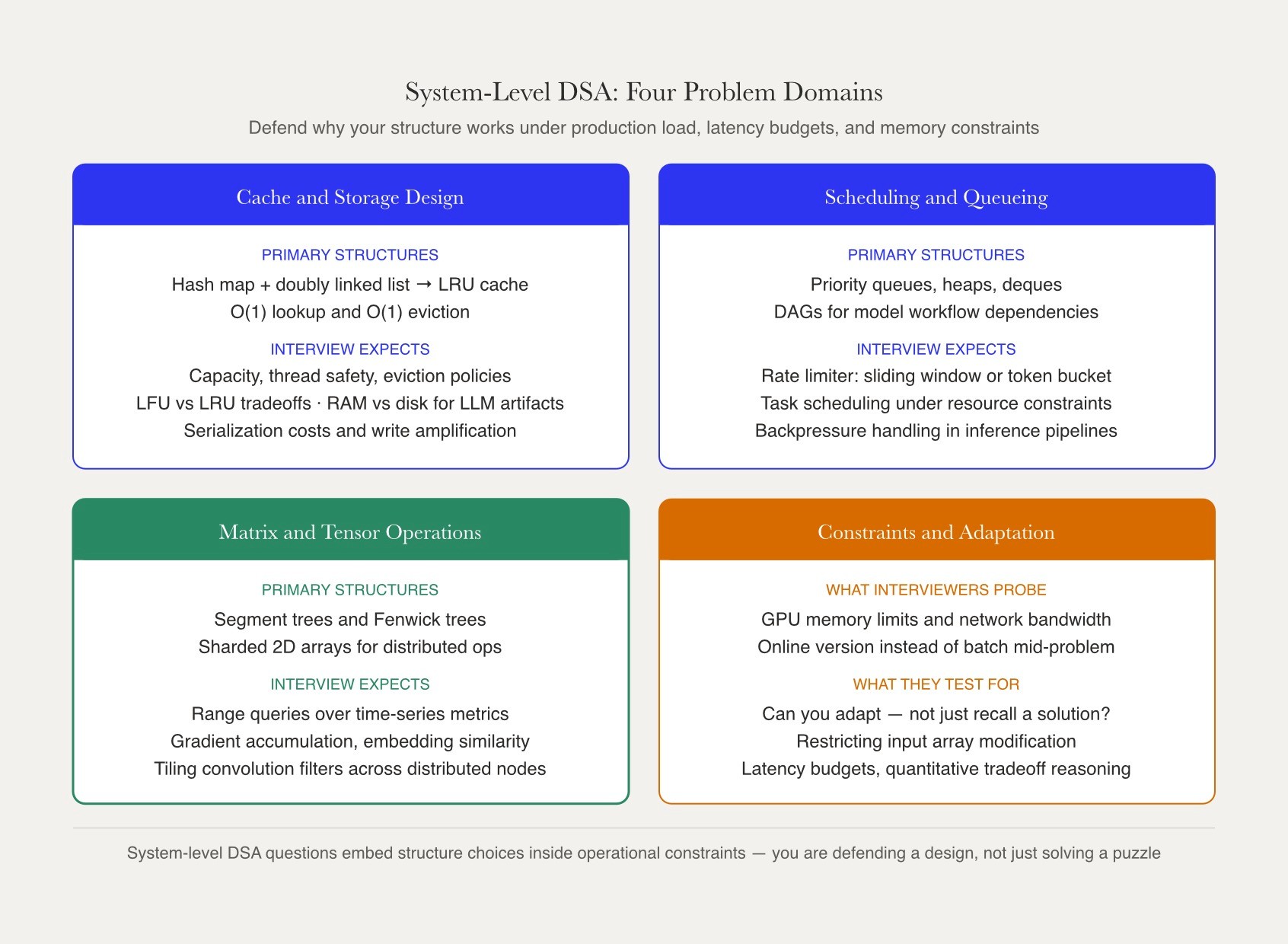
System-oriented DSA questions differ from pure algorithm puzzles in that they embed data structure choices within operational constraints. You are not just asked to solve a problem. You are asked to defend why your structure works under production load, in main memory or on disk, within a latency budget.
Cache and Storage Design
A classic example is designing an LRU cache. Combine a hash map for O(1) lookups with a doubly linked list for O(1) eviction. Discuss capacity, thread safety, and alternative eviction policies (LFU, random). You may also need to determine whether to store large language model artifacts in RAM or on disk, considering serialization costs and write amplification.
Scheduling and Queueing
Priority queues, deques, and heaps appear in job scheduling problems. Implementing rate limiters with a sliding window or token bucket algorithm requires you to count requests over time. Model workflows as DAGs backed by graph data structures, and discuss how to schedule tasks under resource constraints with backpressure handling.
Large-Scale Matrix and Tensor Operations
Interview problems may simulate sharding a given matrix, tiling convolution filters, or aggregating model outputs across dimensions. Range queries solved by segment trees or Fenwick trees show up when aggregating metrics across time windows. These map directly to gradient accumulation, embedding similarity computation, and distributed model serving.
Constraints and Quantitative Reasoning
Interviewers ask you to reason about algorithmic choices under GPU memory limits, network bandwidth, and latency budgets. They may change constraints mid-problem, asking for an online version instead of a batch, or restricting you from modifying the input array. These "AI-resistance" probes test whether you can adapt, not just whether you memorized a solution. Platforms like Fonzi can help align candidates with companies that value this kind of systems thinking, reducing time spent on misaligned whiteboard puzzles.
Fonzi Match Day for AI and Infrastructure Engineers
Fonzi is a curated hiring platform that helps software engineers connect directly with startups and growth-stage technology companies. Instead of relying solely on resumes or large applicant pools, Fonzi reviews candidates, helps refine their profiles, and matches them with companies based on technical skills, experience, and career goals. This approach can be especially valuable for AI, ML, infrastructure, and backend engineers whose strengths may be better demonstrated through technical depth and real-world project experience than through keyword-based screening.
Through Fonzi's weekly Match Day process, participating companies send salary-backed interview requests directly to engineers they want to meet. For candidates preparing for data structures and algorithms interviews, Match Day provides access to companies that still value strong DSA fundamentals while also evaluating system design, engineering judgment, and practical problem-solving skills. This can create opportunities with teams building AI platforms, developer tools, infrastructure products, and other technically demanding systems where applied reasoning matters as much as solving coding challenges.
Summary
Data structures and algorithms remain essential for AI, ML, software, and infrastructure interviews, but employers now focus on applying them to real engineering problems rather than memorized solutions. Candidates should be comfortable with core structures such as trees, graphs, hash maps, heaps, and linked lists, along with patterns like binary search, BFS, DFS, and dynamic programming.
Success in modern interviews depends on optimizing solutions, explaining tradeoffs, and connecting algorithmic choices to scalable systems such as LLM infrastructure, retrieval pipelines, and distributed platforms.
FAQ
How much time should a senior AI engineer allocate to DSA refresh before interviews?
Which data structures matter most for roles involving retrieval-augmented generation or vector databases?
Is dynamic programming still frequently asked in AI interviews?
How can I showcase DSA skills in system design or take-home projects?
How do curated marketplaces or structured hiring processes affect the intensity of DSA rounds?


