Second Round Interview Questions: What to Ask and Expect
By
Samara Garcia
•

Second-round interviews are where hiring teams separate qualified candidates from the strongest long-term hires. Rather than revisiting basic qualifications, this stage should evaluate problem-solving, role-specific expertise, collaboration, and overall fit with the team.
The questions you ask can have a significant impact on the quality of your hiring decisions. This guide explores the most effective second-round interview questions, what strong answers look like, and how to structure interviews that reveal a candidate's true potential.
Key Takeaways
The second round is when you move beyond basic qualifications from the first round and test real capability, culture fit, and long-term potential.
The best second interview questions are specific, behavioral, and tied directly to the role, team context, and your hiring decision criteria.
Candidates should leave the second interview understanding the role, the team, and the next steps in the hiring process.
Effective second round interview questions focus on strategic thinking and role-specific problem-solving, not generic prompts.
What Makes the Second Round Interview Different from the First Interview
In most modern hiring processes for knowledge-work roles, the second round interview sits between the initial screening and a final interview or offer stage. The first interview typically screens for basic qualifications, communication skills, and high-level culture fit, while the second round validates depth of skills, working style, and genuine interest in the role. Second-round interviews are less about confirming qualifications and more about understanding how candidates work. They are also an opportunity to explore prior answers and assess depth and consistency.
The second round often includes hiring managers, potential teammates, and sometimes cross-functional partners who influence the final round and hiring decision. In many companies, the second interview is either the final stage or the key step before an executive interview.
Core objectives for the second round include:
Confirm the candidate can handle day-to-day tasks involved in the role
Stress-test behavioral patterns through specific examples from past experiences
Assess culture fit and alignment with the team culture
Align on expectations around more responsibility and career goals
Evaluate technical skills and critical thinking at a deeper level
How to Prepare Your Second Round Interview Questions and Structure
Second-round interviews must be more structured and intentional than first-round interviews to reduce bias and avoid shallow assessments. A structured interview process also creates more consistent evaluations and improves hiring decisions, which is especially important when multiple interviewers are involved. Candidates should analyze their first interview performance and prepare for more in-depth behavioral and situational questions before the second round.
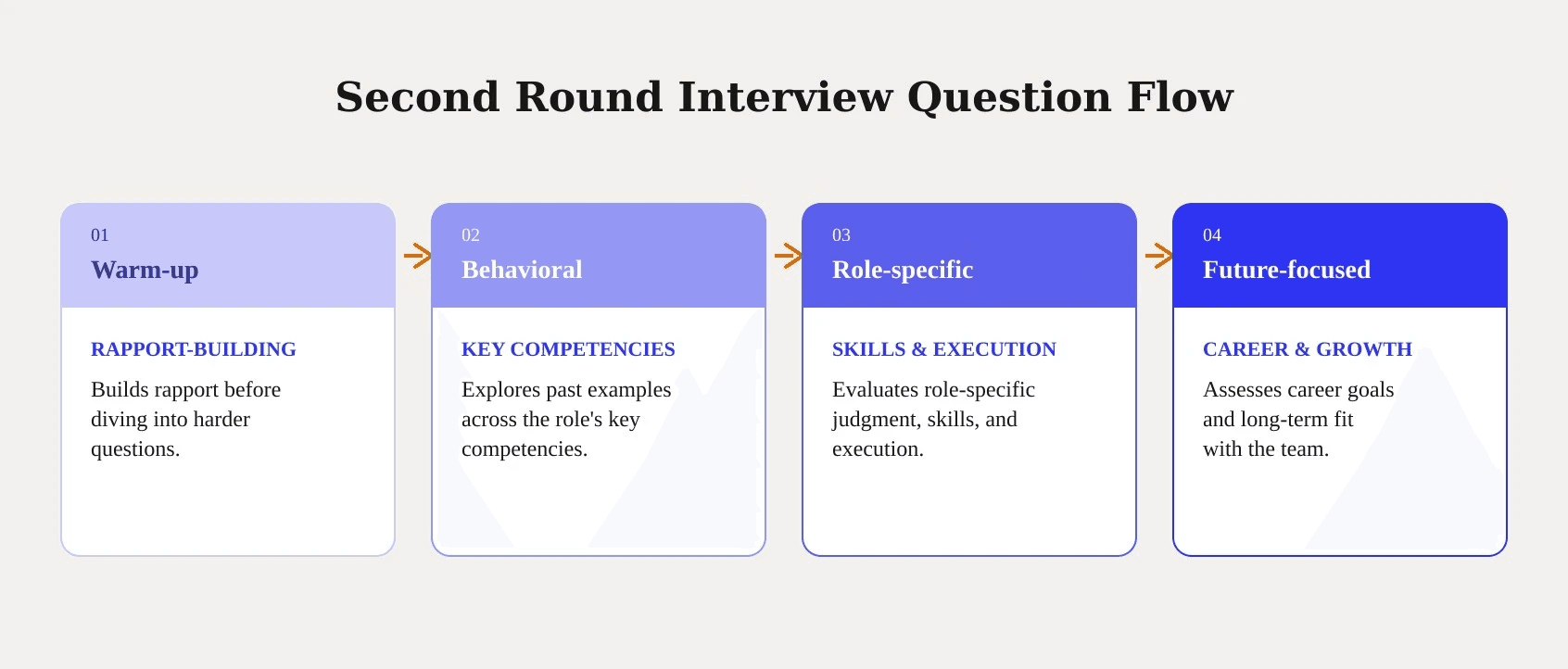
Map your interview questions directly to a short list of hiring criteria drawn from the job description: technical skills, problem solving, collaboration style, culture fit, and alignment with career goals. Sequence your questions so you start with rapport-building, progress to deeper behavioral questions about a time a candidate handled a specific challenge, then move to role-specific and future-focused questions.
Using a scorecard system can streamline the interview process and ensure every interviewer evaluates the same dimensions. Here are a few preparation tips:
Review notes from the previous interview and first-round interviews to avoid asking the same questions without added depth
Align as a panel on must-have competencies before the second round
Assign each interviewer a focus area (technical depth, culture, growth)
Prepare questions that are tailored to the function listed in the job description
Interviewers should understand how their team culture connects to the role so they can evaluate alignment more effectively during the second interview
Common Second Interview Questions to Deepen Skill Assessment
These round interview questions focus on validating hard skills and execution, not just high-level knowledge. Tailoring interview questions to the role improves candidate assessment, so each question below should be adapted for the specific function, whether the candidate is an engineer, a project manager, or an operations lead. Practicing responses to common second interview questions boosts confidence for candidates on the other side.
Consider these sample prompts :
"Walk me through the most complex project you have led end to end in the last 12 months." Probes scope management, technical depth, and leadership skills.
"Describe a time you had to deliver results with limited resources or tight deadlines." Tests prioritization, creative problem solving, and resilience.
"How have you measured the impact of your work in your previous role?" Evaluates analytical rigor and accountability.
"What is the most difficult technical tradeoff you have made recently, and what drove your decision?" Assesses critical thinking and skill set depth.
"Tell me about a process improvement you initiated. What changed and what did you learn?" Reveals initiative and a results-driven work ethic.
"How do you stay current with new skills and evolving tools in your field?" Tests growth mindset and curiosity.
"Give me an example where you had to communicate a technical concept to a non-technical stakeholder." Probes communication clarity.
These questions evaluate skills relevant to the job role. Encourage candidates to use specific dates, metrics, and tools in their answer. Follow up with "What did you do first?" or "How did you measure success?" to uncover depth. Failing to prepare specific examples can weaken responses significantly.
Behavioral Questions to Reveal Patterns, Not Just Stories
Behavioral questions assess past behavior to predict future performance, making the second round the right time to deploy several "Tell me about a time" prompts tied to real job challenges. Behavioral and situational questions help evaluate decision-making and adaptability. Candidates are often asked to describe specific past experiences, and behavioral questions often start with "Tell me about a time when..." to elicit concrete stories rather than hypotheticals.
Use these second-round interview questions:
"Tell me about a time you disagreed with a manager's decision and how you handled it." Targets conflict resolution and self-awareness.
"Describe a time a project did not go according to plan and what you did next." Evaluates resilience and accountability. Employers often ask about handling failure in second interviews.
"Give me an example of a time you had to learn something quickly to solve a problem." Tests learning agility and adaptability.
"Tell me about a time when you received critical feedback. How did you respond?" Reveals openness and thought processes.
"Describe a situation where you had to make a decision with incomplete information." Probes judgment under ambiguity.
"Tell me about a time you went above and beyond for a team or stakeholder." Assesses motivation and initiative.
The STAR method helps structure responses to behavioral questions (Situation, Task, Action, Result), and interviewers can guide candidates toward this format. Using the STAR method helps structure answers so responses are detailed and comparable. Candidates should avoid rehearsed answers to behavioral questions; interviewers will notice scripted responses that lack authentic detail. Listen for consistent patterns across answers. Vague answers can indicate a lack of accountability, and blaming others for failures is a red flag in candidates.
Culture Fit and "Culture Add" Questions for Long-Term Success
Culture fit is about shared values and working norms, not hiring clones. Cultural fit does not mean hiring similar candidates to avoid groupthink. Second interviews assess fit for the role and company culture at a deeper level than initial screens. Culture questions should assess alignment with team values, communication norms, and working expectations while avoiding a preference for candidates who simply resemble existing employees.
Ask these questions:
"What type of feedback helps you do your best work?" Listen for openness and communication preferences.
"Describe a time you had to adapt to a major change in priorities." Reveals adaptability and composure.
"What would make you excited to come to work every day in this role?" Assesses alignment with the company's mission and workplace culture.
"How do you prefer to work in a fast-paced environment versus a more structured one?" Spots mismatches in work environment expectations.
"What does a healthy team culture look like to you?" Uncovers values around open communication and collaboration.
"How do you contribute to employee morale when a team is under pressure?" Tests personal attributes and emotional awareness.
Ask about preferred work environment and recognition style to identify mismatches early, especially around remote, hybrid, or in-office expectations. Documenting responses to culture fit questions supports more consistent and fair hiring decisions across other candidates in the pipeline.
Career Goals, Motivation, and Future-Oriented Questions
The second round is the right stage to ask about career goals, growth expectations, and how the candidate envisions their future at your company. Candidates should discuss their motivations and long-term fit in second-round interviews, and second interviews may include salary discussions and long-term goals.
Use these prompts:
"Where would you like your career to be in three to five years, and how does this role support that?" Uncovers retention risk and ambition.
"What new skills are you focused on developing this year?" Tests growth mindset.
"What would make you decide to stay with a company long term?" Reveals what drives loyalty.
"How does this role compare to your current position in terms of scope and more responsibility?" Assesses expectations alignment.
"What about our company's goals attracted you to this opportunity?" Tests whether the candidate has researched the organization. Not researching the company can lead to poor interview performance.
"What kind of leadership skills do you want to develop next?" Identifies coaching and development needs.
Answers to these questions can guide future development plans and help managers align stretch projects if the candidate is hired. They also give candidates a chance to evaluate whether your organization can realistically support their professional trajectory.
Questions to Ask Candidates About Teamwork, Conflict, and Collaboration
The second round should clarify how the candidate behaves in real team settings, especially around disagreement and cross-functional work. Strong candidates adapt to team dynamics and contribute positively even under pressure, and soft skills like emotional intelligence are often the difference between a good hire and a great one.
Ask these questions:
"Tell me about a time you had to collaborate with a difficult colleague." Evaluates patience and professionalism.
"Describe a situation where you had to influence stakeholders without direct authority." Tests persuasion and communication.
"How do you prefer to handle conflict inside a team?" Reveals default conflict style.
"What role do you naturally take in team projects?" Probes self-awareness and team's success orientation.
"Tell me about a time when open communication prevented a problem from escalating." Tests proactive behavior.
"How do you balance your own priorities with supporting the broader team?" Assesses collaboration maturity.
Ask for examples from the last 12 to 24 months, so stories reflect recent working style rather than early-career situations. End by probing deeper: "What did you learn from that experience?" or "What would you do differently now?" External factors like organizational change or resource constraints often shape these stories, so listen for how the candidate navigated context, not just outcomes.
Smart Questions Candidates Should Ask You in the Second Round (and How to Prepare for Them)
Candidate questions are a strong signal of engagement, preparation, and genuine interest in the role. Before the second interview, candidates should research the interviewers and prepare thoughtful, role-specific questions. Asking informed questions also helps candidates evaluate whether the company and position are the right fit.
Expect strong candidates to ask questions like:
"What are the top priorities for this role in the first 90 days?"
"How does this team measure success year over year?"
"What does the team culture look like day to day?"
"How does performance feedback work here?"
"What is the biggest challenge this team faces right now?"
"How does this role contribute to the company's goals over the next year?"
These interviewers' questions reveal strategic thinking, focus on impact, and genuine interest in team dynamics. Hiring managers should prepare thoughtful, transparent answers about expectations, performance metrics, team structure, and decision timelines. A strong two-way conversation improves the candidate experience and strengthens trust, even for those who do not receive a job offer. A potential employer that invests in this exchange sends a clear signal about its values.
Structuring the Second Round: Formats, Panels, and a Sample Question Plan
Common second interview formats include panel interviews, back-to-back individual conversations, or a mix of case exercises and behavioral questions. A balanced second round interview should include behavioral questions and role-specific scenarios, and using a scorecard system can standardize evaluation across interviewers.
A sample 60 to 90 minute agenda:
Time Block | Focus Area | Owner |
0-10 min | Introductions and rapport | Hiring manager |
10-30 min | Behavioral questions (conflict, accountability) | Team lead |
30-50 min | Role-specific and technical depth | Technical interviewer |
50-70 min | Culture fit and career goals | Hiring manager |
70-85 min | Candidate questions and next steps | Panel |
Divide focus among interviewers so one covers technical depth, another covers culture fit and collaboration, and a third focuses on future growth and career goals. Keep a consistent core set of round interview questions across all candidates for fairness, while allowing each interviewer to add tailored follow-ups. Debrief soon after interviews so details about responses are still fresh when making the final hiring decision. This is where many organizations in the hiring process lose signal by waiting too long to compare notes.
Common Second Round Interview Mistakes and How to Avoid Them
Many organizations undermine the final interview stages with inconsistent questions, unprepared interviewers, or overreliance on gut feel. Improving your interviewing skills as a panel starts with recognizing these patterns and building process improvement into your approach. A career coach would advise the same: structure beats instinct.
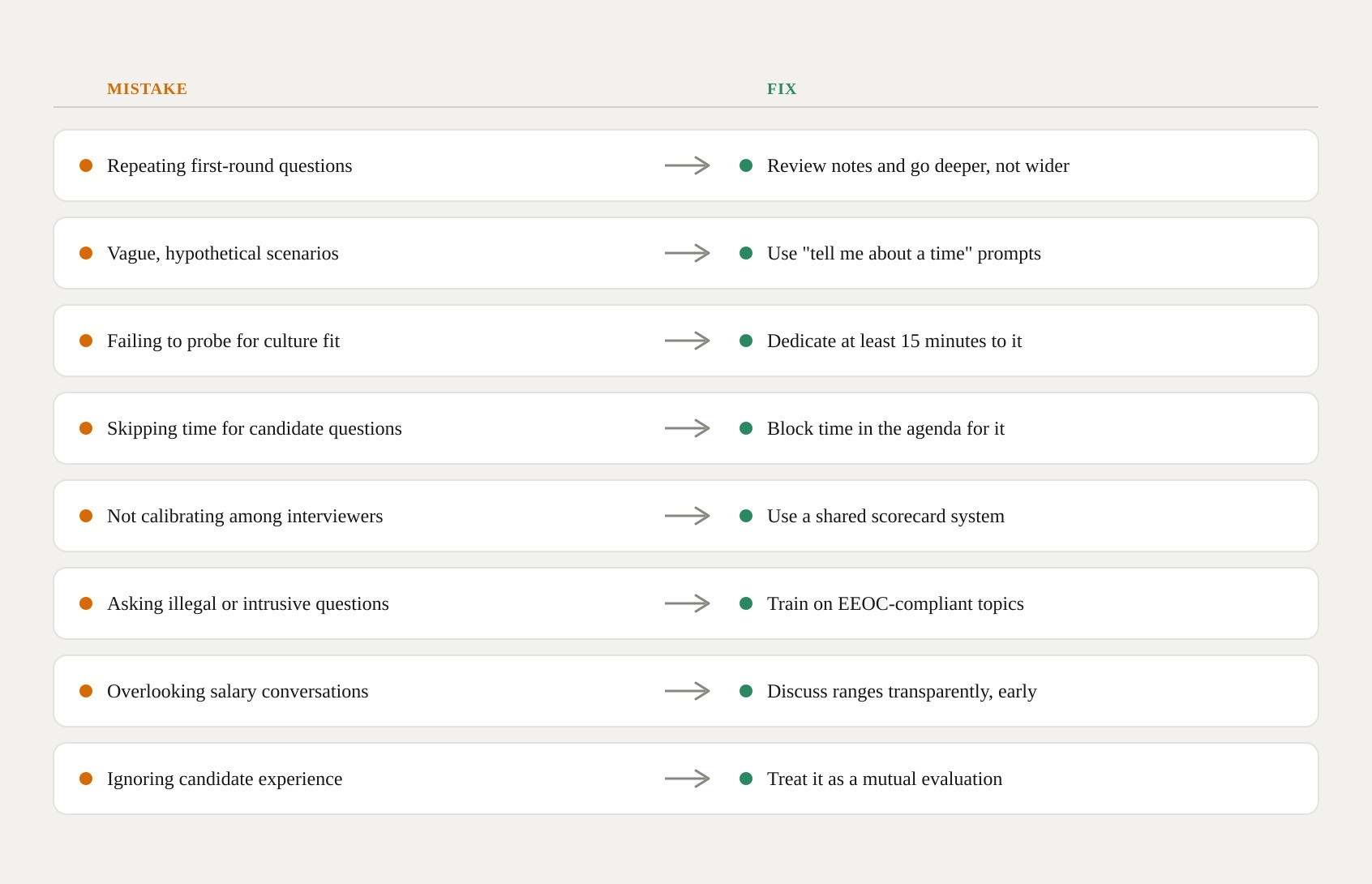
Common mistakes and fixes:
Repeating the same questions from the first round. Fix: review previous interview notes and go deeper, not wider.
Asking vague or hypothetical scenarios instead of behavioral questions. Fix: use "about a time" prompts with follow-ups.
Failing to probe for culture fit. Fix: dedicate at least 15 minutes to values and work style questions.
Skipping time for candidate questions. Fix: block time in the agenda and prepare questions for the candidate to ask.
Not calibrating among interviewers. Fix: use a shared scorecard so the best candidate is selected on evidence, not impression.
Asking illegal or intrusive questions. Fix: reference EEOC guidelines and train interviewers on compliant topics.
Overlooking salary expectations conversations. Fix: discuss salary ranges transparently in the second round to avoid late-stage misalignment.
Ignoring candidate experience. Fix: remember that candidates with positive hiring experiences are more likely to stay if hired.
A thoughtful second round improves both hiring outcomes and the overall candidate experience, even for those who do not receive an offer. When you treat the second round as a mutual evaluation, you attract stronger talent in your job search pipeline and build your reputation as a potential employer worth joining.
Finding Strong Candidates Faster with Fonzi
Even the best second-round interview questions only work if you're interviewing the right candidates. That's why many AI companies use platforms like Fonzi to build a stronger pipeline before interviews begin. Through recurring Match Day hiring events, companies meet pre-vetted software and AI engineers who have already been evaluated for their technical skills, allowing hiring teams to spend less time screening and more time using second-round interviews to assess deeper capabilities, collaboration style, and long-term fit.
For engineers, Match Day also simplifies the job search. Instead of applying to dozens of companies individually, candidates can create one profile on Fonzi and be matched with multiple AI startups and engineering teams looking for their skill set. Once interviews begin, structured second-round questions help both employers and candidates determine whether there's a strong mutual fit.
Summary
Well-designed second-round interview questions help distinguish between candidates who look good on paper and those who will truly excel in the role. Focusing on clear criteria, behavioral depth, and culture fit leads to more confident hiring decisions and stronger long-term performance. Platforms like Fonzi, which connect engineers with curated opportunities at AI startups, also benefit when both sides of the interview table are prepared with structured, thoughtful processes.
Review your current second interview question set and update it before your next hiring cycle. Consider creating or updating an internal interview guide so every hiring manager uses these improved second round interview questions consistently, ensuring you identify and hire the right person every time.
FAQ
How many questions should I plan for a typical second round interview?
Should second round interview questions repeat topics from the first interview?
How do I compare candidates fairly if different interviewers use different follow-up questions?
How can I combine case studies or practical tasks with live second round questions?
Is the second interview the right time to talk about salary expectations and work arrangements?


