Third Round Interview Questions: What to Ask and Expect
By
Samara Garcia
•

Reaching a third round interview means you've already demonstrated the technical skills needed for the role. At this stage, hiring teams are evaluating what it will be like to work with you day to day, including your leadership, communication, decision-making, and long-term potential within the company.
The third interview is often the deciding stage, where small differences between finalists can influence the final hiring decision. This guide explains what to expect, the questions you're likely to face, the best questions to ask your interviewers, and how to prepare strategically using what you learned in earlier rounds.
Key Takeaways
Reaching a third or final round interview means you are among the top candidates, but a third interview does not guarantee a job offer.
Third round interview questions are usually deeper, more behavioral, and more focused on long-term impact, leadership skills, and overall workplace culture rather than technical fundamentals.
Candidates should prepare their own in-depth questions to ask about the technical roadmap, hiring manager expectations, and cross-functional collaboration.
Understanding the Third Round Interview in Modern AI Hiring
The hiring pipeline for AI engineers, ML researchers, infra engineers, and LLM specialists follows a common pattern. The first interview is usually a recruiter screen earlier in the interview cycle, followed by a hiring manager call, then one or more technical rounds (often including take-home tasks or system design exercises). By the time a candidate reaches the third round interview, the conversation shifts toward fit, scope, and strategic impact. Employers use multiple interview rounds to narrow the candidate pool systematically, and the AI Engineer Hiring Report from Recruits Lab confirms that senior AI engineering roles now involve deeper technical loops, more rounds, and longer approval cycles.
For senior and staff-level roles, the third interview is often the first conversation with a director, VP of Engineering, Head of AI, or CTO. Companies use this round to reconcile feedback from previous interviews and decide between two or three final candidates. Many organizations now use AI tools and structured scorecards to summarize earlier round evaluations, so the final conversation can focus on deeper, more strategic questions rather than repeating the same questions from round one.
How Your Chances Change By the Third Interview
Being invited to a third interview means you have survived significant filtering. By the third interview, employers have typically narrowed the candidate pool substantially, although the number of remaining candidates varies by company and hiring process. Research aggregated by Coursera found that candidates who undergo three interviews have about a 51% chance of receiving an offer, though real-world ranges depend on role specificity, company size, and process structure.
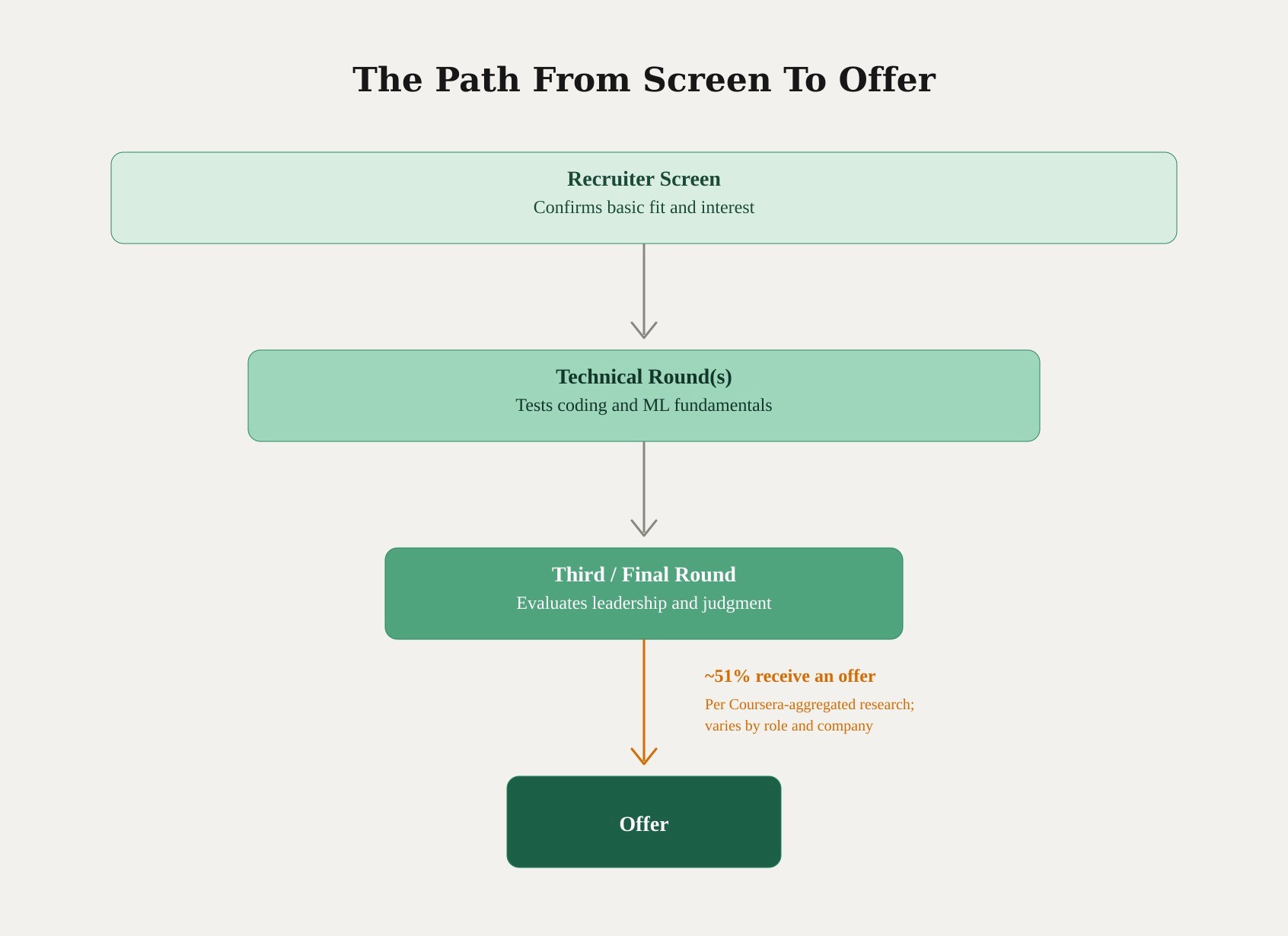
Final interviews are not just a formality. Hiring decisions can still come down to small differences between finalists, compensation discussions, references, or team fit. Positive signs, such as conversations about start dates or onboarding, are encouraging but not guarantees. The best way to improve your chances is to understand the purpose of this round and prepare for targeted third round interview questions.
What To Expect: Common Third Round Interview Question Themes
By the third round, the final conversation usually shifts from "Can you code?" to "How do you make decisions and collaborate over time?" Companies use third interviews to assess cultural fit, and third interviews allow candidates to address any concerns that surfaced in earlier rounds.
Expect behavioral questions that probe leadership, conflict resolution, and dealing with ambiguous research or infrastructure tradeoffs. Behavioral interview questions often start with "Tell me about a time when," and employers use behavioral questions to assess cultural fit and how candidates handle real work situations. The STAR method (Situation, Task, Action, Result) helps structure responses to these prompts. Examples of behavioral questions include handling mistakes and demonstrating leadership in high-stakes environments.
You should also expect intensive questions about previous high-impact projects, production incidents, or research pivots, and how you justified your choices to stakeholders. Topics that frequently appear in AI-specific final interviews include responsible AI practices, evaluation of LLM behavior, privacy concerns, and experimentation velocity. Candidates should expect some overlap with earlier interview questions, but hiring managers will be looking for richer, more strategic answers in this final round. Think of it as the difference between describing what you did and explaining why it mattered.
Key Third Round Interview Questions You Are Likely To Be Asked
This section covers concrete question types that senior AI candidates often encounter at the third interview stage. These are not screening questions. They are designed to reveal judgment, skill set breadth, and comfort operating under ambiguity.

In-depth questions may include such things as:
"How do you decide what to ship versus what to research longer, and who do you involve in that decision?"
"Describe a time you changed a model or system that another team strongly opposed. How did you navigate the disagreement?"
"Tell me about a time you had to prioritize competing deadlines across research and production deliverables."
"Walk us through a past example where you managed stress during a critical launch and what you would do differently."
Behavioral questions around working with product and leadership may sound like:
"Tell me about a time you disagreed with a hiring manager or VP about technical direction and how you resolved it."
"How do you manage competing deadlines when both your research lead and your product partner consider their work the top priority?"
Strategic questions probe long-term planning:
"What would your 30, 60, and 90-day plan look like joining our applied LLM team?"
"What career goals would you want to pursue in this position over the next two years, and how do growth opportunities here support them?"
Culture and management style prompts include:
"How do you want your manager to support you, and what does a good fit between you and a team look like?"
"What environment brings out your best work across research, infrastructure, and delivery? Describe a fast-paced or more structured environment where you felt most productive."
High Leverage Questions To Ask The Hiring Manager In The Third Interview
The questions you ask in the final interview materially affect how senior leadership perceives your seniority and judgment. Questions reveal your priorities and genuine interest in the role, and a weak set of questions can undermine an otherwise strong performance. Prepare at least three informed questions for the end of the interview that demonstrate knowledge of the role and company.
Strong examples for AI and ML roles include:
"What is the biggest technical risk for this team in 2026, and how would this person help reduce it?" Asking about the biggest problem to solve is highly recommended, as it signals you are thinking about immediate value.
"How does this group measure success for LLM-based features over the first six months and the first year?"
"How do you give feedback to senior engineers when a design review goes poorly, and what does your management style look like in those moments?"
"Can you describe how this team collaborates with research and infra, and where the friction points are today?"
"What does professional development look like for someone in this position? Are there learning opportunities tied to new model architectures or tooling?"
"How does the team stay organized when balancing exploration versus production commitments?"
"What shared characteristics do the most successful new employees on this team tend to have?"
Inquire about learning opportunities to show eagerness to grow. Choose which questions to ask based on what earlier interviews did not cover. Avoid asking about salary until a formal offer is made. Detailed salary negotiation is best handled after a written offer, not during the final conversation with a senior leader. Focus your questions on showing that you are interested in delivering impact, not just evaluating perks.
Comparing Earlier Rounds To The Third Interview
Think of the interview process as a progression. Early rounds focus on technical skills, while third round interviews evaluate decision-making, collaboration, and long-term fit. Keep your story consistent, but add new examples and details each round to build a complete picture of your experience and strengths.
Example Comparison Table For Interview Rounds
Round | Primary Focus | Typical Interviewers | Common Question Types | What To Prepare |
First Interview (Screening) | Resume validation, role interest, basic fit | Recruiter, sometimes hiring manager | Background walkthrough, motivation, clarifying questions about the job | Concise career narrative, research on company mission |
Second Interview (Technical) | Coding, ML fundamentals, system design | Engineers, tech leads, ML scientists | Take-home model evaluations, infra design reviews, research deep dives, algorithm problems | Hands-on examples, code walkthroughs, published work |
Third or Final Round (Strategic) | Culture, leadership, long-term impact, decision making | Directors, VPs, CTO, cross-functional partners | Behavioral questions, 90-day plans, thoughtful questions about team and roadmap, strategic tradeoffs | New behavioral examples, interviewer research, targeted questions to ask |
Preparing Strategically For Your Third Interview
Senior job candidates should treat third round prep as synthesis work, using all information gathered so far to refine their story and demonstrate knowledge of the role and company during the interview. Review your notes from previous interviews, job description details, and any take-home feedback to anticipate follow-up topics or concerns. Prepare for behavioral interview questions in the third interview by identifying 3 to 5 new examples that highlight breadth, such as incidents across research, infra, reliability, and cross-team leadership.
Specific preparation tasks include simulating executive-level conversations with a trusted peer, practicing concise answers that a risk taker or senior leader would respect, and preparing a short narrative about your first 90 days tailored to this role. Communicating a genuine enthusiasm for the role is critical during the interview process, and your course of preparation should reflect that.
After the interview, send a follow-up email within 24 to 48 hours. Thank the interviewer for their time, reiterate your excitement for the role, and include a recap of why you are a good fit in your email. If you do not hear back, follow up again after one week. Platforms like Fonzi can reduce noise in the process by aligning expectations between candidates and hiring teams before late-stage interviews, while keeping final decisions human-led.
Reach Better Final-Round Opportunities with Fonzi
Getting to a third round interview means you're close to receiving an offer, but reaching that stage consistently starts with applying to the right opportunities. Rather than spending hours applying across multiple job boards, Fonzi's Match Day connects software engineers, AI engineers, ML engineers, and infrastructure engineers with companies that are actively hiring for their skills.
With one profile, you can be considered by multiple employers during each Match Day, giving you access to opportunities that match your experience and career goals. That means you can spend less time searching for your next role and more time preparing for the interviews that matter most, including the final rounds where leadership, communication, and long-term impact often determine who receives the offer.
Summary
Third round interviews focus less on technical ability and more on how you lead, communicate, make decisions, and contribute over the long term. Hiring managers use this stage to distinguish between the final candidates, evaluating leadership, collaboration, strategic thinking, and cultural alignment. Expect deeper behavioral and situational questions, along with discussions about your past impact, plans, and how you approach complex decisions.
Preparation should build on earlier interview rounds by refining your examples, anticipating follow-up questions, and preparing thoughtful questions about the team's roadmap, leadership, and success metrics. The strongest candidates demonstrate sound judgment, clear communication, and a genuine understanding of how they can create value beyond their technical skills.
FAQ
How long does it usually take to hear back after a third interview for an AI or ML role?
Should I bring up salary again in the third or final interview if it has already been discussed?
How can I tell if the third interview is truly a final round or if more steps are coming?
What should I do if I feel I underperformed in a third interview?
Is it reasonable to ask for feedback if I get rejected after a final round interview?


