What Is a Forward Deployed Engineer?
By
Samara Garcia
•

Since around 2020, AI solutions and complex SaaS platforms have exposed a persistent gap between what technology can do and the business outcomes organizations actually achieve. Traditional product engineers and backend teams, focused on building features for many customers at once, are often too far removed from the operational realities of any single customer to close that gap. This disconnect set the stage for the rise of the forward-deployed engineer, a role purpose-built to embed with clients and deliver real value where it matters most. The rest of this article unpacks what a forward-deployed engineer is, how FDEs work in practice, the essential skills required, and how engineers can pursue this career path.
Key Takeaways
Forward-deployed engineers (FDEs) embed directly with customers to build, deploy, and maintain production systems, bridging the gap between software products and real business outcomes.
The role combines strong software engineering skills with customer communication, problem-solving, and business understanding, making it especially valuable for AI and enterprise software deployments.
As AI adoption grows, demand for FDEs continues to rise because companies need engineers who can integrate complex technologies into real-world workflows and drive measurable results.
Definition: What Is a Forward Deployed Engineer?
An FDE is a customer-facing software engineer embedded in a client's environment. Forward-deployed engineers work directly in a customer's environment to deploy complex systems, adapt them to real-world conditions, and maintain them through ongoing iteration. Unlike product engineers who build features for many customers at once, or consultants who may advise without owning production code, FDEs build, ship, and support live systems under a customer's actual constraints.
The term originated in the early 2010s at Palantir Technologies, where engineers called "Deltas" embedded with government and commercial clients to integrate the company's data platforms into complex operational workflows. By 2009, Palantir had roughly 120 forward-deployed software engineers, and for years it employed more FDEs than core product engineers. Often described as the "special forces" of engineering, FDEs bridge technical and business teams to ensure that software platforms produce outcomes in practice, not just in demos.
By the mid-2020s, the forward-deployed engineer model had spread well beyond Palantir. AI companies, enterprise software vendors, and cloud platforms adopted it. Organizations struggle with the post-deployment value gap in AI, where powerful models sit unused because nobody connected them to existing systems and business processes. FDEs are expected to deliver measurable business outcomes such as reduced cycle times, cost savings, or risk reduction, and they are measured on those results rather than on tickets closed or features shipped.
How Forward Deployed Engineers Differ From Other Customer-Facing Roles
FDEs overlap with job titles like solutions architect, sales engineer, and professional services engineer, but the distinction lies in hands-on implementation and production code ownership. FDEs are a hybrid role combining software engineering, data science, and consulting. They do not just recommend or demo; they build, deploy, and maintain. This is what allows forward-deployed engineers to help bridge the gap between technical capability and operational reality in ways that adjacent roles typically cannot.
Role | Primary Focus | Typical Responsibilities | Ownership of Production Code |
Forward Deployed Engineer | Shipping and maintaining custom solutions in a customer environment to achieve business outcomes | Scoping needs, designing architecture, writing code, building data pipelines, custom integrations, monitoring, continuous improvement | High: builds, deploys, and maintains production systems |
Solutions Architect | Designing system architecture during pre-sales and early implementation | Architecture proposals, feasibility assessments, integration patterns, guiding technical strategy | Medium-low: often hands off to engineering teams |
Sales Engineer | Supporting the sales process with technical credibility | Product demos, technical evaluations, proof-of-concept support, answering objections | Low: no long-term code ownership |
Professional Services Engineer | Post-sales implementation and configuration | Customizing product, integrating with legacy systems, training, deployment support | Medium: temporary ownership, less product feedback |
Core Responsibilities of a Forward Deployed Engineer
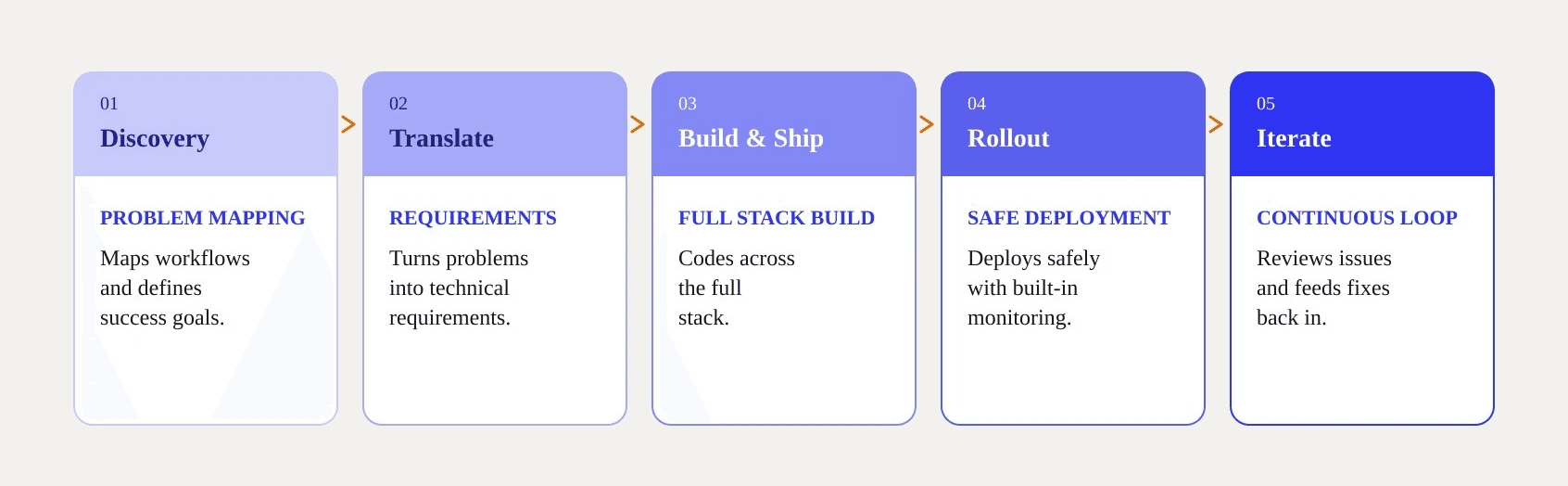
FDEs own the full lifecycle of a deployment inside one customer or a small number of accounts. Key responsibilities of FDEs include implementing, production coding, and troubleshooting across every stage from discovery through continuous improvement. This end-to-end ownership is what distinguishes the role from narrower positions.
Concrete responsibilities include:
Running discovery sessions with operations, data, legal, and business stakeholders to map workflows, identify pain points, and define success metrics before building anything.
Translating ambiguous business problems into technical requirements and architectural designs.
Writing and reviewing code across backend services, APIs, data pipelines, front-end dashboards, and custom integrations with existing infrastructure.
Leading production rollouts using safe deployment patterns, and implementing observability and monitoring so that issues surface early.
Running post-incident reviews when production issues occur in a customer environment, then feeding fixes and stability improvements back into the system.
FDEs help ensure solutions are usable and aligned with business needs by maintaining a continuous loop of feedback and iteration. They accelerate technology adoption by designing workflows around user behavior, analyzing telemetry, gathering input from customer teams, and refining integration logic, model prompts, or process steps so that outcomes keep improving over months. FDEs create tailor-made solutions for individual customers, but the best ones also package reusable artifacts (runbooks, templates, monitoring dashboards) that benefit future deployments.
Essential Skills for Success as a Forward Deployed Engineer
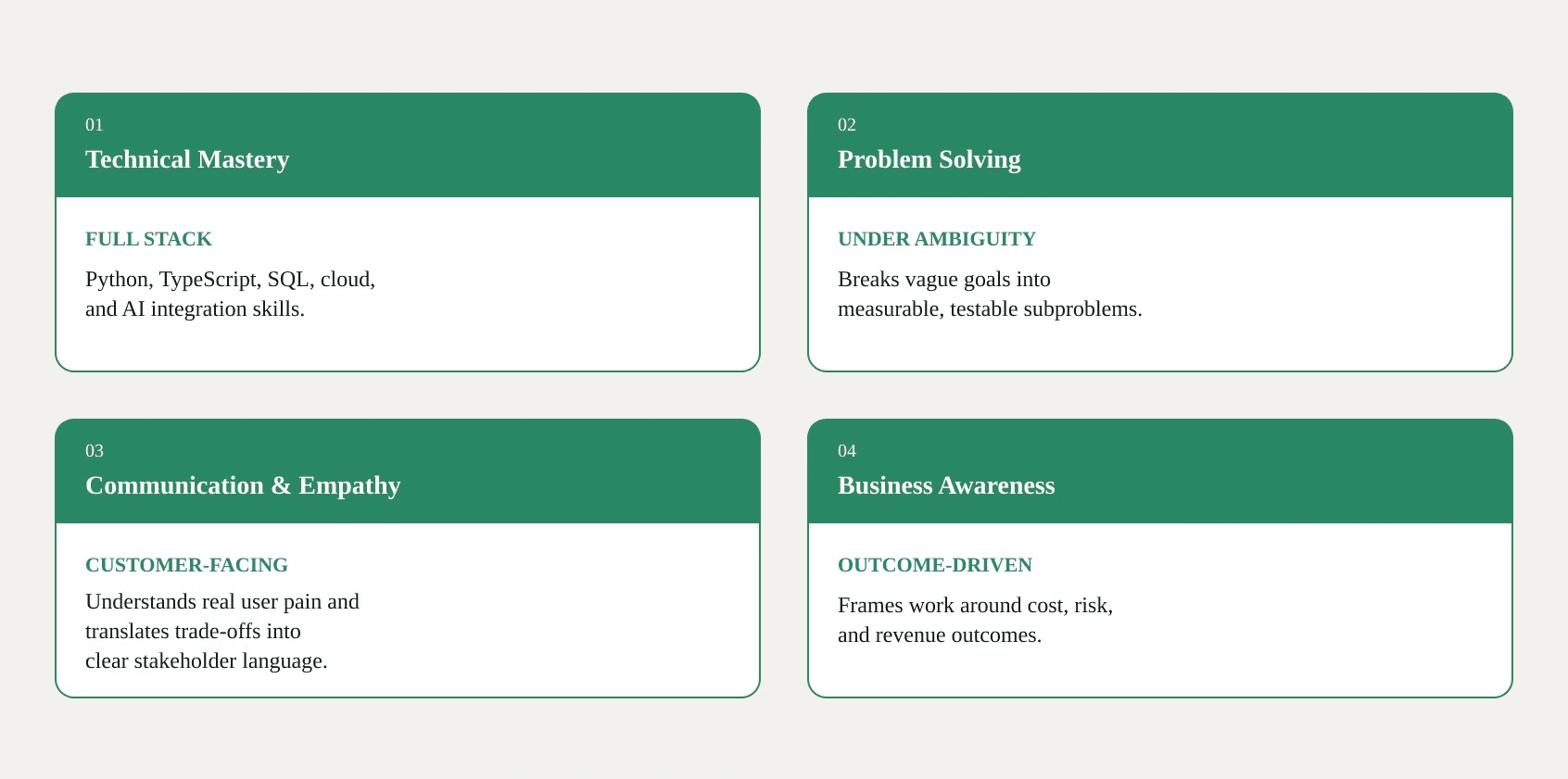
The best engineers in forward-deployed roles blend strong programming and software engineering foundations with customer-facing, problem-solving, and business skills. No single "perfect profile" exists. Some FDEs lean toward data engineering, others toward front-end or infrastructure. In the AI era, modern FDEs often need fluency with AI solutions and data-intensive systems on top of classic full stack skills. What follows breaks the skill set into four areas, each covered below.
Technical Mastery and Full Stack Capability
FDEs frequently touch backend services, APIs, data pipelines, and front-end interfaces within a single engagement. Practical full stack capability matters more than extreme depth in one layer. Technologies that appear consistently in mid-2020s forward-deployed engineer listings include Python, TypeScript, SQL, cloud platforms (AWS, GCP, Azure), and containerization tools like Docker and Kubernetes.
For AI companies, forward-deployed engineers often implement retrieval-augmented generation, connect large language models to private data sources, and configure access control and observability around AI models. Building software that is production-ready means investing in logging, error handling, security basics, and safe rollout patterns such as feature flags or canary releases. Rapid prototyping skills matter too, since FDEs frequently need to produce working prototypes quickly to validate ideas with customer teams before committing to full implementation.
Problem Solving Under Ambiguity
Forward-deployed engineers rarely receive complete specifications. Instead, they work with evolving requirements from business teams in industries like finance, healthcare, logistics, or the public sector. Strong FDEs break down vague goals (such as "reduce manual review time" or "automate call center workflows") into measurable subproblems, then run small experiments or pilots to validate assumptions.
Ambiguity shows up everywhere: inconsistent data quality, unclear ownership of existing systems, conflicting stakeholder priorities across regions, or compliance requirements that differ by geography. In AI-heavy deployments, FDEs must evaluate whether model quality is sufficient for a specific use case and what guardrails are needed. Product discovery in this context means figuring out not just what to build, but whether the underlying data and processes can support the solution at all.
Communication, Empathy, and Customer-Facing Skills
FDEs spend significant time with non-technical business stakeholders, so clear communication is non-negotiable. They must translate trade-offs, system behavior, and risks into language that executives and frontline users understand. Practical behaviors include running structured discovery workshops, documenting decisions, and presenting technical impacts on metrics like error rates, handle time, or revenue.
Empathy is an essential skill because forward-deployed engineers must deeply understand real user pain, day-to-day workflows, and organizational politics. A solution that ignores how people actually work on the ground will either get rejected or misused. These customer-facing skills are a core part of what distinguishes empowered engineers in forward-deployed roles from purely internal product engineers focused on building features for a broad audience.
Business Awareness and Outcome Orientation
A forward deployed engineer frames work in terms of business outcomes (cost reduction, risk mitigation, new revenue, improved service levels) rather than only technical outcomes. FDEs must possess both technical depth and business fluency, collaborating with customer sponsors to define key performance indicators before implementation begins. For example, a target might be a specific percentage drop in ticket resolution time or a measurable increase in center automation rates.
In the AI era, many forward-deployed engineers help design outcome-level agreements, where success is tied to AI solution performance (deflection rates, classification accuracy, drift thresholds) instead of just uptime. Basic fluency in finance, operations, and industry-specific regulations helps FDEs make better architectural decisions that ensure technology aligns with the customer's risk and compliance requirements. This orientation toward measurable business outcomes is what makes the role so valuable to large enterprises.
Forward Deployed Engineers in AI Companies and the AI Era
From around 2022 onward, enterprise interest in generative AI created a surge in demand for forward-deployed engineers who could connect AI models to real workflows and data. Organizations quickly learned that AI systems often fail due to poor integration with existing workflows, not because the underlying models are weak. An estimated 95% of generative AI projects fail to deliver measurable ROI, and much of that failure traces back to the gap between a proof of concept and a production system that delivers real value.
AI companies like OpenAI, Anthropic, and Scale AI, along with cloud platforms like AWS and Microsoft Azure, responded by building dedicated FDE teams. AWS committed a $1 billion investment in its forward-deployed segment. OpenAI launched "DeployCo," acquiring an engineering consultancy to bring FDE capacity in-house. FDEs are used in sectors like AI, SaaS, and government for technical deployment and support at scale.
Typical AI-specific responsibilities include integrating large language models with CRM or ticketing systems, managing retrieval pipelines, implementing human-in-the-loop review, and configuring monitoring for bias or drift. FDEs address the "Last Mile" problem by integrating new technology into existing workflows, handling security reviews, data residency requirements, change management, and user training for customer-facing teams. In many organizations, forward deployed engineering has become the key mechanism for turning AI potential into measurable business outcomes.
Career Path: How to Become a Forward Deployed Engineer
Most forward deployed engineers start as software engineers, data engineers, or full stack developers, then move toward more customer-facing work over time. The transition is gradual, and continuous learning matters more than a single credential.
A practical roadmap looks something like this:
Build strong coding fundamentals and gain experience with production systems, including on-call rotations, reliability work, and software development best practices.
Take on integration projects or partner with customer success and professional services teams to solve problems for key accounts. This builds familiarity with how business processes differ across multiple customers.
Volunteer for high-stakes customer projects or join internal "labs" or solutions engineering teams that sit close to customers and practice hands-on implementation.
Develop deep domain knowledge in a vertical (finance, healthcare, logistics) to sharpen your ability to adapt workflows and solve problems that matter to business teams.
Engineers who already thrive in cross-functional settings and naturally bridge product teams and customer teams are strong candidates for forward-deployed engineering roles. Curated talent platforms like Fonzi, which connect experienced engineers with AI startups, can sometimes expose engineers to FDE-style work where they build solutions for a single customer in a high-impact context.
Demonstrable experience with systems in production, including custom integrations, observability, scaling, and monitoring, is what differentiates forward-deployed engineers from candidates with only internal or non-production code experience.
Is the Forward Deployed Engineer Role Right for You?
Forward-deployed engineering is rewarding, but it is not a fit for every personality or career goal. The role suits individuals who enjoy frequent context switching, feel comfortable in customer meetings, and prefer real-world problem solving over pure algorithmic research.
Traits that align well with the role include:
Enjoying variety across technical domains and business contexts
Being energized (not drained) by direct interaction with business stakeholders and end users
Preferring ownership of outcomes over narrow specialization
Thriving under ambiguity and shifting requirements
Trade-offs exist. Some companies require substantial travel or extended time with customer teams. Exposure to non-technical stress, like executive reviews and shifting business priorities, is constant. Engineers must reprioritize based on business needs, not only technical elegance.
If you already find yourself informally bridging gaps between sales, product, and engineering, or if you gravitate toward cross-functional projects, you are a strong candidate for a forward-deployed path. In the AI era, combining strong engineering skills with customer-facing experience is likely to remain valuable, whether or not someone carries the explicit title "forward deployed engineer."
Find Forward Deployed Engineer Opportunities with Fonzi
Forward deployed engineer roles are still relatively uncommon, especially in AI startups, so many openings are filled through specialized hiring channels rather than large job boards. If you're interested in this career path, platforms like Fonzi can help you discover opportunities with AI companies looking for engineers who combine strong technical skills with customer-facing problem-solving.
Instead of spending time applying to hundreds of jobs, you can create a single profile on Fonzi and join its recurring Match Day hiring events. Companies searching for AI engineers, infrastructure engineers, full-stack developers, and other technical talent review pre-vetted candidates at the same time, making it easier to connect with startups building production AI systems. While not every role carries the title "Forward Deployed Engineer," many involve the same blend of implementation, customer collaboration, and real-world deployment that defines the position. If you're looking to break into forward-deployed engineering, it's a practical way to find companies where those skills are in high demand.
Summary
Forward-deployed engineers sit at the intersection of software, AI solutions, and business operations, turning complex technology into measurable business outcomes for the organizations that adopt it. The role grew out of companies like Palantir and has become central to many AI companies that need to deliver real value in messy, regulated, customer-facing environments. Whether you are an engineer exploring new career directions or a leader evaluating how to close the gap between your product and your customers, the FDE model deserves serious consideration. Explore forward-deployed opportunities inside your current organization, look for roles at AI companies and software platforms that prioritize embedded engineering, or check curated marketplaces such as Fonzi as one path to find work with the same DNA as forward-deployed engineering.
FAQ
What background do you need to become a forward deployed engineer?
Do forward-deployed engineers have to travel frequently?
How are forward-deployed engineers typically measured and compensated?
Does FDE always mean Forward Deployed Engineer?
How do forward-deployed engineers collaborate with core product teams?


