Questions to Ask Before Joining a Startup Built on AI
By Samara Garcia

The questions to ask before joining a startup built on AI test startup runway, gross margin, model dependence, legal exposure, and equity terms. How specific the founders' answers are tells you as much as what they say. On top of the usual startup risks, AI companies carry compute costs and legal exposure that generic startup advice misses, and either can shorten runway or erase equity value.
Before joining an AI startup, ask whether the company will survive long enough for equity to matter, and whether the technical work justifies leaving stable, liquid compensation at a large tech company.
Key Takeaways
- AI startups add financial and legal risks that generic checklists can miss. Check whether the reported runway includes GPU infrastructure, model API spending, data costs, and planned hiring before you join.
- Character.AI’s October 2026 Chapter 11 filing shows why legal and regulatory exposure deserves its own investigation, separate from an AI startup’s commercial prospects.
- Specific founder explanations of burn, model dependence, and defensibility are better evidence than headline funding announcements. Weigh concentrated equity risk against the liquidity and structure of a larger company.
Why Joining an AI Startup Carries Different Risks
Foundation models, GPU supply constraints, and fast model release cycles create risks that a traditional early-stage startup doesn’t face. An AI startup may depend on external providers whose pricing, terms, or model behavior can change with little notice. The pace of new open and closed model releases means a product’s competitive advantage can erode in months, not years. These dynamics sit on top of the usual risks around hiring, product-market fit, and market timing.
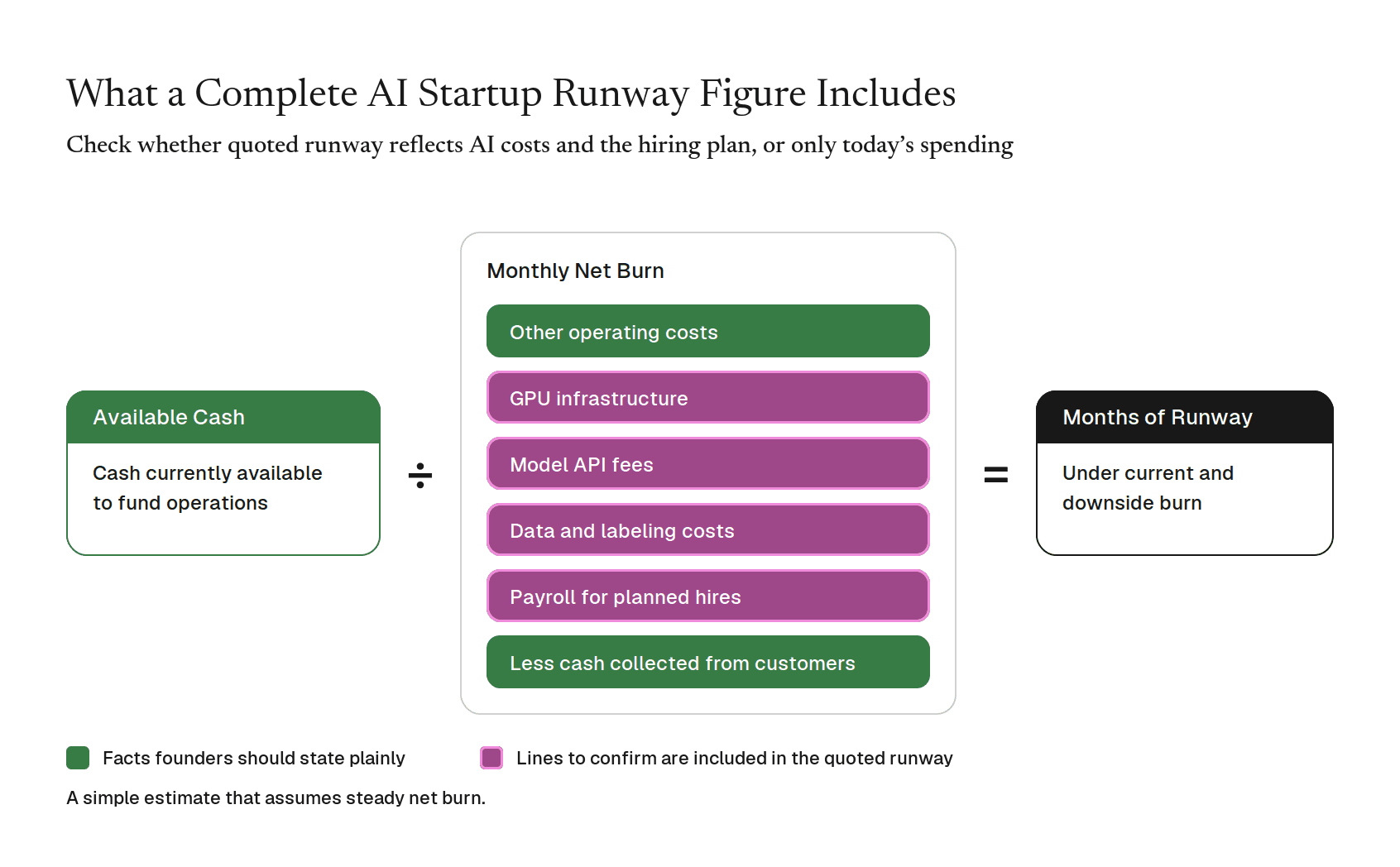
GPU infrastructure, model API fees, and data labeling costs can materially affect burn rate and true runway compared with traditional SaaS, so check which of these founders include in their runway calculation. Dependence on external model providers also affects margins, latency, and the ability to ship features. If a provider raises prices or changes usage limits, the business model can shift overnight. That’s why the team’s plan matters, whether it’s multi-provider routing, in-house fine-tuning, or contract protections.
Legal and regulatory exposure adds another layer. AI companies face content harm claims, IP licensing disputes, and evolving regulation that non-AI startups rarely encounter. Character.AI’s October 2026 Chapter 11 filing, covered below, shows how legal pressure can affect an AI startup even when it has valuable IP deals. It’s not a universal pattern, but it’s why anyone joining a startup built on AI needs a different set of questions.
Questions to Ask Before Joining a Startup
The questions to ask before joining a startup built on AI should test its financial resilience, technical dependencies, legal preparedness, equity terms, and expectations for your role. The table below lists each question, why it matters at an AI startup, and what a weak answer sounds like. Strong answers separate current facts from assumptions and give concrete figures, provider names, and time frames where disclosure is appropriate. Reasonable confidentiality limits are not the same as evasiveness, and the subsections that follow explain how to tell the two apart.
Question to ask before joining a startup | Why it matters at an AI startup | What a weak answer sounds like |
How many months of runway do you have, and does that include GPU, model API, and data costs plus planned hiring? | Compute can be the largest line item; excluding it inflates runway | "We have plenty of runway" with no month count or cost breakdown |
How do you forecast compute spend if user volume doubles? | Inference costs can scale non-linearly with usage | "We will figure it out when we get there" |
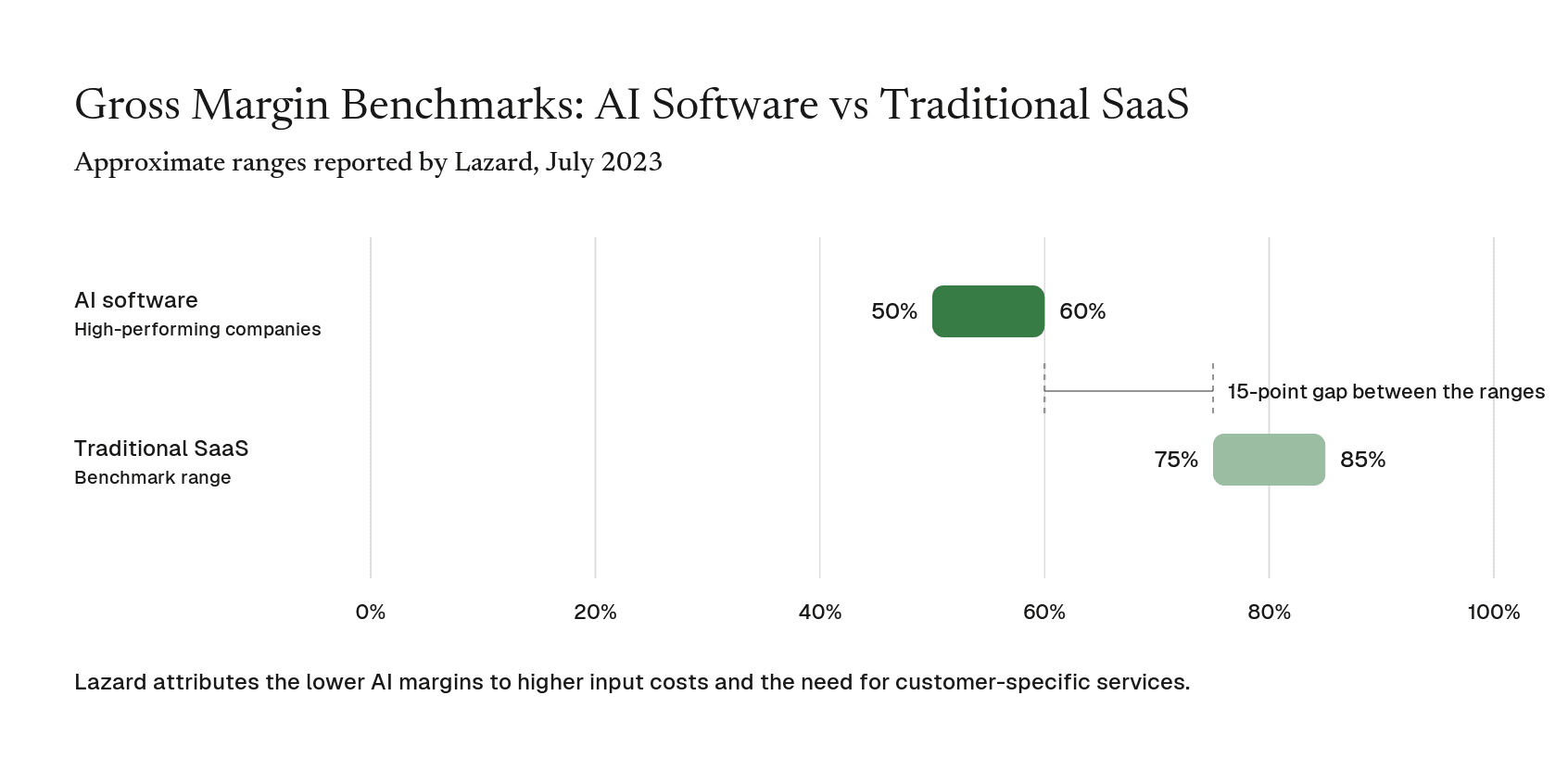
What is your gross margin after model and infrastructure costs? | Lazard’s July 2023 report put gross margins for high-performing AI software companies at roughly 50 to 60%, versus traditional SaaS benchmarks of 75 to 85% | Citing only top-line ARR with no mention of cost of goods sold |
Are your largest customers profitable after inference and support costs? | Customer concentration with unprofitable accounts erodes margins | "All our customers love us" with no unit economics discussion |
Which models are in production, and what happens if your provider changes pricing or terms? | Single-provider dependence creates margin and feature risk | "We always use the best model available" with no switching plan |
Where do you own IP, such as fine-tuned models or proprietary datasets? | Proprietary assets are a defensibility lever and reduce provider lock-in | No clarity on what is owned versus rented |
What legal or regulatory risks has your counsel identified around your AI features? | Content harms and IP claims can block fundraising | "Our lawyers will handle it" with no named counsel or process |
How do you handle harmful or high-risk outputs in production? | Safety incidents can create legal liability and user churn | No mention of moderation, monitoring, or incident response |
Who led your last round, and what milestones trigger the next round? | Investor quality and expectations shape future dilution and exit strategy | Refusal to name investors or discuss any milestone framework |
What percentage of fully diluted shares does my grant represent, and what is the liquidation preference stack? | High-preference stacks can wipe out common shareholders in a distressed sale | Citing only option count or headline valuation |
What decisions will I own in the first 6 to 12 months? | Scope clarity prevents a senior hire from becoming a generalist firefighter | "You will have massive impact" with no defined ownership area |
What does product-market fit look like today, and how do you measure it? | AI products can show usage growth without retention or willingness to pay | Vague references to user counts without retention or revenue data |
What is the total addressable market for your product, and how do you validate it? | TAM claims in AI can be inflated by hype cycles | Citing trillion-dollar AI market size with no segment focus |
Is there a clear path to profitability, or does the business plan assume another raise? | Perpetual fundraising increases dilution and failure risk | "We are focused on growth, not profitability" with no timeline |
Startup Runway, Burn, and Compute Costs
Ask about current startup runway and future funding plans. A strong answer includes the latest funding round, cash in the bank, months of runway under current and downside burn scenarios, and explicit line items for compute and third-party AI services. A weak answer says “runway is good” without specifying months, or excludes GPU leases and model API fees from burn.
Stage changes what to expect. Seed-stage companies often have less visibility into how compute scales, while Series A companies should have production data to ground their forecasts, as the seed vs Series A comparison explains.
Revenue Quality, Margins, and Unit Economics
Ask what gross margin looks like after model and infrastructure costs, and whether the largest customers are profitable after inference and support. A strong answer explains how the company measures margin after these costs, distinguishes pilot from production customers, and explains how AI-related costs scale with usage. A shared margin range strengthens the answer but may be confidential. Also ask how customer acquisition cost compares with lifetime value, and whether revenue depends on a single customer.
A weak answer focuses only on annual recurring revenue, without acknowledging that each query or generation has a cost tied to GPU time or external APIs. A business that can’t explain its unit economics may not survive the next funding cycle.
Model and Provider Dependence
Ask which models are in production today and what the plan is if providers change pricing, terms, or behavior. Ask too where the company owns IP, such as fine-tuned models or proprietary datasets. A strong answer names providers, acknowledges concentration risk, describes any in-house model work, and outlines a concrete migration or multi-model routing plan.
Weak answers skip switching costs, quality trade-offs, and contract terms. A product that is only a thin wrapper on one provider is easier to copy and more exposed to margin compression, which affects job security for the engineers building it.
What Stays Defensible When New Models Ship
Ask what stays defensible when the next generation of models ships, and what would stop a competitor from rebuilding the product on a newer model. Defensibility worth probing includes:
- proprietary data that is hard to replicate
- domain-specific evaluation and compliance posture
- embedded workflows and deep integrations
- distribution advantages and customer lock-in
- regulatory licensing or certifications
Strong answers talk concretely about data access, domain evaluation, or embedded workflows. Weak answers rely on general claims about speed or brand.
Legal, Regulatory, and Content Risk
Ask what legal or regulatory risks counsel has identified around the AI features, and how the company handles harmful or high-risk outputs in production.
Character Technologies, the company behind Character.AI, filed for Chapter 11 in the U.S. Bankruptcy Court for the District of Delaware on October 12, 2026, to pursue a court-supervised sale. Its bankruptcy petition estimated both assets and liabilities at $50 million to $100 million. Before the filing, Disney agreed to serve as the stalking-horse bidder, offering $20 million for a non-exclusive perpetual license to certain Character.AI IP. In a statement, Character.AI CEO Colin Adams said the company had faced “significant legal, regulatory, and operational headwinds.”
Strong founder answers acknowledge concrete categories of legal risk, mention counsel involvement, and describe how they monitor regulatory change. Weak answers dismiss legal risk or defer it without saying who advises the company or owns the risk.
Investors, Next Round, and Exit Strategy
Ask who led the last round, how those investors view compute-heavy businesses, and what needs to be true for the next round or an exit. Strong answers name investors and board members and outline expectations for the next 12 to 24 months, such as revenue, infrastructure usage, or regulatory readiness. Also ask what happens if initial goals aren’t met. Weak answers give no milestones and no plan if a raise is delayed. Reasonable confidentiality about financing terms is different from unexplained evasiveness.
Equity Terms, Dilution, and Down Round Risk
Ask what percentage of fully diluted shares your grant represents, and how a down round or a sale below the last valuation would affect common shareholders. Strong answers share the fully diluted share count, strike price, vesting schedule, post-termination exercise window, and a qualitative view of the liquidation preference stack. Some of these details may only come with a written offer, so read how to evaluate equity offers.
Weak answers cite only the option count or a headline valuation, with no context on dilution, preferences, or how compute-heavy burn could force a down round. Treat equity as high-variance upside rather than guaranteed money.
Role, Scope, and Leadership Expectations
Ask which decisions you’ll own in the first 6 to 12 months, and how senior and staff engineers shape technical direction as the team grows. Strong answers give specific ownership areas, such as the retrieval pipeline, safety systems, or cost optimization. Weak answers promise unlimited impact with no boundaries, or stay so vague you can’t tell whether the role is IC, managerial, or a catch-all for operational gaps.
This is also the place to ask about hours and on-call expectations for AI infrastructure, which can be intense at a small company running model serving in production. Ask whether anyone has recently left and why. Founders set the culture early, so ask about company values directly.
How to Interpret Founders' Answers at an AI Startup
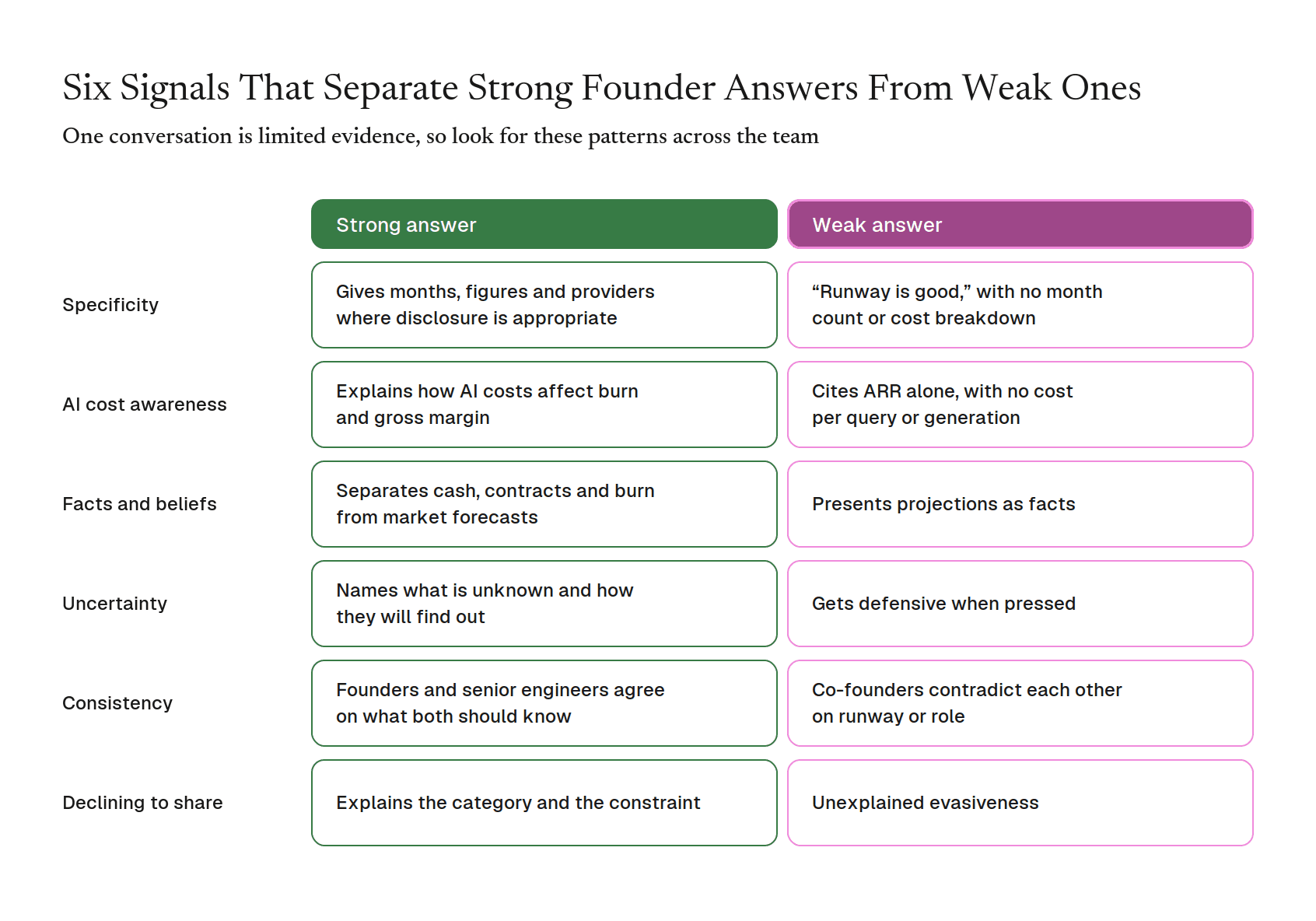
Two AI startups can report the same headline runway yet differ sharply in clarity, assumptions, and awareness of AI-specific risk. Watch for numerical specificity, awareness of AI cost structure, acknowledgment of uncertainty, and consistency between different team members’ answers.
Strong answers separate facts (cash, contracts, current burn) from beliefs (how fast the AI market grows). Weaker answers present projections as facts. A red flag is when co-founders or managers give contradictory answers to the same question, so cross-check runway and role answers between the founders and senior engineers. Founders who acknowledge what they don’t know yet, and explain how they’ll find out, show a more constructive approach than those who get defensive, though one conversation is limited evidence.
How to Ask Founders Hard Questions Without Burning Bridges
Direct questions about runway, legal risk, or model dependence can feel like they make you seem difficult. Use a collaborative, investor-like tone, opening with something like “I want to understand this well so I can commit fully if I join,” rather than implying distrust.
Group your questions to ask founders into a few themes and share a short list before a founder conversation. That gives founders time to prepare and signals seriousness on both sides. It’s reasonable for founders to decline to share some details, but they should still explain the category and the constraint. For example: “We can’t share specific legal advice, but here is how we think about that risk and what we’re doing.” The right startup for a senior hire is one where founders welcome scrutiny.
Is It Worth Joining a Startup Over Staying at a Large Tech Company?
For a senior or staff engineer, the decision often comes down to “rest and vest” at a large company with high liquid compensation versus joining a startup with higher variance and potentially more autonomy and growth. The main things to consider before joining a startup are these:
- Impact and scope. A small company offers more impact per engineer and direct access to technical decisions, compared with narrower scope at a large company.
- Systems exposure. Startups mean end-to-end ownership, including ML infrastructure, rather than well-defined boundaries.
- Career development. Startups offer less structured career paths but rapid skill growth across disciplines. Advancement often depends on self-advocacy.
- Financial risk. Compare the startup’s runway, including compute and model API spend, with your personal runway: how many months of expenses you could cover if the company fails or makes deep cuts. A pay cut combined with equity concentrated in one company is a very different risk profile from diversified public stock. Equity becomes money only through a liquidity event, so it helps to understand how startup equity works.
- Role and culture fit. Know who resolves disagreements about model choices or safety trade-offs, who handles incidents for bad outputs, and what on-call looks like. Consider your ethical comfort with the product.
Write down your minimum requirements for job security, learning, compensation, and ethics, then test each conversation against that list. Engineers later in their careers or with heavy financial obligations may reasonably require more evidence of runway, legal preparedness, and defensibility before joining. For a comparison that goes beyond AI startups, see how AI labs and startups differ for engineers.
How Fonzi Can Help Engineers Evaluate AI Startup Offers
Many of the questions to ask before joining a startup only get answered late in a hiring process, after an engineer has sat through weeks of interviews. Compensation is often one of the last details to come into focus.
Fonzi connects engineers with startups and growth-stage companies. After Fonzi reviews your profile and accepts you into the Match Day candidate pool, companies can send you salary-backed interview requests, so you can review the role and proposed salary before deciding whether to interview. That leaves founder conversations free for the harder questions in this guide about runway, model dependence, and legal risk.
What to Know Before Joining a Startup Built on AI
The questions to ask before joining a startup built on AI go beyond standard startup checklists. They cover startup runway that includes compute and model API costs, gross margin after inference, provider dependence, defensibility, legal and regulatory exposure, the equity preference stack, and the decisions you will own in the first 6 to 12 months. Lazard’s July 2023 report put gross margins for high-performing AI software companies at roughly 50 to 60%, against 75 to 85% for traditional SaaS, so a runway figure that leaves out compute deserves a follow-up question. On legal risk, ask who advises the founders and who owns the risk.
Specific, honest founder answers are better evidence than funding announcements, and a founder who declines to share a detail should still explain the category and the constraint. Whether joining a startup beats staying at a large tech company depends on comparing the company’s runway and risks with your own financial runway, career goals, and minimum requirements.
FAQ
How can I ask about an AI startup's runway, including compute costs, without sounding difficult?
Frame it as wanting to understand how you can help extend runway, for example by optimizing infrastructure. Ask: “When you quote your runway in months, does that include your current GPU, model API, and data costs, and the hires you’re planning over the next year?” That positions you as someone who thinks about the business.
What does model dependence mean for my job security at an AI startup?
It raises the risk. A product that is mainly a thin wrapper over one external model provider is easier for competitors to copy and more vulnerable to pricing or policy changes. That can affect both the company’s survival and the long-term value of your role.
Should I join a startup before or after Series A if it relies heavily on AI?
Neither is categorically safer. Earlier stages offer more upside and influence alongside higher risk and often shorter runway. Post-Series A companies have clearer funding and product signals but less equity and more structure. The quality of the answers you get to the questions above matters more than the stage label.
Should I join a startup if founders give vague answers about legal or regulatory exposure?
Not without pushing further. Follow up once with pointed questions about how they track legal risk and who advises them. If the answers stay vague, treat that as a significant signal that the company may not be taking AI-specific legal risk seriously enough for a senior hire.
Is it worth joining a startup if equity is my main reason?
Only if you can afford for the equity to be worth nothing. Equity is high-variance and illiquid until an exit. Confirm the fully diluted percentage and the preference stack before you count it, and weigh it against the liquid compensation you’d give up.