Equity Refresh Grants: How Engineers Should Read Them
By Shye Uy
An equity refresh policy, more than the size of the initial grant, decides what an engineer earns in equity after the fourth year at a company. The initial grant is the number on the offer letter, but it vests over four years and then stops, so the refresh policy determines whether equity income holds steady, rises, or falls sharply afterward. Carta's April 2024 data put a typical equity refresh grant at about 30% of a current new-hire grant for the same role. Engineers leaving large tech companies for startups often compare initial grants line by line and never ask how, or whether, the new company refreshes them.
Key Takeaways
- An equity refresh is a new equity grant made to an existing employee, on top of the new-hire grant, and it vests on its own schedule.
- Because the initial grant vests over four years, an offer with no refresh policy means equity income falls sharply once that grant finishes vesting.
- Meta, Uber and Google all document recurring equity awards to existing employees in SEC filings or company communications reported by established outlets, and all of them leave the size to company discretion.
- Startup refresh practice varies widely, and the data from Carta, Pave and Sequoia disagree on how common refreshes are before later funding stages.
- The most useful pre-signing questions cover cadence, basis (performance, tenure or promotion), vesting schedule, size relative to a new-hire grant, and whether the policy is written down.
How Equity Refresh Grants Work
An equity refresh grant is an additional stock or option award given to an employee who already holds a new-hire grant, with its own vesting schedule that runs in parallel with, or after, the original grant. Carta defines it as "a stock grant issued to employees who have already received a new-hire grant." You will also see the terms equity refresher, refresher grant, top-up, or refresh equity grant; they describe the same instrument.
What refresh grants reward
Refresh grants exist to keep an employee holding unvested equity, but the trigger differs by company. Carta's April 2024 guide groups them into three types:
- Time-based (tenure or retention) grants, issued at a tenure milestone or as the new-hire grant nears the end of its vesting, "generally issued when the initial grant has vested at least halfway."
- Promotion grants, sized to reflect the compensation of the new level.
- Performance grants, which reward top performers, are awarded once a year during a standard review cycle, and "generally start vesting immediately."
Sequoia adds that some companies time refreshes to milestones such as a funding round or product launch, and its 2025 data show non-executives receiving refreshes through promotion more often than through performance, which is increasingly reserved for executives. Pave reports the same pattern from its own data: a median of 95% of promoted employees receive an ongoing grant, against 44% of high performers who are not promoted.
How refresh vesting stacks on the initial grant
Each refresh is a separate grant with its own clock, so grants accumulate. Carta describes two structures:
- Traditional (overlapping) refreshes start vesting immediately and vest "over either one or four years on top of any other grants."
- Boxcar grants are made in year two or three but only begin vesting once the new-hire grant is fully vested, and they vest over one year, so the vesting periods do not overlap.
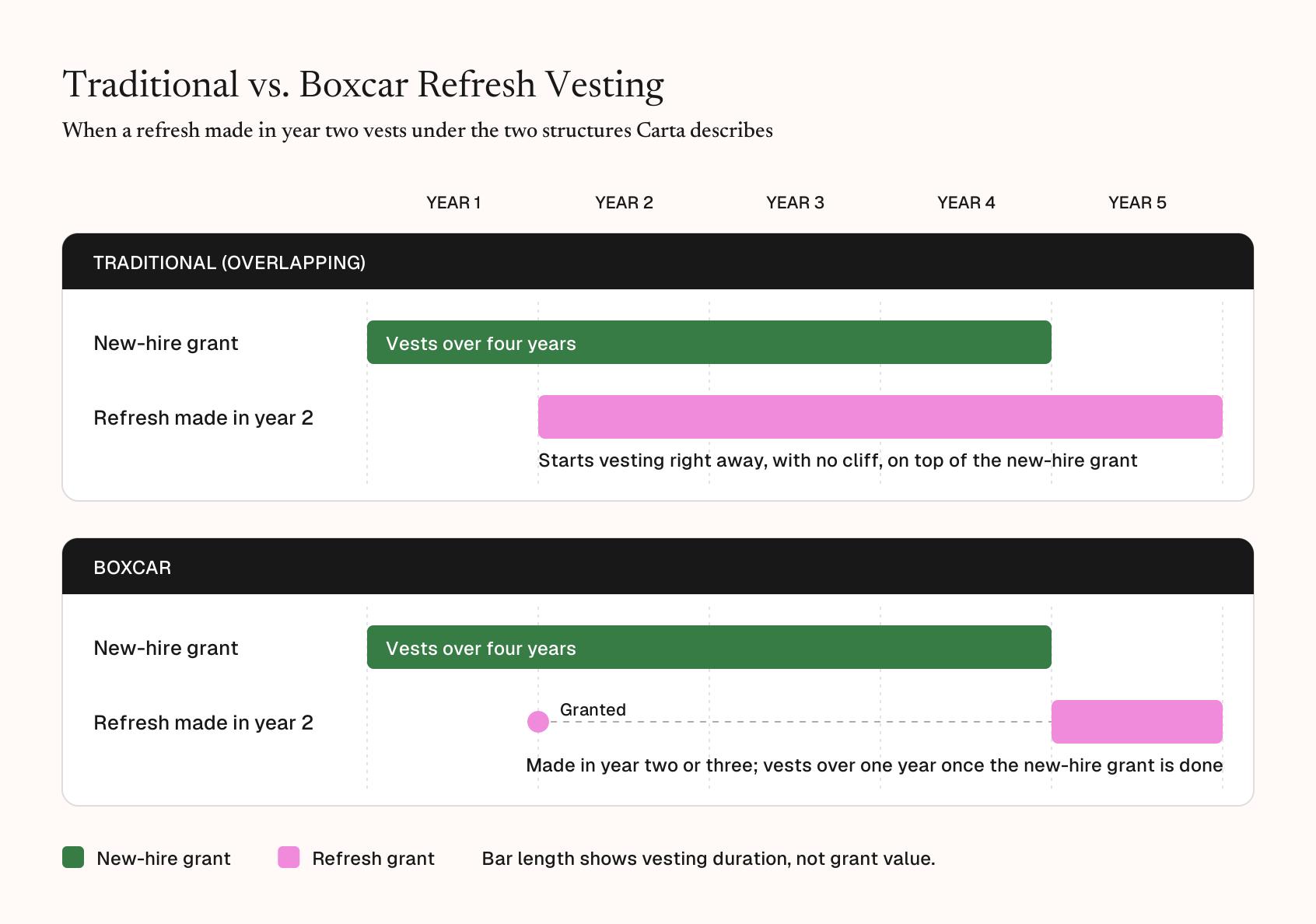
PostHog publishes a concrete version of the overlapping model in its company handbook: every employee is eligible for an annual refresh worth "between 18%-25% of the value of a new grant for your current role," each refresh "vests over four years on its own schedule," and refreshers carry a 12-month cliff. The handbook states that by the time the new-hire grant has fully vested, "four refreshes are vesting in parallel."
How big a refresh grant is
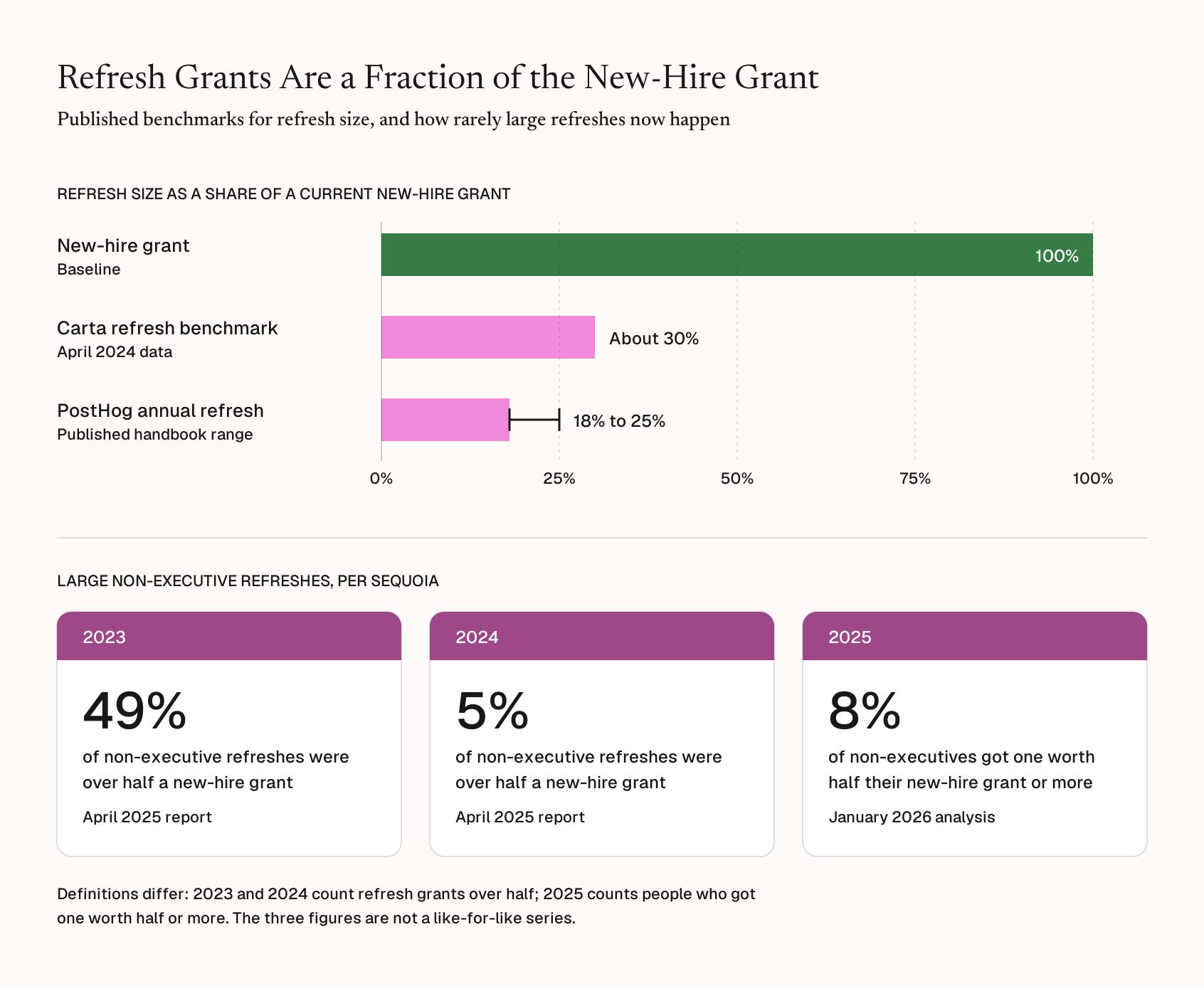
Refresh grants are smaller than new-hire grants because, as Carta's guide puts it, they "are usually being issued on top of other existing holdings"; the guide's author, Josh Steinfeld, previously led compensation at Google for YouTube and Google's corporate functions. Carta's April 2024 data show refresh grants at "about 30% of what a new hire would be granted if that person were hired today for that same role or level." Sequoia's April 2025 report shows them shrinking: in 2023, 49% of non-executive refresh grants were more than half the size of a new-hire grant, and by 2024 only 5% were. Sequoia's January 2026 analysis found that in 2025 only 8% of non-executives received a refresh equal to half or more of their new-hire grant, and that most refreshes now come in below 30% of the initial grant.
Why the Equity Refresh Matters More After Year Four
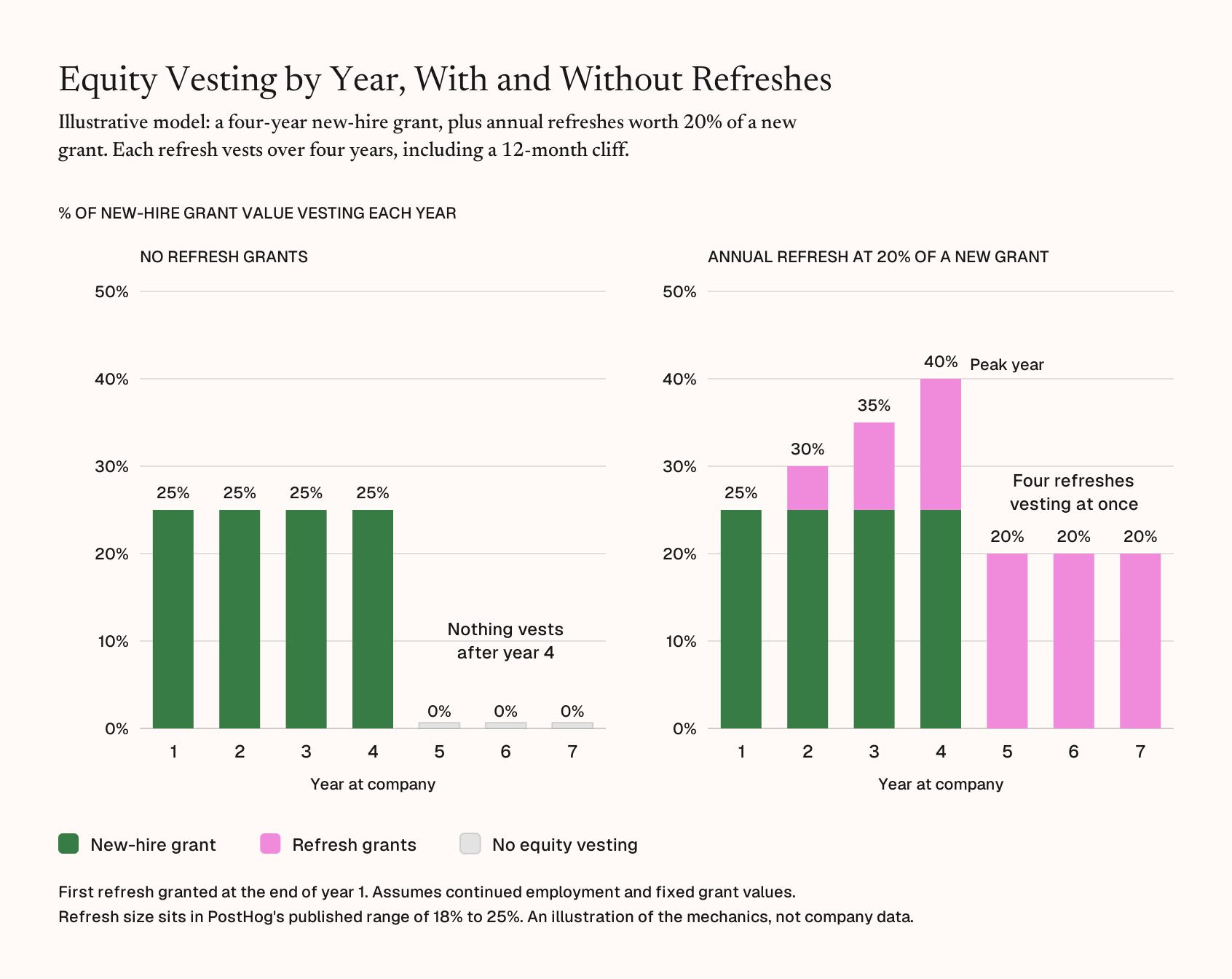
The equity refresh matters most after year four because that is when the initial grant finishes vesting and refreshes become the only equity still arriving. In the first four years, every vest includes a slice of the large new-hire grant. In year five, that slice disappears. If the company has made no refresh grants, equity income goes to zero overnight while base salary continues, so total compensation falls sharply even though nothing about the job has changed.
Refreshes soften this drop but do not automatically erase it. Carta's April 2024 guide notes that a traditional annual refresh program "can exacerbate the drop-off after year four because employees will never earn more equity than they do during their fourth year," since year four is the last year in which the new-hire grant and the overlapping refreshes vest together. PostHog's handbook describes the steady state honestly: after the new-hire grant vests, "you're still vesting roughly 18-25% of a new grant's value every year," which at most matches the 25% a year the initial grant delivered on its own and falls well short of the year-four peak, when the initial grant and overlapping refreshes vested together. This is a common pattern, not a rule: a promotion grant, a strong stock price, or a larger-than-usual refresh can offset it, and a front-loaded new-hire schedule changes where the drop lands.
Front-loaded schedules move the cliff earlier rather than removing it. Forbes, citing Business Insider's September 2021 reporting, states that Google's RSUs "used to vest evenly over four years (25% yearly)" and now "vest 33% per year for the first two years, 22% in the third year, and 12% in the fourth." Under that schedule the new-hire grant's contribution shrinks in years three and four, so the refresh policy carries more of the load from year three onward.
The practical consequence for an engineer evaluating an offer is that the initial grant describes years one through four, and the refresh policy describes everything after. Two offers with identical initial grants can produce very different year-five compensation. The question to ask before signing is not only how large the grant is, but whether and how the company refreshes it.
Equity Refresh Programs at Large Tech Companies
Large public tech companies run recurring equity programs for existing employees, and their filings show a consistent shape: four-year vesting, annual grant cycles, and sizes set at company discretion. What follows is limited to what each company has published or what established outlets have reported first-hand.
Meta equity refresher program
Meta describes a "company-wide equity refresher program" in its SEC proxy statements and prices employee refreshers once a year. Its 2026 proxy statement states that executive RSU counts were calculated using "$701.32, which was the same value used for 2025 refresher awards to all other employees in March 2025." Meta's FY2025 Form 10-K states that "in general, our RSUs vest over a service period of four years."
The Financial Times, as reported by Reuters on February 20, 2025, described Meta's refreshers as annual grants that "make up the majority of their remuneration, alongside base salaries and annual bonuses" and that "stack and 'vest' every three months over four years," and, citing several people familiar with the matter, reported that most employees "have been told they would receive about 10% less equity this year," with the exact reduction depending "on where the employees are based and their level within the organization." Reuters reported again on February 19, 2026, citing the FT, that Meta cut its annual stock awards by about 5% for most of its staff, the second cut in a row. Meta did not comment on either report. For an engineer, the lesson is that even a well-established annual equity refresher can shrink year over year, and the published program says nothing about size.
Uber equity refresh
Uber writes annual equity refresh eligibility into the form employment agreement it filed for its executive officers, but it does not guarantee a refresh. The employment agreement form Uber filed as Exhibit 10.2 to its Q3 2020 Form 10-Q, drafted for executive-level hires, states that the employee "will be eligible to receive an annual equity refresh grant," that "equity refresh awards are subject to manager and Company discretion, based on your performance and the performance of the Company," and that the company "will determine the amount of each Annual Equity Refresh Grant, and the applicable vesting conditions, on an annual basis." The same form describes the new-hire RSU grant vesting 12/48 at the one-year anniversary and 1/48 monthly thereafter.
Uber's 2026 proxy statement refers to "the annual equity refresh portion of our compensation program at the beginning of 2025" for its named executive officers. For engineers below the executive level, a first-hand account comes from Gergely Orosz, a former Uber engineering manager, writing in The Pragmatic Engineer: "While I was at Uber, both myself and most people I knew received equity top-ups every year." The contract language is the part to note: eligibility is promised, the amount and vesting are not.
Google equity refresh
Google ties ongoing equity awards to annual performance ratings, and changed its new-hire vesting schedule in 2021. Alphabet's FY2025 Form 10-K states that "RSUs generally vest over four years contingent upon employment on the vesting date." As noted above, Forbes, citing Business Insider's September 2021 reporting, describes Google's shift to a 33/33/22/12 schedule for its RSU grants.
On how ongoing equity is sized, HR Grapevine, reporting on an internal email first published by Business Insider, quotes John Casey, Google's VP of Global Compensation and Benefits, saying the company would be "slightly reducing the bonus and equity individual multipliers for Significant Impact and Moderate Impact ratings" to fund larger rewards for top-rated employees, effective in 2026. HR Grapevine describes the rating as determining "a multiplier that is used to calculate the bonus and equity payment they receive each year." Google's public filings do not use the term "refresh grant" for rank-and-file employees, so the most precise reading is that Google makes annual, rating-driven equity awards whose multipliers the company can and does change.
Equity Refreshers at Early-Stage Startups
Early-stage startups are far less predictable on equity refreshers than large public companies, and the available data disagree on how common they are before later funding stages. Big tech programs share three features: an annual cycle, a documented program, and grants paid in liquid stock. A seed or Series A company may have none of these, because refreshes draw on a limited option pool and require board approval.
The data sources diverge on early-stage practice:
- Evidence that early-stage companies refresh: Carta's April 2024 data show that between 2022 and 2024, about 20% of employees received a refresh grant at year one and nearly 50% had received "at least one additional grant beyond their new hire grant" by year two, and that pre-seed to Series A companies allocated "approximately 35-37% of their equity pool to refresh grants" (Series B to E companies allocated 40% to 50%). Sequoia's April 2025 report says refreshes are now common across businesses of all sizes, including those with fewer than 100 employees, with 79% of surveyed companies offering refresh grants to at least some non-executives.
- Evidence that they are less common early: Pave's equity refresh guide states that "equity refresh grants are fairly uncommon when a majority of employees haven't even hit their cliff yet," and its data show ongoing grants account for "almost none" of equity spend "in the early years," rising to more than 50% at later stages. Sequoia's own data show refreshes are most common at companies with 500 to 999 employees, and that 64% of companies in that range award executive refreshes annually.
Both positions can be true at once: a company can technically offer refreshes while issuing few of them, and the samples differ by platform and company size. For a candidate, the disagreement means no industry benchmark tells you what one specific startup will do. Pave's data also show refresh eligibility skews by level, with 82% of director-level employees receiving refresh grants against 25% of P1 (entry-level) employees, which matters for senior and staff engineers negotiating their level.
Several points about startup refreshers have no public data behind them, so treat them as questions rather than assumptions. Ask whether the company has ever issued a refresh grant, how many employees received one, and whether the option pool has room for refreshes after the next round. Ask whether a refresh would be priced at a higher strike price than your initial grant, since PostHog's handbook notes its refreshers "will likely be subject to a different strike price due to changes in valuations." Ask whether fundraising can delay grants; PostHog states that "funding rounds disrupt when we are able to issue new grants." For the mechanics of options, strike prices and exercise windows, see Fonzi's guide to equity compensation; this article stays focused on refresh policy.
Equity Refresh Questions to Ask Before You Sign
The questions to ask about equity refresh before signing are the ones that reveal cadence, basis, size, vesting and documentation, because those five dimensions determine what you earn after year four. Ask them of the recruiter first, then confirm the answers with the hiring manager or founder.
Refresh dimension | What to ask | Why it matters |
|---|---|---|
Cadence | Are refreshes granted annually, at review cycles, at promotion only, or ad hoc? When is the first one possible? | Determines whether equity keeps arriving before the initial grant runs out. |
Is the refresh driven by performance rating, tenure, promotion, or a mix? | A promotion-only policy means no refresh if you stay at the same level. | |
Size | How is refresh size set, as a percentage of a current new-hire grant, a dollar value, or a share count? | Carta puts the benchmark at about 30% of a new-hire grant; PostHog publishes 18% to 25%. |
Vesting schedule | Does each refresh vest over one, three or four years? Is there a cliff? Does it overlap with the initial grant (traditional) or start after it (boxcar)? | Controls how much equity vests in years five and beyond. |
Written policy | Is the refresh policy in the offer letter, an employee handbook, or a board-approved plan, or is it discretionary? | Uber's filed executive agreement illustrates that eligibility does not guarantee an award; ask for written terms that clarify what is promised, what remains discretionary, and which approvals are required. |
Beyond the table, these specific questions surface the details that matter most:
- "What percentage of engineers at my level received a refresh grant in the last cycle?"
- "What did the last refresh cycle look like relative to new-hire grants at the same level?"
- "Has the company ever reduced or skipped a refresh cycle, and why?"
- "How much of the current option pool is reserved for refreshes?"
- "If I am promoted, is there a separate promotion grant, and how is it sized?"
- "Will my first refresh be priced at the current 409A valuation or a later one?"
- "Can you put the refresh policy, or a reference to it, in writing?"
Note how a company answers as well as what it says. A founder who can cite a refresh cycle, a percentage and a written policy is describing a program. A founder who says refreshes "will be handled fairly" is describing an intention. If you want to compare how refresh answers fit into the rest of an offer, Fonzi's guide on how to negotiate salary covers negotiation tactics, which are outside the scope of this article.
Equity Refresh: What to Check Before Year Five
The initial grant tells you what you earn in equity for four years; the equity refresh policy tells you what happens after that, and an offer with no refresh policy sets up a sharp drop in year five. Equity refresh grants are also smaller than most candidates expect. Carta's April 2024 data put them at about 30% of a current new-hire grant, and Sequoia found that only 8% of non-executives received a refresh worth half or more of their new-hire grant in 2025. Even an established annual equity refresh program like Meta's was reportedly cut in both 2025 and 2026.
Before signing, ask about cadence, basis, size, vesting and documentation, and weight a written, recurring program over a verbal assurance. At an early-stage startup, also ask whether the company has ever issued a refresh grant, since the Carta, Pave and Sequoia data disagree on how common refreshes are before later funding stages. If you are exploring senior or staff roles at AI startups, sign up on Fonzi and put these questions to every company you talk to.
FAQ
What is an equity refresh grant?
An equity refresh grant is an additional stock or option award given to an existing employee on top of the new-hire grant, with its own vesting schedule. Companies use refreshes to keep employees holding unvested equity as the original grant vests.
How big is a typical equity refresher compared with the initial grant?
Carta's April 2024 data put refresh grants at about 30% of a current new-hire grant for the same role, and Sequoia's January 2026 analysis found only 8% of non-executives received a refresh equal to half or more of their new-hire grant in 2025. Ask the company for its own figure rather than relying on a benchmark.
Why does compensation drop after year four?
The new-hire grant finishes vesting after four years, so its share of each vest disappears in year five. Without refreshes, equity income falls to zero; with refreshes, it falls to whatever the stacked refreshes deliver.
Does Meta still give annual equity refreshers?
Yes, Meta's 2026 proxy statement references refresher awards to all employees in March 2025, but Reuters, citing the Financial Times, reported cuts of about 10% in 2025 and about 5% in 2026. The program continues while the size has shrunk.
Should I accept a startup offer with no refresh policy?
That depends on whether the initial grant alone justifies four years and whether you expect to stay longer. If you do plan to stay, ask the founder to commit to a refresh cadence and basis in writing before you sign.