Technical Deep Dive Interview: How to Present a Project
By Shye Uy
A technical deep dive interview asks you to walk an engineer through a project you built and then defend the decisions behind it under steady questioning. The round looks simple on paper, but it rewards a specific kind of preparation: knowing exactly why you made each call, what you gave up, and what happened after launch. The candidates who struggle are often the ones who picked their most impressive project instead of the one they can explain.
Key Takeaways
- A technical deep dive tests ownership and judgment on a real project, not the size or prestige of what you worked on.
- Interviewers spend most of the round on follow-up questions about decisions, tradeoffs, failures and measured results, so the prepared walkthrough is only the opening.
- The strongest project choice is one you led, where you can defend the reasoning, show a measured outcome and name something that went wrong.
- Among companies hiring on Fonzi whose interview plans include a deep dive, most place it in the first or second round of the loop, so it can decide whether you see the rest of the process.
- Shopify publishes the agenda for its Technical Deep Dive, while details of OpenAI's project round come from candidate reports rather than OpenAI itself.
What a Technical Deep Dive Interview Tests
A technical deep dive interview tests what you actually did on a real project: the decisions you owned, the tradeoffs you accepted, how you handled what went wrong, and whether you can explain all of it clearly to another engineer. It is also called a project deep dive, a past project interview or a project walkthrough, and it usually opens with some version of "walk me through a project you led."
Real work instead of a simulation
Ashby's guide for candidates, Engineer Past Projects Deep Dive, explains why the format exists. Ashby says most of its own interviews are simulations of work that force candidates through problems with artificial time limits and little context, while walking through a past project shows what a candidate would actually do on the job, including how they gather information, make decisions, plan work and deal with setbacks. Ashby states that the project should be one the candidate "led and made critical decisions for," and that interviewers will stop the candidate along the way and may go very deep into pieces they find interesting.
What interviewers assess in a technical deep dive
Across the public descriptions of the round, the same four signals come up.
- Ownership. Interviewers separate what you personally built or decided from what the team did. Ashby asks for a project where you led technical decision-making and implementation.
- Technical judgment. Shopify's technical interview guide lists technical decisions and "trade-offs and alternatives considered" among the topics its interviewers cover, and Ashby asks candidates to explain why important decisions were made, including technology choices, testing and reliability considerations.
- Depth. Ashby expects candidates to remember details such as properties on a data model, milestone timelines and customer reactions. Shopify notes that its interviewers are engineers and "want to hear specific technical details."
- Honesty about failure. Shopify includes "challenges and failures" and "lessons learned" in its agenda and asks how you might have done things differently. A walkthrough with no setbacks gives the interviewer nothing to probe.
Ashby adds a fifth signal that is easy to overlook: communication. Its guide says an impressive project counts for little if the interviewers cannot understand it, and that the candidate, not the interviewer, should decide where context is needed.
How the deep dive differs from system design
A system design interview asks you to design a new system for a hypothetical prompt within the session, so it tests how you reason about an unfamiliar problem. A technical deep dive asks about a system that already exists and that you helped build, so it tests whether the decisions you made under real constraints hold up. The two can overlap, and some companies combine them in one round, but preparing for one does not prepare you for the other. The system design round has its own preparation, covered in Fonzi's guide to the system design interview.
Where the Technical Deep Dive Interview Sits in AI Startup Loops
Among AI startups hiring on Fonzi, the technical deep dive interview often comes early in the loop, sometimes as the first technical conversation, which means it can decide whether a candidate reaches the coding, design and onsite rounds at all. That placement is the opposite of the way many candidates prepare, treating the project walkthrough as a late, low-stakes conversation after the technical rounds are done.
What interview plans on Fonzi show
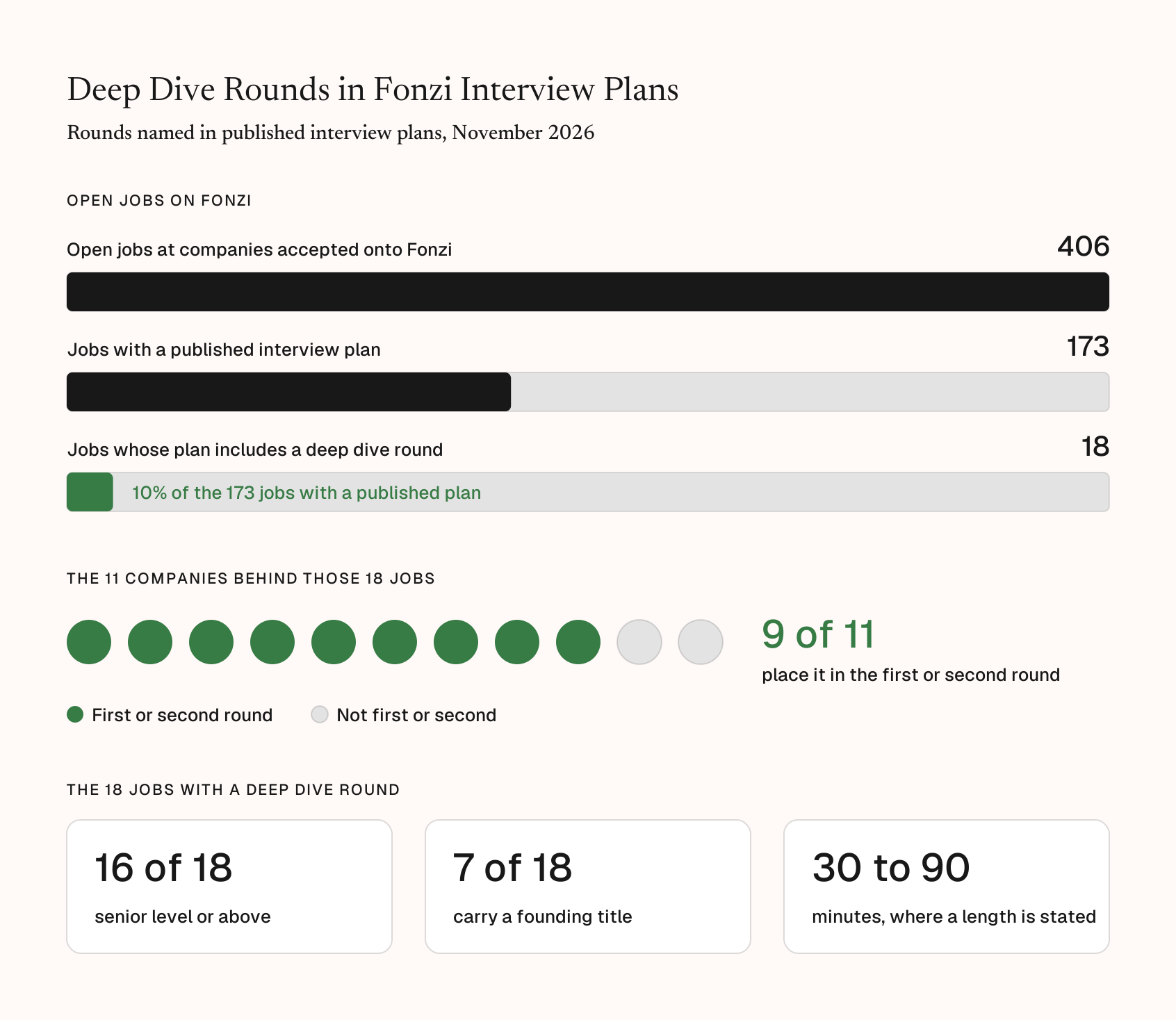
As of November 2026, 173 of the 406 open jobs at companies accepted onto Fonzi had a published interview plan. Of those 173 jobs, 18 included a round named as a technical deep dive, project deep dive or project walkthrough, across 11 companies. At 9 of those 11 companies, the deep dive is the first or second round of the loop, and at one it is part of the intro call.
Most of the roles that use the round are senior ones. Of the 18 jobs with a deep dive, 16 are senior level or above and 7 carry a founding title. Where the plan states a length, the round runs from 30 to 90 minutes.
The way companies name the round shows what they plan to ask about. As written in those plans (with contractions expanded), the rounds include:
- "90-min deep dive on an agent system you shipped: what broke, what you measured"
- "90-min technical deep dive on something you built"
- "45 minute intro call, deep-dive into prior work experience"
- "Technical deep-dive on past work"
- "A deep dive into a project you have done in the past"
- "Architecture deep-dive"
The first of those names states the agenda outright: something you shipped, what broke and what you measured. The round is not always standalone, either. One of these companies follows its architecture deep dive with a separate round where the candidate writes a one-page design doc, and another combines system design and a technical deep dive in a single 1.5-hour round.
A published example of an early deep dive
Ashby documents the same early placement in its own Engineer Past Projects Deep Dive guide. Its candidates walk through a past project twice: for about 10 to 20 minutes in the introductory call with an engineering leader, and again in the final round with the VP of Engineering and another engineering leader for 30 or 45 minutes, depending on seniority. Ashby also lets candidates use the same project both times, as long as it has enough material to fill the longer session.
The practical consequence is that the deep dive deserves preparation before the first call, not after the technical screens. If the walkthrough is weak, there may be no later round to recover in.
Choosing a Project for a Project Deep Dive Interview
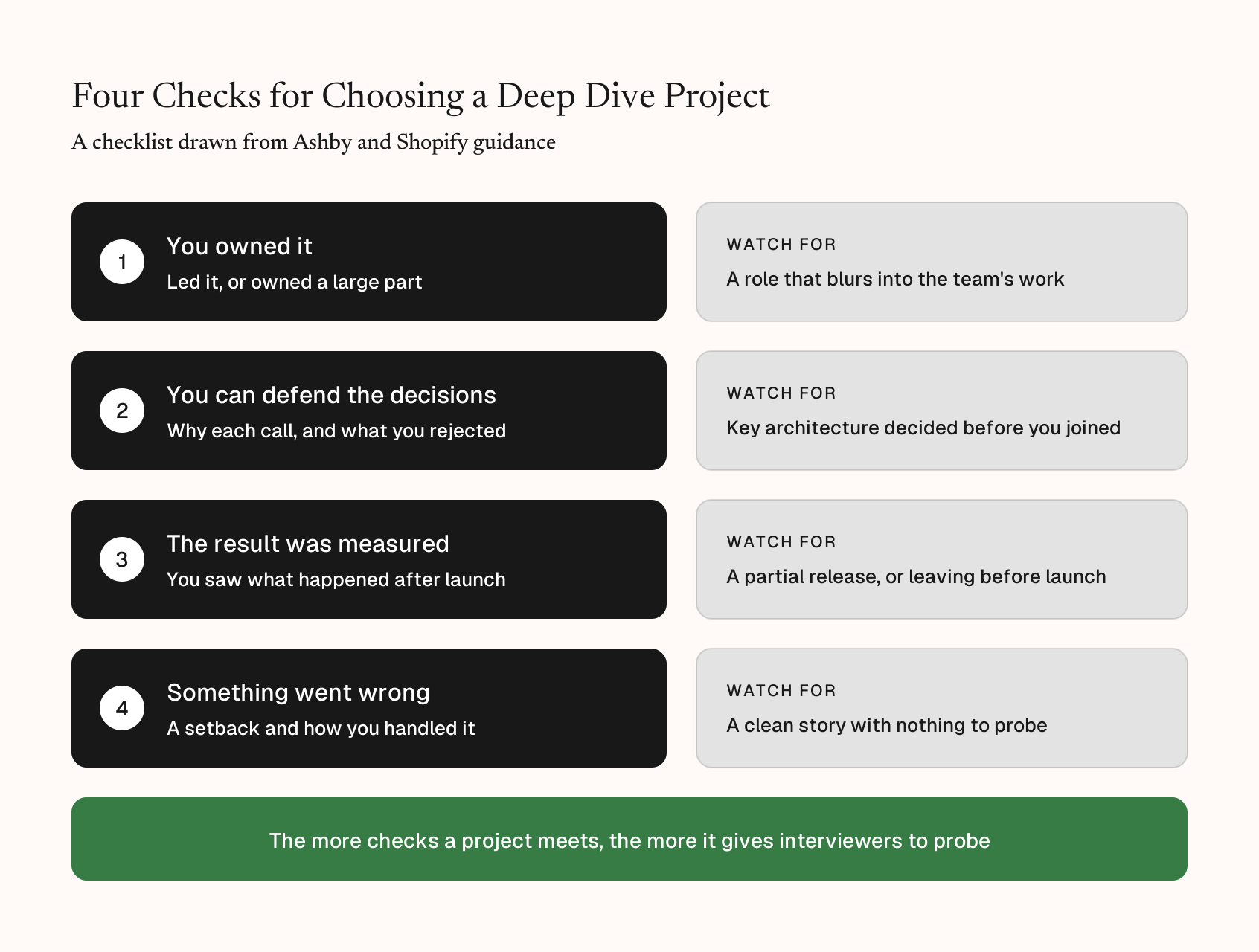
The best project for a project deep dive interview is the one whose reasoning you can defend under questioning: work you led, decisions you made yourself, an outcome you measured and at least one thing that went wrong. Scale and prestige help only when they come with that depth. A smaller system you designed end to end gives an interviewer more to probe than a famous one where your part was narrow.
Four criteria for the project
- You owned it. Ashby's Engineer Past Projects Deep Dive asks for a project where the candidate "led the technical decision-making and implementation" and can describe it in great detail. Shopify's technical interview guide suggests something you owned "from idea to launch" or worked on extensively.
- You can defend the decisions. Ashby wants candidates to explain why important decisions were made, including technology choices and tradeoffs, and to show how customer or business needs shaped the technical choices. If the key architectural decision was made before you joined, the project will be hard to defend.
- The result was measured. Ashby lists a project that was only partially released, or one you left before release, among those it is much less interested in, because it is hard to judge the outcomes of decisions a candidate did not see firsthand. Pick work where you saw what happened after launch.
- Something went wrong. Shopify's agenda includes challenges, failures and lessons learned, and asks what you would do differently. A project with a real setback, and a clear account of how you handled it, gives you material for the hardest follow-up questions.
Projects that work against you
Shopify advises candidates to avoid solo or side projects, because they "can be hard to dig into" and rarely involve business tradeoffs or product components. It also recommends picking a project that aligns with the scope of the role and one you remember well.
Ashby's list of weaker choices is more specific. It is much less interested in projects that are mainly CRUD without interesting abstractions or data model decisions, projects that were mostly cross-team coordination rather than ambiguous technical problems, projects that mostly involved navigating company politics, and projects that did not make an impact or were driven by poor decisions outside the candidate's control. It also lists migrations from one technology to another, on the grounds that they rarely involve product or business-driven technical decisions.
That last point has a nuance worth noting. One of the projects Ashby describes as receiving a perfect or near-perfect score was a migration: an engineer moved customers from a hard-to-use scripting language to a new one, built a parser and an automated migration path, and could explain the alternatives and why they were rejected. The difference was that the engineer identified the customer problem, chose the target language and justified it. A migration where the destination was decided by someone else is the weaker version.
Check the project against the role
Scope expectations vary by company. In candidate reports collected by Aced (formerly Exponent), OpenAI candidates said scale mattered in the project round, and the guide warns that a project which never reached real scale can count against you unless you can explain concretely how it would get there. That is a candidate-reported pattern for one company, not a published rule, but it is a reason to check whether your project matches the scale the role works at.
Ashby also invites candidates who are unsure to send the hiring manager a couple of project ideas with one- or two-sentence descriptions, or ask for a short call. Asking is a reasonable move at any company that does not say otherwise, and it costs less than discovering mid-round that the project does not fit.
How to Structure Your Technical Deep Dive
A strong technical deep dive follows the order in which the project's decisions were made: the context and constraints, the architecture, the key decisions and the alternatives you rejected, what broke, the measured outcome, and what you would change. That sequence mirrors the topics Shopify and Ashby say their interviewers cover, and it puts your reasoning in front of the interviewer before they have to dig for it.
The six parts of the walkthrough
Context and constraints. Start with the problem, who it affected and what limited the solution: deadlines, team size, existing systems, budget or compliance. Ashby asks how candidates "scoped the problem and defined success" and how the project fit into the broader technical and business landscape. Shopify lists business impact first in its agenda.
Architecture. Describe the system at the level an engineer needs to follow the rest of the story, then stop. Both Shopify and Ashby allow a whiteboard, diagram or slides but say they are not expected. Ashby notes that a technical diagram can make a complex data model easier to explain and that slides can be as simple as black text on a white background.
Key decisions and alternatives rejected. This is the core of the round. For each decision, name the options you considered, the one you chose and the reason. Shopify's agenda names "trade-offs and alternatives considered," and in one of Ashby's top-scoring examples, the engineer could explain the alternatives and why they were discarded.
What broke. Cover the incident, the wrong assumption or the design that did not survive contact with production, and what you did about it. Shopify includes challenges and failures as a standard topic, and one of the interview plans quoted earlier names the round after it: a deep dive on an agent system you shipped, covering "what broke, what you measured."
Measured outcome. Give the result in the units the business cared about, and say how you measured it. Ashby also asks how long the project took to reach important milestones and why that time was necessary.
What you would change. Close with what you would do differently with what you know now. Shopify asks this directly, and it gives the interviewer a view of your judgment that the rest of the walkthrough cannot.
What each part shows the interviewer
Part of the walkthrough | What to cover | What the interviewer is assessing |
|---|---|---|
Context and constraints | The problem, who it affected, how success was defined, what limited the solution | Whether you understood the business need and scoped the problem yourself |
Architecture | Components, data flow, the data model where it matters | Technical depth and whether you can explain a system clearly at the right level |
Key decisions and alternatives rejected | Each major choice, the options considered, why you chose as you did | Technical judgment and ownership of the decisions |
What broke | Failures, incidents, wrong assumptions, how you responded | Honesty about failure and how you handle setbacks |
Measured outcome | Results in business or system terms, how they were measured, time to milestones | Whether you measure the impact of your work and saw it firsthand |
What you would change | Decisions you would revisit and why | Self-awareness and whether your judgment has grown since |
Leave room for the interviewer
Shopify describes its round as "a conversation not a presentation" and asks candidates who bring a visual aid to pause so the interviewer can ask questions throughout. Ashby says its interviewers will stop candidates along the way, may go very deep into parts they find interesting, and will try to bring the candidate back to where they left off.
A practical preparation step, suggested rather than required by any of these companies, is to rehearse the walkthrough so it can survive interruption: know the six parts well enough to resume from any of them. The Aced guide to OpenAI's process, based on candidate reports, also recommends preparing material beyond what you expect to cover, because interviewers often ask candidates to keep going past their prepared content.
Technical Deep Dive Interview Questions to Prepare For
Technical deep dive interview questions fall into a small set of groups: ownership, decisions and tradeoffs, technical depth, failure, measured impact, scale and reflection. The questions below come from two kinds of source, and the difference matters. Some are questions candidates report being asked, collected in the Aced (formerly Exponent) guide to the OpenAI software engineer interview. The rest are preparation prompts drawn from the topics Shopify and Ashby say their interviewers cover, phrased as questions so you can rehearse against them.
Ownership
These questions separate your work from the team's.
- Did you work on this project end to end? (candidate-reported, OpenAI)
- Which parts did you personally build, decide or lead, and which did others own?
- Who did you collaborate with, and what was that working relationship like? (candidate-reported, OpenAI)
Decisions and tradeoffs
These questions test technical judgment, the center of the round.
- Why did you choose this approach, and what alternatives did you consider? (topic listed by Shopify and Ashby)
- What did you give up with this design, and when would that tradeoff become a problem?
- How did customer or business needs change the technical decision? (topic listed by Ashby)
- Was this a build-versus-buy decision, and how did you make it? (Ashby suggests such projects as candidates)
Technical depth
These questions check whether you know the system at the level you claim.
- What does the data model look like, and what properties does it hold? (Ashby expects this level of detail)
- How did you approach testing and reliability? (topic listed by Ashby)
- Walk me through what happens when a request hits this component.
Failure and recovery
These questions test honesty and how you handle setbacks.
- What were the technical challenges, and how did you handle them? (candidate-reported, OpenAI)
- What broke after launch, and how did you find out?
- Which assumption turned out to be wrong? (Shopify lists challenges and failures as a standard topic)
Measured impact
These questions test whether you measured the result and saw it yourself.
- How did you define success before you started, and did you hit it? (topic listed by Ashby)
- How long did the project run from start to finish? (candidate-reported, OpenAI)
- What was the business impact, and how was it measured? (Shopify lists business impact first)
Scale
These questions come up where the role works at large scale. Aced reports that OpenAI candidates were pushed on how a project would hold up under much larger usage; that is a candidate-reported pattern for one company.
- How would this design behave at ten or a hundred times the current load?
- Which component would fail first as usage grew, and what would you change?
Reflection
These questions test self-awareness and how your judgment has developed.
- What did you learn, and what would you do differently today? (candidate-reported, OpenAI, and asked by Shopify)
- If you rebuilt this now, which decision would you reverse first?
A useful test while preparing: if the honest answer to a question in the ownership or decisions groups is "someone else decided that," the project is probably the wrong one for this round.
The OpenAI and Shopify Technical Deep Dive Interviews
Shopify and OpenAI both run a project-based round, but the public record on them is very different. Shopify describes its Technical Deep Dive in detail on its own engineering blog, while OpenAI's official interview guide does not name a deep dive round, and the specifics come from candidates.
The Shopify technical deep dive interview
Shopify's technical interview guide, published on Shopify Engineering in July 2022, describes the Technical Deep Dive as a 60-minute conversational interview about your impact in previous roles or projects. Candidates join a Google Meet prepared to talk about one or two development projects they know well, ideally ones that match the scope of the role. Shopify lists the topics it wants to cover: business impact, architecture setup, technical decisions, trade-offs and alternatives considered, challenges and failures, successes, lessons learned, and teamwork and mentorship. It also asks how you might have done things differently.
The guidance on format is specific. Interviewers are engineers who want technical detail, a whiteboard or slides are welcome but not expected, and the round is "a conversation not a presentation," so candidates using a visual aid should pause for questions. Shopify advises against solo or side projects because they are hard to dig into and rarely involve business tradeoffs. The same round doubles as the candidate's chance to ask questions about engineering at Shopify, the role and the teams.
The Technical Deep Dive sits alongside other stages in the same guide: a one-hour Life Story conversation with a recruiter, a 40-minute coding exercise and a pair programming session of about 75 to 90 minutes. Shopify notes that the guide is updated as its hiring practices change and that the process can vary by role and team, so the recruiter's instructions for your loop take precedence.
The OpenAI technical deep dive interview
OpenAI's official interview guide describes the process in stages: application review, introductory calls, a skills-based assessment and final interviews. It tells candidates to be ready to discuss their work and academic experience in the introductory call, says the skills-based assessment varies by team and may include pair coding, take-home projects or technical tests, and states that final interviews usually take 4 to 6 hours with 4 to 6 people over one or two days. The guide says OpenAI's interviews are designed to understand how candidates approach problems, make decisions and communicate their reasoning. It does not describe a project presentation or deep dive round by name. If your loop includes a take-home instead, that format is covered in Fonzi's guide to the take-home assignment.
The details of OpenAI's project round are candidate-reported. The Aced (formerly Exponent) guide, built from candidate and interviewer reports, describes a virtual onsite of four to five rounds that can include a technical deep dive, also called a project presentation, lasting 45 minutes. According to that guide, candidates present a project and defend the decisions behind it, interviewers treat polished summaries and headline metrics as a starting point, and they push on what the candidate personally did, why, who they worked with and how the project would hold up at much larger scale.
Individual accounts on Aced vary, which is itself useful information. One senior candidate described the project deep dive as the most probing part of the loop because interviewers kept asking what they actually did and why. Another candidate reported presenting a past project with slides and receiving feedback that scale mattered in that round. Before preparing slides for an OpenAI technical deep dive interview, confirm the format with your recruiter. Aced's own guide notes that OpenAI's loops differ between teams and even between candidates for the same team, so these accounts describe what some candidates experienced, not OpenAI policy.
Across both companies, the overlap is clear even where the sources differ in authority. Both rounds ask what you owned, why you made your decisions, what went wrong and what you learned. The round names in the interview plans above point to the same set of questions, from "what broke, what you measured" to "something you built."
How to Prepare for a Technical Deep Dive Interview
A technical deep dive interview rewards the project you can defend, not the one that sounds biggest: choose work you led, structure the walkthrough around the decisions and what broke, and prepare for follow-up questions on ownership, tradeoffs and measured results. Because 9 of the 11 companies on Fonzi whose interview plans include a project deep dive place it first or second in the loop, the round is worth preparing for before the first call rather than after the technical screens. Shopify publishes the agenda for its 60-minute Technical Deep Dive, while details of the OpenAI technical deep dive interview come from candidate reports, so confirm the format with your recruiter before you build slides. If you are exploring senior AI and infrastructure roles, sign up on Fonzi.
FAQ
How long is a technical deep dive interview?
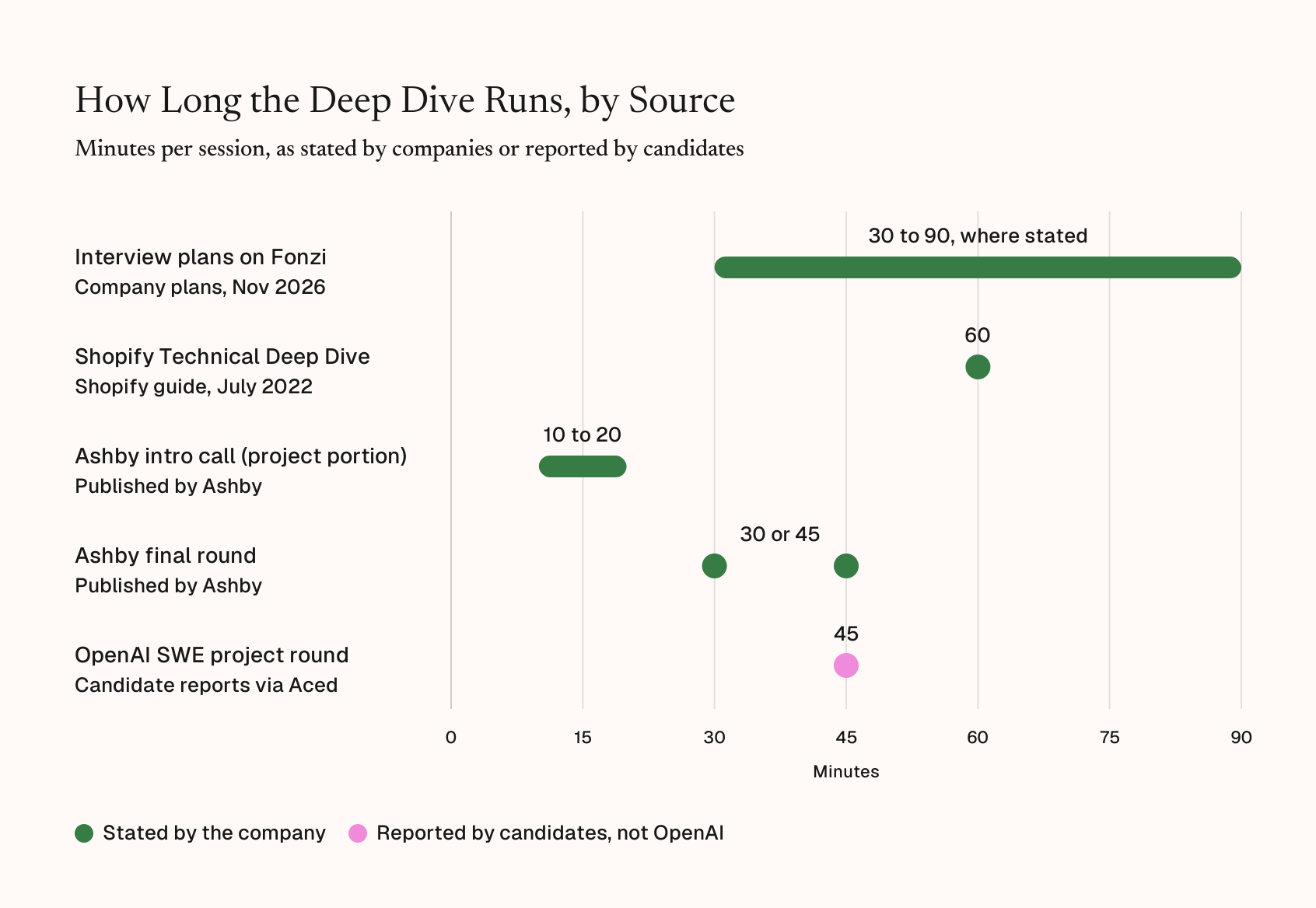
Published lengths vary: Shopify's Technical Deep Dive runs 60 minutes, Ashby's final-round version runs 30 or 45 minutes, and candidate reports put OpenAI's project round at 45 minutes. Interview plans on Fonzi that state a length range from 30 to 90 minutes.
Can I use slides in a project deep dive interview?
Shopify and Ashby both allow slides or diagrams but say they are not expected, and Ashby adds that using them earns no bonus points. Use them only if they make a data model or architecture easier to follow, and pause for questions when you do.
Should I present a side project in a technical deep dive?
Shopify advises against solo or side projects because they are hard to dig into and rarely involve business tradeoffs. A side project can still work at companies that do not say otherwise, but only if you can show real decisions, users and measured results.
Can I present a project from a previous employer if it is confidential?
You can describe the problem, architecture, decisions and outcomes in general terms without sharing proprietary code, names or exact figures. If confidentiality leaves too little to discuss, choose a different project or ask the hiring manager how to handle it.
How is a technical deep dive different from a system design interview?
A system design interview asks you to design a new system for a hypothetical prompt, while a technical deep dive asks you to defend decisions you already made on a real project. Some companies combine the two in one round, but they test different skills and need separate preparation.