AI Code Review: What Companies Now Hire Seniors to Do
By Samara Garcia
In the future of software engineering, the bottleneck for agent-heavy teams is reviewing AI-generated code, a load that AI code review tools absorb only in part. By August 2026, agent-authored pull requests on GitHub outnumbered human-authored ones, so code production has become abundant and cheap. The scarce skills for senior engineers at startups are shifting toward review judgment, architecture decisions, and production ownership.
Code review, production ownership, and validation now sit at the center of the senior job, and those are the skills senior candidates need to show startups.
Key Takeaways
- AI coding agents are producing more code in agent-heavy environments. GitHub data reported by Gergely Orosz shows rapid growth in agent-authored pull requests, and Anthropic’s source control redesign shows the infrastructure pressure that volume creates.
- March 2026 reporting said Amazon would require senior sign-off on AI-assisted changes by junior and mid-level engineers, though Amazon disputed parts of the coverage. The debate centers on human review and accountability, not a specific AI code reviewer.
- In an October 2026 snapshot of 120 senior job descriptions on Fonzi, 60 cited end-to-end ownership, 59 cited architecture, 33 cited production reliability, and 27 cited code review. Candidates can show judgment through documented examples of decisions they made, risks they caught, and production outcomes they influenced.
How Agentic Coding Made Code Review the Bottleneck
Agentic coding makes code production high-volume and low-cost. The central question is no longer “can we write code fast enough?” but “can we review and validate what agents produce?”
Coding agents are systems that plan, generate, modify, or test code with varying levels of autonomy. Tools like Claude Code, OpenAI Codex, and Cursor can open pull requests, co-author code, and perform refactors automatically, and their work now spans connected tasks from first implementation to running tests and proposing fixes. The AI agent engineer role grew out of building and operating these systems.
In an October 6 post summarizing his LDX3 New York keynote, Gergely Orosz shared previously unpublished pull request data provided by GitHub. It showed agent-authored pull requests growing ninefold over eight months, and by August 2026 there were more agent-authored PRs on GitHub than human-authored ones. These figures describe pull requests on GitHub specifically, not the share of production code written by AI across the industry.
This surge changes the economics of software development. Writing code becomes abundant, while high-quality human review of that code becomes the scarce resource.
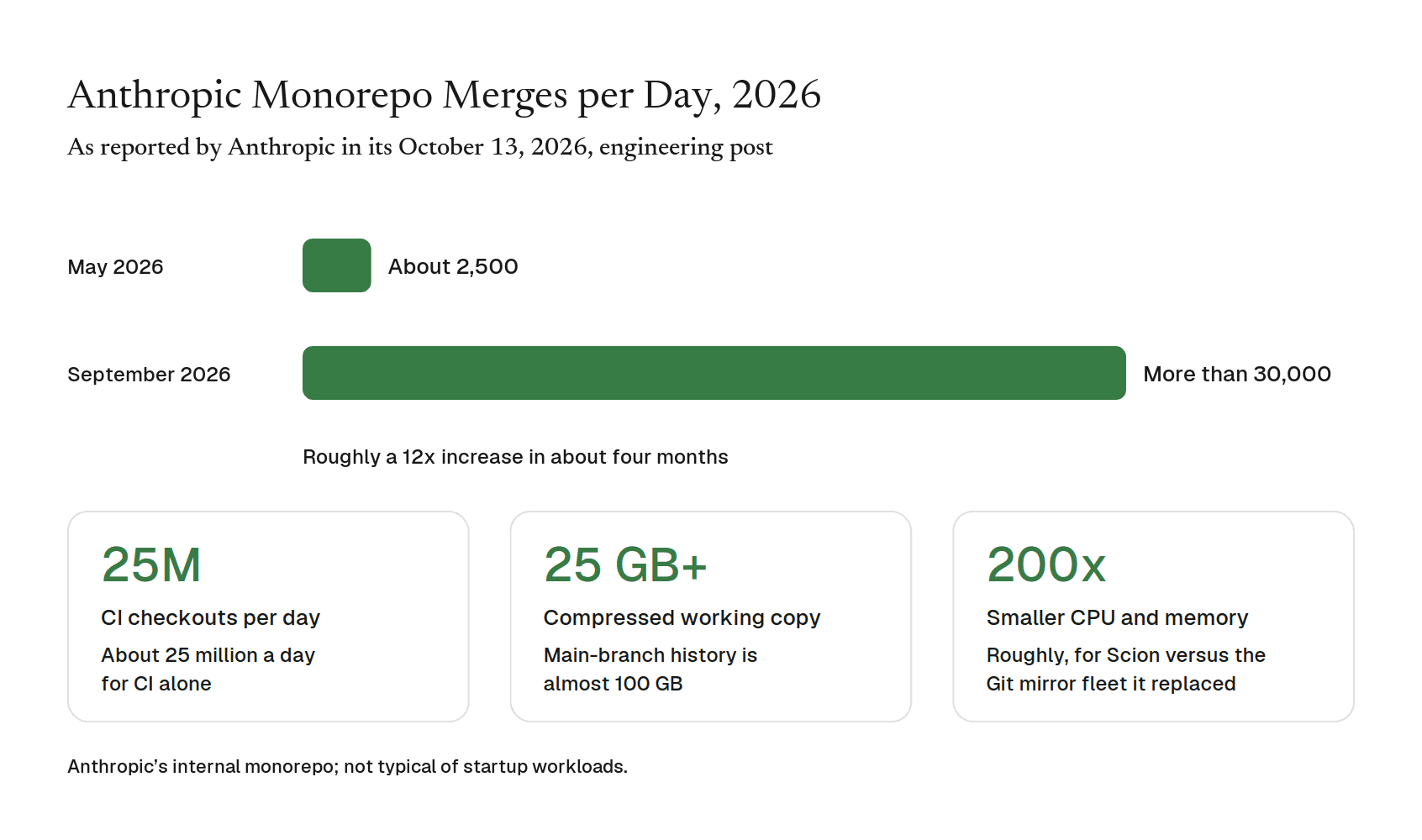
Anthropic’s October 13, 2026, engineering post, “Redesigning source control at Anthropic,” gives a concrete example of this pressure:
- Merge volume: merges in its monorepo rose from about 2,500 per day in May 2026 to more than 30,000 per day by September 2026.
- Load: CI performed about 25 million checkouts per day. The main-branch history was almost 100 GB, with a compressed working copy over 25 GB.
- Response: Anthropic built Scion, an in-house version control system. The post reports a roughly 200-times smaller CPU and memory footprint than the Git mirror fleet it replaced.
- Review tooling: the same team also built Antique, a new code review tool.
Anthropic says Scion is not a suitable Git replacement for general use. Its scale is not representative of startup workloads, but it shows the kind of operational pressure that AI-driven code volume can create.
These data points are not about AI code review tools themselves. They show the system-level effect of AI coding: the bottleneck moves to judging, sequencing, and safely rolling out AI-assisted changes. In modern workflows, much of a senior engineer’s strategic value lies in acting as the review and judgment layer above high-volume AI agents.
Amazon and Senior Sign-Off on AI-Assisted Changes: The March 2026 Reporting
March 2026 reporting about Amazon shows the debate over human accountability for AI-assisted changes. It raises a core question for the code review process: who is accountable when AI-assisted code causes problems in production?
On March 10, 2026, Ars Technica republished a Financial Times report that junior and mid-level Amazon engineers would need senior engineer sign-off for AI-assisted code changes. According to the report, this followed a set of outages linked internally to “Gen-AI assisted changes.” This is presented as reported, not as confirmed company policy, and it does not describe a mandate for AI tools to review code.
The reporting discussed two separate incidents. In December, Kiro, Amazon’s AI coding tool, reportedly contributed to an interruption in AWS Cost Explorer. Separately, a retail outage was linked to a “software code deployment.” These were distinct events, and they did not share a confirmed AI-related cause. Amazon attributed the Cost Explorer interruption to user error and misconfigured access controls rather than AI-generated code, and it disputed parts of the coverage. Where the accounts conflict, the cause remains disputed.
The distinction that matters is between human sign-off and automated review. The reported requirement would place approval responsibility for AI-assisted changes with senior engineers. That is different from mandating any specific AI code review tool. Different teams take different approaches. Some require senior approval for all AI-assisted changes. Others use risk-based review, where only higher-risk changes require direct human inspection. No single approach has emerged as a universal standard.
The Future of Software Engineering: Agents Write, Seniors Review and Own
Software engineering is shifting from manual coding toward system orchestration. As AI coding agents and automated checks make code production high-volume and cheap, senior engineers become the decision-makers about what merges and what ships to users.
In agentic coding setups, where an agent such as Claude Code, OpenAI Codex, or Cursor plans, writes, and refactors code, the human increasingly specifies intent, constraints, and high-level design instead of hand-writing every line. The work depends more on judgment and less on raw coding speed, with more time on architecture, design, and product integration.
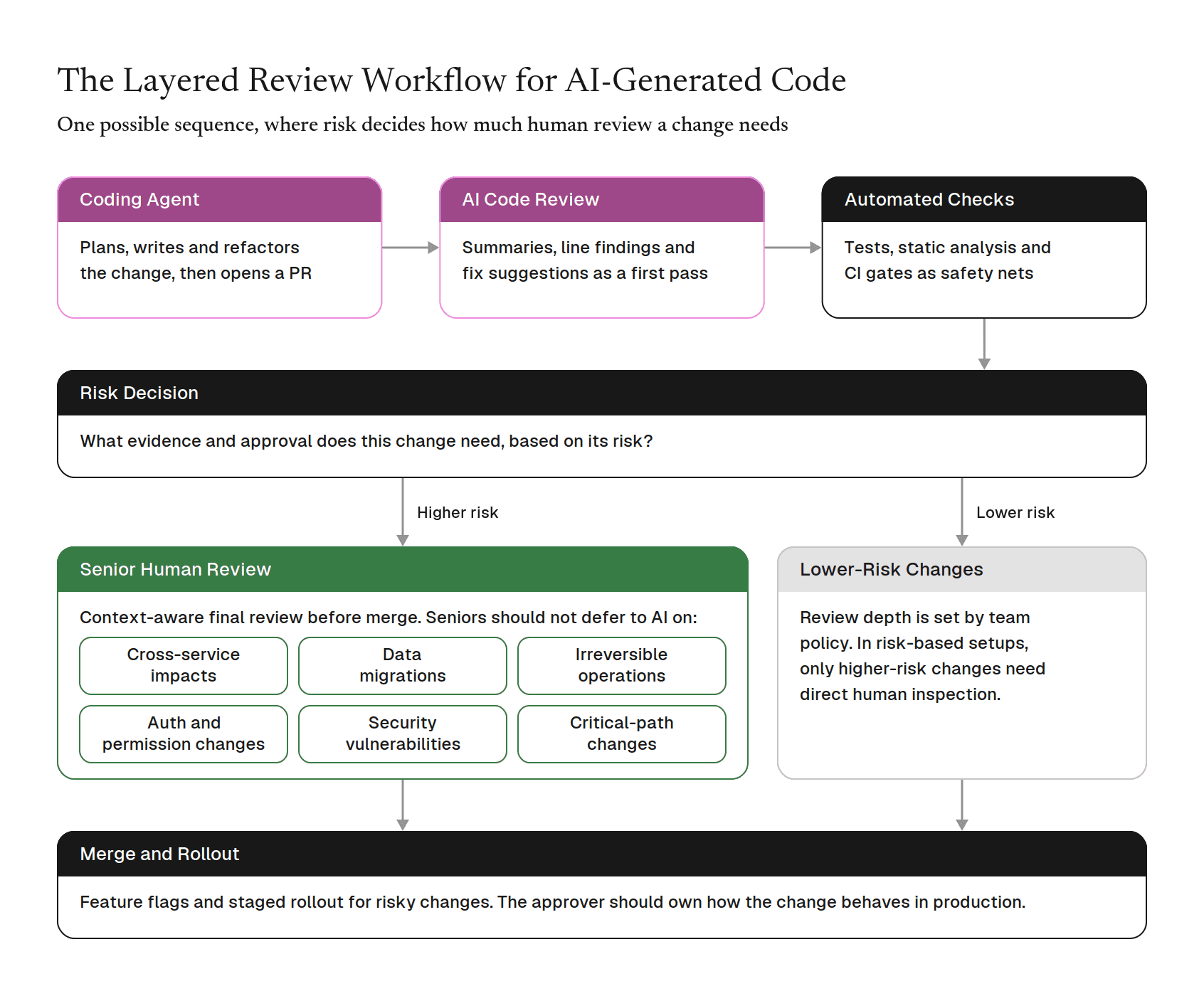
One possible layered workflow looks like this:
- AI agents generate code and perform an initial AI review.
- Automated checks and rule-based static analysis run as safety nets.
- A senior engineer performs a final, context-aware human review before merge.
Teams combine these steps differently, and no single sequence is a standard industry process.
The future of software engineering careers, especially at startups, is skewing toward ownership of systems rather than ownership of individual code fragments. Senior engineer code review is where that ownership shows up in practice. AI does not remove the need for human review: the GitHub data shows agent-authored pull request volume, and with it the potential review load, growing sharply, and the Amazon reporting shows that the consequences of insufficient review are real, whatever the cause of each incident.
What AI Code Review Means for Senior Engineers at Startups
Two related but distinct activities deserve separate attention:
- Automated AI code review: an AI code reviewer analyzes changes and produces findings or suggested fixes.
- Human review of AI-generated code: engineers evaluate changes produced by coding agents or AI assistants.
This article focuses mainly on the second, and on how automated review can support it. The senior engineer’s job is to judge whether the underlying change is correct, appropriate for the system, and safe to release. That means more than accepting or rejecting AI reviewer comments.
In small AI-first startups, senior engineers become the judgment layer on top of AI reviewers and coding agents. They decide when agent-generated code is safe enough, when it must be rewritten, and how to sequence changes across services.
An October 2026 snapshot of senior roles at companies on Fonzi shows how those companies describe the work. It covered 120 senior-level job descriptions, including staff and principal roles, across 50 companies.
Responsibility stated in the job description | Job descriptions | Companies |
End-to-end ownership from design through rollout | 60 of 120 | 33 |
Architecture and technical direction | 59 of 120 | 31 |
Production reliability or on-call response | 33 of 120 | 19 |
Code review or setting the quality bar through review | 27 of 120 | 11 |
Building evals or validation to catch wrong output before it ships | 20 of 120 | 13 |
Using AI coding tools and judging the output critically | 18 of 120 | 12 |
Source: senior job descriptions from companies on Fonzi, October 2026. Counts reflect what job descriptions state, not what engineers do in practice.
These counts show that many of the reviewed roles explicitly include responsibilities beyond implementation. That supports the argument that review judgment and system ownership matter alongside implementation skills.
An AI code reviewer can flag potential bugs, test gaps, style issues, and some more complex problems, but its findings still need validation and judgment. The system-level decisions senior engineers own still require weighing consequences and deciding what should merge or ship. Those decisions include architectural boundaries, failure modes, data contracts, security issues, and user-facing risk.
How AI-Generated Code Review Is Changing Senior Time Allocation
In AI-heavy startups, senior engineers spend less time on greenfield implementation and more on AI-generated code review, system design, and production decisions. The table below compares what senior engineers were evaluated on before high-volume AI agents with what matters now.
Evaluation area | Before high-volume AI agents | Now, with agentic coding and AI code review |
Primary signal of impact | Features shipped, code written, commit volume | Quality of review decisions, production outcomes, rollout success |
Time spent in code review | Moderate; reviewing human-authored PRs of manageable size | Growing; reviewing larger, more frequent agent-authored and AI-assisted pull requests |
Involvement in automated code review and evals | Limited; CI and linters as background tools | Active; configuring AI review tools, building test suites, defining risk categories for changes |
Ownership of production incidents and rollouts | Shared broadly or assigned by rotation | Concentrated; the senior reviewer is accountable for what ships |
Interaction with AI coding tools | Optional or exploratory | Expected; using and critically evaluating output from coding agents |
AI review moves seniors up a level. Instead of searching for every bug themselves, they curate AI findings, decide which issues matter, and balance speed against risk at merge time. The signal-to-noise ratio of review comments matters more when volume is high.
Performance conversations for seniors can center on production reliability, quality of review feedback, successful rollouts, and the ability to manage agentic coding workflows rather than commit counts. That change shifts what separates engineering career levels at AI-first startups.
How AI Code Review and Automated Checks Fit Into the Senior Review Loop
AI code review tools are first-pass filters, not final authorities, especially in safety-critical or high-scale systems. Code generation, automated checks, AI-generated review feedback, and human approval serve different purposes in an AI-assisted workflow. The senior skill is deciding what evidence and approval a change needs, based on its risk.
AI code review tools can produce PR summaries, line-level findings, and fix suggestions that help human reviewers focus on what matters. They also have real limits:
- Inconsistent results. Findings can vary across runs, unlike rule-based static analysis.
- Cross-cutting changes. They often struggle with changes whose implications span multiple files, services, or data contracts.
- Limited context. A reviewer who sees only the diff may miss the context needed to judge whether a change is safe.
- False positives. Noise consumes reviewer attention.
There are areas where senior engineers should not defer to AI:
- cross-service impacts
- data migrations
- irreversible operations
- auth and permission changes
- security vulnerabilities
- any change that can bring down a critical path
A comment an AI generates about an unused variable is different from a senior engineer’s review of whether a service boundary should exist. Ownership of the quality bar can also extend beyond individual PR comments to review requirements, automated checks, risk categories, and approval controls. In AI-heavy teams, the value of a senior reviewer is not being faster than AI. It’s being a better judge of where AI is safe to trust and where human skepticism is mandatory.
Owning Production Reliability for AI-Assisted Changes
AI-assisted development ships more changes faster, which also increases the surface area of what can go wrong in production. That helps explain why 33 of 120 senior job descriptions on Fonzi assign production reliability or on-call response, and 60 of 120 assign end-to-end ownership from design through rollout.
In AI-heavy teams, senior engineers have to think about failure modes that agents make worse:
- high-rate config changes
- schema drift
- subtle regressions that tests don’t yet cover
- logic errors that appear only on specific code paths
AI can assist with deployment planning and incident response, but accountability for rollout decisions remains human.
Anthropic responded to AI-driven volume by redesigning its infrastructure, which is the kind of system-level thinking senior engineers are expected to bring. Even at a smaller scale, startups need engineers who reason about how infrastructure handles great change volume, how to prevent security review gaps, and how to design rollback strategies for agent-generated changes.
Production ownership and review responsibility are two sides of the same role. The person who approves AI-assisted changes should also be accountable for how those changes behave in real users’ hands.
Designing Evals, Tests, and Validation for AI-Assisted Changes
When AI agents produce code and AI reviewers comment on it, tests and evals become the main way to constrain behavior before it reaches production. In the Fonzi snapshot, 20 of 120 job descriptions, spanning 13 companies, explicitly mention building evals or validation to catch wrong output before it ships.
Practical forms this work takes include:
- regression test suites that target known AI failure modes
- release-readiness checklists and CI gates
- offline eval harnesses for coding agents’ suggestions
- test suites that validate system behavior after high-volume agent-generated patches
This is different from traditional unit test writing. The emphasis is on system-level validation of high change volume, including error handling across multiple files, data contract validation, and secrets detection in agent-generated code.
Evals and AI code review reinforce each other. AI reviewers can be configured to flag missing tests, and custom rules can target specific failure patterns, but senior engineers still decide the coverage model and the thresholds. Collect concrete examples of evals, test frameworks, or validation pipelines you have built or led. These are strong signals that you can own an AI-accelerated development loop.
How to Show Code Review and Ownership Skills to Startups
Senior and staff engineers should present themselves to AI startups as strong reviewers and system owners, not only as prolific implementers. Code you have reviewed, production systems you have owned, and architectural decisions you have made are all evidence that matters.
Resume guidance. Add specific bullet points about code review responsibilities:
- "Led code review for X critical systems, setting code quality standards and review checklists"
- "Owned AI code review integration and policy for team of Y engineers"
- "Set and maintained quality bar through manual review of agent-generated pull requests for critical services"
Reference measurable outcomes like reduced incident counts or improved lead time where you have verifiable data.
AI-specific judgment. Include bullets that show how you exercised judgment over AI output, such as acting as the human reviewer of agent-generated pull requests for critical services, with a focus on architecture, security, and cross-service impacts. Focus on decisions and outcomes, not tools for their own sake.
Production ownership. Describe owning on-call rotations, leading incident reviews, designing rollbacks and progressive delivery, and being the final approver for risky or AI-assisted changes.
Interview preparation. Prepare short, concrete stories where you overrode or rejected AI-generated code, refined an AI-generated review, or insisted on more testing before rollout. Include your reasoning and the outcome. Bring written examples of review comments or design feedback, with proprietary details removed, alongside prep on common AI engineer interview questions.
Concrete Examples of High-Leverage Senior Review Behavior
At AI-heavy startups, the highest-leverage reviews change system outcomes rather than style. Review decisions that show senior judgment include:
- insisting on a feature flag and staged rollout for a risky change, even when CI passes
- rejecting a large agent-generated refactor that lacks tests or touches critical code paths
- catching a cross-service contract mismatch that diff-only tools could not see
- questioning the data shape assumptions in an AI-generated migration that affects multiple files
- flagging a security vulnerability in auth logic that an AI code reviewer missed for lack of context
These behaviors map to responsibilities in the Fonzi snapshot: architecture decisions (59 of 120), production reliability (33 of 120), and setting the quality bar through review (27 of 120).
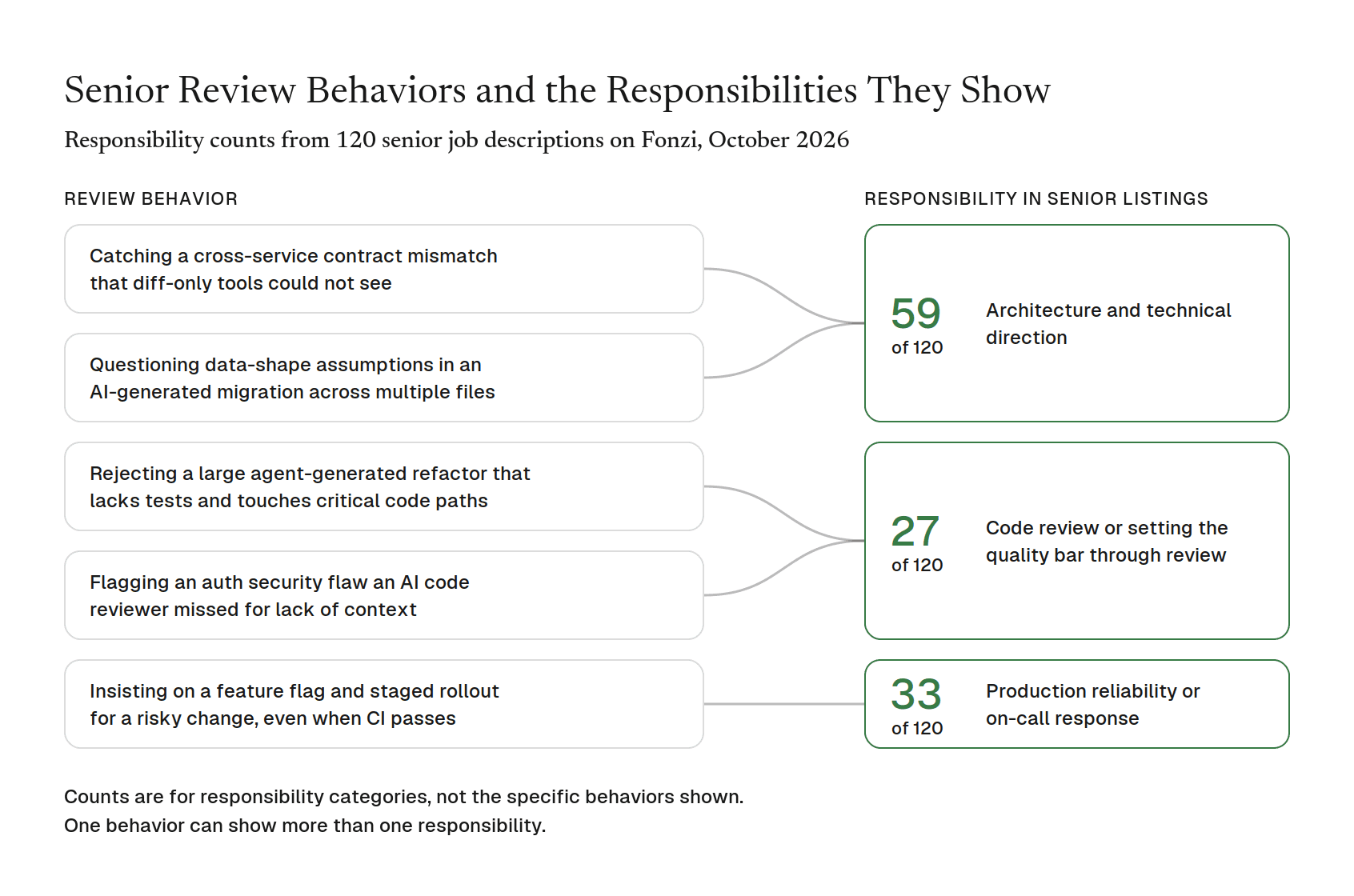
Senior review comments can shift from line-by-line edits to questions about use cases, failure modes, and data shape. This matters most when agents can change multiple files or services at once. Audit your own recent reviews for this kind of judgment, and turn the best examples into interview stories. Startups may probe for them in system design interviews, incident debriefs, and “tell me about a time you stopped a bad change” questions.
Questions to Ask About AI Workflows and the Code Review Process
Choosing the right startup in an AI-accelerated environment means understanding how the team uses AI agents, AI code review tools, and human review, not just which models it runs.
On agent usage:
- How much of your code is written or modified by AI coding agents today?
- Which coding agents does your team use, and how autonomously do they run?
On review policy and approval authority:
- Which AI-assisted changes require human approval, and who has final approval authority for higher-risk changes?
- Are there categories of changes that must receive human review regardless of automated checks?
On production ownership:
- When an AI-assisted change causes an incident, who is accountable, and how is it reviewed?
- Do you have written guidelines for rollout and rollback of agent-generated changes?
On automated review and evals:
- Which AI code review tools do you use, and how do you balance false positives against missed issues?
- Who owns test and eval infrastructure for AI-assisted workflows?
These questions protect you, and they signal that you understand the realities of AI-accelerated development.
Developing AI-Era Review Skills in Your Current Role
Senior engineers in environments where AI agents are still emerging can start building the review and ownership skills startups value:
- Volunteer to review AI-assisted pull requests, or be the human reviewer who double-checks code produced by AI assistants before merge.
- Learn at least one AI code review tool in depth, focusing on how to interpret findings, configure custom rules, manage signal-to-noise, and decide when to accept or override comments.
- Lead or contribute to team code review guidelines that address AI-generated code and AI review comments.
- Seek out on-call and incident review responsibilities if your exposure is limited.
- Keep a personal record of review decisions, incident mitigations, and evals you have implemented. These translate into resume bullets and interview stories.
Common Misconceptions About AI Code Review and Senior Roles
Misconception: AI code review tools will replace human review entirely. AI tools can handle obvious issues like style violations, unused variables, and some bug patterns. Humans still decide whether a change is safe to ship. The reported Amazon sign-off requirement, whatever its final form, shows how one large organization approached that accountability.
Misconception: AI reviewer accuracy is all that matters. Even accurate tools still require context-aware prioritization and trade-off decisions. Whether a data migration is reversible, or whether a feature flag is wired correctly, remains a human responsibility.
Misconception: Writing less code makes a senior engineer less valuable. Many senior job descriptions state architecture, review, and production ownership responsibilities alongside implementation. In the Fonzi snapshot, 59 of 120 job descriptions cited architecture and technical direction, and 60 of 120 cited end-to-end ownership.
AI agents and automated review are also not “set and forget” systems. They require continuous tuning, policy updates, and new evals as systems and threats change. For a senior engineer, what matters is how AI fits into the end-to-end development and deployment process they own.
Future of Software Engineering Skills Senior Engineers Should Prioritize
As agents handle more implementation, senior engineers should invest in the skills that make them effective reviewers and system owners.
System design and architecture. Understanding boundaries, data flows, and failure modes, and keeping systems maintainable under great change volume from agents.
Review judgment. Reading large AI-generated pull requests, synthesizing AI review comments, and deciding which issues block a merge and which can wait, based on risk and business impact.
Production engineering and reliability. Observability, incident response, rollout strategies, and resilience patterns, which appear as explicit responsibilities in senior job descriptions.
AI literacy. Understanding LLM failure modes, how agentic coding workflows run, and how AI tools integrate with version control and CI.
Communication and leadership in review. Writing clear, actionable review comments, mentoring less experienced reviewers, and setting team-level review standards.
These skills hold up as specific tools change, and they match how many senior, staff, and principal job descriptions in the October 2026 Fonzi snapshot describe the work.
How Fonzi Can Help Senior Engineers Find Review-Heavy Roles
Senior job titles rarely say how much of the work is review, architecture, and production ownership. In the Fonzi snapshot, senior roles with similar titles included some where review was explicit and others where it was never mentioned, so candidates have to read each description closely.
Fonzi is a curated AI engineering hiring marketplace that connects AI startups and high-growth tech companies with software and AI engineers it has screened. Through Match Day, companies send salary-backed interview requests directly to engineers, who can review the role and compensation before deciding whether to proceed, then ask the hiring team about review responsibilities and production ownership.
Senior Engineer Code Review Is the New Bottleneck
In the future of software engineering, human review of AI-generated code is the bottleneck, because coding agents make code production abundant and AI code review tools cover only part of the review load. Senior engineer roles are shifting toward review judgment, architecture, and production ownership, especially at AI-first startups where code volume is high and teams are small. Three sources point the same way: GitHub data showing agent-authored PRs overtaking human ones by August 2026, Anthropic’s source control redesign at more than 30,000 merges a day, and an October 2026 snapshot of 120 senior job descriptions on Fonzi, where 60 cited end-to-end ownership, 59 cited architecture, and 27 cited code review.
Human review remains the final safety layer, because whether a change is safe to ship depends on system context, testing, and the consequences of failure. March 2026 reporting that Amazon would require senior sign-off on AI-assisted changes, parts of which Amazon disputed, describes one large company placing that accountability on senior engineers. Senior candidates should document the review decisions, rollouts, and evals that show their review judgment.
FAQ
Does code review experience matter more than coding speed for senior roles now?
Both matter. In an October 2026 snapshot of 120 senior job descriptions on Fonzi, 60 cited end-to-end ownership, 59 cited architecture, and 27 cited code review, but the snapshot does not measure coding speed. Show both implementation ability and evidence of sound review and system ownership decisions.
What did the March 2026 reporting say about Amazon and senior sign-off on AI-assisted code?
According to a Financial Times report republished by Ars Technica on March 10, 2026, junior and mid-level Amazon engineers would need senior engineer sign-off for AI-assisted code changes. The report said this followed outages linked internally to AI-assisted changes. Amazon attributed a December interruption in AWS Cost Explorer to user error and misconfigured access controls rather than AI-generated code, and it disputed parts of the coverage.
How can I demonstrate review judgment in a startup interview?
Prepare specific stories where you overruled AI suggestions, caught issues that automated review missed, or changed rollout plans based on risk. Walk interviewers through your reasoning and the production impact of those decisions.
Are AI code review tools enough to keep AI-generated code safe in production?
No. AI review feedback alone cannot establish whether a change is safe for production, because that depends on system context, testing, and the consequences of failure. Human review, tests, and evals remain part of the safety net.
Should I specialize in a specific AI code review tool to stay relevant?
Not as your main bet. Familiarity with at least one AI code reviewer is useful, but the more durable skill is integrating AI reviewers into a safe workflow and exercising human judgment on their output, since specific tools will keep changing.