How Senior Engineers Run a Job Search Without Mass Applying
By Samara Garcia

A senior software engineer job search works best when it runs quietly through trust-based channels, such as referrals, in-house recruiters, public technical work, curated inbound platforms, and direct outreach, rather than through mass applications. Running a loud, high-volume search while employed risks damaging relationships, signaling instability, and filling your calendar with low-quality conversations.
Each of those five channels can produce senior-level interviews without a traditional application. Their tradeoffs in speed, control, and effort matter most in a passive job search, where you cannot signal widely to your current employer.
Key Takeaways
- High-volume cold applications are poorly matched to how senior hiring decisions actually get made, which rely heavily on trust, context, and specific team needs; a low-visibility, relationship-driven search that surfaces a small number of highly relevant opportunities performs better.
- Five channels (former colleagues, in-house recruiters, public technical work, curated inbound platforms, and direct outreach to target companies) can each produce interviews without traditional applications, but they differ sharply in speed, control, and effort required.
- Getting recruiters to contact you at the senior level depends more on search strategy than on profile keywords, though clear, consistent skill descriptions still help recruiters find you through search. Applying directly still has a place as a precision tool for narrow, well-matched roles rather than a default strategy.
Why Senior Software Engineer Job Searches Work Differently
Navigating the job market as a senior software engineer requires a targeted approach because the hiring process at this level is fundamentally different from early-career recruiting. Hiring managers filling senior roles are not sifting through hundreds of resumes looking for specific keywords. They are trying to reduce risk. Senior positions often value architectural impact and leadership over algorithm proficiency, so the evidence they seek involves judgment, ownership across systems, mentorship, and alignment with a team's direction.
Senior roles frequently have fuzzy or evolving scopes. A job description may describe one position, but the actual gap on the team might shift before a candidate is even brought in. This means hiring managers prioritize warm inbound signals (referrals from known collaborators, visible technical work, introductions from trusted connections) over anonymous applicants.
The goal of a job search strategy for senior engineers is not to maximize the number of applications sent. It is to surface a small number of serious conversations where the hiring manager already has reason to believe you are a fit, based on something more substantive than a resume parsed by an applicant tracking system.
Channels for a Low-Visibility Senior Software Engineer Job Search
Five channels cover most of what actually works at this level, and they differ sharply in what they require, what they produce, and how quickly results appear. Use the table to decide where to invest based on your network depth, available time, and urgency.
Channel | What It Requires | What It Produces | Time to See Results |
Former Colleagues and Referrals | Existing relationships from past roles, periodic check-ins, concrete ask | Fewer but serious interview loops, roles shaped to your strengths | Weeks, if relationships are warm |
In-House Recruiters | Targeted outreach, warm intros, clear constraints | Access to unpublished open roles, priority review | Weeks to a few months |
Public Technical Work | Sustained content creation, technical depth, community engagement | Inbound outreach from hiring managers and engineering leaders | Months (compounds over time) |
Inbound Talent Marketplaces | Detailed profile, openness to range of companies | Interview requests without manual applications | Varies by platform demand |
Direct Outreach to Target Companies | Company research, personalized messages to engineering leaders | Informal conversations, early access to emerging roles | Weeks to months |
How Referrals and Former Colleagues Drive Senior Engineer Opportunities
This channel covers anyone from past roles who can introduce you directly to hiring managers at companies you care about: former managers, peers, tech leads, and cross-functional partners such as product managers. Referrals often surface senior engineering roles before they are publicly posted, and some never reach job boards at all.
In practice, this looks like quiet check-ins with former colleagues: letting them know you might be open to your next opportunity, and asking specifically to be introduced to a hiring manager rather than pointed toward a generic job description. Keep the conversation grounded in the relationship, and make one specific ask rather than a general request for openings. A concise career narrative helps here too, so contacts understand clearly what kind of challenge, tech stack, or problem space you want next.
What it produces: fewer but more aligned interview loops, sometimes with target roles shaped around your strengths, and faster alignment on scope, title, and expectations, since the trust is already established.
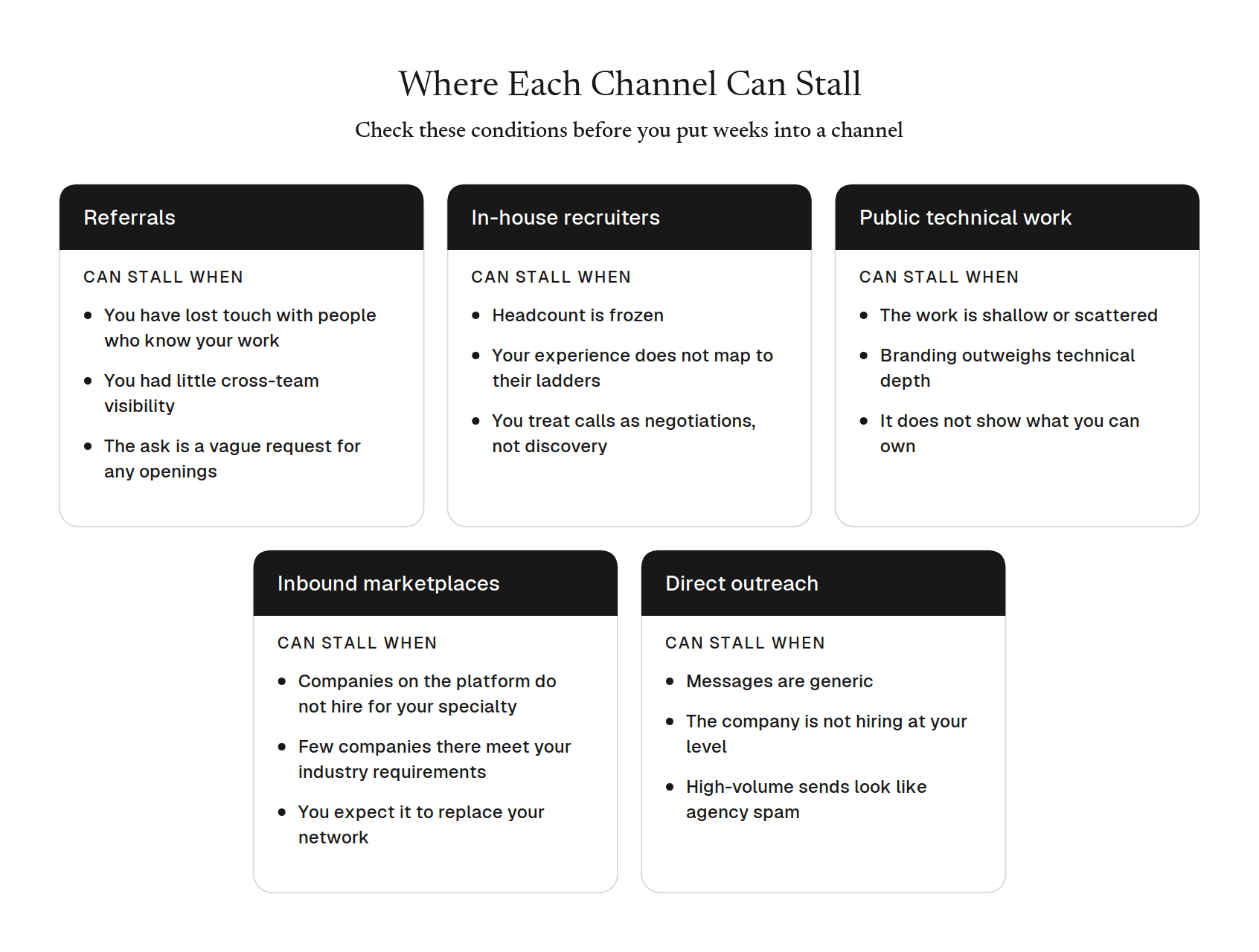
This channel can stall when you have lost touch with people who know your work, when you were isolated in your last role with limited cross-team visibility, or when you ask too vaguely for "any openings" instead of a focused senior engineer opportunity. Genuine relationships built before you need them are the prerequisite.
Working Directly with In-House Recruiters as a Senior Engineer
In-house recruiters are company employees who own specific engineering requisitions, distinct from agency recruiters or staffing firms. They have visibility into upcoming needs and hiring trends, sometimes before roles are written, making them powerful partners in a senior software engineer job search.
To get in front of them without mass applying, use targeted outreach to recruiters who own the teams you care about. Warm introductions through colleagues help. Personalized outreach gets further than templated messages: say what you are interested in, why this team, and why now. Following up about a week after initial contact keeps you on their radar without being intrusive.
What it produces: invitations to interview for roles that may not be public yet, priority review when something opens that matches your background, and guidance on which teams will actually value your expertise.
This channel can stall when the company has strict headcount freezes, when your experience does not map cleanly to their internal ladders, or when you treat every conversation as a negotiation instead of a discovery process.
How to Get Recruiters to Contact You as a Senior Engineer
Getting recruiters to contact you depends on aligning yourself with their current and near-future roles, making your constraints and interests concrete, and being low-maintenance and predictable in communication. Recruiters often filter candidates using Boolean search techniques across platforms, so having clear, consistent descriptions of your skills and domain across your profiles helps.
How to Get Headhunted as a Software Engineer Through Public Technical Work
Public work includes open-source contributions, technical blog posts, conference talks, podcasts, and thoughtful participation in engineering communities. It establishes a public track record of expertise and can attract inbound opportunities from potential employers who discover your work organically.
What it takes: choose a narrow slice of your expertise, whether that is infrastructure, data science, security, or a specific system design challenge. Publish real artifacts with code and narrative instead of generic career advice. Engage consistently in a couple of visible places (a focused technical community or a conference circuit) rather than everywhere at once. Highlighting leadership, mentorship, and cross-team alignment in what you share gives readers a clear sense of what you can own as a senior engineer.
What it produces: targeted outreach from hiring managers and staff engineers who found you through a library you maintain, a detailed post on scaling an internal platform, or a deep dive into an inference pipeline. These conversations tend to begin with shared vocabulary and assumptions, making them more productive from the start.
This channel is slow to ramp up, requires real time investment, and works best when you are not under immediate pressure to leave your current role. It can stall when the work is too shallow or scattered, when you focus on personal branding instead of technical depth, or when your content does not convey what you can own at a senior level.
Using Inbound Talent Marketplaces Without Volume Applying
Inbound talent platforms reverse the traditional search: instead of applying to every job posting on major job boards, you create one detailed profile and companies request interviews with you. This model suits senior job seekers who want to reduce manual effort while remaining discoverable to interested employers.
Fonzi is a curated AI engineering hiring marketplace where software and AI/ML engineers build one detailed profile, go through a review by the Fonzi team, and, if accepted, receive interview requests from AI startups and high-growth tech companies. In a senior software engineer job search, that means no browsing or applying to each company, and every interview request shows the company, role, base salary, and why the team thinks you fit.
What it takes: willingness to invest time in one detailed profile, clarity about role types and levels you will consider, and openness to a range of companies within your constraints, since matching is handled by the platform rather than by you choosing each company manually.
What it produces: inbound interview requests without manually applying to each role, conversations with companies that have already reviewed your profile and chosen to reach out, and less manual work to reach a first conversation when you are ready to move.
This channel works poorly if the companies on the platform are not hiring for your specialty or few of them meet your industry requirements, or if you expect the platform to replace your network entirely. You trade some control for reduced effort, relying on platform-mediated matching instead of hand-picking every company.
Direct Outreach to a Short List of Target Companies
This means building a small, concrete list of companies whose problems, scale, or mission you already understand, then reaching out directly to the most relevant engineering leaders instead of applying to every listed job description.
To assemble the list: look at funding news, technical blog posts you respect, architecture talks, open job descriptions that hint at upcoming needs, and insight from your network about where strong teams are being built.
What it takes: targeted messages that connect your past work to a specific business or technical challenge that company faces, references to real systems or products they operate, and a clear statement that you are exploring. Personalizing each outreach message is essential, and engaging with company content on LinkedIn before reaching out helps signal that your research is genuine.
What it produces: conversations that may begin informally, opportunities to shape a role before it is written, and trust based on your demonstrated understanding of the company's actual engineering problems.
This can stall when outreach is generic, when the company is not hiring at your level right now, or when you send high-volume messages that look indistinguishable from agency spam.
Passive Software Engineer Job Search: How the Channels Compare
A passive search means you are open to talking but cannot signal widely to your current employer or spend hours every week on applications. This changes how you weigh each channel.
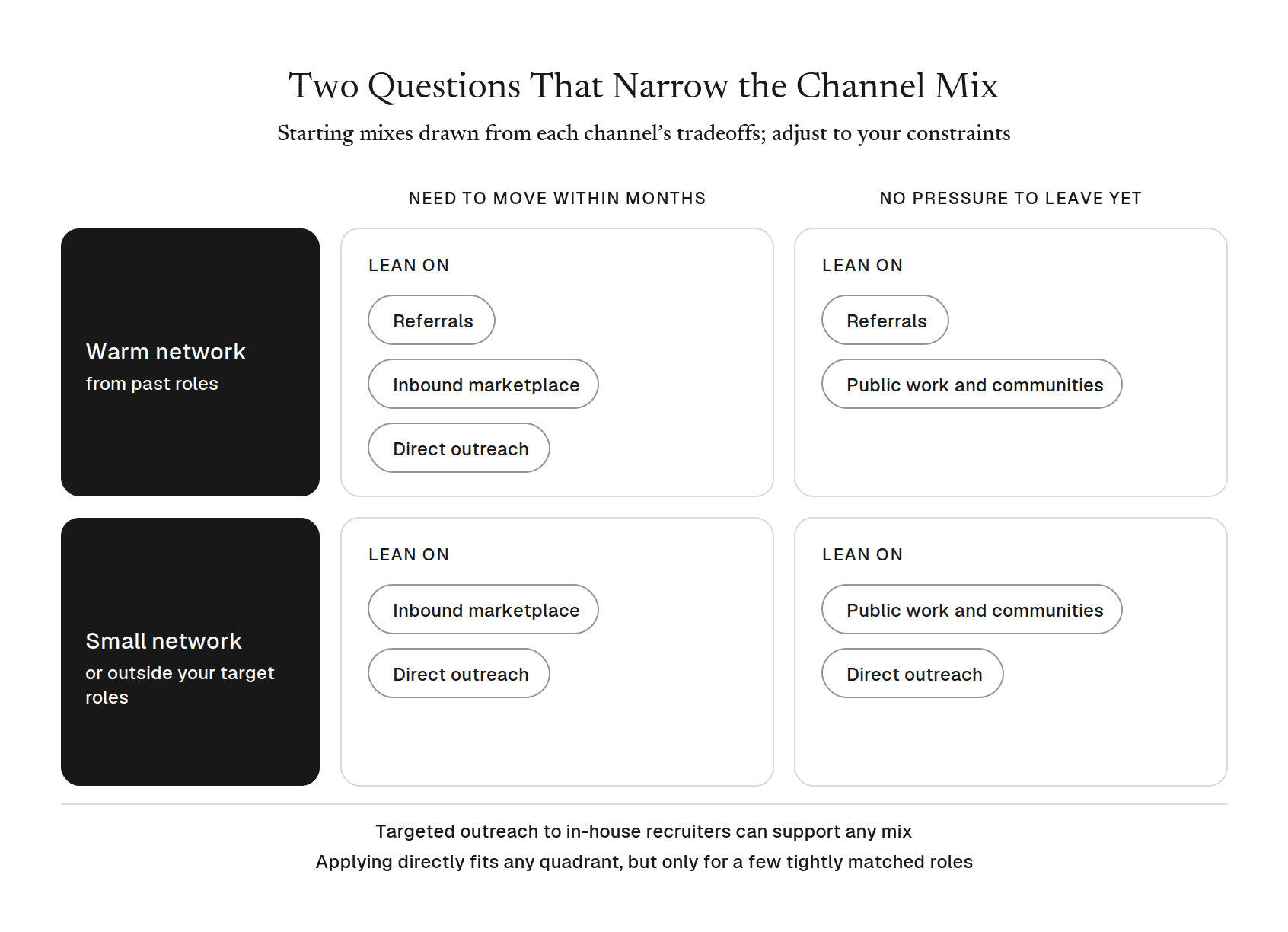
Referrals and in-house recruiters depend on discretion from people you trust. Public work reads as normal professional activity and does not raise flags. Inbound marketplaces trade hand-picked targeting for less manual effort. Direct outreach gives the most control but takes the most time per lead. A senior backend engineer who needs to move within a few months might combine referrals, an inbound marketplace, and targeted outreach to a small set of infrastructure-heavy or company-size-appropriate employers. The right mix is always context-specific.
When Applying Directly Still Makes Sense for Senior Software Engineers
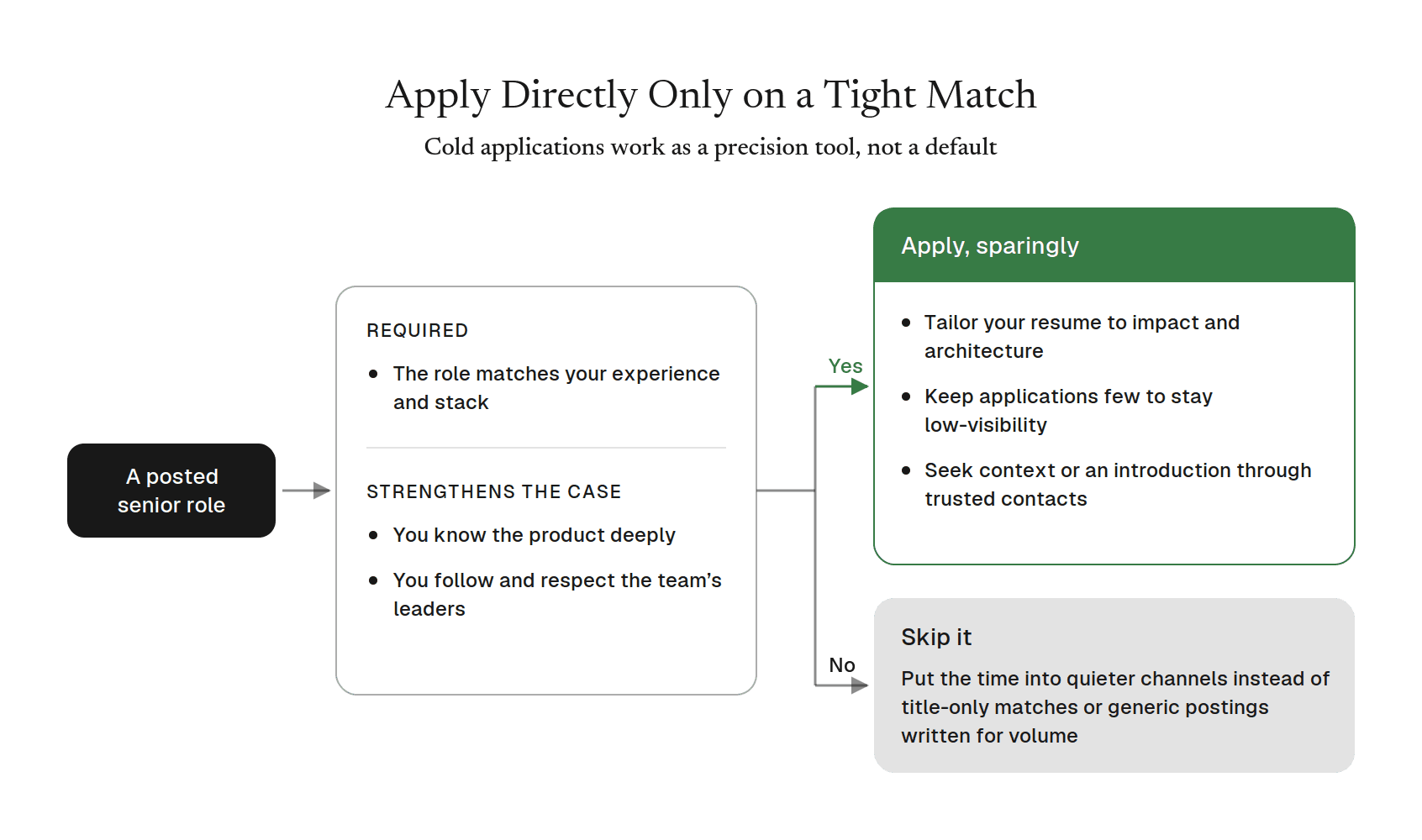
Cold applications are not useless at this level. They are just a precision tool with a narrower use case. Applying directly makes sense when a role is a very tight match to your experience and stack. Knowing the product deeply or following and respecting the team's leaders can strengthen the case, but neither replaces a match on experience.
When you do apply, customize your senior engineer resume for each application, focusing on business impact and system architecture rather than listing every technology you have touched. Keep this compatible with a low-visibility search by limiting applications to a small number spread over time, combined with quiet backchanneling through mutual contacts or in-house recruiters.
Direct applying can stall when you apply to any role with "Senior Software Engineer" in the title, when the job description is generic and written for volume, or when you rely entirely on applicant portals and expect them to filter for nuance.
Job Search Strategy for Senior Engineers: Matching Channels to Your Urgency
Frame your search strategy as a simple plan that matches your urgency, risk tolerance, and network strength to one or two primary channels plus one or two supporting ones. This is not about optimizing every detail of a profile. It is about directing a finite amount of senior attention toward the channels most likely to produce substantive conversations.
Concrete planning steps: assess your current network health, write down constraints such as location or hybrid expectations, identify whether you prefer startups or large companies, and pick channels that map to those realities. Define a minimal weekly cadence (a fixed number of quiet reach-outs, one or two conversations, or one public artifact) to keep the search moving without making it a full-time job.
How to Stay Discoverable Without Alerting Your Current Employer
The central tension of a passive software engineer job search is staying employed and protecting relationships while still being easy for the right people to contact. This requires quiet signaling.
LinkedIn's Open to Work setting can be limited to recruiters only, which shares your status with users of its paid LinkedIn Recruiter product without adding a profile badge. LinkedIn says it takes steps to hide your Open to Work status from LinkedIn Recruiter users at your current employer and affiliated companies, but it cannot guarantee complete privacy.
Beyond that, discreet updates to your network and participating in technical discussions demonstrate your interests without announcing that you are looking. Each channel supports low visibility differently: referrals travel through trusted contacts, in-house recruiters who value long-term relationships respect confidentiality, public work reads as normal professional activity, inbound platforms keep your search off public job boards with visibility controls that vary by platform, and direct outreach is initiated selectively by you.
Manage risks carefully. Oversharing reasons for leaving, broadcasting frustration publicly, or signaling desperation can leak back to your current team and damage the professional connections you depend on.
Common Failure Patterns in Senior Software Engineer Job Searches
Several mistakes recur in senior searches:
- Relying only on job boards without leveraging other channels.
- Staying invisible to people who would refer you, or assuming years of experience automatically generate inbound interest.
- Waiting until a layoff to build any external relationships with recruiters or engineering leaders.
- Sending resumes that list tools and keywords without showing what you have owned as a leader, system owner, and decision-maker.
Senior engineers sometimes misjudge their leverage. They decline exploratory calls that could inform future moves, or they stretch into roles where the company expects a different level. Strong engineers can also be down-leveled if they cannot clearly articulate past complexity and impact. For interviews that do materialize, prepare one or two strong stories highlighting complexity and impact, and be ready to discuss system design, tradeoffs, and scalability. The standard STAR framework (situation, task, action, result) works. The SOAR variant (situation, obstacle, action, result) replaces "task" with "obstacle," which suits senior candidates whose strongest stories involve ambiguity and problem-solving rather than a straightforward assignment.
To course-correct: rebalance your channel mix, ask trusted peers for honest feedback about how your work is perceived externally, and tighten the definition of the problems and stacks you want to own. Fixing the search process usually matters more than endlessly tweaking personal branding language.
Senior Software Engineer Job Search Summary
An effective senior software engineer job search is a low-volume, high-signal process. It favors referrals, aligned in-house recruiter relationships, visible technical work, curated inbound platforms, and focused outreach over mass applying, and the right mix depends on your current network, urgency, and how much time you can commit each week.
Put most of your effort into one or two of those five channels rather than spreading it evenly. Referrals can produce conversations within weeks when relationships are warm, while public technical work takes months to compound. Direct applications still have a place, but only for a small number of roles that tightly match your experience and stack.
Pick one primary channel to strengthen this week, map out a short list of specific people or companies, and start a deliberate, quiet search now, before circumstances force an urgent move.
FAQ
How many channels should I use at once in a senior software engineer job search?
Choose one or two primary channels plus one or two supporting ones instead of spreading thin across every possible option, since each channel needs sustained effort before it produces conversations. Depth in a few channels outperforms shallow activity across many.
How long should I expect a low-visibility, passive search to take before real interviews appear?
Timelines vary by market and specialization, but referrals and direct outreach can generate conversations quickly, marketplace timing depends on current company demand, and public technical work usually compounds over a longer horizon. Plan for the search to run in the background over several weeks or months.
What if my existing network is small or mostly outside the roles I want next?
If your network is small or sits outside the roles you want, lean on inbound marketplaces, direct outreach to engineering leaders at target companies, and consistent participation in focused technical communities.
How do I keep conversations exploratory without feeling like I am wasting people's time?
Be explicit about your timeline and openness, come prepared with specific questions about the team's problems, and connect discussions to whether there is a real senior-level fit worth pursuing. Most hiring managers and engineering leaders are interested in meeting strong technical talent even when timing is uncertain.
Should I pause my job search if my current company suddenly improves my situation?
You can slow down or narrow your search, but keeping a light, ongoing cadence of external conversations is often healthier for long-term career growth than fully switching it off. Maintaining relationships and visibility ensures you are never starting from zero when your next opportunity becomes relevant.