Research Engineer vs Research Scientist: Which to Pursue
By Samara Garcia

In research engineer vs research scientist comparisons, the core split is this: research engineers own the code and infrastructure that make experiments run at scale, while research scientists own the research questions and experiment design. If you are a senior engineer weighing a specific offer, that split decides how you will spend your day, what you will be measured on, and where the role leads in three to five years.
Research engineer vs research scientist roles differ on five axes: publishing expectations, code versus experiments, PhD expectations, agenda ownership, and career trajectory. A PhD remains the norm for scientist roles at top-tier labs, while an AI research engineer is more often hired on strong systems and production ML experience alone.
Key Takeaways
- Research engineers tend to own production-quality code and infrastructure and get measured on shipped systems and impact; research scientists tend to own hypotheses and experiment design and get measured more on papers, though the overlap at frontier AI labs like Google DeepMind and OpenAI is substantial, and research engineers there frequently coauthor publications.
- A PhD is not a hard requirement on either track, but it shapes which roles list it as an expectation, most often research scientist positions at top-tier labs, while research engineers are more often hired on strong systems and production ML experience alone.
- The two tracks diverge more over time than at entry: research engineers tend to move toward staff engineering or applied leadership, research scientists toward research leadership or lab direction, though movement between tracks stays genuinely possible and agenda ownership often crosses over in practice.
Research Engineer vs Research Scientist at a Glance
The table below maps each axis covered in this article to the typical expectations for each role.
Axis | Research Engineer | Research Scientist |
Publishing expectations | Evaluated primarily on internal engineering impact; coauthorship is common at larger labs, but papers are not the main performance signal | Evaluated on papers at top conferences (NeurIPS, ICML, CVPR), citations, and visible contributions to the research community |
Production code vs experiments | Engineering-heavy; builds data pipelines, training infrastructure, and high-performance implementations; often runs and designs experiments | Hypothesis and experiment-heavy; writes substantial code and prototypes but is accountable for the research question more than long-term systems |
PhD expectations | Often holds a master's degree or PhD, but many teams hire experienced industry engineers without a doctorate if systems and ML engineering skills are strong | Usually prefers a PhD in machine learning, statistics, or a related field, and many top-tier labs list one as an expectation |
Who sets the agenda | Influences direction through feasibility, infrastructure, and evaluation; some roles own a research direction outright | More often drives problem formulation, proposes new ideas, and defines the long-term research roadmap |
Three-to-five-year career paths | Staff or principal research engineer, ML infrastructure tech lead, applied AI leadership, platform architect | Senior or principal research scientist, research manager, lab lead, possible move into academia |
Publishing Expectations and How They Shape the Work
Expectations around publishing papers are one of the clearest cultural differences between the two roles, though they vary materially by organization and team. Where each title sits on the publishing spectrum tells you a lot about what your weeks will actually look like.
Research scientists are more often evaluated on conference papers and visible research impact. They submit to venues like NeurIPS, ICML, and CVPR, and their work is measured by the novelty and impact of the ideas and discoveries it produces. This emphasis on publication encourages generalizable findings supported by clearly documented experiments. In effect, a research scientist's main output is papers, and a research engineer's main output is working systems, though at frontier labs each regularly contributes to the other's.
Research engineers are more often evaluated on internal impact: shipped models, tooling, reproducibility, and reliability. Strong research engineers often contribute new ideas and may coauthor papers while implementing research. At labs like Google DeepMind, Meta, and OpenAI, research engineers are frequently coauthors on high-profile publications and often design and run the experiments behind them. But their primary performance signal remains engineering impact, not publication count.
This publishing pressure affects day-to-day choices. Research scientists prioritize work that leads to novel findings and publishable results. Research engineers are rewarded for solving messy, high-leverage engineering bottlenecks that accelerate the entire team. If you want to be measured mainly on research contributions such as papers and talks, the scientist title aligns better. If you prefer your output to be robust systems and internal adoption, the engineer track is the stronger fit, even though most roles blend both.
Production Code vs Experiments: What a Research Engineer in Machine Learning Actually Does
Both roles touch code and experiments, but the balance and expectations differ, and the two often overlap heavily on modern machine learning teams. The real question is which activity dominates your calendar and how your performance review treats each.
A research engineer focuses on production-quality code, data pipelines, training infrastructure, evaluation tooling, and integration with products or platforms, building experimental frameworks and translating abstract prototypes into robust, high-performance architectures. At many labs, research engineers also design experiments, develop deep learning algorithms, and own model improvements directly. They are measured by engineering impact: system reliability, performance, and scalability.
Research scientists spend a larger share of their time on experimental design, literature review, analyzing data, and interpreting results. Their code is a tool rather than the primary artifact. Strong research scientists may write code and build prototypes alongside their theoretical work, but they are more often accountable for the research question than for long-term code maintenance. Many work directly in large training stacks, yet the emphasis falls on conducting experiments and understanding model behavior rather than on operational excellence.
Senior engineers who care deeply about code quality, large-scale systems, and ML engineering will usually feel more at home in a research engineer role. Those who enjoy open-ended experimentation, model behavior analysis, and data analysis may prefer the scientist title.
Do You Need a PhD to Be a Research Scientist or Research Engineer?
PhD expectations vary by employer, team, and market segment. Neither "research engineer" nor "research scientist" has a single global standard, so treating the doctorate as a binary gate will lead you to the wrong answer.
Research scientist roles usually prefer a PhD, and many at top-tier labs list one as an expectation. Highly theoretical groups hold the same expectation, since they assume deep specialization in mathematics, statistics, and domain-specific science. Not everyone in a scientist role holds a doctorate, but it remains the norm, especially for positions that emphasize original research and the discovery of new phenomena.
Research engineers often have advanced degrees like a master's or PhD, but many teams hire research engineers without doctorates when candidates bring strong systems, distributed computing, or production ML experience. Experience building infrastructure, scaling training, or contributing to open-source frameworks can carry significant weight. Some organizations even treat experienced non-PhD hires as research scientists if they have a track record of published work or recognized impact, which shows formal credentials are not the only signal that matters.
If you do not hold a PhD, the research engineer track is the more direct route, and a publication record can open scientist roles later. If academia is a long-term goal, the scientist track plus a doctorate keeps that door more open. Either way, read specific job descriptions carefully, and talk to hiring managers. One big company might label a heavily applied AI role as "research scientist" while another uses "research engineer" for similar work.
Who Sets the Research Agenda in Each Role
For senior engineers, autonomy and scope often matter more than any specific technology or stack. This axis is where the two titles diverge most for people who want to shape what gets built, not just how.
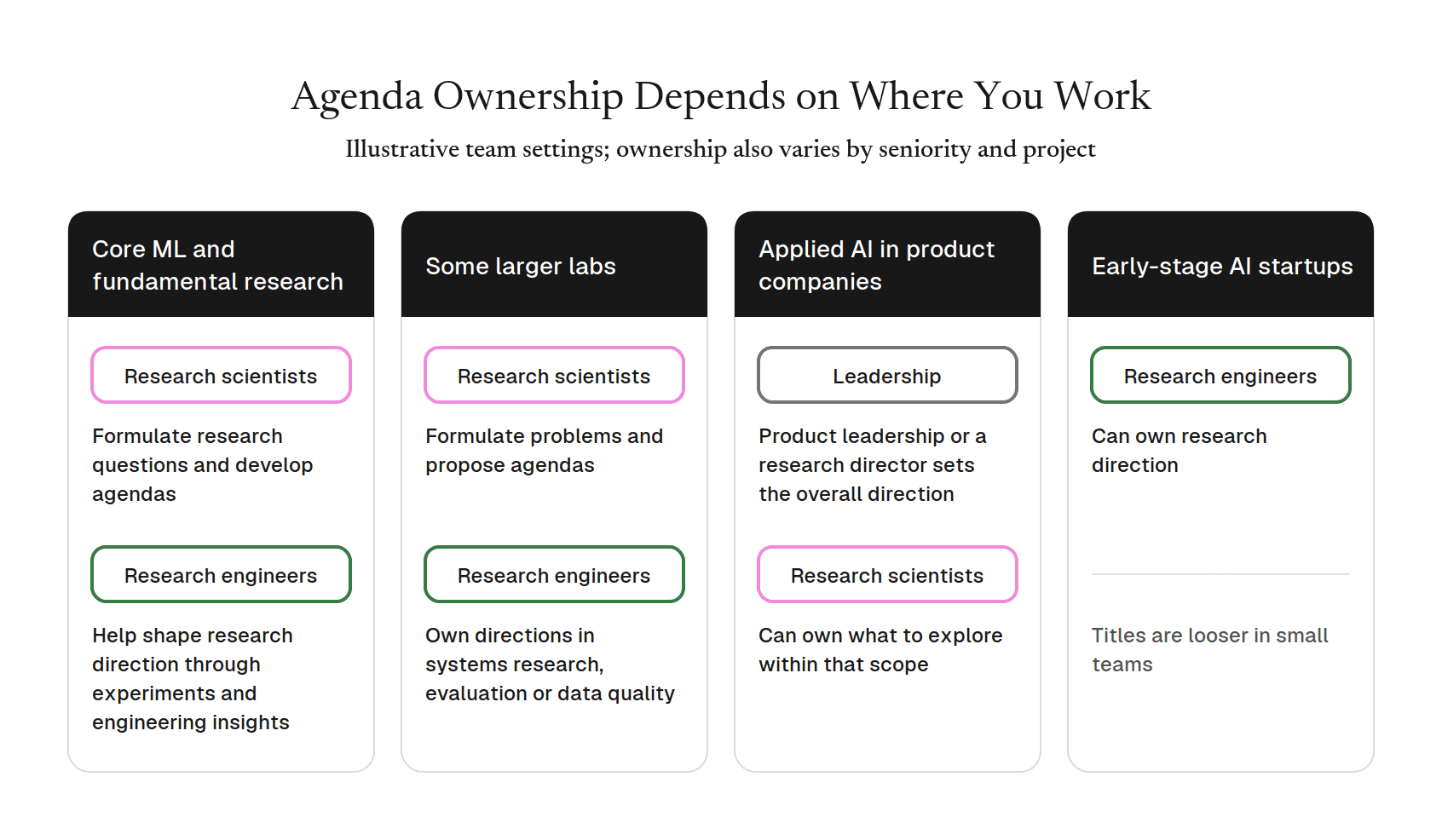
Research scientists are more likely to own problem formulation, define new research directions, and propose long-term agendas, especially in core ML teams or fundamental research groups. Research scientists identify open questions, form hypotheses, and design the experiments that test them, and their read of the research frontier often determines what the team pursues next.
Research engineers can help shape research direction alongside scientists: Anthropic's careers page says engineers have as much input into its direction as anyone else, while engineers also contribute through experimentation, systems design, and identifying feasibility constraints. At some larger labs, they own research directions outright, particularly around systems research, evaluation, or data quality. In applied AI groups inside large product organizations, product leadership or a central research director usually sets the overall direction, and within that scope scientists are typically treated as the owners of what to explore.
At early-stage AI startups, titles are often looser. Research engineers commonly own research direction, since small teams rarely maintain a strict split between the two roles, and senior research engineers can gain significant influence over the roadmap through their control of data, evaluation frameworks, and deployment channels.
If you want to drive high-level research questions and write the documents that define a field, lean toward the research scientist track. If you would rather shape outcomes through implementation details and system design, the research engineer path may fit your skills and goals better.
AI Research Engineer and Research Scientist Career Paths After Three to Five Years
The first few years set a trajectory, and the research engineer vs research scientist question is as much about future options as about initial responsibilities.
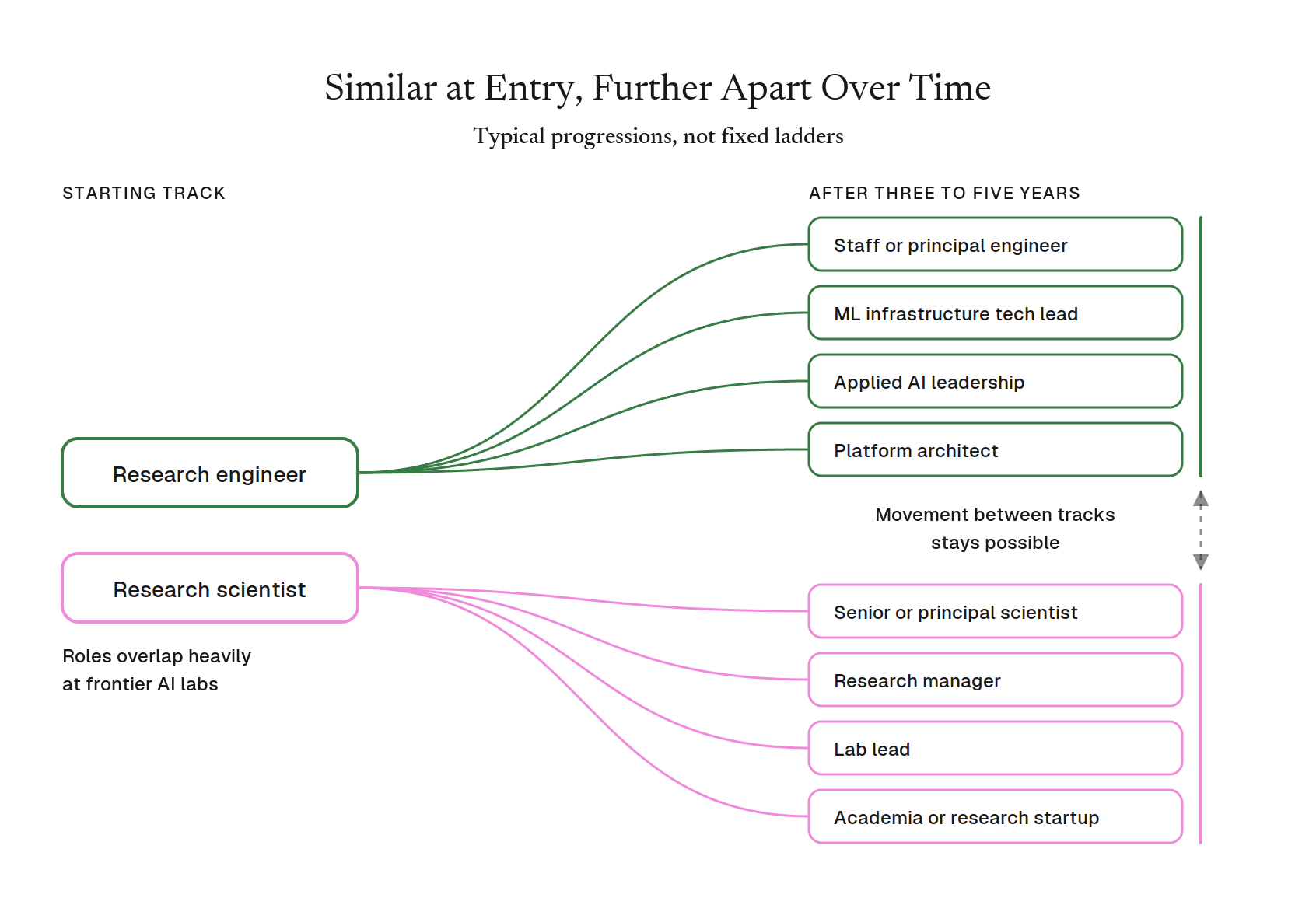
Research engineers who perform well typically progress to senior or staff research engineer, tech lead for ML infrastructure or model serving, or applied AI leadership overseeing teams of engineers and researchers. Those who excel at cross-functional work can move into roles like platform lead, principal engineer on foundation models, or architect for large-scale ML systems in major tech companies or well-funded startups. Career growth on this track rewards building and shipping at scale.
Research scientists follow paths such as senior research scientist, research manager, or lab lead, with growing responsibility for setting research direction, mentoring, and representing the organization in the research community. A strong publication record, usually combined with a PhD, makes a move into academia more realistic, which is one reason some engineers choose the research scientist track. Experienced scientists may also start research-focused startups or lead new research groups.
Map these trajectories against your own preferences. Do you want to be known for leading research programs and papers, or for building and scaling systems that power widely used products? Both paths carry real prestige in the industry; they simply reward different kinds of contribution.
Research Scientist vs Research Engineer: Which Role Fits Your Profile
Research scientists aim to discover what is possible, while research engineers aim to make it work reliably. The choice comes down to how you want to spend your time and be evaluated.
Engineers who tend to thrive as research engineers often have strong backend or infrastructure backgrounds, enjoy large codebases, bring interest in ML systems, and have a lower appetite for publication pressure, preferring their impact to show up in scalable, reliable technology. Engineers who thrive as research scientists enjoy reading and writing technical papers, designing experiments, leading exploratory projects, and publishing findings at conferences such as NeurIPS and ICML, and they accept a higher level of ambiguity and risk in outcomes.
Both roles can exist inside the same organization and collaborate closely, so the choice is less about prestige and more about preferred output. Use current offers and job descriptions to benchmark which title better aligns with your desired balance of research depth, engineering rigor, and ownership over direction. Total compensation, while important, varies by industry, location, and experience; it should not be the primary factor when the day-to-day work differs this much.
How Fonzi Can Help You Find the Right Research-Track Role
Titles in this space are genuinely inconsistent between companies, which makes it hard to search effectively: the same posting title can mean two different jobs, and the same actual job can be posted under two different titles depending on the company.
Fonzi is a curated AI engineering hiring marketplace that connects engineers with startups and growth-stage companies building AI. Each Interview Request shows the company, role, base salary, and why the team thinks you fit, which helps when you are weighing research engineer vs research scientist roles whose titles say little about the actual work.
Research Engineer vs Research Scientist: Which to Choose
The research engineer vs research scientist choice comes down to what you want to be measured on: shipped systems and their adoption, or research contributions and papers. Most roles blend both, so weigh your comfort with publishing pressure, the balance of production code and experimentation you prefer, whether you hold or want a PhD, how much of the research agenda you want to own, and where you want to be in five years.
Engineers most energized by shipping reliable systems at scale usually fit the research engineer track, and those drawn to testing novel hypotheses against ambiguous data usually fit the research scientist track. Because companies apply both titles inconsistently, the job description and a conversation with the hiring manager tell you more than the title does.
FAQ
Can I move from research engineer to research scientist later in my career?
Moving from research engineer to research scientist is possible, especially if you build a publication record, collaborate closely with scientists, and take ownership of experimental design. It is easier in organizations that already recognize fluid movement between the two tracks and value experience alongside formal credentials.
How portable are these titles if I want to leave a big tech or AI lab environment?
Research engineer experience typically maps to ML engineer, AI engineer, or senior or staff engineering roles depending on the work performed. Research scientist experience typically maps to applied scientist, ML researcher, or technical research leadership roles depending on the hiring culture of the target organization.
Will I be blocked from leadership roles if I choose the research engineer track?
Research engineers can absolutely move into leadership, often as tech leads, platform leads, or managers of applied research teams. Strong cross-functional communication, roadmap influence, and a track record of delivered systems are the skills that unlock those roles.
How important is a publication record for an AI research engineer who wants long-term impact without becoming a research scientist?
Impactful open-source contributions, widely adopted systems, and internal platform successes can be strong evidence of impact for research engineers. Their weight relative to papers depends on the employer and team, with product-oriented organizations placing especially high value on shipped engineering work.
What should I look for in a job description to tell which side of research vs engineering the role really sits on?
Scan for signals like emphasis on conference deadlines and novelty (scientist-leaning) versus focus on reliability, deployment, and collaboration with product or infrastructure teams (engineer-leaning). At some labs, including OpenAI, research and engineering hires share the internal title Member of Technical Staff, and many postings use a combined Research Engineer / Research Scientist title, so conversations with the hiring manager are essential to validate where the role actually sits.