What a Staff Engineer Actually Does, and How to Get There
By
Samara Garcia
•

A staff software engineer owns technical direction across multiple teams rather than shipping features within one. The problems arrive without clear requirements, span quarters instead of sprints, and get solved through other engineers as much as through code. That change in scope, not more years or more output, is what separates staff from senior. Getting there means operating at that scope before the title exists, and being able to show it.
Key Takeaways
Staff engineers create impact across multiple teams by owning complex systems, making technical decisions, and solving ambiguous problems without direct authority.
Moving from senior to staff requires deliberately expanding your scope through cross-team projects, technical leadership, mentoring, and long-term ownership.
To demonstrate staff-level readiness, document measurable outcomes, architecture decisions, and examples of influence through design docs, project deep dives, and strong interview stories.
From Senior Software Engineer to Staff Engineer: How the Job Actually Changes
The typical career ladder in software engineering runs from Software Engineer through Senior Software Engineer, Staff Engineer, Senior Staff, Principal Engineer, and eventually Distinguished Engineer or Fellow. At large AI-driven companies in 2026, a staff engineer sits at the inflection point where the job shifts from feature-level delivery to platform and systems-level ownership.
The shift is not about more coding hours. Senior engineers typically have 5 to 8 years of experience and focus on delivering features end-to-end, while staff software engineers generally bring 8 to 12+ years of experience, owning multi-team systems and long-term technical strategy. At staff level, the problems change. You move from owning features to owning multi-team systems, from clear requirements to vague ones, and from sprint-length horizons to multi-quarter or multi-year initiatives.
A senior engineer might own one retrieval subsystem, optimizing the vector database, embeddings, and latency. A staff engineer aligns retrieval, observability, cost, and safety across multiple LLM products. Likewise, while a senior engineer may improve one training pipeline, a staff engineer designs shared infrastructure across multiple pipelines, manages reproducibility, and coordinates compute resources across teams.
Scope, Impact, and Ambiguity at Staff Level
In practical terms, "scope" refers to the domains, services, or teams a staff engineer influences, and "impact" refers to downstream effects like cost savings, reliability improvements, enabling other teams to ship faster, or aligning safety and compliance across products. Staff engineers move from owning a single service to owning end-to-end systems that may include training pipelines, inference infrastructure, data governance, and on-call practices across multiple teams.
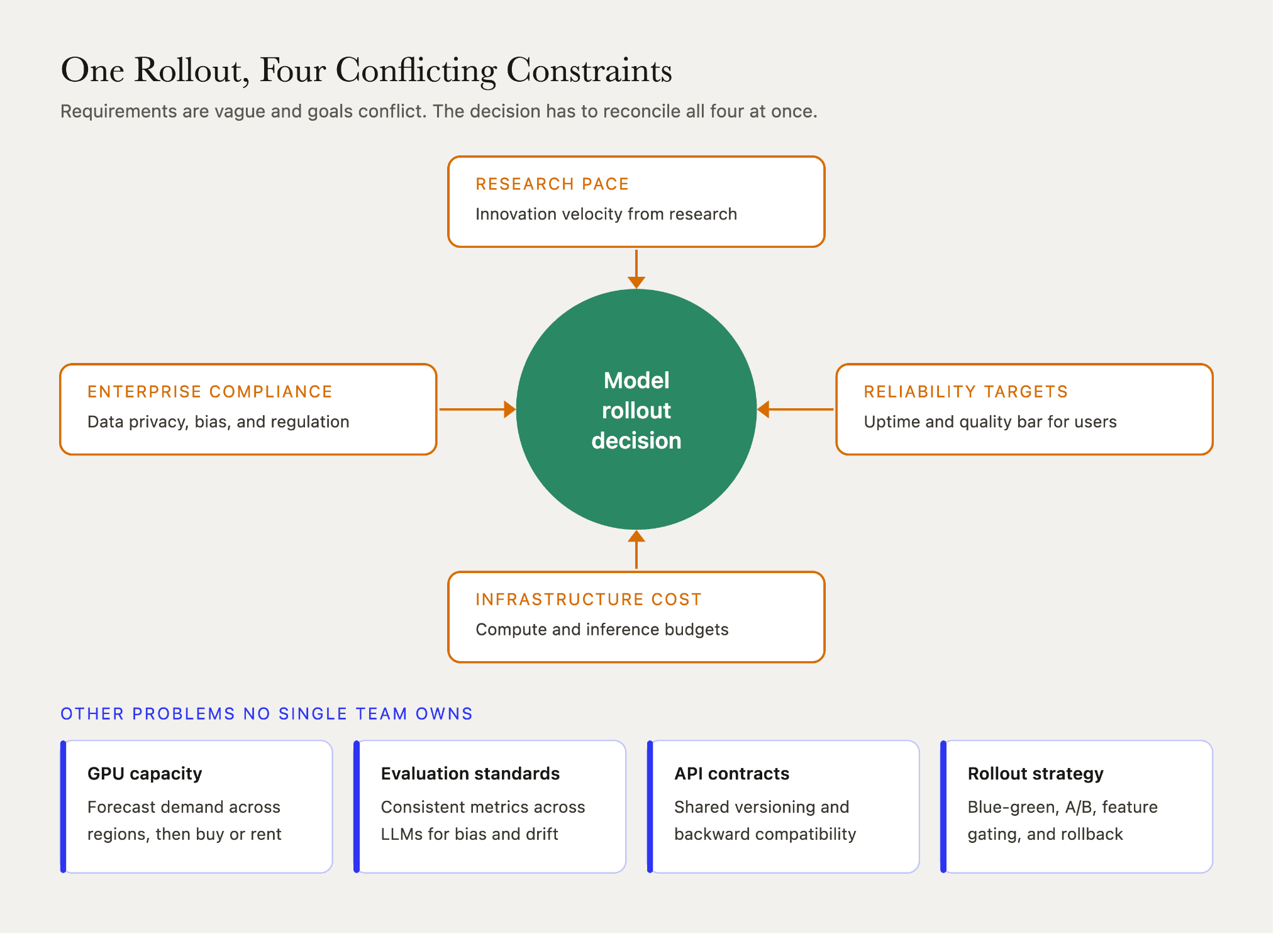
Staff engineers are expected to solve ambiguous and complex technical problems where requirements are vague and goals conflict. For example, rolling out a new model requires reconciling a research team's innovation pace with a product team's reliability targets, enterprise compliance needs, and infra cost constraints. Their decisions impact multiple teams and systems within the organization, and they often address high-risk, poorly scoped organizational problems that no single team owns.
Concrete types of staff-level problems include:
Taming GPU capacity bottlenecks across regions by forecasting demand and deciding when to buy, rent, or use spot instances
Standardizing evaluation frameworks across multiple LLMs, ensuring consistent metrics for bias, robustness, latency, and drift
Resolving inconsistent API contracts across ML services by building shared versioning and backward compatibility standards
Designing rollout strategies for new models with blue-green deployments, A/B experiments, feature gating, and rollback plans
Staff Engineer vs Senior Engineer vs Principal Engineer: Roles and Job Titles
Job titles differ between companies. At Google, the career ladder uses numeric levels (L5 for Senior, L6 for Staff, L7 for Senior Staff, and L8 for Principal). At mid-size AI startups, titles may be compressed or inflated. Understanding what "staff software engineer" actually means at a given company requires looking at the scope of problems
The typical relationship works like this: a senior software engineer (often L5) handles feature-driven execution and guides technical delivery within their immediate team. A staff engineer (L6) is a cross-team or domain owner providing technical leadership in platform and infra. A senior staff or principal engineer (L7 or L8) sets technical roadmaps across organizations, influences hiring and reorgs, and drives company-wide strategy. Staff engineers often report to principal engineers or directors, and the role is parallel to, not below, the engineering manager track. An engineering manager handles people management, team culture, and performance reviews, while a staff engineer provides technical direction without direct reports.
Comparing Senior, Staff, and Principal Engineer Responsibilities
The following table offers a concise summary for software engineers evaluating where they sit on the career ladder and what each level demands in practice.
Dimension | Senior Software Engineer | Staff Engineer | Senior Staff Engineer | Principal Engineer |
Typical Scope | One product or service within a specific team | Multiple teams or a platform-level domain | Entire group or several domains; influence across org | Organization-wide systems; cross-company influence |
Decision Horizon | A few weeks to one quarter | Several quarters to a year | One to two years; roadmap alignment among many teams | Multi-year (2 to 5 years); foundational architecture and strategy |
Coding Expectations | Majority hands-on development | Balance of code, design, architecture, reviews, and strategy | Less coding; more guidance, architecture, and proposals | Occasional coding; mostly design, strategy, and oversight |
Cross-Team Influence | Mostly within own team; peer collaboration | Leads cross-team alignment; defines shared patterns and APIs | Shapes how multiple teams operate; mentors other staff engineers | Sets org-wide standards; works with executive leadership |
Example AI/ML Project | Building and training a single ranking model | Designing a shared feature store and unified evaluation pipelines for a 500-person company | Architecting foundation model inference strategy across product lines | Defining safety or robustness policy guiding the entire AI platform |
What Do Staff Engineers Do Day to Day in AI and ML Organization?
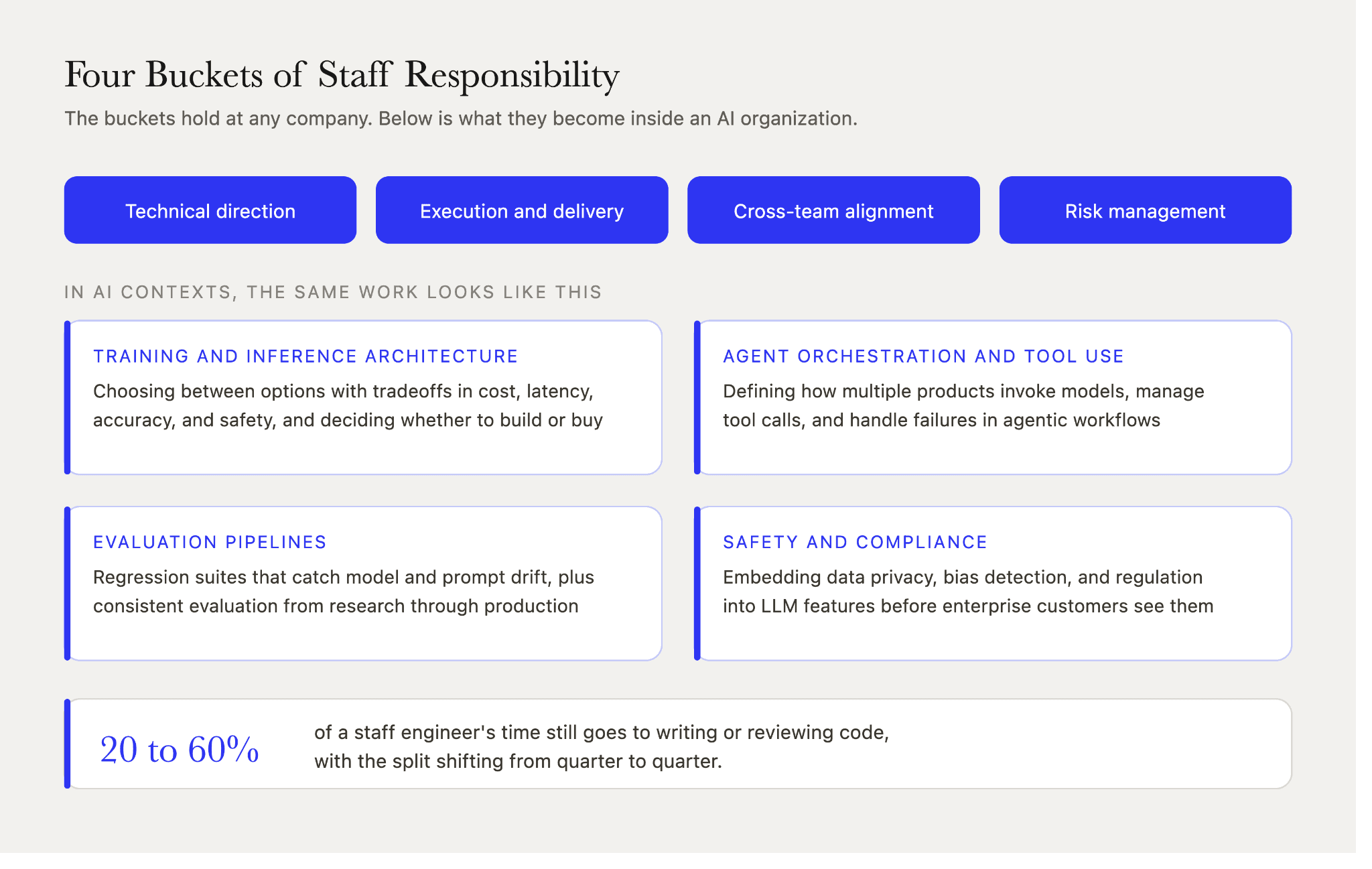
The core responsibility buckets for a staff software engineer fall into four areas: technical direction, execution and delivery, cross-team alignment, and risk management. A staff software engineer drives technical strategy and architecture across multiple teams, not just within a single product.
In AI contexts, these responsibilities take specific forms:
Designing training and inference architectures: choosing between options with trade-offs in cost, latency, accuracy, and safety, and deciding whether to build or buy services
Owning agent orchestration and tool-use infrastructure: defining how multiple products invoke models, manage tool calls, and handle failures in agentic workflows
Shaping evaluation pipelines: building regression suites that catch model and prompt drift, and ensuring consistent evaluation from research through production
Integrating safety and compliance constraints: embedding data privacy, bias detection, and regulation into LLM features before they reach enterprise customers in 2026
Staff engineers act as the engineering perspective in product, research, and policy discussions. When a company considers launching a new LLM feature, staff engineers weigh reliability, cost, user needs, and business objectives against the pace of research innovation.
Staff engineers still touch code, but they also spend significant time in design reviews, incident postmortems, RFC discussions, and written strategy documents. Staff engineers need substantial hands-on engineering knowledge, and writing code remains part of the job, typically 20 to 60 percent of their time depending on the quarter.
Technical Depth, Breadth, and Communication at Staff Level
Staff engineers are expected to maintain deep technical knowledge in at least one domain, whether that is distributed training, retrieval systems, low-latency inference, or machine learning infrastructure. Technical depth in a specific area is crucial for staff engineers because it provides the credibility needed to make consequential decisions about trade-offs like cost versus latency versus accuracy in production LLM systems. Staff engineers have a broad understanding of technology across various domains, including data pipelines, observability, security, and cost optimization.
Written and verbal communication is a core part of the job. Writing design docs and technical strategies is essential for staff engineers. These artifacts, including RFCs, decision records, and strategy memos, often survive reorganizations and team changes. They are referenced by other team members and other teams long after the original author has moved on.
Strong writing is increasingly evaluated in hiring loops, especially at remote-first AI companies that rely on async processes. A concrete example: a design doc that consolidated three separate ranking pipelines into a shared feature store, defining API contracts, cost allocation, and evaluation standards. Another example: a strategy memo arguing for a unified evaluation framework covering bias, safety, and performance across the research-to-production path. These are the kinds of artifacts that distinguish a very senior engineer from someone simply writing more code.
How Companies Hire Staff Engineers Today, Including AI-Assisted Processes
Staff engineer hiring loops in 2024 to 2026 differ meaningfully from senior interviews. There is more emphasis on system design, cross-org collaboration history, and real-world track records, and less emphasis on algorithmic puzzles. Companies want evidence that you can lead complex projects, create alignment across functions, and handle ambiguity.
AI is now part of the hiring workflow. Amazon has publicly described using AI for job matching, real-time interview transcripts, and role recommendations, and reports that candidates surfaced through AI matching who reach the interview stage are 24% more likely to get a positive outcome. Many companies use LLM-based tools to summarize candidate histories and run structured scorecard analysis. However, final decisions remain human-driven. AI in hiring works best when it helps recruiters focus on people, not when it replaces human judgment.
Typical stages of a staff-level process at AI companies include:
Recruiter screen evaluating background, multi-team ownership signals, and domain expertise
Technical deep dive with architecture and systems design discussions
Cross-functional rounds with infra leaders, ML research, product, or policy stakeholders
Behavioral interviews focused on ambiguity, conflict resolution, and influence
Code or design component, sometimes including AI-augmented tasks or prompt-based problem solving
Preparing Your Profile, Portfolio, and Signals for Staff Engineer Roles
Signaling the right scope and impact is critical for staff-level roles. Most recruiters and hiring managers scan for clear evidence of cross-team influence, long-running projects, and architectural ownership. Tool lists or domain buzzwords without evidence are weak signals.
Use the STAR method to rewrite experience bullets around organizational scope. Instead of "built feature X in service Y using Kubernetes," write: "Led the migration of service Y's inference pipeline to Kubernetes, enabling three teams to share the platform and reducing GPU spend by 18% in Q4 2025.” Add supporting artifacts where possible, such as public talks, open-source contributions, or research collaborations in ML systems, inference infrastructure, or data tooling.
Prepare a short, concrete staff-level story that demonstrates ownership of an ambiguous, multi-quarter initiative. Frame the context, constraints, decisions, and measurable outcomes. Staff software engineers typically hold a bachelor's or master's degree in computer science or a related field, but production impact and cross-team execution carry more weight in hiring decisions than credentials.
How to Become a Staff Engineer: Steps and Timelines
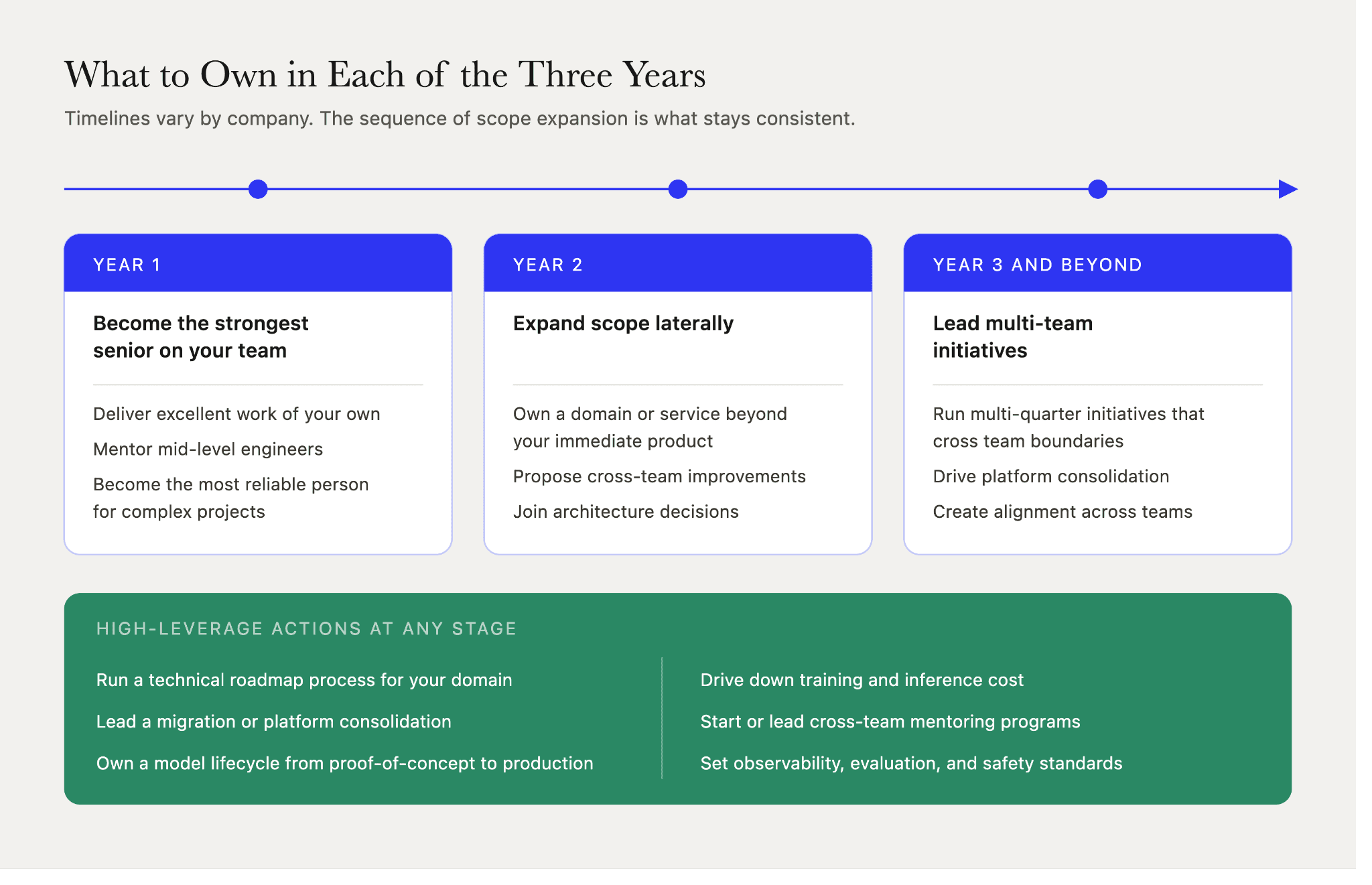
Timelines vary, but senior engineers typically progress to the staff level over several years by deliberately expanding their organizational scope and technical visibility. Some software developers reach the staff engineer role faster at fast-growing startups, while at larger companies the path may take longer.
A staged approach works well:
Year 1: Become the strongest senior on your team. Deliver excellent own work, mentor mid-level engineers, and become the most reliable person for complex projects.
Year 2: Expand scope laterally. Take on domain or service ownership beyond your immediate product. Propose cross-team improvements. Participate in architecture decisions with other teams.
Year 3 and beyond: Lead one or more multi-quarter, multi-team initiatives. Drive platform consolidation, shared infrastructure, or performance and cost optimization. Seek visibility and create alignment across stakeholders.
High-leverage actions that fit AI and ML organizations:
Run a technical roadmap process for your domain
Lead a migration or platform consolidation (for example, unifying ML serving or evaluation infra)
Take ownership of a model lifecycle from research proof-of-concept through deployment, monitoring, and drift detection
Drive cost optimization for training runs or inference, such as reducing GPU spend through mixed precision or shared infrastructure
Start or lead mentoring programs across engineering teams, helping individual contributors develop expertise
Drive standards around observability, evaluation, or safety that multiple teams adopt rather than reinvent
This path should emphasize sustainable growth, not heroics. Staff engineers scale impact by helping other team members succeed, documenting decisions, and building relationships upward. If you are already driving cross-team technical decisions, authoring foundational design docs, and resolving ambiguous issues no single team owns, you may already be operating at the staff level. Operating at the staff level is about maximizing your impact through leverage and strategic judgment, rather than taking on unsustainable workloads.
How Fonzi Helps Staff Engineers Find the Right Opportunities
Staff-level hiring puts more weight on technical scope, cross-team influence, and measurable impact than on simply matching a list of skills. That can make the job search challenging for experienced engineers because resumes often fail to capture the architecture decisions, multi-team initiatives, and long-term ownership that define staff-level work. A curated AI engineering hiring marketplace like Fonzi can give engineers another way to find roles that align with their technical experience and career trajectory.
Fonzi connects companies with pre-vetted AI and software engineers, making it easier for experienced candidates to find opportunities where their background in AI infrastructure, systems architecture, technical strategy, or engineering leadership is relevant. Its recurring Match Day hiring event gives companies a scheduled window to meet batches of pre-vetted engineers, adding a more focused path alongside traditional recruiting channels. For engineers pursuing staff roles, Fonzi can complement an existing job search by connecting demonstrated technical impact with companies looking for experienced engineering talent.
Summary
Staff engineers own systems that cross team boundaries. The decisions land where constraints conflict, between a research team's pace and a product team's reliability bar, or between inference cost and latency, and there is rarely a requirements doc waiting. Much of the output is written rather than committed. Design docs, decision records, and strategy memos outlive the reorgs around them, which is why writing shows up in staff hiring loops as often as system design does.
What a staff software engineer means varies by company, so the scope of problems is a more reliable signal than the level on an offer letter. How to become a staff engineer comes down to operating at that scope before the title exists, then describing it in terms a hiring committee recognizes: architecture decisions, multi-quarter initiatives, and outcomes with numbers attached. If you are already writing the documents everyone references and owning the problems no single team will claim, the gap may be recognition rather than readiness.
FAQ
How much coding does a staff software engineer typically do week to week?
Is it realistic to switch companies and land a staff engineer role as a current senior engineer?
How do I show staff-level scope if my team or company is too small for cross-team work?
When should I choose the engineering manager path instead of pursuing staff engineer roles?
Do I need published research or open source projects to become a staff engineer in AI-focused companies?


