How to Get a Job at an AI Startup as an Engineer
By
Samara Garcia
•

Getting hired at an AI startup as an engineer depends less on model-training credentials than on evidence you have shipped model-powered features into production. Founders at seed through Series B hire for end-to-end ownership under uncertainty, so a portfolio showing a feature you built, deployed, and measured outweighs a resume listing frameworks. The AI startup hiring process for engineers runs shorter and less standardized than a Big Tech loop, with founders making the call directly rather than a hiring committee. Knowing what they screen for, and how to weigh an offer where equity carries most of the risk, is what separates a targeted search from a scattershot one.
Key Takeaways
AI startups value engineers who can take ambiguous problems from idea to production while combining strong technical, AI, and product skills.
Candidates should highlight recent AI projects, measurable results, open-source contributions, and practical experience with modern AI tools.
Engineers should evaluate startups carefully by considering technology, runway, team quality, equity, role scope, and long-term growth potential.
What Founders at AI Startups Are Really Optimizing For
Seed-to-Series B AI startups often prioritize force multipliers over narrow role fit. They want engineers who can own systems end to end, ship under uncertainty, and learn quickly.
In practice, that might mean building a retrieval pipeline, improving evaluation infrastructure, or taking a product feature from idea to launch. Strong candidates also communicate well, understand users, and adapt as priorities change.
Early-stage startups tend to favor versatile generalists, while later-stage teams hire more specialists. For senior candidates, demonstrated impact and cross-functional skills often matter more than titles or credentials.
Core Technical Skills AI Startups Expect From Senior Engineers
Senior roles at AI startups demand a balance of production software engineering, distributed systems knowledge, and AI-native skills.
Foundational Skills
Production-grade Python remains the baseline. Candidates should demonstrate strong programming skills in Python, and familiarity with TypeScript is increasingly expected for full-stack work on small teams. Beyond language fluency, startups expect distributed systems knowledge, observability practices (metrics, logs, tracing), and hands-on experience with cloud platforms such as AWS, GCP, or Azure. Data engineering skills, including building and maintaining data pipelines, remain foundational across most AI engineering roles.
AI-Specific Technical Expectations
Modern AI startups expect fluency with LLM APIs from providers like OpenAI and Anthropic, including prompt engineering as an engineering discipline, which now extends into context window management, structured outputs, and agentic loop orchestration. Building evaluation harnesses, working with vector databases, and integrating external tools via function calling, agent frameworks, or the Model Context Protocol are now core expectations. Experience with natural language processing fundamentals and generative AI systems is assumed.
Startups also look for engineers with practical experience in deep learning frameworks like PyTorch or TensorFlow, especially for roles involving model fine-tuning. Strong candidates demonstrate familiarity with open-source stacks such as LangChain, LlamaIndex, vLLM, SGLang, Ray, Triton, DSPy, or Instructor, and can explain tradeoffs between proprietary and open models.
System Design and ML Depth
System design thinking is crucial for AI startup interviews. You should be prepared to discuss handling context limits, latency constraints, streaming responses, memory architectures, and safety or guardrail design in AI-native systems. When an AI startup actually needs someone who can train or fine-tune models, the job description will specify it. Most applied roles need engineers who orchestrate and ship model-powered features rather than train models from scratch.
Domain expertise in fields like healthcare or finance is beneficial for AI roles, as many startups building AI products in regulated verticals need engineers who understand compliance and data sensitivity alongside their technical skills.
How AI Startups Structure Their Hiring Process in 2026
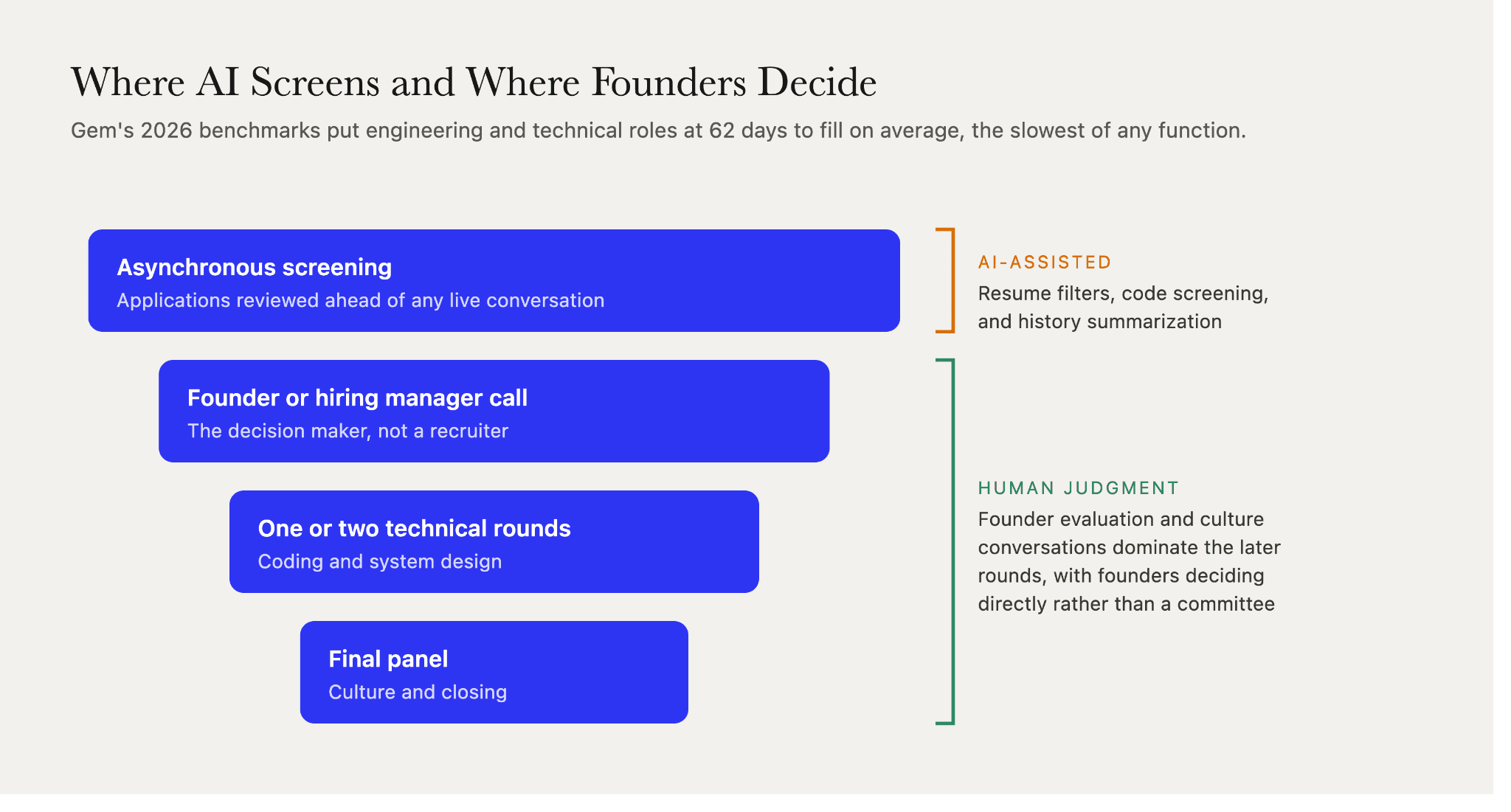
The typical funnel at AI startups from seed through Series B differs significantly from Big Tech loops. Gem's 2026 recruiting benchmarks put engineering and technical roles at an average 62 days to fill, the slowest of any function, and senior AI searches often run longer still. Expect a multi-month process even at startups that describe themselves as fast.
Common stages include asynchronous screening (often with AI-assisted resume filters), a founder or hiring manager call, one or two technical rounds focused on coding and system design, and a final panel. AI is used during recruiting for tasks like automated job description matching, code screening, or summarization of candidate histories. However, human judgment still dominates later rounds, particularly the founder evaluation and culture conversations.
Some companies now expect that candidates may use AI during parts of the technical interview, and they screen for judgment of AI output and the ability to validate or correct it. Employers expect candidates to understand both the strengths and limitations of AI tools.
Comparison of Big Tech vs AI Startup Hiring Loops
The two processes diverge most on who makes the decision and how much of the role is defined before you start.
Dimension | Big Tech | AI Startup |
Timeline | 4 to 8 weeks, often longer | Variable; often longer than expected given founder availability and competing offers |
Interview Focus | Standardized coding rounds, behavioral questions | AI system design, product reasoning, ownership evidence |
Decision Makers | Hiring committee, recruiters | Founders and engineering leads directly |
Role Scope | Well-defined within a team or org | Broad, often spanning infra, product, and ML |
Negotiation | Structured bands, limited flexibility | More variable, equity negotiation is central |
AI startup processes are more variable, but candidates who proactively propose trial projects or paid work samples can influence the direction of the evaluation. Big Tech loops are more standardized and often involve a group of interviewers using rubrics.
Building a Portfolio That Signals AI-Native Impact
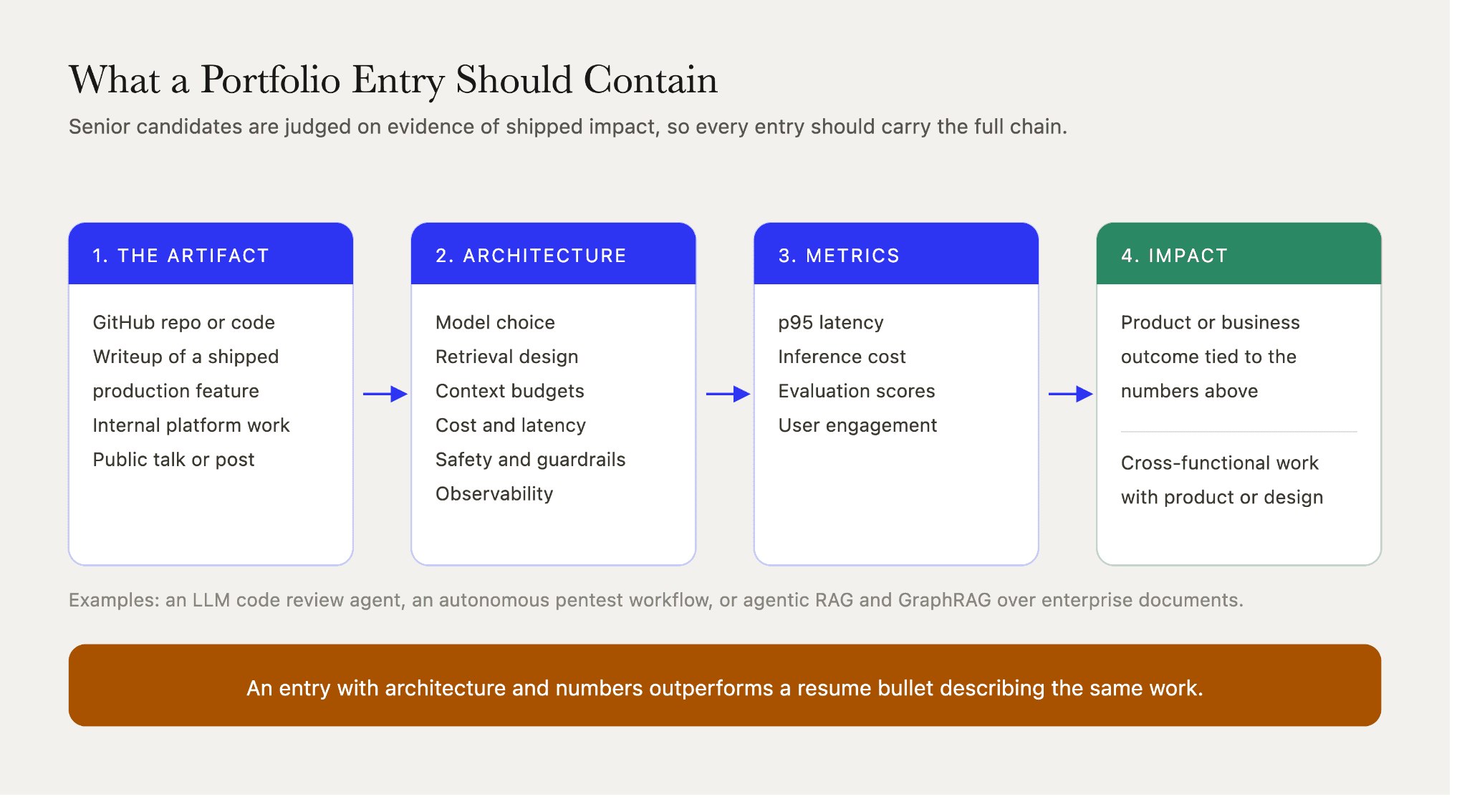
For candidates focused on getting hired at an AI startup, demonstrating concrete project impact through a practical portfolio often proves far more convincing than standard resume bullet points. Senior candidates are judged heavily on evidence of shipped impact, not only job titles and employer names.
Maintain a concise but concrete portfolio: GitHub repos, short writeups of production features, internal platform work, and public talks or posts. When documenting projects, focus on architecture and measurable outcomes. For example, describe an LLM-powered code review agent, an autonomous penetration testing workflow, or a RAG system for proprietary documents, ideally extended into agentic RAG, GraphRAG, or hybrid retrieval over an enterprise knowledge base.
Include metrics like p95 latency, inference cost, evaluation scores, or user engagement. Connect technical results to product or business impact. Highlight cross-functional work with product, design, or customers, along with personal projects, open-source contributions, or technical writing that demonstrates your AI expertise.
Preparing for AI Startup Interviews: Coding, System Design, and Product Depth
While LeetCode-style coding is still present, AI startups value problem-solving skills over traditional coding tests. Architecture and product reasoning carry more weight for experienced hires.
Prioritize interview prep in this order: first refresh core data structures and algorithms, then focus on system design around AI-heavy workloads, and finally refine product storytelling. Examples of AI-specific system design prompts include designing an LLM-based assistant for enterprise documents, a real-time anomaly detection system for security monitoring, or a robotics teleoperation data loop.
Frame answers around tradeoffs like model choice, context budgets, retrieval, cost, safety, and observability. Show how technical decisions affect users, scale, and future development. Be clear about how you use AI tools and demonstrate that you can collaborate with them effectively. Practice with peers and, when appropriate, consider paid trial projects with early-stage companies.
Navigating Titles, Compensation, and Risk in AI Startup Offers
Offers at AI startups can look very different from Big Tech packages, and candidates should understand equity and risk before signing.
Typical titles include Founding Engineer, Senior AI Engineer, Staff ML Engineer, or Head of Machine Learning, and scope differs by stage. A Founding Engineer at a seed startup owns everything from infrastructure to customer conversations, while a Senior AI Engineer at Series B works within a more defined product area.
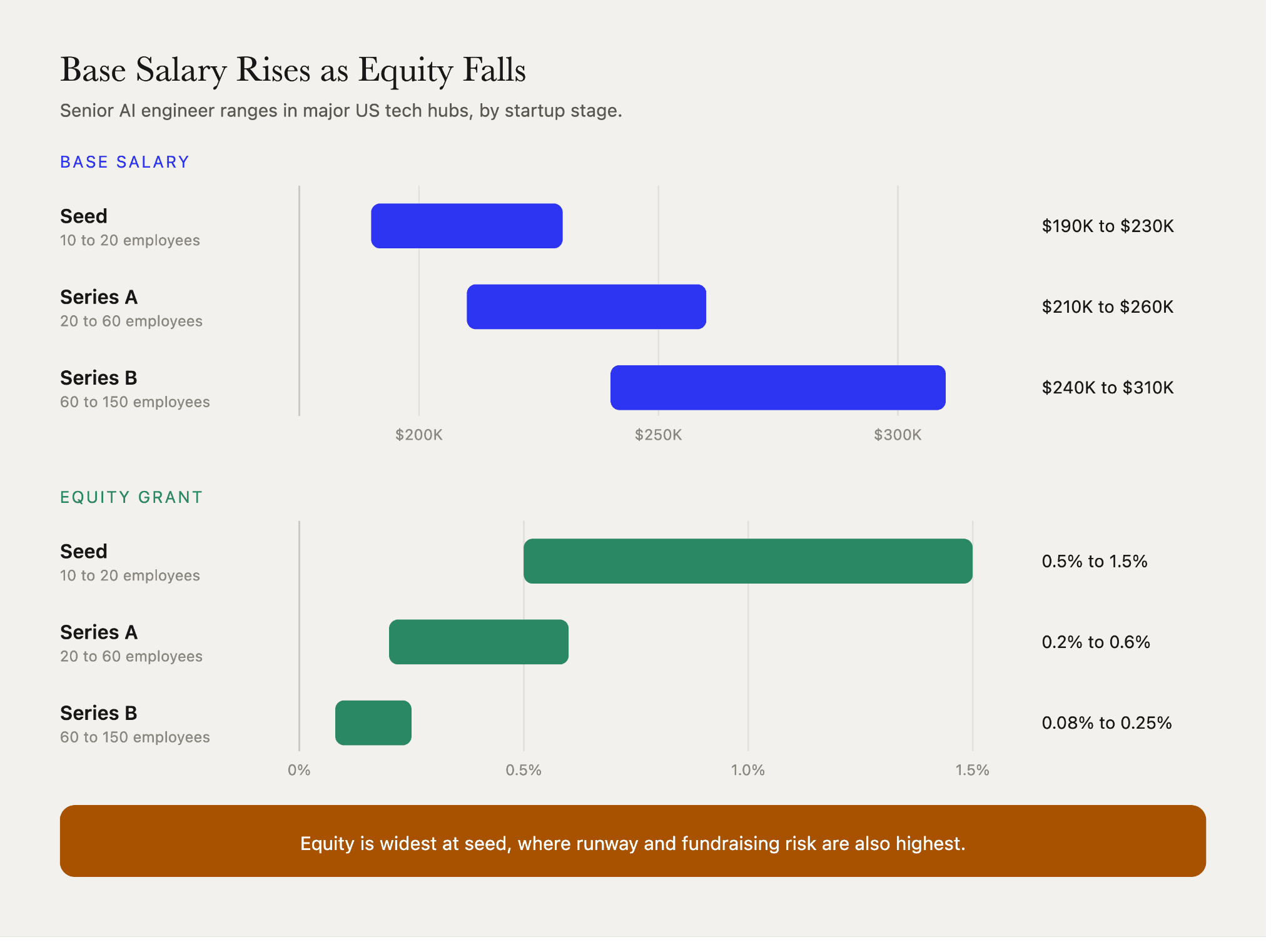
Typical base salary ranges for senior AI engineers in major US tech hubs break down as follows across startup growth stages:
Seed stage (10 to 20 employees): $190,000 to $230,000 base, with equity around 0.5% to 1.5%
Series A (20 to 60 employees): $210,000 to $260,000 base, with equity around 0.2% to 0.6%
Series B (60 to 150 employees): $240,000 to $310,000 base, with equity around 0.08% to 0.25%
Evaluate runway, fundraising, customer concentration, regulatory risk, and the company's competitive moat. Talk to current or former employees to validate the startup's culture and trajectory. Big Tech or strong startup experience can help, but recent AI-native work matters more.
How to Find AI Startup Jobs That Match Your Skills
Finding the right applied AI engineering role can be difficult when job boards create more noise than signal. Curated hiring platforms like Fonzi help connect experienced AI engineers with companies hiring for production AI work, using structured profiles and matching to surface roles that fit a candidate's background
Fonzi’s Match Day gives applied AI engineers another way to find relevant roles, matching candidates to AI-focused companies on technical background rather than application volume. Instead of relying on high-volume applications, candidates can be matched with AI-focused companies based on their technical background and experience. For engineers looking to work on production AI systems, Match Day can provide a more focused path to companies where their skills are directly relevant.
Summary
Seed through Series B teams hire engineers who can point to shipped production work, whether that is an LLM-integrated feature, an evaluation harness, or a system owned from prototype through deploy. Founders screen for ownership and speed under ambiguity rather than narrow role fit, which is why a portfolio outperforms a list of titles. Lead with architecture decisions and numbers. Before signing, weigh runway, technical quality, team, equity, and role scope, because an offer at this stage carries risk that base salary does not price in. Most of how to get a job at an AI startup reduces to those two moves, showing the work and pricing the risk.
FAQ
Is machine learning research experience mandatory for AI startup engineering roles?
How do you get hired at an AI startup coming from a non-AI big tech background?
How can I evaluate the technical quality of an AI startup before joining?
Are remote senior AI roles realistic at early-stage startups?
How long does it typically take for a senior engineer to move into an AI startup role?


