Applied AI Engineer Jobs: Skills and Hiring Guide
By
Samara Garcia
•

An applied AI engineer builds, evaluates, and deploys products on top of pretrained foundation models rather than training models from scratch, and applied AI engineer jobs now sit at the point where machine learning, software engineering, and product work meet. Instead of building models from scratch, many engineers now focus on adapting, integrating, evaluating, and deploying powerful pretrained models in real products.
That shift puts applied AI engineering at the intersection of machine learning, software engineering, and product development. This guide breaks down what applied AI engineers do, the skills employers look for, and how the role is evolving as teams place greater emphasis on reliability, evaluation, and real-world impact.
Key Takeaways
Applied AI engineers bridge AI and production software: The role combines ML and LLM expertise with strong software engineering, infrastructure, evaluation, and product skills to ship reliable AI systems.
Hiring increasingly rewards end-to-end ownership: Candidates stand out by demonstrating real production work, thoughtful tradeoffs across accuracy, cost, latency, and safety, and measurable business or user impact.
Build visible, practical signals: Maintain focused projects, technical writing, or open-source contributions that demonstrate your ability to design, evaluate, deploy, and improve AI systems, then use those examples in interviews and job searches.
What Is an Applied AI Engineer?
An applied AI engineer focuses on bridging foundational machine learning models and production software. Unlike research scientists, who are judged on theoretical novelty, applied AI engineers are evaluated on shipped product, reliability, and business impact. Unlike pure ML engineers, who may focus on training pipelines or model architecture, applied AI engineers reuse foundation models and concentrate on inference, prompt engineering, evaluation, and cost-performance tradeoffs. The AI Roles Continuum, a 2026 preprint analyzing public job descriptions at leading AI labs, argues that research scientists, research engineers, applied scientists, and machine learning engineers occupy overlapping positions rather than distinct categories, sharing competencies such as distributed systems design and rigorous experimentation.
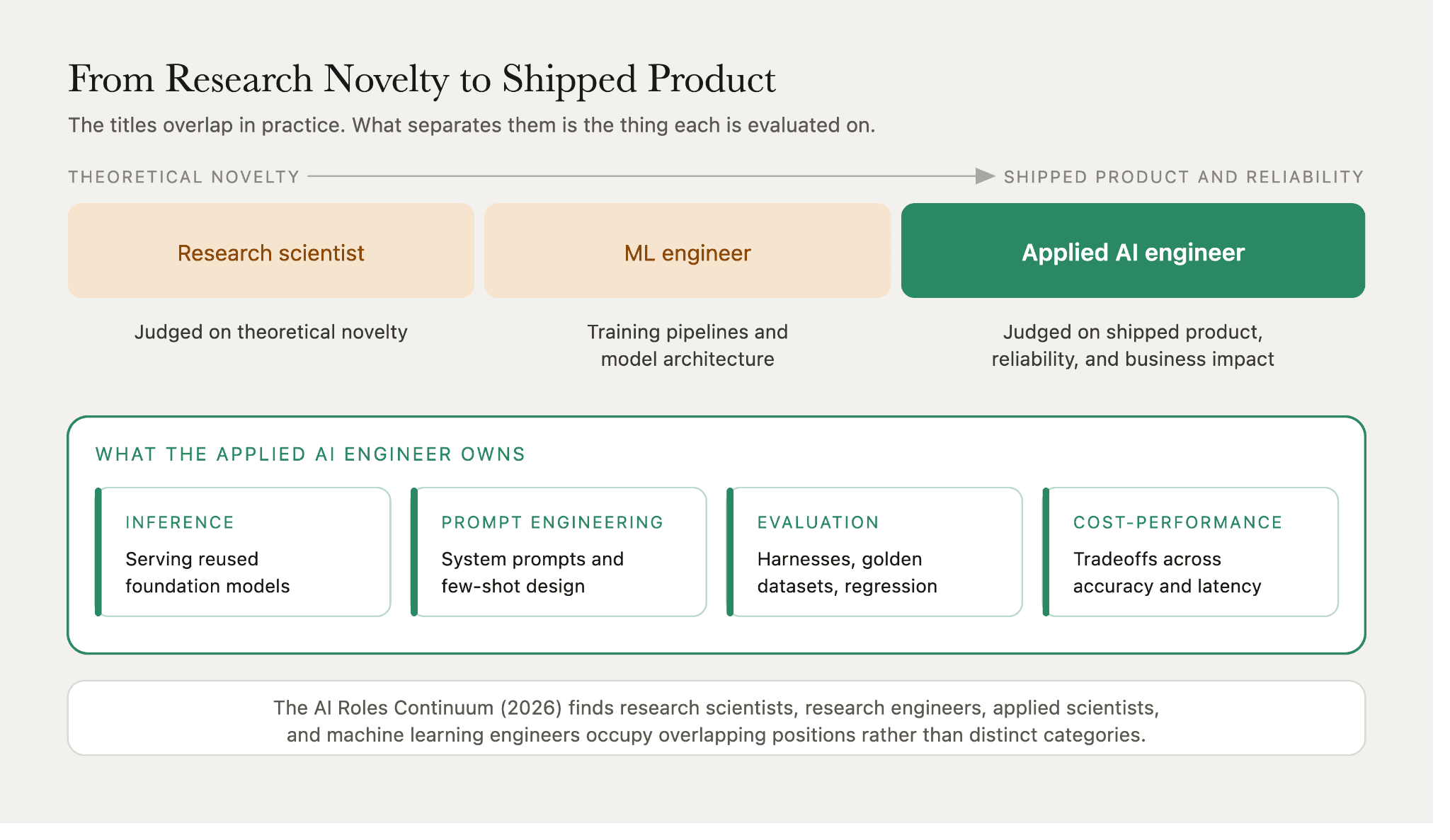
The core responsibilities include application integration, productionization, and evaluation. In practice, this means building RAG systems, integrating vector databases, managing prompt libraries, instrumenting evaluation harnesses, and building and managing data ingestion and evaluation pipelines. These engineers collaborate with cross-functional teams spanning product, design, and domain experts, and they own what ships, not just prototypes.
The role varies significantly by company stage. In early-stage AI startups, applied AI engineers often own the full stack: prompt design, deployment, DevOps, cost optimization, and even data labeling. In regulated enterprises such as GSK, and at large technology companies such as NVIDIA, responsibilities tend toward specialization in platform safety, evaluation, governance, or model adoption patterns.
Core Skills for Applied AI Engineers: From LLMs to Infrastructure
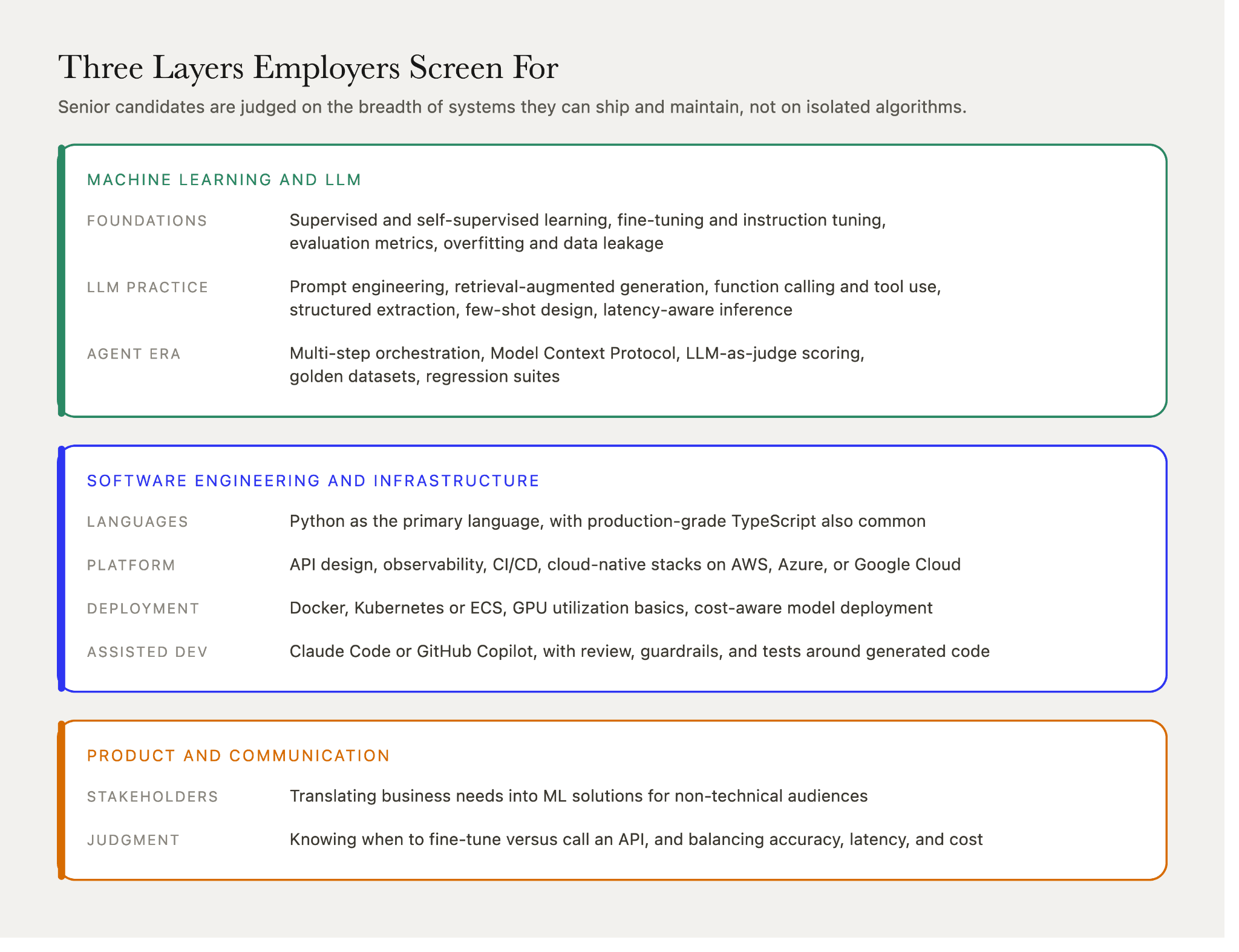
Senior applied AI engineers are evaluated less on isolated algorithms and more on the breadth and depth of systems they can ship and maintain. Employers look for a solid understanding of both the ML fundamentals and the software engineering capabilities needed to deliver reliable production systems.
Machine Learning and LLM Skills
Applied AI roles require knowledge of machine learning concepts including supervised and self-supervised learning, fine-tuning and instruction tuning for LLMs, evaluation metrics, and awareness of overfitting and data leakage. Experience with machine learning frameworks like PyTorch and TensorFlow remains relevant. Practical LLM capabilities that matter in hiring include prompt engineering, Retrieval-Augmented Generation, function calling and tool use, structured extraction, few-shot and system prompt design, and latency-aware inference patterns. Experience with retrieval-augmented generation architecture is increasingly important, alongside hands-on experience with vector databases like Pinecone or Milvus.
Current agent-era capabilities are now core to many roles. This includes multi-step agent orchestration and task decomposition, connecting models to external systems through the Model Context Protocol, and systematic evaluation work such as LLM-as-judge scoring, golden datasets, and regression suites that catch prompt drift before deployment. Some employers now list agentic platform work explicitly, including sandboxed runtime environments and tool integration, in applied AI engineer job descriptions. A focus on measurement of AI quality, including evaluating for hallucinations and safety, is crucial. Automation of model evaluation and safety measures are now standard parts of the applied AI engineer's responsibilities.
Software Engineering and Infrastructure
Applied AI engineers require strong software engineering skills. Python is the primary programming language for applied AI engineering roles, though production-grade TypeScript is also common. Expectations include API design, observability, CI/CD, and working with cloud-native stacks. Knowledge of cloud platforms such as AWS, Azure, and Google Cloud is important, and AI engineers must understand cloud computing and cloud infrastructure. Infra-related skills increasingly required include containerization with Docker, orchestration with Kubernetes or ECS, GPU utilization basics, and cost-aware model deployment. Applied AI engineers build low-latency inference services that hold up under real user traffic.
AI-assisted development practices matter too. Engineers are expected to leverage AI tools like Claude Code or GitHub Copilot, review AI-generated code carefully, and set up guardrails and tests around AI-powered components. Developer tooling fluency is now part of standard expectations.
Non-Technical Skills
Problem-solving skills and product thinking are key soft skills. Applied AI engineers must be able to communicate effectively with non-technical stakeholders, translating business needs into ML solutions. Pragmatic decision-making, including knowing when to fine-tune versus use an API and how to balance accuracy, latency, and cost, separates strong candidates from those who only know models in isolation. A bachelor's degree in computer science or a related field is common among applicants, though evidence of shipping real systems often carries more weight than credentials alone.
How Applied AI Engineer Jobs Differ by Company Type and Stage
The same title, applied AI engineer, can describe very different day-to-day work depending on company size, maturity, and business model. The table below compares typical expectations across four common environments.
Environment | Scope of Ownership | Key Technologies | Common Success Metrics |
Early-stage AI startup | Full stack: prompts, deployment, DevOps, data | LLM APIs, agent frameworks, vector DBs, Python | User adoption, response time, cost per request |
High-growth SaaS adding AI | Feature-level: integrate AI into existing product | RAG pipelines, embedding models, evaluation harnesses | Workflow adoption rate, error-rate reduction |
Big tech/cloud provider | Specialized: model integration, internal AI tooling | Large-scale inference infra, Kubernetes, custom models | Latency, throughput, revenue impact |
Regulated enterprise (pharma, finance) | Domain-embedded: compliance, safety, governance | Secure APIs, audit logging, responsible AI tooling | Regulatory compliance, cost savings, accuracy |
PwC's 2026 Global AI Jobs Barometer, based on more than one billion job advertisements across 27 countries, puts the average wage premium for workers with AI skills at 62%, up from 57% the previous year. That figure covers AI-skilled workers across all occupations rather than applied AI engineering roles alone.
Modern Hiring Pipelines for Applied AI Engineers
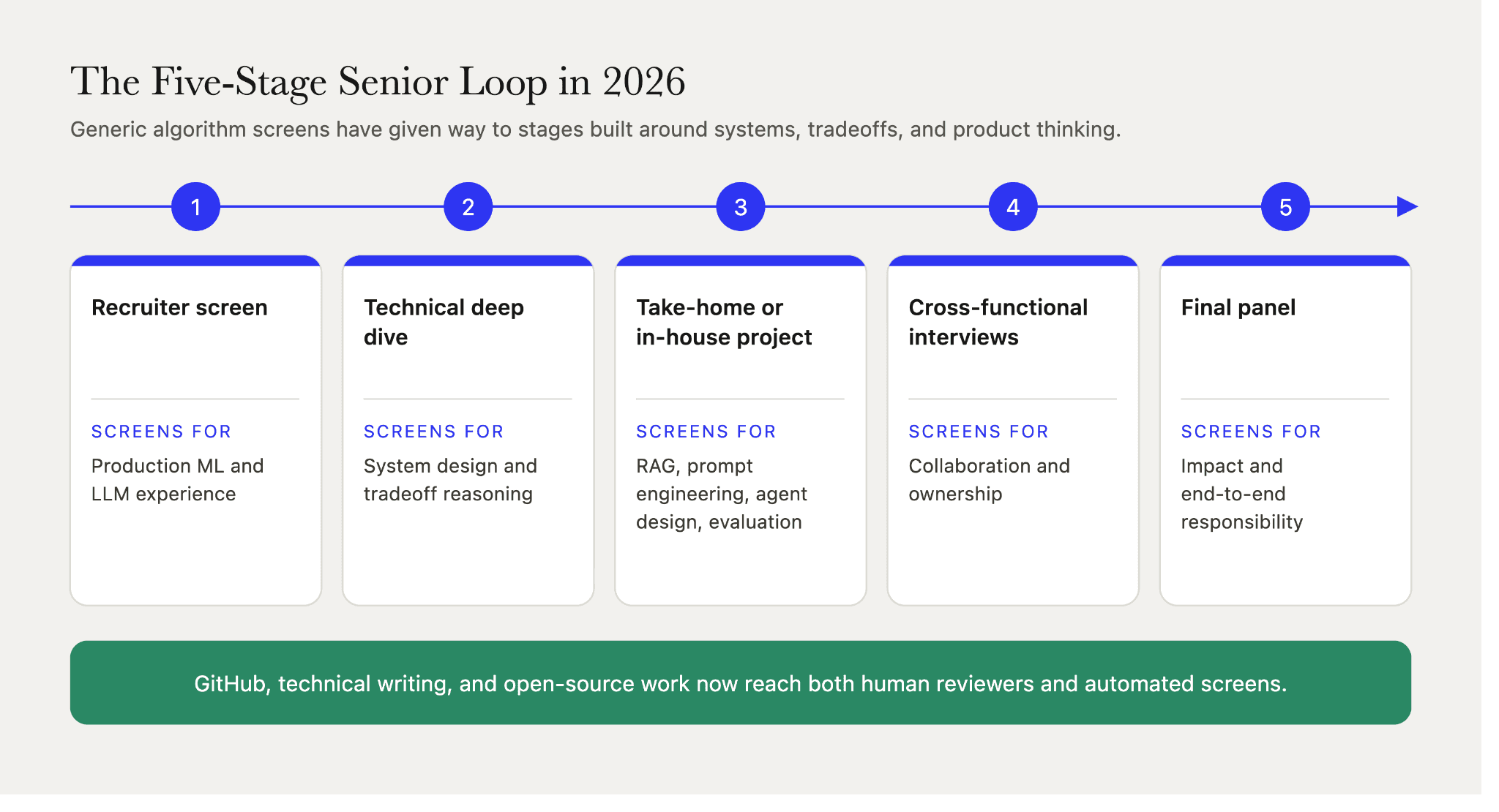
Hiring flows for applied AI engineers have evolved significantly since pre-LLM days. Generic LeetCode pipelines have given way to role-specific assessments that blend systems design, ML understanding, and product thinking.
Common stages for senior applied AI engineer jobs in 2026 include: a recruiter screen covering production ML and LLM experience; a technical deep dive on system design and tradeoff reasoning; a take-home or in-house project built around RAG, prompt engineering, agent design, or evaluation; cross-functional interviews on collaboration and ownership; and a final panel on impact and end-to-end responsibility. Companies are experimenting with AI-assisted screening, including automated resume parsing and coding task evaluation. Strong signals on GitHub, published technical writing, or open-source contributions now matter more because they are directly accessible to both human reviewers and automated tools.
Some organizations and curated marketplaces use structured profiles and standardized skill tags to match candidates to roles, helping reduce noise compared with traditional job boards. Fonzi, for example, operates as a curated AI engineering hiring marketplace that connects applied AI engineers with AI-focused startups and technology companies through structured profiles and skill tags. Regional and remote-work variations persist: many applied AI engineer roles are fully remote across North America and Europe, while others centralize teams in hubs like San Francisco, New York, London, or Berlin.
Showcasing Your Applied AI Work: Portfolios, Repos, and Signal
In a crowded applied AI job market, concrete evidence of shipped systems and thoughtful experimentation is more persuasive than a generic list of models and frameworks.
You should maintain a focused GitHub or GitLab presence that includes at least one or two well-documented projects, such as a small RAG pipeline, a tool-augmented agent with performance benchmarks, or an automated evaluation harness for model outputs, with clear READMEs and architecture diagrams. Summarize impact in terms of specific production metrics where possible: latency improvements, cost reductions, adoption rates, or error-rate reductions. Write short technical posts or internal design documents that articulate lessons learned about prompt design, failure patterns, data labeling, and guardrail strategies, then reference these during interviews.
Participating in reputable open-source AI or ML infrastructure projects can be a strong signal of collaboration skills and familiarity with current tooling ecosystems. Curated marketplaces such as Fonzi look for these concrete signals when matching applied AI engineers with companies building production AI systems.
How AI Is Used in Hiring and What It Means for Candidates
AI use in recruitment has grown since 2022, most often in screening and ranking rather than in final offer decisions. Common uses include ranking applications, extracting resume skills, and summarizing interviews. To perform better in AI-assisted screening, use clear project descriptions, standard terminology, and measurable results.
Benefits include efficiency gains for recruiters and faster access to relevant roles for candidates. Risks include potential bias amplification if models are poorly designed. A Stanford HAI study published in May 2026 analyzed 4 million applications processed by a single AI screening vendor and found that 26% of Black applicants and 15% of Asian applicants applied to positions where the system produced adverse impact under the EEOC's four-fifths rule. The most effective hiring processes use AI to reduce repetitive work and free hiring managers to spend more time in substantive technical conversations.
Regulation now shapes how AI hiring tools are disclosed. New York City Local Law 144 requires bias audits and candidate notification for automated employment decision tools. The Illinois Artificial Intelligence Video Interview Act governs AI analysis of video interviews. The European Union AI Act classifies hiring systems as high risk under Annex III, though the Digital Omnibus on AI (Regulation (EU) 2026/1744) deferred those compliance obligations to 2 December 2027.
Finding Applied AI Engineering Jobs
Applied AI engineering roles are spread across company types that screen for different things. An early-stage startup is hiring someone to own prompts, deployment, and cost from day one, while a regulated enterprise is hiring someone who can document an evaluation process well enough to survive an audit. Fonzi is a curated AI engineering hiring marketplace that matches applied AI engineers to companies using structured profiles and skill tags rather than keyword search. Its recurring Match Day hiring event puts pre-vetted engineers in front of several companies during scheduled hiring windows. It works as one channel alongside direct applications and referrals, not a replacement for either.
Summary
Applied AI engineers adapt pretrained foundation models into production systems, which puts them between machine learning and software engineering rather than inside either one. The work spans LLM integration, RAG, agent orchestration, evaluation harnesses, Python, cloud infrastructure, API design, and observability, with the mix shifting by company stage. At an early-stage startup an applied AI engineer often owns prompts, deployment, and cost optimization at once, while at a regulated enterprise the same title narrows toward safety, governance, and audit-ready evaluation.
Hiring for applied AI engineer jobs has moved away from generic algorithm screens toward system design, tradeoff reasoning across accuracy, cost, latency, and safety, and take-home projects built on RAG or agent design. Candidates who show production work with measurable results, whether through GitHub repositories, technical writing, or open-source contributions, give both human reviewers and automated screens something concrete to evaluate.
FAQ
How can a research-focused ML scientist transition into an applied AI engineer role?
Is a formal degree in machine learning required for senior applied AI engineer positions?
How important is open-source contribution for landing competitive applied AI roles?
What is the best way to stay current with rapidly changing LLM and AI engineering tooling?
Can AI-assisted coding tools reduce the need for strong software engineering fundamentals?


