How to Find Full Stack Engineer Jobs at Startups
By
Samara Garcia
•

Full stack engineer jobs at startups are roles where one engineer owns a feature end to end, from database schema through deploy, and the strongest of them rarely appear on traditional job boards first. High-ownership opportunities often move through founder networks, startup communities, and curated talent platforms before they become public listings.
This guide breaks down where to find these roles, how to evaluate startups beyond the job description, and which factors matter most, from runway and team quality to technical ownership and growth potential. It also looks at how AI is changing the hiring process for both candidates and startups.
Key Takeaways
Look beyond traditional job boards: Use accelerator networks, founder communities, direct outreach, and curated marketplaces to find high-ownership startup roles that may never reach public listings.
Evaluate the startup, not just the role: Assess founder quality, product traction, runway, equity terms, codebase health, team structure, and how much end-to-end ownership the position actually provides.
Show that you can ship across the stack: Highlight complete features, measurable impact, AI integration, and production ownership in your resume, portfolio, and interviews, then compare offers based on scope, growth, compensation, and long-term career value.
Why Full Stack Engineer Roles Are Central to Modern Startups
Between 2020 and 2026, startups building with lean product teams shifted toward hiring senior full stack engineers who can ship entire features end to end, from database schema to deploy. SignalFire's State of Talent Report 2026 found that early-stage startups hired about 7% more engineers in 2025 than in 2019, even as total hiring at the largest tech companies ran roughly 25% below its 2019 baseline.
The distinction between a full stack developer and a full stack engineer matters here. Full stack developers work on both frontend and backend code. A full stack engineer at a startup, by contrast, owns production systems: architecture decisions, CI/CD pipelines, observability, and cross-functional collaboration with product and ML teams. Common job titles include Full Stack Engineer and Full Stack Architect, but the scope is what separates these roles from their counterparts at larger companies.
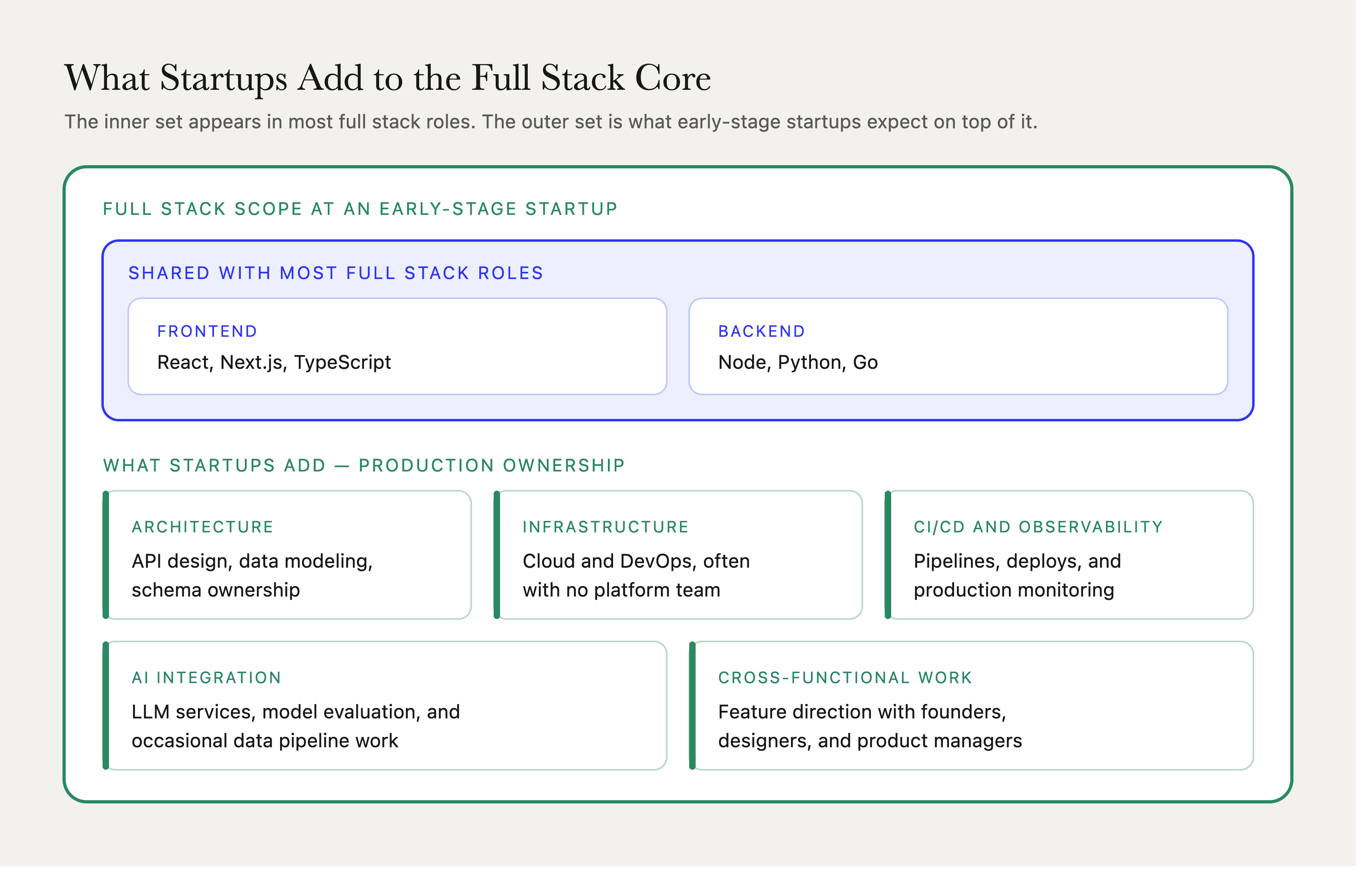
Concrete responsibilities in 2025 and 2026 include:
Designing APIs and building React or Next.js frontends
Writing backend services in Node, Python, or Go
Maintaining cloud infrastructure and DevOps, often without a dedicated platform team
Integrating LLM services and occasionally touching data pipelines
Collaborating with founders, designers, and product managers on feature direction
Common skills include React, TypeScript, Python, Node.js, Next.js, Postgres, and cloud infrastructure. For AI-focused startups, experience with ML systems, APIs, evaluation, and model serving can be a major differentiator.
How Do Startup Software Engineer Jobs Differ by Funding Stage
After 2022, more disciplined fundraising reshaped hiring. Startups became selective, raising the bar for each full stack developer hire. At a seed-stage company with three to ten people, one engineer might own the entire stack, from frontend to backend to infrastructure. At a Series C with 50 to 150 employees, a software engineer title may map to full stack work in practice, but within a narrower domain. Early-stage startups typically favor candidates with at least three years of production experience, as lean teams depend on engineers who can execute independently across the stack.
The table below contrasts key dimensions across startup stages, using 2026 compensation benchmarks.
Dimension | Pre-seed / Seed | Series A | Series B+ |
Ownership scope | Full stack across frontend, backend, infra, sometimes ML and analytics | Broad but with emerging specialization | Defined domains; clearer role boundaries |
Base salary (US) | $155K-$200K | $180K-$240K | $200K-$265K |
Equity range | 0.4%-1.0% | 0.15%-0.45% | 0.05%-0.2% |
Interview complexity | 2-3 stages; founder screens | 3-4 stages; technical leads involved | Structured loops with domain experts and recruiting function |
AI in product | Experimental; early LLM usage | Growing; ML features becoming core | Mature; dedicated AI infra and evaluation |
Compensation and expectations differ across geographies. Levels.fyi reports a median total compensation of $236,300 for full stack software engineers in the San Francisco Bay Area and $190,500 in New York City, with both figures covering base, stock, and bonus rather than base salary alone. In Europe, Levels.fyi puts senior software engineer total compensation in Paris between €64,469 and €102,057, and in Munich between €85,262 and €121,504, both measured as the 25th to 75th percentile of self-reported packages including base, stock, and bonus.
Where to Find High-Quality Full Stack Engineer Jobs at Startups
Senior engineers should treat a job search like pipeline building: multiple channels, tracked outreach, and a focus on quality over volume. The easiest way to start is by mapping the channels where high-signal startup jobs actually appear.

Accelerator and startup-specific job boards. Y Combinator's Work at a Startup portal lists open roles across hundreds of active YC portfolio companies. Other accelerator networks and curated AI and web development boards carry similar density. These are where you find companies that are continuing to hire for roles requiring both frontend and backend ownership.
Curated marketplaces and match-based platforms. These work by pre-vetting companies and matching candidates based on stack, seniority, and preferences. Fonzi is a curated marketplace that connects software engineers with AI startups and technology companies hiring for full stack engineer jobs at startups. The benefit is reduced noise: you view roles that match your profile rather than scrolling through hundreds of listings where the role title says stack developer but the actual work is something else entirely.
Founder and community networks. Many startup jobs never appear on public job boards. Open source communities, conference Slack or Discord groups, and Twitter or LinkedIn are strong sources of unadvertised roles. Engineers who love building in public, whether through GitHub contributions, technical blog posts, or talks, often get notified about roles before they are posted. Founders staffing early roles often reach out directly to engineers whose work they have seen in these communities, before any listing goes public.
Direct outreach. If a specific AI infrastructure company in San Francisco or a fintech startup in New York interests you, reach out even when no full stack engineer role is posted. Reference a specific product decision, a recent launch, or a technical blog post. A message referencing specific work is far more likely to get a reply than a generic application. Founders at early-stage companies typically read their own inbound, so a specific, well-researched message has a reasonable chance of reaching a decision maker.
How AI Is Changing Hiring for Full Stack and Software Engineers
By 2025, AI tooling became standard in tech recruiting. SHRM's 2025 Talent Trends research found that 51% of organizations use AI to support recruiting, and among those organizations, 66% use it to write job descriptions and 44% to screen resumes.
For candidates, AI-powered sourcing can mean faster response times and better role matching for full stack roles. When implemented well, these systems cut the volume of irrelevant outreach and surface opportunities that align with your stack and seniority.
AI screening can over-filter candidates based on keywords, overlook non-traditional backgrounds, or miss equivalent experience described differently. Human review remains important for evaluating technical depth, potential, and context. The best hiring processes use AI to reduce screening noise while keeping humans involved in final decisions.
Preparing Your Profile, Portfolio, and Signals for Startup Roles
Senior candidates are evaluated more on impact, ownership, and clarity than on long lists of technologies. Your profile should reflect this.
CV, LinkedIn, and GitHub. Emphasize full stack ownership with clear, measurable outcomes. Use the STAR method (Situation, Task, Action, Result) to turn technical experience into concise impact stories. Instead of listing “React, Node, Postgres,” show what you shipped: “Built and deployed a customer-facing dashboard using React and Node, serving 12K daily users and reducing support tickets by 40%.” Add location preferences and visa status if relevant.
Showcasing AI-related work. Even if your primary title is full-stack engineer, highlight AI integration: instrumenting evaluation dashboards, building internal tools around models, or integrating LLMs into a product workflow. This signals versatility that startups value.
Portfolios and public signals. Small but production-grade projects carry more weight than a dozen tutorial apps. Contributions to open source, technical writing, or conference talks demonstrate design judgment and the ability to communicate complex tradeoffs. Startups also often seek junior engineers with strong portfolios and evidence of shipping complete features, so this advice applies across seniority levels, though the scale of impact differs.
Strong references from previous founders, tech leads, or staff engineers can materially change how a startup perceives risk for a senior hire. If a former collaborator can speak to your ability to learn fast, work across the stack, and maintain systems under pressure, that reference carries more weight than a polished resume alone. Offer to share professional references early in the hiring process when confident in your former collaborators' endorsements.
Navigating Technical Interviews for Full Stack Engineer Jobs at Startups
Interview loops for full stack engineer and software engineer jobs have gradually standardized since 2020, but early-stage startups still keep them relatively lightweight. Seed-stage companies typically run two to three rounds; Series B and above may run four to five.
Common stages include:
Initial screen with a founder or recruiter (30-45 minutes)
Systems and architecture discussion covering API design, data modeling, and scaling basics
Practical coding exercise, often a take-home project or in-repo task where you build a feature end to end
Cross-functional conversation with product or design to assess communication and product thinking
Senior candidates should favor realistic work samples over whiteboard puzzles. If given a take-home, clarify the scope and timeline. Be ready for API design, databases, frontend performance, observability, CI/CD, and, for AI startups, model serving and evaluation.
Ask about 90-day expectations, on-call, and team collaboration. Keep a simple interview log to compare startups and avoid hindsight bias.

How Do You Find Startup Full Stack Engineer Jobs That Match Your Experience?
Finding the right startup role can be difficult when high-ownership engineering positions are spread across founder networks, private communities, and multiple recruiting channels. Senior full stack engineers also need to distinguish between roles that genuinely offer end-to-end ownership and those that use the full stack title for a narrower set of responsibilities.
Curated hiring marketplaces can reduce some of that search noise by connecting engineers with companies based on experience, technical skills, and role fit. Fonzi is one example, connecting software and AI engineers with startups and technology companies looking for technical talent. Its recurring Match Day hiring event allows engineers to meet companies hiring pre-vetted AI and software talent during scheduled hiring windows.
For full stack engineers who want startup roles with meaningful ownership, a curated channel can complement direct outreach, accelerator networks, and traditional job searches while helping surface opportunities that align more closely with their experience.
Summary
Most high-ownership startup roles for senior full stack engineers surface through accelerator boards, founder networks, private communities, and direct outreach before they ever appear as public listings. Stage determines scope. At seed, one engineer often owns frontend, backend, and infrastructure at once. By Series B, the same title usually maps to a defined domain with clearer boundaries, which is why the title alone settles nothing about the work. Before accepting an offer, check runway, founder track record, product traction, equity terms, and how much of the stack the role covers in practice. Hiring managers weigh evidence of shipped production features and measurable outcomes above lists of technologies, so a resume, portfolio, or GitHub profile should lead with what was built and what changed as a result.
FAQ
How can I tell if a full stack startup job is really full stack or mostly backend or frontend?
Are full stack engineer roles at Y Combinator startups different from other startup jobs?
How should AI and ML specialists position themselves for full stack roles that include model work?
What is the best way to handle take-home assignments as a senior engineer?
Is it realistic to find remote full stack engineer roles at high-growth startups in 2026?


