Why Product-Minded AI Engineers Are in Demand
By
Samara Garcia
•

AI has made writing and shipping code faster, but it hasn't made product judgment any easier. That gap is why product-minded AI engineers are in demand.Engineers still need to understand what users need, decide what is worth building, and turn those decisions into products that deliver real value.
That shift is creating more demand for product-minded AI and ML engineers who can own problems from user need to shipped outcome. This guide breaks down how expectations are changing, the skills that matter, and what hiring teams are looking for in product-minded engineering roles in 2026.
Key Takeaways
Product-minded AI engineers combine technical depth with product judgment, using user needs, business goals, and real-world constraints to decide what to build and how to measure its impact.
AI-native teams increasingly value end-to-end ownership, so engineers should develop skills in rapid prototyping, experimentation, communication, and evaluating tradeoffs beyond model performance.
Candidates can stand out by showing product impact, framing projects around the customer problem, decisions made, measurable outcomes, and how they iterated based on real user feedback.
What Is a Product-Minded AI Engineer?
A traditional AI engineer focuses on models, APIs, and benchmarks. A product-minded engineer owns the full problem: from understanding the customer problem through deployment, monitoring, and iteration. Product-minded AI engineers sit at the intersection of machine learning, software engineering, and business strategy. They take responsibility for outcomes across the product lifecycle and own features from specification to validation.
Core traits include:
Curiosity about the "why": questioning specifications, investigating user behavior, and uncovering root causes rather than symptoms.
Comfort with ambiguity: product goals are rarely precise at the start.
Bias to validate quickly: shipping a working prototype before perfecting the architecture.
Attention to business metrics: conversion rates, LTV, support ticket volume, and user outcomes.
Product-minded AI engineers must possess core skills in user empathy. They focus on user needs rather than just AI capabilities, and this product-minded culture shifts focus from building features to solving customer problems. In early-stage AI native companies, this role often merges responsibilities that used to belong to an AI product manager team, data scientists, and backend engineers. Product thinking is a mandatory skill for modern engineers, and these practitioners own features end-to-end, including user behavior results.
How Product Thinking Changed AI Engineering Roles
In big tech during the 2010s and early 2020s, engineering roles were narrowly specialized. Separate teams handled ML modeling, data engineering, infrastructure, product management, and design. An engineering manager might coordinate across five or six distinct functions just to ship a single feature.
The 2023 to 2026 AI tooling boom, including OpenAI's GPT-5.x series, Anthropic's Claude Opus 5, Meta's Llama 4, vector databases, and orchestration frameworks, reduced the cost of experimentation dramatically. The bottleneck shifted from technical implementation to product decisions and coordination. AI is reshaping engineering roles towards product-oriented thinking, and the boundary between product management and engineering is fading.
Today, more engineers in AI-native product teams participate in product decisions from day one. Product engineers can make product-level decisions independently within clearly defined guardrails. Engineers are increasingly expected to understand business goals, not just system architecture. Lemon.io's 2026 Software Developer Rate Benchmark Report, based on more than 2,500 contracts, found that the generic 'AI engineer' label has fragmented into distinct specializations including LLM developer, ML engineer, and MLOps roles, each with its own rate band.

Key Skills That Differentiate Product-Minded AI Engineers
Strong fundamentals in ML and systems remain table stakes. Product-minded AI engineers should have strong AI and software engineering fundamentals. What differentiates candidates is a blend of product skills, communication, and judgment. The AI Skills Shift paper found that 78.7% of observed AI interactions across 3,364 task-level patterns are augmentation rather than automation, which makes human judgment part of the work rather than an overhead on it.
Key skill dimensions include:
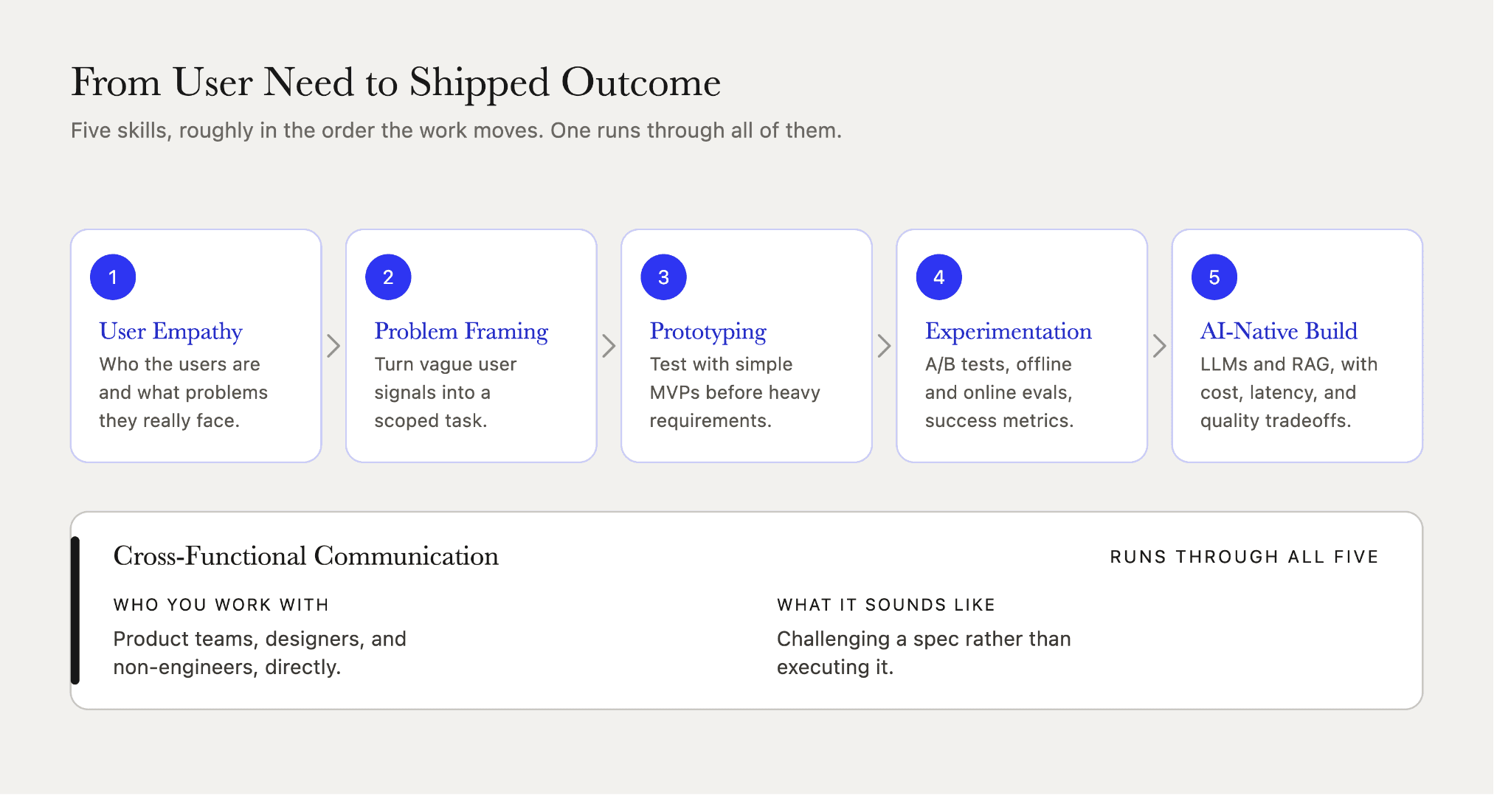
User empathy: knowing who the users are and what problems they actually face.
Problem framing in user and business terms: translating a vague user context or customer feedback signal into a scoped engineering task.
Rapid prototyping: testing ideas with simple MVPs before committing to heavy technical requirements.
Experimentation design: setting up A/B tests, offline and online evals, and defining success metrics tied to business outcomes.
AI-native execution: building with LLMs, embeddings, vector search, and RAG pipelines while managing cost, latency, and quality control tradeoffs.
Cross-functional communication: working directly with product teams, designers, and non-engineers.
Product-minded engineers challenge specs rather than executing them, asking what problem the spec is actually solving and proposing alternatives when there is a better path. They recognize that the most sophisticated solution is not always the best one; sometimes a simpler heuristic wins on cost, latency, or maintainability. Modern AI engineers should know how to work effectively with AI tools, and product-minded engineers must have curiosity and continuous learning to keep up with advancements in models, tooling, and user interactions.
AI-Native Execution: From Models to Measurable Outcomes
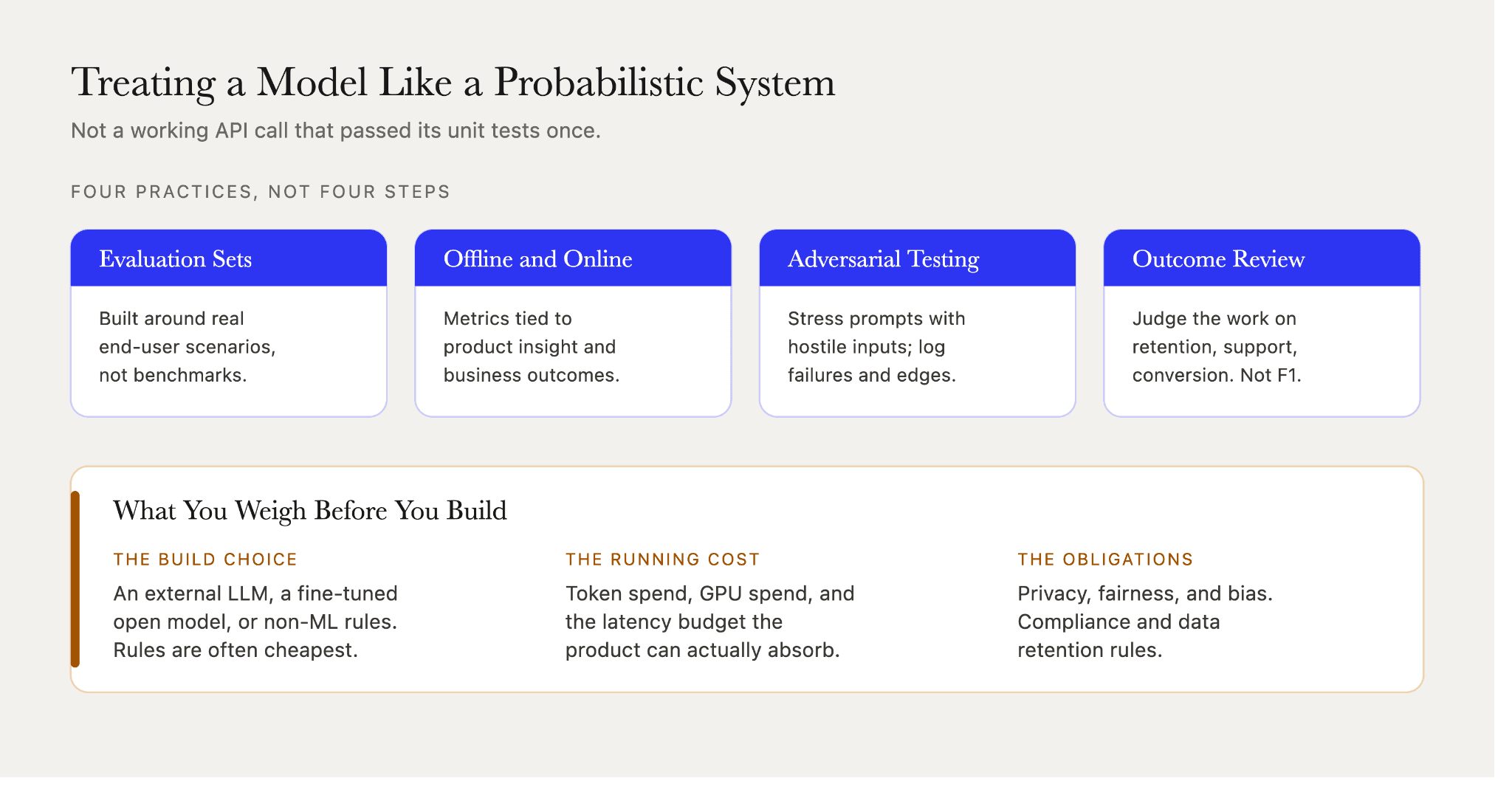
AI-native execution is the discipline of integrating LLMs or ML models into products in a way that is reliable, observable, and economically viable. AI products rarely exist in isolation and involve data pipelines, infrastructures, and multiple service layers. Product-minded AI engineers treat AI components as probabilistic systems that need evals, guardrails, and user-centric metrics, not just a working API call that passes unit tests once.
Specific behaviors include:
Designing evaluation sets aligned with end user scenarios.
Setting up offline and online metrics tied to product insights and business outcomes.
Stress testing prompts with adversarial inputs and capturing telemetry on failure modes and edge cases.
Evaluating engineers on product outcomes such as retention, support volume, or conversion rather than model accuracy alone.
Build vs buy judgment is critical: knowing when to use an external LLM like Claude or GPT-5.x, when to fine-tune open models, and when to rely on non-ML heuristics because they are cheaper and more predictable. A responsible AI mindset includes considering privacy, fairness, and bias in every technical decision. Product-minded AI engineers also think ahead about operational costs (token usage, GPU spend), latency budgets, compliance, and data retention. All this adds up to making product decisions that balance technical ambition with real-world constraints.
How Hiring Processes Are Shifting for AI and Product Engineers
Hiring for AI roles in 2026 increasingly evaluates product thinking through structured interviews, take-home projects, and portfolio reviews. Many companies have moved away from purely algorithmic whiteboard interviews toward case studies that involve scoping an AI feature, reasoning about business context, or designing an experiment.
Real examples of this shift:
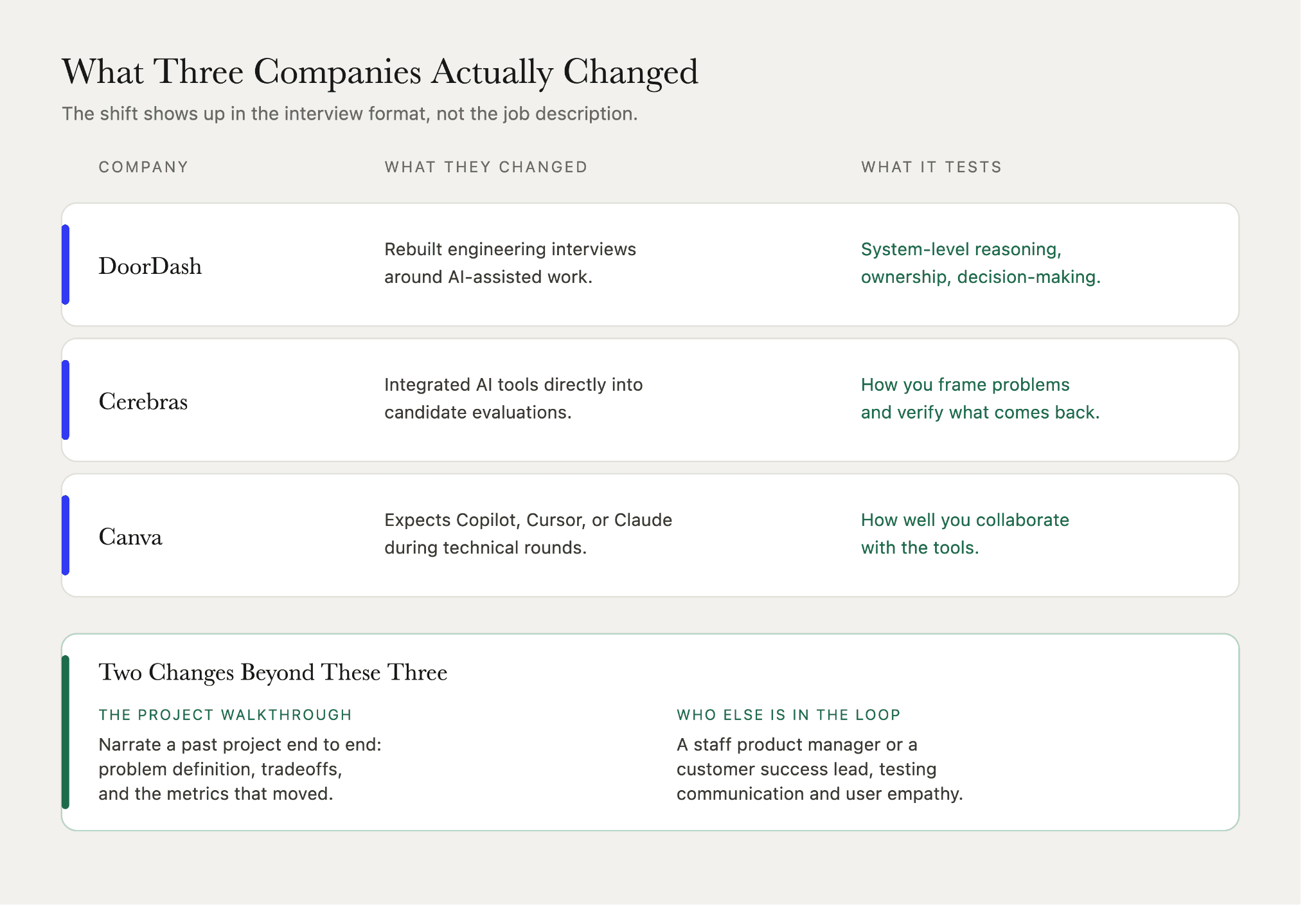
DoorDash rebuilt its engineering interviews around AI to evaluate candidates on system-level reasoning, ownership, and decision-making rather than puzzle-solving under time pressure.
Cerebras integrates AI tools into candidate evaluations, assessing how candidates frame problems, verify outputs, and communicate tradeoffs.
Canva expects candidates for backend, frontend, and machine learning roles to use AI tools such as Copilot, Cursor, or Claude during technical interviews, and evaluates how well they collaborate with those tools.
Engineering leaders now often ask candidates to walk through a past project end to end, including problem definition, tradeoffs, and real metrics, rather than only the architecture or model choice. Hiring loops may also include conversations with non-engineers like a staff product manager or customer success lead to test communication skills, user empathy, and the ability to translate technical decisions into terms the whole company understands.
Practical Ways to Demonstrate Product Mindset in Your Portfolio and Interviews
Senior AI engineers can influence hiring outcomes significantly by how they present past work. Engineers who understand their users build more valuable products, and framing your experience around user context and impact is what makes that visible to a hiring team.
For each project in a resume, GitHub README, or personal site:
Describe the customer problem and user context, not just the stack and algorithms.
Include metrics and outcomes: for example, a retrieval-augmented generation system that cut support tickets by 30 percent, or a ranking model that improved click-through rate and revenue by a measurable amount. Add dates and scale.
Show where you questioned a spec and proposed a better path.
In system design and behavioral interviews, start from user needs, define success metrics, then walk through constraints and tradeoffs. A tech lead or senior staff-level engineer who can narrate a project from the customer problem through technical decisions to business outcomes will stand out among other developers.
Participation in hackathons, internal tooling initiatives, or cross-functional working groups serves as evidence of working effectively with product management and non-engineers. Even building software as a side project that involves a user-facing interface, feedback loop, and measurable impact demonstrates product focus.
Comparing Traditional AI Engineer vs Product-Minded AI Engineer
The following table provides a quick reference for how responsibilities and expectations differ across these two profiles.
Dimension | Traditional AI / ML Engineer | Product-Minded AI Engineer |
Success metrics | Optimizes F1 score or benchmark accuracy | Balances model accuracy with support contacts per 1,000 users and revenue impact |
Typical collaborators | Other ML researchers, data scientists | Product managers, designers, customer success, engineering teams |
Decision scope | Model architecture, training pipeline | Feature scope, UX tradeoffs, build vs buy, cost per request |
Interview focus | Algorithmic puzzles, ML theory | Case studies, product scoping, system design with business context |
Business context awareness | Limited to project brief | Understands funnel metrics, unit economics, and user behavior |
Edge case handling | Logs errors for later review | Triages by user impact, patches critical paths, iterates |
Product management interaction | Receives specs, executes | Co-creates specs, challenges scope, suggests alternatives |
Communication with non-engineers | Occasional presentations | Regular syncs with sales, support, making product decisions collaboratively |
How Structured Marketplaces and Match-Based Models Help Product-Minded Engineers
Traditional inbound applications create noise for senior candidates and hiring managers. A software engineer with strong product skills may apply to dozens of roles without knowing which company truly values product and engineering collaboration vs just listing it in a job description.
Curated marketplaces and structured hiring platforms evaluate engineers on richer signals: portfolio depth, communication skills, product insights, and demonstrated product focus. They then match candidates with companies that value those traits. Fonzi, for example, is a curated talent marketplace connecting experienced software and AI engineers with startups that care about product engineers, helping reduce misaligned interviews by pre-filtering for roles where AI engineers will collaborate closely with product teams and own end-to-end features.
AI in recruiting is most useful when it augments human judgment. Ranking candidates, summarizing profiles, and surfacing relevant matches are valuable when done well. But final decisions, culture fit, and nuanced product judgment assessments must remain human-led.
Summary
A product-minded AI engineer owns a problem from user need to shipped outcome, rather than owning a model and handing it to someone else. The skills that separate them are problem framing, rapid prototyping, experimentation design, and knowing when a simple heuristic beats a model. Technical fundamentals in ML and systems are assumed at this level, so they rarely decide an offer.
Product thinking has also changed how AI engineers get hired. DoorDash rebuilt its engineering interviews around decision-making and system-level reasoning, and Canva now expects candidates to use AI coding tools during technical rounds. Hiring loops increasingly include a product manager or a customer success lead. The candidates who advance are the ones who can walk a project from the customer problem through the tradeoffs to the metric that moved.
FAQ
How is compensation for product-minded AI engineers different from traditional AI roles?
Can an ML researcher transition into a product-minded AI engineer role without prior product management experience?
How can infra or platform engineers build credible product experience?
Do all AI startups expect engineers to be product-minded, or are there still pure specialist roles?
How much business context is enough for an engineer to be considered product-minded?


