The Engineering Career Ladder: Understanding Ranks, Levels, and Paths
By
Liz Fujiwara
•

Between 2015 and 2026, engineering titles became far more complex. The growth of AI, distributed systems, and cloud-native architectures introduced new specializations, along with inconsistent ranks and leveling systems that vary widely by company. A “Senior Engineer” at a Series A startup may be operating at a Staff level elsewhere, while a “Principal Engineer” title can mean very different things depending on the organization. For AI engineers, ML researchers, infrastructure specialists, and LLM practitioners, this makes career planning difficult.
The challenges are practical and common. Titles do not translate cleanly across companies, promotion criteria are often unclear, salary bands lack transparency, and interviews frequently assess candidates at the wrong level. Today, advancement depends on scope, ownership, and cross-team impact, not just years of experience with tools like Python, Kubernetes, or PyTorch.
This article breaks down common industry level frameworks and offers clear career and interview guidance for AI-focused engineers.
Key Takeaways
Most engineering ladders run from Junior through Distinguished, with levels defined by scope, autonomy, and impact rather than years of experience.
AI, ML, infrastructure, and LLM roles follow the same ladder but evaluate impact through model performance, system reliability, and governance in addition to feature delivery.
Fonzi AI helps engineers map their skills to standardized levels and participate in Match Day, a focused 48-hour hiring process with pre-committed salary bands and concierge support.
Engineering Levels 101: Common Ranks and What They Really Mean
Most software organizations, especially in the US and Europe, now follow a ladder that roughly mirrors Google’s L3 to L8 structure, even when the titles differ. Understanding this framework is essential for navigating your engineering career effectively.
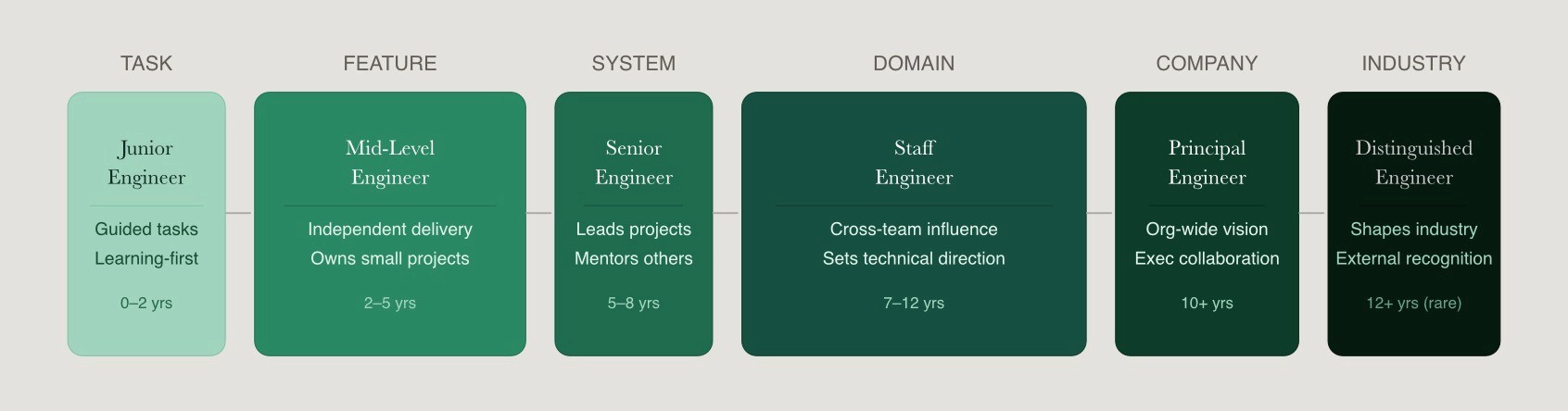
Junior Engineer / Engineer I (0–2 years)
At this level, engineers focus on developing technical skills through hands-on problem solving. Work assignments are smaller in scope, with quality checks handled by supervisors. The primary expectation is learning, including understanding coding patterns, completing tasks assigned by team leads, and contributing in meetings. Junior engineers typically work on configuring and testing services while ensuring tasks meet the Definition of Done.
Mid-Level Engineer / Engineer II (2–5 years)
Engineers at this tier have a solid understanding within their specialty and can complete day-to-day tasks with minimal error. They may own projects and handle straightforward work independently, while more complex tasks may still require guidance. The focus shifts from learning to consistent, independent delivery.
Senior Engineer / Engineer III (5–8 years)
Senior engineers work on complex technical problems and may write project proposals or lead small teams. Expectations shift toward demonstrated expertise and accumulated experience within a domain. Impact expands from individual features to entire services or systems.
Staff Engineer (7–12 years)
Staff engineers manage multiple initiatives and focus on identifying and solving technical problems across teams or domains. This level emphasizes technical leadership and setting direction, not just execution.
Principal Engineer (10+ years)
Principal engineers sit near the top of the individual contributor track. They collaborate with senior engineers and executives, influence company-wide technical direction, and make high-impact product and architecture decisions. They also provide technical and professional leadership to other engineers.
Distinguished Engineer (rare, 12+ years)
Distinguished engineers represent the highest level on the technical ladder and are typically among the most respected technical experts in an organization. They shape long-term technical strategy, influence industry standards, and advise senior leadership. Reaching this level requires sustained technical excellence, innovation, leadership, and external recognition.
For AI, ML, and infrastructure roles, the same core ladder applies, but definitions of impact differ. A Senior ML Engineer may be evaluated on model performance, training pipeline reliability, and governance practices, while a Senior Infrastructure Engineer may be measured on latency improvements, platform resilience, and cost optimization.
Management tracks such as Engineering Manager, Director, and VP typically run parallel to Staff and higher individual contributor levels rather than sitting above Senior ICs. In mature organizations, both paths offer comparable influence and compensation.
How Big Tech Defines Engineering Levels (Google, Meta, Amazon, Microsoft)
Understanding how major tech companies structure their IC ladders helps you translate your experience when targeting new roles or when explaining your background to hiring managers.
Google (L3–L8+)
Google’s ladder runs from L3, entry-level and typically new graduates, through L8+ (Distinguished Engineer and beyond). L3 and L4 engineers focus primarily on execution within defined projects. L5 (Senior Software Engineer) marks the transition to owning complex systems and mentoring others. L6 (Staff) and L7 (Senior Staff) involve cross-team influence and architectural decision-making, while L8+ reflects organization-wide or industry-level impact.
Meta (E3–E8+)
Meta follows a similar structure. E3 is entry-level, E4 represents solid mid-level proficiency, and E5 is Senior Engineer, often considered the career level where many engineers remain long term. E6 (Staff) and above require demonstrated impact across multiple teams or products.
Amazon (SDE I/II/III, Principal, Senior Principal)
Amazon’s titles are more explicit. SDE I is entry-level, SDE II is mid-level, and SDE III corresponds to Senior Engineer. Principal and Senior Principal Engineers align with Staff and higher levels, with significant influence over architecture and engineering strategy.
Microsoft (62–70+)
Microsoft uses numeric levels, with 62 and 63 representing entry-level, 64 and 65 as mid-level, and 66 and 67 as Senior. Levels 68 and above correspond to Principal and Distinguished roles with increasingly broad scope.
While titles vary, the core patterns remain consistent across these companies. Lower levels focus on execution, mid-level roles emphasize ownership and mentorship, and Staff and Principal levels center on cross-organization influence and strategy.
Individual Contributor vs Management: Two Parallel Career Tracks
In 2026, most mature engineering organizations offer two parallel career paths, Individual Contributor (IC) and Management. Both paths can reach senior, director, and VP-level influence, but through different responsibilities.

The Individual Contributor Track
ICs focus on deep technical expertise, architecture, hands-on design, and technical leadership without direct people-management responsibility. Progression looks like:
IC3: Expertise in team-owned technical and business domains, contributing significantly to large-scale projects
IC4: Accumulated unique experience, ownership of both technical and product roadmaps
IC5+: Domain-wide or company-wide architectural influence, providing technical leadership across teams
ICs at senior levels often serve as go-to experts, shaping how systems are built without managing anyone’s performance review.
The Management Track
Managers focus on hiring, performance management, coaching, roadmap alignment, stakeholder communication, and setting team or organization-level direction. Engineering Leads at the first level typically own a single team and are responsible for delivery, reliability, and team growth. More senior Engineering Leads manage multiple teams and contribute to both product and technical strategy.
When Engineers Move to Management
Engineers often consider management after reaching Senior or Staff levels. Some prefer developing people over systems, while others recognize that organizational alignment and hiring decisions require managerial authority.
The key takeaway is that remaining on the IC track is equally valued at modern AI-first companies. Senior engineers should not feel pressured to move into management solely due to tenure.
AI-Focused Roles on the Ladder: AI, ML, Data, Infra, and LLM Specialists
The AI wave from 2018 to 2026 introduced new titles such as Applied ML Engineer, LLM Engineer, MLOps Engineer, Data Engineer, and Research Scientist without fundamentally changing the underlying level framework. What differs is how responsibilities scale at each level.
Key AI-Aligned Roles and Their Progression
AI/ML Engineer: Builds and deploys machine learning models. Junior engineers implement model features, Senior engineers own training-to-deployment pipelines, and Staff engineers shape model strategy across product lines.
ML Researcher: Focuses on advancing model capabilities. Junior researchers run experiments; Seniors drive research directions; Principal-level researchers set company-wide AI research agendas.
Infra/Platform Engineer: Builds the systems that AI models run on. Progression moves from maintaining existing infrastructure to designing new platforms that serve multiple teams.
Data Engineer: Manages data pipelines and quality. Senior Data Engineers own end-to-end data architectures; Staff-level roles involve setting data strategy across the organization.
LLM/Prompt Engineer: A newer specialty focused on fine-tuning, prompt engineering, and deploying large language models. Senior roles involve optimizing model behavior and cost; Staff roles shape how the company uses LLMs across products.
What Changes at Senior Levels
At senior levels, AI roles require more than model quality. Reliability, governance, observability, and responsible AI practices become core expectations. A Staff ML Engineer is responsible for fairness, safety, and compliance, while also mentoring other engineers on best practices.
How Companies Use AI in Hiring and How Fonzi Does It Differently
Since 2020, many hiring platforms have introduced AI screening, often in opaque or biased ways. Black-box resume filters, uncalibrated scoring systems, and automated rejections without explanation have become common pain points for candidates.
Common Uses of AI in Hiring
Resume parsing and keyword matching
Automated ranking of candidates
Coding test evaluation and plagiarism detection
Video interview analysis (tone, keywords, facial expressions)
Fraud detection for falsified credentials
The highest risk of bias and noise exists in resume ranking and video analysis, where training data often reflects historical hiring patterns that disadvantaged certain groups.
Fonzi’s Philosophy: AI for Clarity, Not Obscurity
The highest risk of bias and noise appears in resume ranking and video analysis, where training data often reflects historical hiring patterns that disadvantaged certain groups.
Specific Fonzi Differentiators
Structured evaluation rubrics per level: Every candidate is assessed against consistent criteria for their target level, reducing subjective variation.
Anomaly detection: We flag inconsistent feedback patterns that may indicate evaluator bias.
Fraud detection: We identify plagiarized portfolios, autogenerated interview answers, and credential inconsistencies, protecting both candidates and companies.
Candidate Protections
No ghosting during Match Day, candidates always know their status
Clear timelines, with offers targeted within 48 hours of the event window
Salary transparency built into every participating role
Companies commit to salary bands upfront before Match Day. You’ll know what compensation to expect before you invest time interviewing.
Inside Fonzi Match Day: A High-Signal Path to the Right Level and Role
Imagine you are a Senior AI Engineer with six years of experience. You have built production ML systems, led small teams, and shipped models that drive business outcomes. You are ready for your next role, but a traditional job search often means dozens of applications, inconsistent interviews, and weeks of uncertainty.
Match Day offers a different experience.
Pre-Match Day Process
You apply once and upload your resume, GitHub, and portfolio. You then complete a single structured vetting and leveling interview, typically 60 to 90 minutes, with Fonzi reviewers. Your background is captured once, in a standardized way, rather than repeated across companies.
How We Map Candidates to Levels
Based on the vetting interview, we assign a calibrated level such as Senior IC equivalent, roughly L5, that hiring teams recognize. This ensures candidates are matched with companies that have pre-committed salary bands aligned with their experience and skills.
Match Day Itself
Match Day is a curated 48-hour window in which participating companies request interviews with candidates whose profiles match their needs. Fonzi coordinates scheduling so candidates are not managing multiple calendars. Both sides operate on compressed decision timelines, reducing the prolonged uncertainty of traditional hiring.
Concierge Support
Fonzi recruiters help candidates prioritize conversations, prepare for interviews based on each team’s focus, and manage multiple offers without burnout. Candidates receive hands-on support at no cost, as the success fee is paid by hiring companies.
Typical Engineering Levels, Responsibilities, and Fonzi Support
Level/Title | Typical Experience | Primary Scope/Impact | Example AI/ML or Infra Work | Fonzi Support Focus |
Junior / Engineer I | 0–2 years | Task-level; guided contributions | Implementing model features, writing code for data pipelines, basic testing | Resume rebuilding, foundational interview prep |
Engineer II (Mid) | 2–5 years | Feature-level; owns small projects | Contributing to model deployments, building infra components, code reviews | Matching to roles with strong mentors and clear growth paths |
Senior Engineer | 5–8 years | System-level; leads projects | Owning production ML pipelines end-to-end, designing service architectures | Targeting roles with architectural influence and promotion ladders |
Staff Engineer | 7–12 years | Domain-level; cross-team strategy | Defining evaluation standards across products, platform-wide decisions | Ensuring Staff roles are true IC leadership, not disguised management |
Principal Engineer | 10+ years | Org-level; shapes technical vision | Setting company AI roadmap, model governance, working with leadership | Connecting with companies needing strategic technical direction |
Distinguished / Chief Scientist | 12+ years (rare) | Industry-level; moves the field forward | Influencing industry standards, publishing research, advising executives | Highlighting opportunities at advanced AI labs and late-stage startups |
How to Assess Your Current Level (Beyond Just Years of Experience)
Years of practical experience matter, but they are not the whole story. A stronger signal is the scope, autonomy, and impact of your work over the last 12 to 24 months.
Questions to Ask Yourself
Do I define architecture or implement it?
Do other engineers depend on my decisions?
Is my impact local (a single feature), team-wide, or org-wide?
Do I mentor others? Do they seek my guidance without being told to?
Have I led complex projects from conception to delivery?
Why Titles Can Be Misleading
Early-stage startups often use inflated titles to attract talent. A Principal Engineer at a 10-person company may have responsibilities that align with a Senior role at a larger organization. Conversely, a Software Engineer II at Google may have more scope and impact than a Staff Engineer at some startups.
Document Concrete Examples
When preparing for interviews or Fonzi’s vetting process, document:
Systems you designed (not just implemented)
Models you shipped and their measurable outcomes
Incidents you led resolution for
Teams you influenced without formal authority
Quantifiable results: latency reduced, accuracy improved, cost saved
Growing from Junior to Senior: What Changes at Each Stage
Progression from Junior to Mid to Senior is less about years served and more about the shift from following instructions to owning outcomes.
Junior to Mid-Level Transition
The key shift is becoming self-sufficient. You no longer need step-by-step guidance for standard tasks. You can break down ambiguous problems, identify blockers early, and deliver independently while continuing to build technical skills and domain knowledge.
Mid-Level to Senior Transition
This is where many engineers get stuck. The jump to Senior requires demonstrating:
End-to-end ownership: You don’t just build the feature; you ensure it works in production, monitors correctly, and scales appropriately.
Mentoring: Junior and mid-level engineers seek your guidance. You’re raising the bar for others through code reviews, design discussions, and pairing sessions.
Design input: You’re not just executing on designs; you’re creating them, considering tradeoffs, and pushing back on requirements that don’t make sense.
Concrete AI/ML and Infra Examples
A Junior ML Engineer implements model features as specified. A Mid-level ML Engineer owns feature development end to end and contributes to deployment. A Senior ML Engineer designs and maintains the full training, deployment, and monitoring pipeline, makes architectural decisions around model serving, and mentors others on ML engineering practices.
Behaviors Hiring Managers Expect for “Senior” in 2026
Driving software design decisions with clear reasoning
Pushing back appropriately on scope when timelines or resources don’t match
Improving system reliability proactively, not just reactively
Raising the bar for team members through thoughtful feedback
Communicating effectively with product managers and other stakeholders
Fonzi’s interview preparation focuses on helping you showcase these behaviors to hiring teams through STAR-style stories and system design narratives.
Breaking into Staff and Principal: From Execution to Strategy
The transition from Senior to Staff or Principal is significant. Responsibilities shift from primarily executing work to setting technical direction for others to execute.
Staff Engineer Expectations
At Staff level, you’re expected to:
Own critical systems that multiple teams depend on
Influence technical decisions across team boundaries
Make difficult tradeoff decisions (speed vs. quality, build vs. buy)
Be accountable for cross-cutting initiatives like platform migrations or reliability improvements
Have a deeper technical understanding of your domain than most other engineers
Staff engineers often do not have the highest commit or pull request counts. Their value comes from decision-making, alignment, and unblocking other engineers.
Principal Engineer Expectations
Principal engineers operate at company-level strategy:
Setting long-term technical vision and architectural direction
Establishing engineering practices and standards that scale across the organization
Collaborating closely with executive leadership such as the CTO, VP of Engineering, or Head of AI
Mentoring Staff engineers and strengthening the senior technical bench
AI/ML Examples
A Staff ML Engineer may define evaluation standards across all ML-powered products, ensuring consistent validation and monitoring. A Principal ML Engineer shapes the company’s AI roadmap, including decisions around building versus buying capabilities, model governance, and multi-year technical strategy.
Fonzi’s marketplace explicitly identifies Staff and higher-level roles and ensures they are structured as true individual contributor leadership positions. We filter out roles where the Staff title lacks expanded scope or is effectively a management role.
Interviewing for the Right Level: Practical Preparation Tips
Aligning interview performance with your target level requires intentional preparation, especially for AI, ML, infrastructure, and LLM engineering roles.
Preparation Domains
Algorithms and data structures: Still foundational, though depth required varies by level
System design: Increasingly important from Senior onward; expect distributed systems questions
ML/LLM fundamentals: Model training, evaluation, deployment, and monitoring
Behavioral interviews: Focus on ownership, leadership, and problem solving at senior levels
Level-Appropriate Stories
Junior/Mid-level: Focus on learning velocity, collaboration, and delivering solid work under guidance
Senior: Emphasize owning complex deliveries, mentoring, and making design decisions with tradeoffs
Staff+: Highlight shaping strategy, unblocking multiple teams, and influencing technical direction without formal authority
Showcasing Impact
Quantify outcomes whenever possible:
Latency reduced by a measurable percentage
Model accuracy improved from one baseline to another
Infrastructure costs reduced on a monthly basis
Team velocity increased following process improvements
Discuss the tradeoffs you considered and highlight collaboration with product managers, data scientists, and partner teams. Demonstrate that you operate with context and judgment, not just technical execution.
How Fonzi Supports Interview Prep
We provide role-specific preparation guidance based on insight into each participating company. Candidates know in advance whether a team prioritizes system design, ML depth, or another focus area. We also share feedback patterns from prior hiring events so candidates are better prepared going into interviews.
Conclusion
Engineering levels exist to clarify expectations, not to gatekeep. Understanding these frameworks allows you to plan your career intentionally rather than waiting for promotions to occur.
Think of your engineering career like an evolving product roadmap. Define your technical vision: Do you want to go deep in AI and ML, or broad across infrastructure? Choose your path: Individual Contributor or Management. Measure progress through impact, not just title changes or years of experience.
If you are an AI engineer, ML researcher, infrastructure specialist, or LLM practitioner with three or more years of experience, we can help you find your next role. Apply to Fonzi, complete your profile, and join an upcoming Match Day to access curated, salary-transparent opportunities at AI startups and high-growth companies.
Your next career move should feel deliberate, not like a lottery, and it should move you closer to the engineer you want to become.
FAQ
What are the standard engineering levels used by major tech companies like Google, Meta, and Amazon?
How long does it typically take to progress from Junior to Senior engineer?
What is the difference between an Individual Contributor track and a Management track in the engineering hierarchy?
At what level do responsibilities shift from execution to high-level system architecture?
Are engineering levels and titles standardized across different industries like civil, mechanical, and software engineering?


