OpenAI Robotics Jobs: Where Software and ML Engineers Fit
By Samara Garcia
OpenAI robotics jobs span a full technical stack, from training infrastructure and exabyte-scale data pipelines down to real-time controls, embedded firmware, and electrical hardware, with 27 roles listed on OpenAI's careers page in September 2026, up from 11 in May, according to a Business Insider review. If you are an experienced software or ML engineer, the useful question is not whether you can work in robotics, but which layer of that stack matches the systems you already know.
Key Takeaways
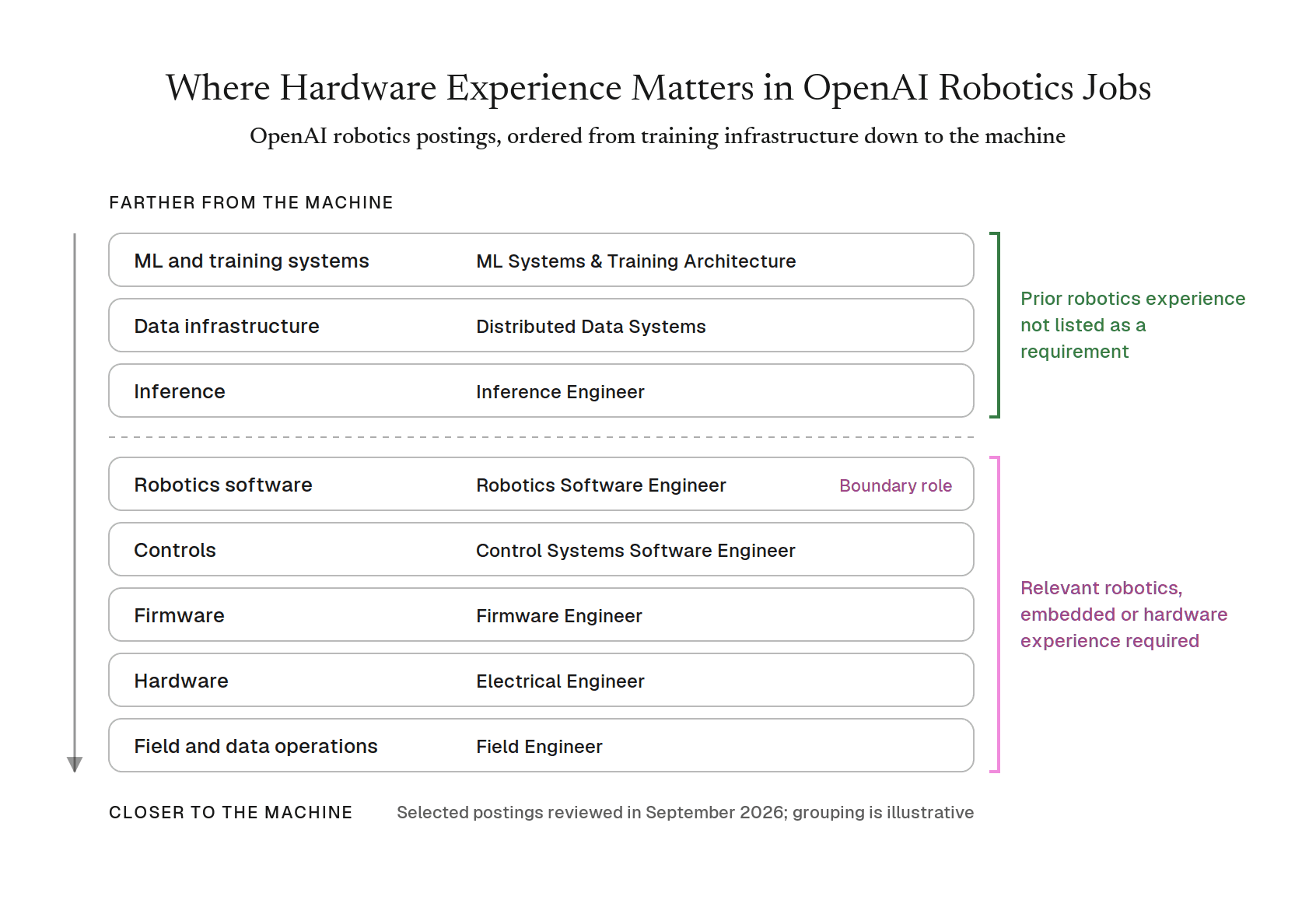
- OpenAI's robotics postings split by how close a role sits to the physical machine. Training systems, data infrastructure, and inference roles do not list robotics experience as a requirement, making them the realistic entry points for software and ML engineers. The Robotics Software Engineer role sits on the boundary, and controls, firmware, electrical, and field roles require hands-on experience with physical systems.
- Rust or C++ is named specifically in the robotics software, controls, and firmware postings, while the upper-layer roles stress distributed systems, GPUs, and performance work instead of a specific language.
- All robotics roles reviewed are based in San Francisco, with three to five days a week in the office depending on the role, and no remote option across any of them.
What OpenAI Robotics Is Building
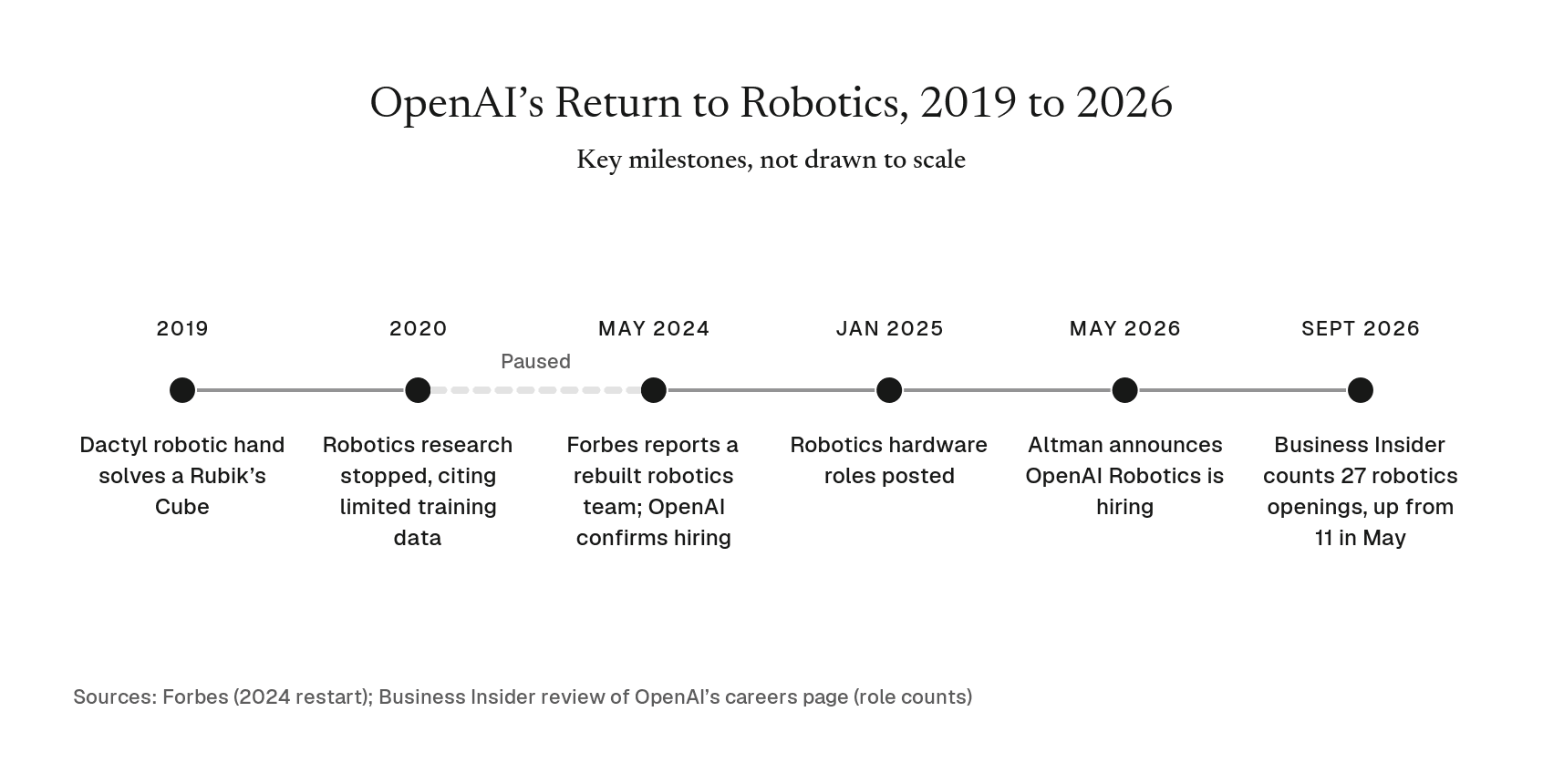
OpenAI has worked on robots before. Its original robotics group trained Dactyl, a robotic hand that solved a Rubik's Cube in 2019. The company stopped that research in 2020, citing limited training data. In May 2024, Forbes reported that OpenAI was rebuilding a robotics team, and the company confirmed it had begun hiring. It began posting robotics hardware roles in January 2025.
The current push became public on May 31, 2026, when Sam Altman posted that OpenAI Robotics was hiring hardware, operations, systems, and ML engineers. He said the world simulation research program led by Aditya Ramesh had evolved into OpenAI Robotics, built on co-design between robotics hardware and ML research. Altman described the near-term focus as robots that support skilled workers building infrastructure, with personal, general-purpose robots as the longer-term aim.
For candidates, the important point is breadth. OpenAI is not hiring one generic "robotics engineer" profile. Its openings map to distinct layers with very different requirements.
OpenAI Robotics Jobs Across the Technical Stack
The table below maps one current posting to each layer. The higher layers draw on ML systems, distributed infrastructure, and performance engineering. The closer a role sits to the physical machine, the more it asks for robotics, embedded, or electromechanical experience.
Stack layer | Example role | What the work involves | Best-fit background | Office requirement | Posted base pay |
ML and training systems | Software Engineer, ML Systems & Training Architecture | Keeping the robotics training framework healthy, reviewing code, debugging failures across GPUs, clusters, and networking | ML systems, training frameworks, GPU or distributed systems experience | 5 days a week | $295K to $380K |
Data infrastructure | Software Engineer, Distributed Data Systems, Robotics | Exabyte-scale data processing, data selection, automated labeling and training data loaders | Distributed systems and large-scale infrastructure | Hybrid, 3 days a week | $230K to $385K |
Inference | Inference Engineer, Robotics | Model serving efficiency through kernel and data movement optimization, serving infrastructure | Inference performance and kernel-level systems work | Hybrid, 3 days a week | $380K |
Robotics software | Robotics Software Engineer | Integrating new robot hardware, building control interfaces and tooling to evaluate robot policies | 5+ years of software in robotics or hardware-integrated environments, Rust or C++ | 4 days a week | $255K to $325K |
Controls | Control Systems Software Engineer, Robotics | Real-time control, state estimation and actuator control, from hardware interfaces to whole-robot behavior | Classical control, dynamics and estimation, C++ or Rust | 5 days a week | $380K to $460K |
Firmware | Firmware Engineer, Robotics | Embedded architecture across boot, real-time execution, peripherals, hardware bring-up, and fault handling | Shipped embedded systems, low-level languages (the team uses Rust) | 4 days a week | $380K to $445K |
Hardware | Electrical Engineer, Robotics | Circuit design, PCB layout, bring-up, and integration of compact electromechanical systems | 6+ years developing electrical systems for robotics or similar products | 4 days a week | $295K to $380K |
Field and data operations | Field Engineer | Keeping a fleet of robotic workcells online, diagnosing failures across mechanics, electronics, controls, and software | 5+ years supporting electromechanical or robotic systems, engineering degree | 5 days a week | $225K to $318K |
All roles are in San Francisco. Pay ranges are base salary as posted on each OpenAI listing for San Francisco roles, and they can change between versions of a posting. Treat every figure here as a starting point and confirm it on the live listing. The postings list equity separately.
The practical dividing line is not software versus robotics. It is how close the role sits to the physical machine. Training infrastructure, data systems, and inference draw on disciplines that already exist in large AI and software organizations. Everything from robotics software downward asks for direct experience with robots or hardware.
OpenAI Robotics Roles That Fit Software and ML Engineers
None of the postings in this section list robotics experience as a requirement. That does not mean a strong backend engineer qualifies automatically. It means the gap is narrower than the word "robotics" suggests.
Training systems
The ML Systems & Training Architecture role keeps the robotics team's training framework healthy. The work involves reviewing and cleaning up code, catching risky changes before they land, debugging failures across GPUs, clusters, and networking, and unblocking researchers whose training jobs break. The posting favors engineers who read unfamiliar codebases quickly and prefer deep individual work over running process-heavy initiatives.
If you already operate large training systems, much of the core systems work overlaps with your existing experience. The remaining gap is more likely to involve the robotics research context than controls or hardware engineering, plus the five-day office requirement and a role built around making other people faster. If your ML experience is mostly application development on top of model APIs, this role is a longer reach.
Data infrastructure
Two postings cover this layer. The Software Engineer, Distributed Data Systems role owns the end-to-end data stack for robotics training at exabyte scale, including data selection, automated labeling, and training data loaders. A companion Machine Learning Engineer role on the same team focuses on distributed compute, data orchestration, storage, and streaming, with a posted range of $380K to $500K.
Both ask for strong distributed systems experience and rigor in running reliable systems, and neither lists prior work with robot or sensor data. Engineers from data platforms, storage, distributed compute, or high-scale backend systems may already have substantial overlap with the infrastructure requirements. The robotics-specific learning curve includes how those systems support multimodal training and robot data.
Inference
The Inference Engineer role centers on GPU model serving for robotics research. It covers kernel and data movement optimizations, serving infrastructure, and helping researchers design models that are efficient to serve. The posting asks for deep inference optimization expertise and a kernel-level systems background.
Engineers who have optimized LLM or other large-model serving systems may overlap substantially with the inference and performance skills listed in the posting. The gap is seniority: the posting expects someone who sets technical direction, not someone learning inference on the job.
What training, data, and inference roles share
Across training, data, and inference, the postings consistently ask for work below the application layer, heavy debugging, and close collaboration with researchers. Two robotics postings also mention AI-assisted engineering directly: the ML Systems role values experience reviewing AI-generated code, and the Firmware posting, outside these three layers, favors engineers who make heavy use of Codex, Claude Code, or similar coding agents. If your strongest work is at the systems level, these are the postings to read first.
OpenAI Robotics Roles That Require Robotics or Hardware Experience
The Robotics Software Engineer role is the boundary case. It asks for 5+ years of software experience in robotics or hardware-integrated environments, experience deploying automation or off-the-shelf robot platforms, and strong Rust or C++. A backend engineer without hardware exposure does not meet that as written.
Controls and firmware
The Control Systems Software Engineer posting asks for a strong background with manipulators, mobile robots, or similar systems, plus fundamentals in classical control, dynamics, and estimation. It expects significant time on-site commissioning and tuning real robots. The ML connection is real but narrow: the role works with ML engineers to implement reinforcement learning models on hardware.
The Firmware Engineer posting asks for deep experience building safety-critical or high-consequence systems, a record of leading architecture on shipped embedded products, and first-principles knowledge of interrupts, scheduling, memory layout, buses, and DMA. Robotics experience is not the only route in, since other demanding embedded environments count. The gap for a cloud or backend engineer is still fundamental.
Hardware and field operations
The Electrical Engineer role covers circuit design, PCB layout, bring-up, and integration of compact electromechanical systems, and asks for 6+ years of ownership from concept through deployment. The Field Engineer role keeps a fleet of robotic workcells running in daily data collection operations, diagnosing issues across mechanics, electronics, controls, software interfaces, and logs, and building the tools and playbooks technicians use. It asks for 5+ years supporting electromechanical or robotic systems and an engineering degree.
A strong infrastructure background does not substitute for controls, embedded, PCB, or hands-on troubleshooting experience where a posting requires it.
How to Apply to OpenAI Robotics Jobs
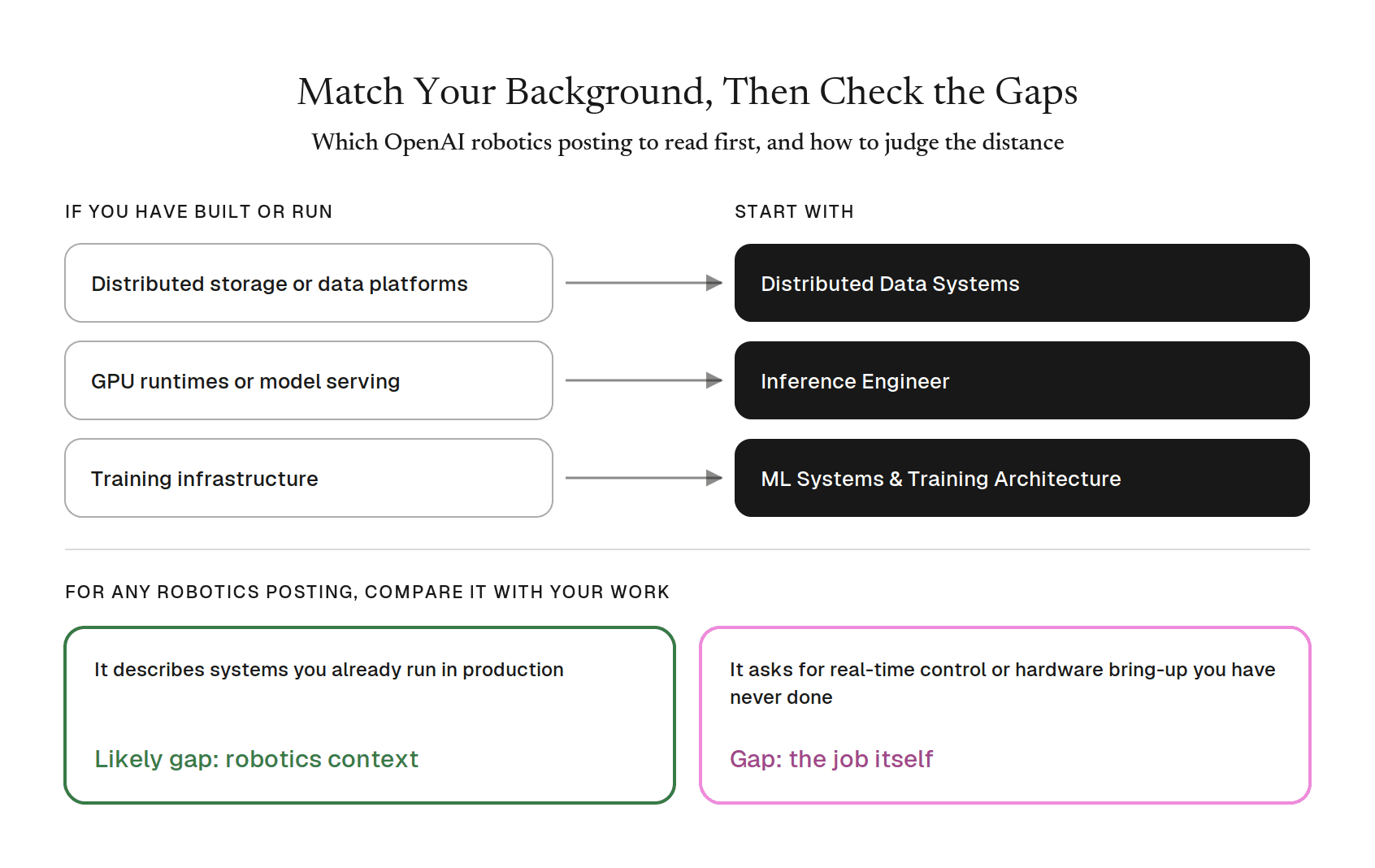
Choose the layer before you choose the title. If you have built distributed storage or data platforms, start with Distributed Data Systems. If you work on GPU runtimes or model serving, start with Inference. If you run training infrastructure, start with ML Systems. This also shows you the gap before you apply: when a posting describes systems you already run in production, the gap is robotics context, and when it asks for real-time control or hardware bring-up you have never done, the gap is the job itself.
Apply through each posting's application page on OpenAI's careers site. Altman's May post also invited candidates to email their background to a robotics recruiting address; that address does not appear on current postings, so treat the application page as the primary route and confirm with a recruiter whether the email route is still active.
Check the office requirement before applying. None of the robotics roles reviewed are remote. The data and inference roles are hybrid at three days a week, robotics software and firmware are four days, and training systems, controls, and field operations are five days. Several postings also offer relocation assistance.
Other Companies Hiring for Physical AI Jobs
OpenAI is not the only company with robotics AI jobs for software and ML engineers. At Figure, the Helix AI team lists data infrastructure, training performance, backend, and pretraining roles alongside controls and manufacturing roles, with engineers based in San Jose five days a week. Google DeepMind lists robotics roles in model lifecycle engineering and applied robotics research that ask for production Python and C++ and experience building model development pipelines. NVIDIA posts humanoid robotics roles for software engineers and ML engineers working on its GR00T and Cosmos foundation models.
1X, which builds home humanoid robots, launched a World Model Lab in June 2026 dedicated to large-scale embodied world model pretraining, and said at launch it was hiring across data, infrastructure, and machine learning to build foundation models for its NEO humanoid. Physical Intelligence, which builds foundation models for robots in San Francisco, invites strong engineers to apply even when no listed role fits.
These examples do not show that every physical AI company is organized like OpenAI. They do show that an embodied AI engineer can come from data, training, or infrastructure work, not only from controls and hardware.
How Fonzi Can Help You Find Physical AI Roles
Finding the right entry point into robotics is mostly a matching problem: your infrastructure or ML background maps cleanly onto some roles and not at all onto others, and that distinction rarely comes through in a generic job board search.
Fonzi is a curated AI engineering hiring marketplace that connects software and ML engineers with AI startups and high-growth companies, including teams working in physical AI and robotics. If you are considering AI startups and growth-stage companies alongside OpenAI, Fonzi lets you explore participating employers through its Match Day hiring process.
OpenAI Robotics Jobs: Choosing Your Layer
OpenAI robotics jobs divide by how close a role sits to the physical machine. Training systems, data infrastructure, and inference roles build on skills you may already have as a software or ML engineer, though they still expect deep systems expertise. Controls, firmware, electrical, and field roles require hands-on experience with physical systems, and the robotics software, controls, and firmware postings name Rust or C++. Every robotics role reviewed is in San Francisco, with three to five days a week in the office, no remote option, and posted base pay from $225K to $500K.
Robotics AI jobs outside OpenAI follow a similar pattern. Figure, Google DeepMind, NVIDIA, and 1X all list data, training, ML, or infrastructure roles, so physical AI jobs are open to more backgrounds than the word "robotics" suggests, and an embodied AI engineer can come from data or infrastructure work.
Identify the layer that matches your strongest work, compare it line by line with the live posting, and apply while the role is open.
FAQ
Are OpenAI robotics jobs remote?
No. Every robotics role reviewed is in San Francisco and requires three to five days a week in the office, depending on the role.
Do I need a robotics degree for OpenAI robotics jobs?
The training systems, data infrastructure, and inference postings do not list a robotics degree or robotics experience. The Field Engineer posting asks for a degree in mechanical, electrical, mechatronics, robotics, computer engineering, or a related field.
Which programming languages come up in OpenAI robotics postings?
Rust or C++ appears in the robotics software, controls, and firmware postings, and the firmware posting says the embedded stack uses a lot of Rust. The training, data, and inference postings emphasize systems skills rather than a specific language.
Which OpenAI robotics roles suit infrastructure engineers?
ML Systems & Training Architecture, Distributed Data Systems, and Inference have the clearest overlap with ML infrastructure, distributed systems, data platform, and model serving backgrounds.
Does OpenAI Robotics hire software engineers without robotics experience?
Yes, some current training systems, distributed data, and inference postings do not list prior robotics experience as a requirement. Those roles still demand substantial systems, infrastructure, or performance expertise.