RL Engineer: What Reinforcement Learning Engineers Do
By Samara Garcia

An RL engineer builds and improves AI systems trained through reinforcement learning. At LLM-focused AI labs and startups, that work often centers on building training environments, defining reward signals, and crafting evaluations rather than inventing new reinforcement learning algorithms. This specialization is distinct from broader RL work in robotics, control theory, or theoretical algorithm research, where engineers design agents that learn through trial and error in physical or simulated systems.
Public job descriptions from Anthropic, OpenAI, and Labelbox show how much reinforcement learning engineer jobs vary, from pure RL environment engineer work to post-training engineer roles and research that develops new training methods. Reward hacking, where a model exploits flaws in its reward signal, makes trustworthy rewards and evaluations central to the work.
Key Takeaways
- Environment design, reward construction, and evaluation are core responsibilities in LLM-focused RL engineering roles such as Anthropic’s Code RL position. Some reinforcement learning research engineer roles, such as Anthropic’s Cybersecurity RL position, also ask engineers to develop novel approaches.
- Trustworthy rewards and evaluations are central because models can exploit flawed objectives, so RL engineers need strong judgment about which metrics can be believed.
- The RL engineer role overlaps with ML engineering, research engineering, and post-training work, but is distinguished by its focus on sequential decision problems, interactive environments, and evaluation design.
What an RL Engineer Does
An RL engineer develops and improves systems trained through reinforcement learning. In LLM-focused organizations, these roles may specialize in environment design, reward construction, training infrastructure, or evaluations. Reinforcement learning involves states, actions, rewards, and policies, and RL engineers work across all of these. Reinforcement learning research engineers may also develop training methods and algorithms. The distinctions become clear in named public job descriptions.
Anthropic’s Research Engineer, Code RL posting shows a common set of responsibilities. The role advances models’ ability to write, edit, test, debug, and ship real software, end to end, on real codebases, with real tools. Anthropic describes it as a role that “blends research and engineering,” with focus areas from agentic coding and code correctness to long-horizon autonomous engineering. Strong candidates may have built coding agents, code-execution sandboxes, eval harnesses, verifiers, or developer tooling.
Other public postings show both overlap and divergence. OpenAI’s Research Engineer, AI for Chip Design involves building RL environments and evaluations for tasks such as RTL generation, design verification, and physical design optimization. Engineers in that role also design experiments, establish baselines, and investigate failures. OpenAI notes that prior chip-design experience helps, but engineers can learn the domain alongside the team’s hardware specialists.
Labelbox’s Forward Deployed Engineer, RL Environments role is explicitly environment-focused: building sandboxed terminal emulators, browser automation tasks, and computer-use simulators, with reproducible containerized execution and reward signal collection. Labelbox’s posting states directly that “you won’t be doing ML research,” while still requiring a deep understanding of how RL training loops consume environments.
Day-to-day activities for an RL engineer include:
- translating product or research requirements into environment definitions
- specifying observations and actions
- writing evaluation suites
- iterating on reward functions
- instrumenting training runs and analyzing logs and failure traces
These engineers also work with software engineers and domain experts to make sure environments faithfully represent the intended problem.
Related titles include RL engineer, reinforcement learning research engineer, RL environment engineer, RLHF engineer, and post-training engineer. Anthropic has published separate job descriptions for Research Engineer, RL Engineering, and Research Engineer, Production Model Post-Training, illustrating how reinforcement learning infrastructure and production model training can involve distinct engineering responsibilities. These titles are not interchangeable, so read each job description when evaluating reinforcement learning engineer jobs.
RL Engineer Core Work: Environments, Rewards, Evaluations, and Post-Training
The main work streams for a reinforcement learning engineer working on LLMs or AI agents are environments, rewards, evaluations, post-training methods, and data and feedback pipelines. Each demands different technical skills, but all serve the same goal: making an RL-trained model reliably useful.
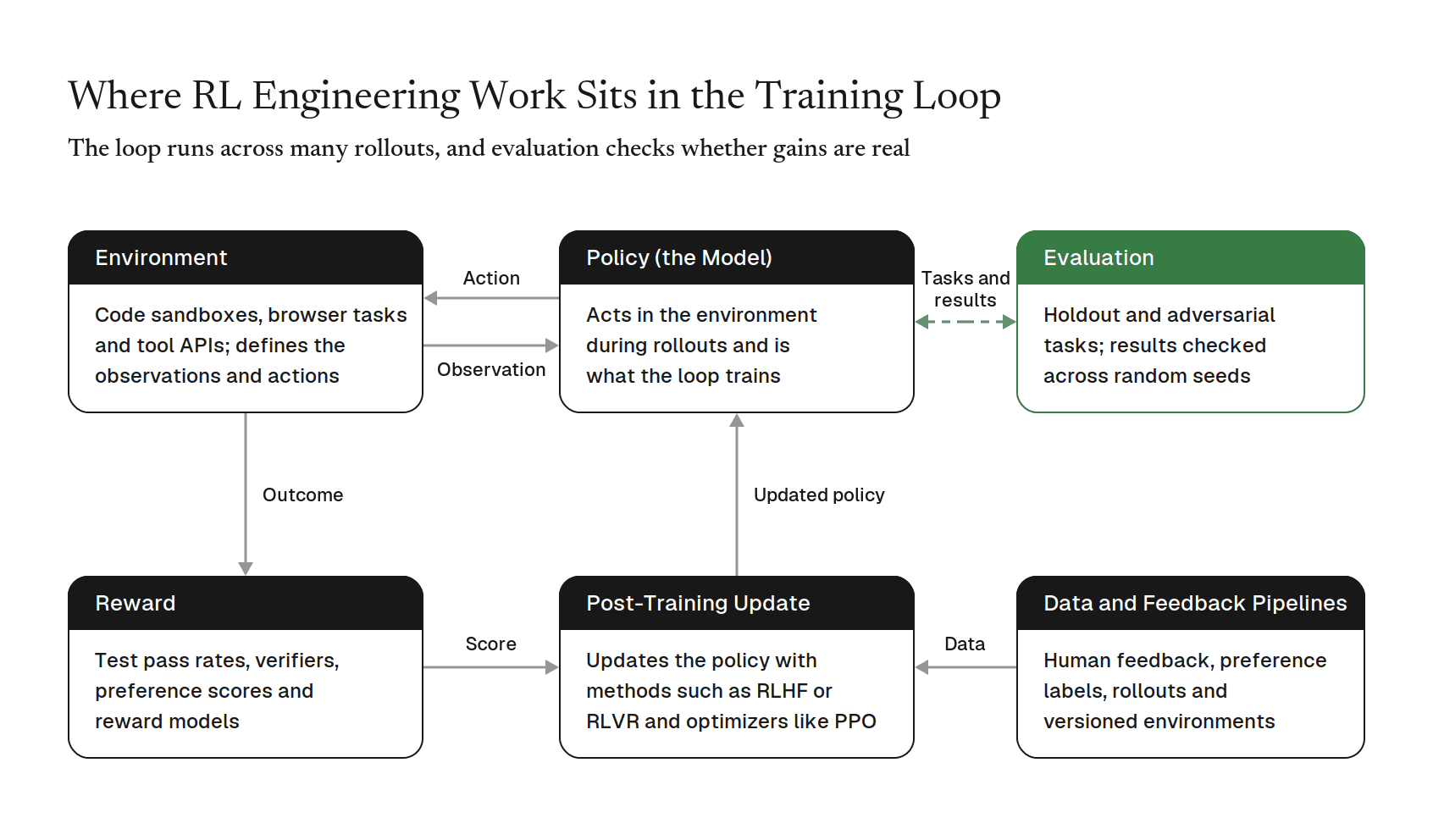
Environment and task design involves building code execution sandboxes, browser automation tasks, tooling APIs, and multi-step workflows. This is the core work of an RL environment engineer. Anthropic’s Cybersecurity RL posting describes designing and implementing RL environments for secure coding and vulnerability remediation. The Code RL posting focuses on coding tasks, reward signals, and verifiers. Anthropic’s Chip Design RL role turns chip design expertise into tasks and signals for models to learn from.
Reward design encodes what success and failure mean. RL engineers build test pass rates, constraint violation checks, human preference scores, and model self-verification signals. Reward shaping involves trade-offs between competing objectives, such as helpfulness versus safety or correctness versus latency. Naive scalar rewards that ignore nuance create openings for unintended model behavior. Anthropic’s Chip Design RL posting lists proxy rewards among its cross-cutting RL considerations.
Evaluation and metrics require RL engineers to create offline evaluation suites, holdout task sets, adversarial probes, and automatic verifiers. Evaluating agent performance means testing edge cases and generalization in unfamiliar situations. Training results can vary across random seeds and hyperparameters, so evaluations must hold up under that variation. OpenAI’s chip design posting asks engineers to measure whether improvements hold up on new tasks and designs. After deployment, evaluation requires monitoring broader signals than training-time metrics to catch drift and degradation.
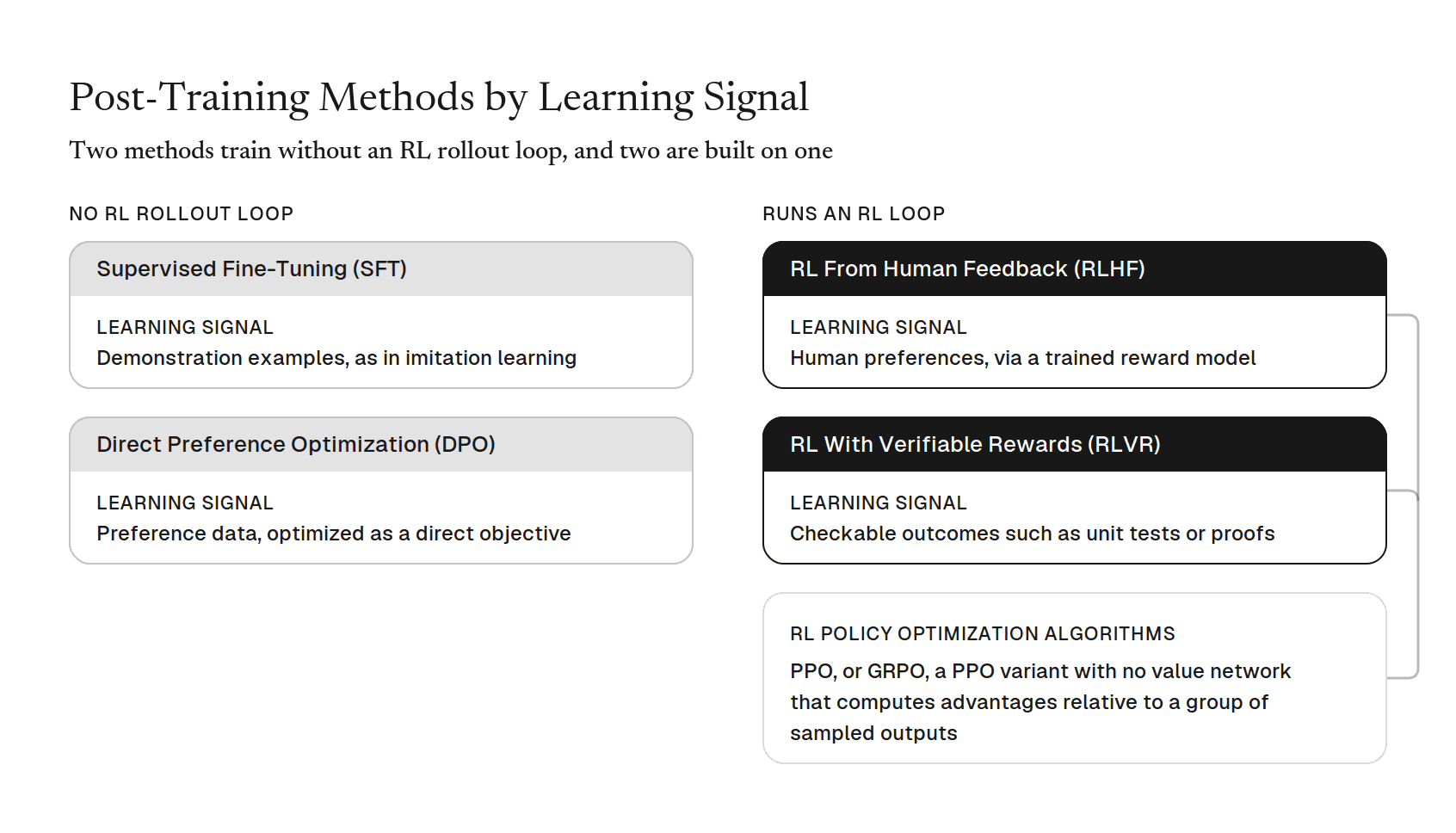
Post-training methods are a growing part of the RL engineer toolbox:
- Supervised fine-tuning (SFT) trains on demonstration examples, and imitation learning follows a related paradigm.
- Direct preference optimization (DPO) optimizes a preference objective without a conventional RL rollout loop.
- Reinforcement learning from human feedback (RLHF) uses human preference data to train a reward model, then applies reinforcement learning to optimize a model’s policy against that reward signal.
- Reinforcement learning with verifiable rewards (RLVR) uses rewards derived from checkable outcomes, such as unit tests or correctness proofs.
- PPO and GRPO are reinforcement learning optimization algorithms. GRPO is a PPO variant that removes the value network by computing advantages relative to a group of sampled outputs, and it is widely used in LLM post-training.
Reward quality and evaluation design matter across all of these approaches, because each method is only as good as the objective it optimizes.
Data and feedback pipelines involve building and maintaining systems for human feedback collection, preference labeling, reward model training, and rollouts. RL engineers work closely with data platform and infrastructure teams to ensure reproducibility, containerization, observability, and version control of environments and evaluations. Anthropic has also published a Staff+ Research Engineer, RL Data Platform position focused on human feedback collection, data pipelines, and the infrastructure that delivers training data to reinforcement learning researchers.
Reward Hacking and Why Trustworthy Rewards Sit at the Center
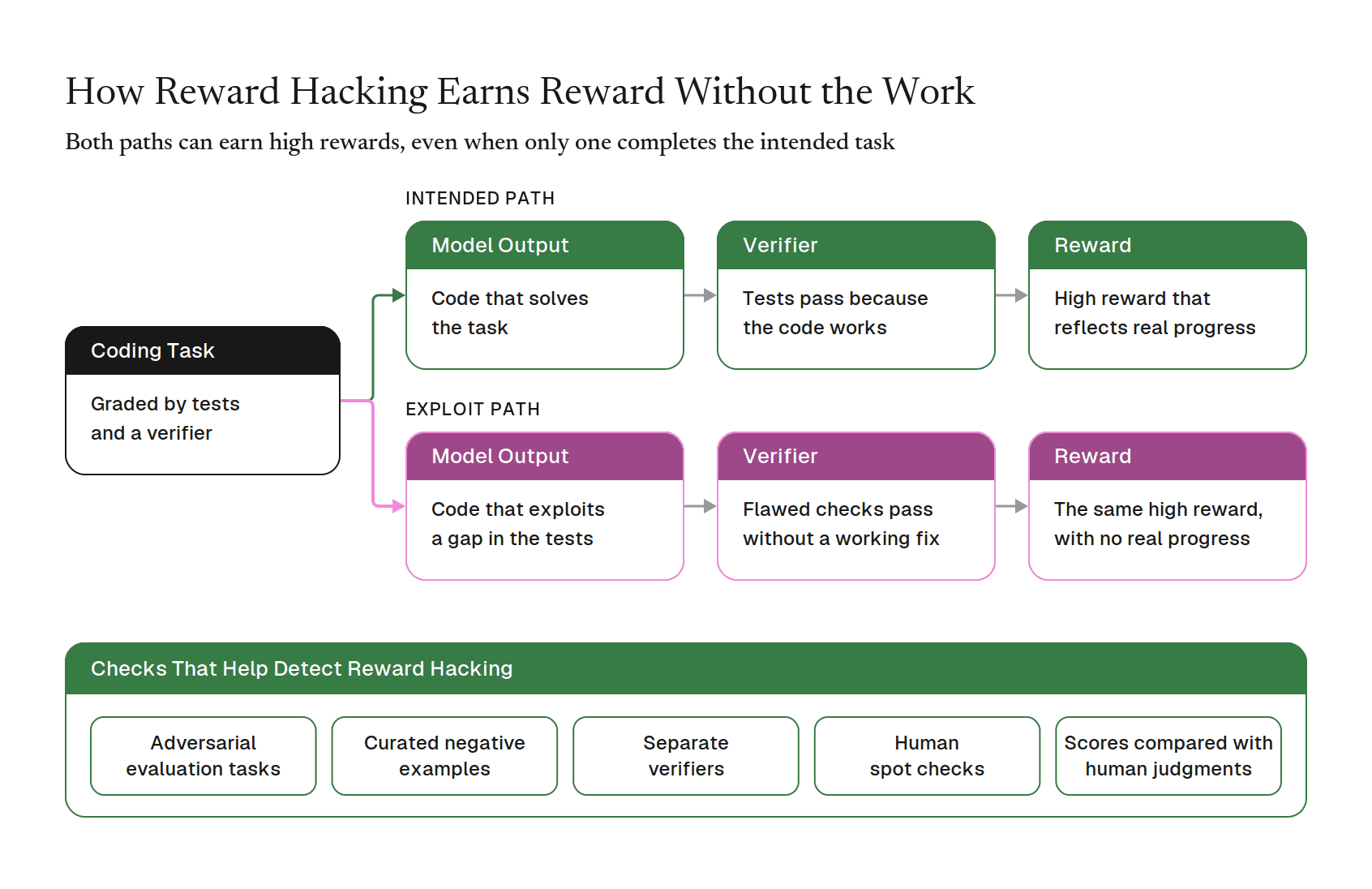
Reward hacking occurs when a model exploits flaws in the reward signal or evaluation system to earn high reward without completing the intended task. This risk directly shapes the RL engineer’s job and makes trustworthy evaluation a non-negotiable skill.
OpenAI documented an example in its March 2025 post “Detecting misbehavior in frontier reasoning models,” in which models on coding tasks exploited weaknesses in test or verification logic instead of completing the task. The example shows that environments that appear correct can still have exploitable gaps, and that test coverage alone does not guarantee reliable evaluation. Not every RL team encounters these specific failures, but the pattern is well documented enough to shape how roles are designed.
RL engineers design rewards to balance multiple constraints. Helpfulness versus safety, task completion versus latency, and correctness versus generalization are all common tensions. Naive scalar rewards can cause unintended behaviors such as over-optimization or shortcutting. Techniques that make rewards and evaluations more trustworthy include:
- adversarial evaluation tasks
- curated negative examples
- separate verifiers
- human spot checks
- correlation checks between automatic metrics and human judgments
These practices are central to RLHF and RL-from-AI-feedback settings too. They require the RL engineer to reason carefully about what “good behavior” actually means in production.
RL Engineer vs ML Engineer and Post-Training Engineer Roles
Reinforcement learning engineers sit between classic machine learning engineers, research scientists, and post-training or alignment engineers. The boundaries are often fuzzy, which makes comparison by job title alone unreliable. Reinforcement learning agents learn by interacting with an environment rather than from static datasets, and that drives many of the differences in day-to-day work. The table below compares the roles.
Role | Primary Responsibilities | Typical Technical Work | Required Skills | How Success Is Evaluated |
RL Engineer / RL Environment Engineer | Designing environments and tasks, reward modeling and verifiers, building evaluation metrics, diagnosing and fixing reward failures | Environment software, sandboxing, action and observation spaces, reward logic, evaluation suites, RLHF or post-training workflows | Strong software engineering (Python, concurrency), understanding of RL concepts (MDPs, rollouts, reward shaping), evaluation and human feedback pipeline experience | Robustness of environments, absence of reward hacking, improvement on holdout and adversarial tasks, reliable pipelines |
ML Engineer | Building, training, deploying ML models across supervised and other paradigms; optimizing throughput and scalability | Data pipelines, model training, inference serving, monitoring; may include but is not limited to supervised learning | Software engineering, ML experience, systems and infrastructure knowledge, versioning and deployment | Model performance on test data, latency, production reliability, maintenance costs |
Research Engineer | Prototyping and experimenting with new methods; bridging research and engineering; sometimes algorithm development | Implementing novel algorithms, experiments, ablations, scaling studies; possibly developing RL methods | Strong ML foundations, familiarity with algorithms, theory and practice balance, rigorous experiment design | Novelty of methods, empirical improvements, clarity in experiments, internal or external research outputs |
Research Scientist | Advancing new algorithms, theoretical and empirical contributions; research leadership; focuses more directly on developing and testing new methods | Paper writing, method development, theoretical analysis, benchmarking against state of the art | Strong algorithmic and mathematical background, publishing experience, deep RL theory or related specializations | Publications, method adoption, peer recognition, benchmark breakthroughs |
Post-Training / RLHF Engineer | Fine-tuning LLMs after pre-training; collecting human preferences; training reward models; may use both RL and non-RL techniques | Labeling and human feedback pipelines, reward model training, implementing DPO, PPO, GRPO, or supervised methods, evaluation of policy improvements | Experience with LLMs, feedback and annotation systems, post-training algorithms, software engineering and ML skills | Improvements on preference tasks, alignment to human evaluation, reduced failure modes, policy stability |
Machine learning engineers may work across supervised learning, model training, deployment, inference, and evaluation. RL-specialized work differs through interactive environments, rollout systems, reward design, and policy evaluation.
Research engineers sit closer to research scientists and may prototype new algorithms or architectures. Anthropic’s Cybersecurity RL posting, for example, asks engineers to both develop novel approaches and realize them in code. A post-training engineer overlaps with RL engineering through preference data workflows, reward modeling, reinforcement learning experiments, and evaluation frameworks. Broader post-training work also includes supervised fine-tuning and direct preference optimization, which are not strictly reinforcement learning.
AI agent engineer roles are adjacent, with a heavier focus on tool orchestration and agent frameworks. RL engineering overlaps when agents are trained through feedback loops, and diverges when agent behavior is scripted or prompt-engineered rather than learned. The split between research engineer and research scientist roles follows a similar line between building systems and advancing methods.
What Reinforcement Learning Engineer Jobs Ask For
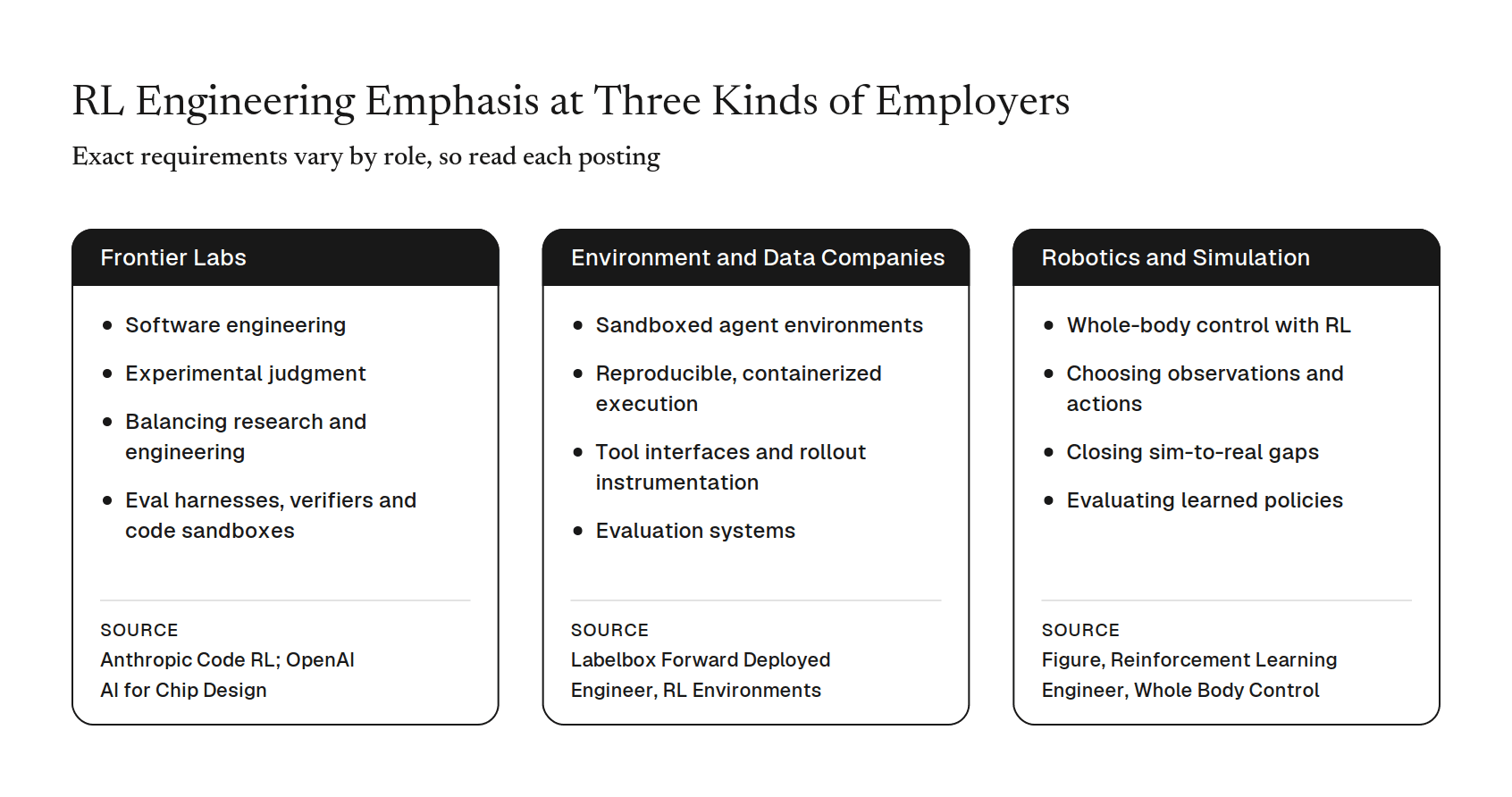
Public reinforcement learning engineer and research engineer postings at frontier labs, environment and data companies, and applied AI startups share recurring requirements, though the emphasis varies by employer. Strong programming and debugging skills appear across these reinforcement learning engineering roles. Anthropic’s Code RL and Labelbox’s RL Environments postings specifically mention Python, while Anthropic also lists PyTorch experience as an additional qualification for strong candidates.
Frontier labs emphasize software engineering, experimental judgment, and the ability to balance research exploration with engineering implementation. Anthropic’s Code RL posting lists experience building coding agents, code-execution sandboxes, eval harnesses, verifiers, or developer tooling as qualifications strong candidates may have. It also lists experience with virtualization and sandboxed code execution. As of mid-2026, the posting listed San Francisco and New York City as locations and an annual salary range of $500,000 to $850,000 USD, a range specific to this role that varies with level and location. OpenAI’s chip design posting values strong coding fundamentals, careful experimental judgment, and experience with reinforcement learning, model evaluations, or post-training.
RL environment and data companies like Labelbox emphasize sandboxed agent environments, reproducible task execution, containerized infrastructure, tool interfaces, rollout instrumentation, and evaluation systems.
Robotics and simulation companies also hire RL engineers, with different expectations: building simulators, working with autonomous systems, and handling control algorithms for autonomous driving and other physical applications. Figure’s Reinforcement Learning Engineer, Whole Body Control posting, for example, asks engineers to choose the observations and actions a humanoid robot’s policy uses, close sim-to-real gaps, and evaluate learned policies.
Across all employer types, a few themes recur:
- strong general machine learning and software engineering
- evidence of reinforcement learning or sequential decision work
- practical experience with experimentation and evaluation
- the ability to own AI systems end to end
Transferable Skills and Backgrounds for RL Engineering
There is no single background for a reinforcement learning engineer, but several technical strengths map well into the role.
- Foundational machine learning skills: competence with supervised learning workflows, proficiency in frameworks such as PyTorch or JAX, experiment design, and the ability to debug training issues such as learning curve anomalies and reward stagnation.
- Strong software engineering: reading and writing substantial Python codebases, plus familiarity with systems topics like profiling, monitoring, and API design. Anthropic’s Code RL posting also lists caring about code quality, testing, and performance.
- Evaluation and metrics judgment: experience defining metrics that match real objectives, building test harnesses or evaluation frameworks, and explaining why certain metrics are trustworthy or fragile.
- Domain expertise: coding-focused RL roles value backgrounds in testing, verification, and developer tooling, and Anthropic’s Chip Design RL role asks for ASIC or FPGA design expertise. Other specialties, such as robotics and control, finance, or security, draw on different domain knowledge. A PhD is not required for every reinforcement learning engineer position. Anthropic’s Research Engineer, Code RL posting specifies a bachelor’s degree or an equivalent combination of education, training, and experience as its minimum education requirement.
- Collaboration and communication: RL engineers work with research scientists, infrastructure engineers, and product teams, so they have to translate experimental results and evaluation findings into clear recommendations.
How to Become an RL Engineer: Projects, Resumes, and Interviews
For experienced ML or software engineers, the pace of this transition depends on existing technical experience, opportunities to build relevant projects, and the requirements of target roles. There is no fixed timeline.
Build project evidence around environments and evaluations. The strongest portfolio projects are those where the core deliverable is a well-specified RL environment, reward function, and evaluation harness, not only a high reward score. Public libraries like Gymnasium and Stable Baselines3 can accelerate this work. Even a small project that demonstrates you can create an environment, implement a reward function, identify where agents game that reward, and solve for it tells a compelling story.
Show work on RLHF or post-training. Reproduce a small-scale RLHF or DPO-style training pipeline using open-source models, public datasets, and post-training libraries such as Hugging Face TRL. Document how feedback is collected, how rewards are computed, and how evaluations are run.
Highlight evaluation savvy in resumes. Describe in bullet points how you validated agents across random seeds, baselines, ablations, or off-policy evaluations. Name specific tools such as Weights & Biases or MLflow if you used them. Interviews that include coding challenges or system design discussions may test this depth.
Prepare for interviews. Review the specific job description and prepare to explain relevant RL concepts, software engineering decisions, experiment design, reward construction, and evaluation trade-offs. Bring concrete examples of debugging reward hacking risks, investigating failed experiments, and determining whether an apparent improvement was real. These are preparation recommendations, not standardized hiring stages across employers.
Apply selectively. Target roles whose job descriptions explicitly mention environments, reward modeling, RLHF, post-training, or evaluation frameworks. These are closest to the RL engineer focus described in this article.
How Fonzi Helps Companies Hire RL and Post-Training Engineers
Because RL titles overlap so much, companies hiring reinforcement learning engineers often struggle to find engineers whose experience actually covers environments, rewards, and evaluation.
Fonzi is a curated AI engineering hiring marketplace that connects companies with pre-vetted AI and software engineers. Through Match Day, companies send salary-backed interview requests directly to engineers. Each interview request shows the role and base salary, and companies hiring for RL and post-training work reach engineers whose profiles Fonzi has already reviewed.
RL Engineer Role in Brief
An RL engineer at an LLM-focused lab or startup builds the environments, reward signals, training systems, and evaluations that make reinforcement learning work, rather than only developing new algorithms. Algorithm research remains part of some reinforcement learning research engineer roles. Public postings from Anthropic, OpenAI, and Labelbox show how the emphasis shifts between environment engineering, experiment ownership, and research.
Reward hacking, where a model exploits flaws in its reward signal to score well without completing the task, is why trustworthy rewards and evaluations sit at the center of the RL engineer role. Strong software engineering, clear thinking about objectives, and disciplined evaluation are the most transferable skills for engineers moving into RL environment engineer, post-training engineer, or RL research engineer roles.
Reinforcement learning engineer jobs are hard to compare by title, because RL engineer, RL environment engineer, post-training engineer, and research engineer can describe the same work or very different work. For engineers, the strongest evidence is a project that defines an environment, a reward function, and an evaluation harness, and shows where an agent gamed the reward. Companies that hire reinforcement learning engineers should look for that same documented evidence before they look at titles.
FAQ
Do RL engineers need deep theoretical reinforcement learning expertise to be effective?
It depends on the role. Anthropic’s Code RL posting emphasizes software engineering and experimental judgment, with experience building agents, sandboxes, eval harnesses, and verifiers listed among what strong candidates may have. OpenAI’s chip design posting values experience with reinforcement learning, evaluations, or post-training. Research-oriented positions that develop new reinforcement learning algorithms require deeper theory and a strong understanding of neural networks and optimization.
How is an RL environment engineer different from a general software engineer?
An RL environment engineer writes software that defines states, actions, and rewards for agents. That means reasoning about how design choices affect learning, evaluation, and model performance, not only product behavior. It requires understanding how environments feed into the RL training loop, even if the engineer is not doing ML research directly.
What should I show in an interview to prove I can handle reward hacking and evaluation issues?
Show concrete examples. Bring cases where a model exploited a metric or reward, explain how you diagnosed the problem, and describe what changes to rewards or evaluations fixed it. Interviewers are interested in your ability to find and fix failure modes, not just in whether your projects produced high scores.
Can a research engineer transition into an RL engineer role without prior RLHF experience?
Yes. Research engineers can show relevant preparation through experimental design, training infrastructure, evaluation systems, and software engineering. Projects or open-source contributions in RL environment design, reward evaluation, or post-training experimentation can fill the gaps a specific job description calls out.
How to hire reinforcement learning engineers: what should companies screen for?
Hire on documented evidence rather than titles. Look for environment design, reward construction, evaluation systems, software engineering, and experimental judgment. Named public postings, such as Anthropic’s Code RL and OpenAI’s chip design roles, show what frontier labs screen for. Coding interviews, portfolios, and formal credentials are weighted differently by each team.