AI Agent Engineer: The Role, the Skills and Who Is Hiring
By Samara Garcia
An AI agent engineer designs, builds, and operates LLM-powered agents that use tools, maintain context, and perform multi-step work in production. Companies are hiring for this work right now, but under different titles. In an October 2026 sample of 14 startup roles focused on agents or agentic platforms, only 1 used the exact phrase “Agent Engineer” in the title.
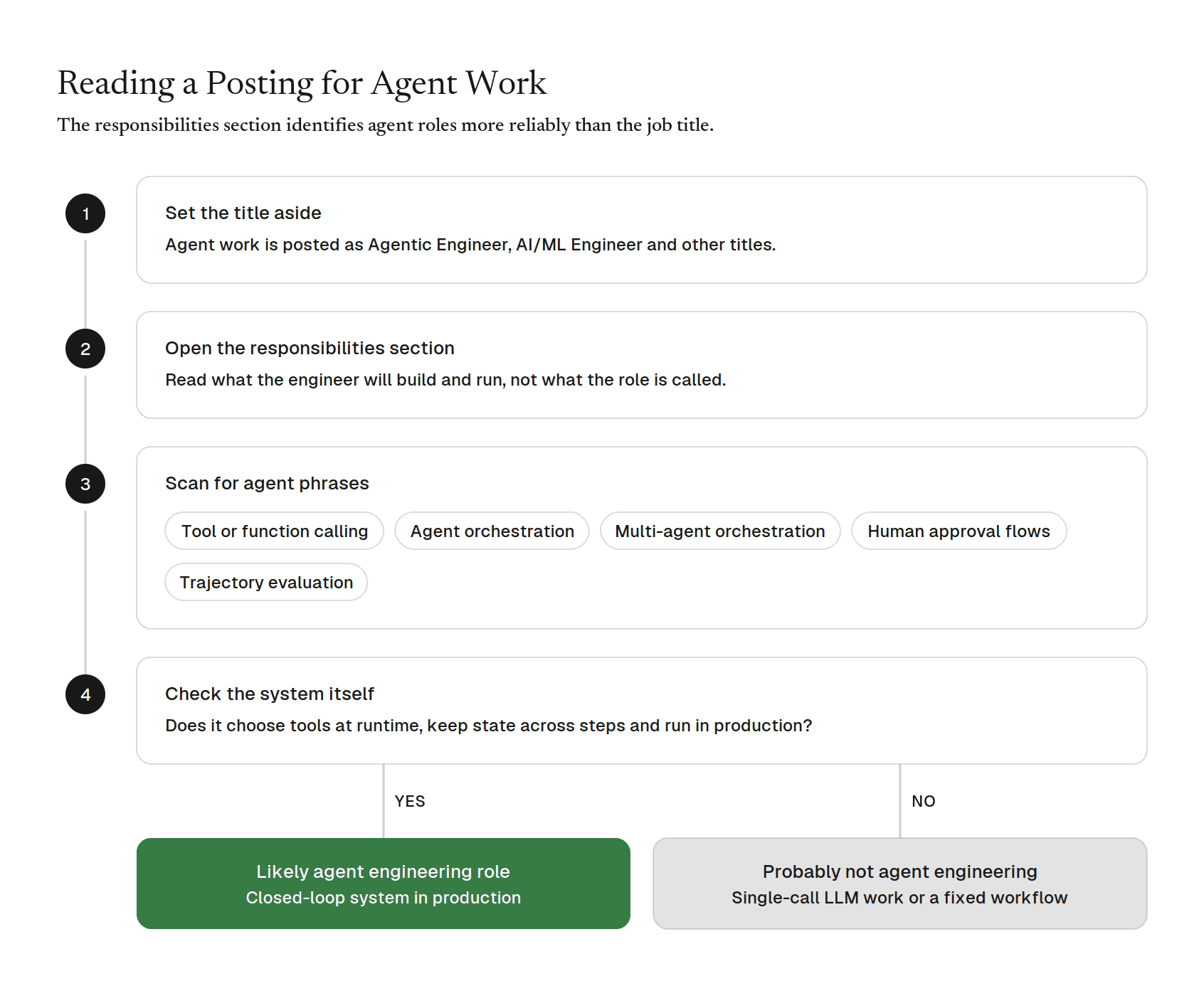
Because agent engineer titles vary so widely, the responsibilities section of a posting tells you more than the title. The AI agent engineering skills employers list overlap heavily with applied AI engineering.
Key Takeaways
- An AI agent engineer designs, builds, and operates LLM-powered agents and agentic systems that use models, tools, context, and state to complete multi-step tasks. Public postings from Gigi and Binance use the exact title, and Sierra and Decagon have published articles describing the same discipline.
- Agent-focused engineering roles usually appear under other titles. Among agent-related engineering roles listed on Fonzi in October 2026, only 1 of 14 used “Agent Engineer” in the title, while 6 used “agentic,” 2 used “agent platform,” and 2 were titled “Member of Technical Staff.”
- Employers ask for strong software development skills, LLM application experience, agent frameworks, tool calling, and production evaluation. All 14 roles in the Fonzi sample were senior level or above, but early-career openings exist elsewhere, such as Binance’s AI Agent Engineer internship.
What Is an AI Agent Engineer?
There is no single canonical definition of “AI agent engineer,” and responsibilities vary by employer. The working definition below draws primarily on named public postings that use the exact title, supplemented by published descriptions from companies that have written about agent engineering as a discipline.
Gigi’s AI Agent Engineer posting describes the role as owning end-to-end development of the agents and workflows behind Gigi’s AI media manager. Responsibilities include defining how LLMs reason, use tools, retain context, and take actions on behalf of customers. The engineer designs APIs, models data, and builds tools, retrieval, memory, orchestration, guardrails, and human approval flows. The posting also expects strong engineers to learn LangGraph, agent orchestration, evaluations, retrieval, and tool use on the job.
In contrast, Binance’s “Binance Accelerator Program - AI Agent Engineer” is an early-career internship. It focuses on contributing to AI agents integrated into live systems, building benchmark datasets for evaluation, and implementing backend services in Python or Go.
These postings show that AI agent engineers bridge the gap between LLMs and practical software engineering.
Sierra’s article “Meet the AI agent engineer” describes its agent engineers as working with customers to design, build, and ship AI agents on Sierra’s platform, Agent OS. Sierra places the role within the broader discipline of AI engineering. This is Sierra’s specific approach, not a universal definition.
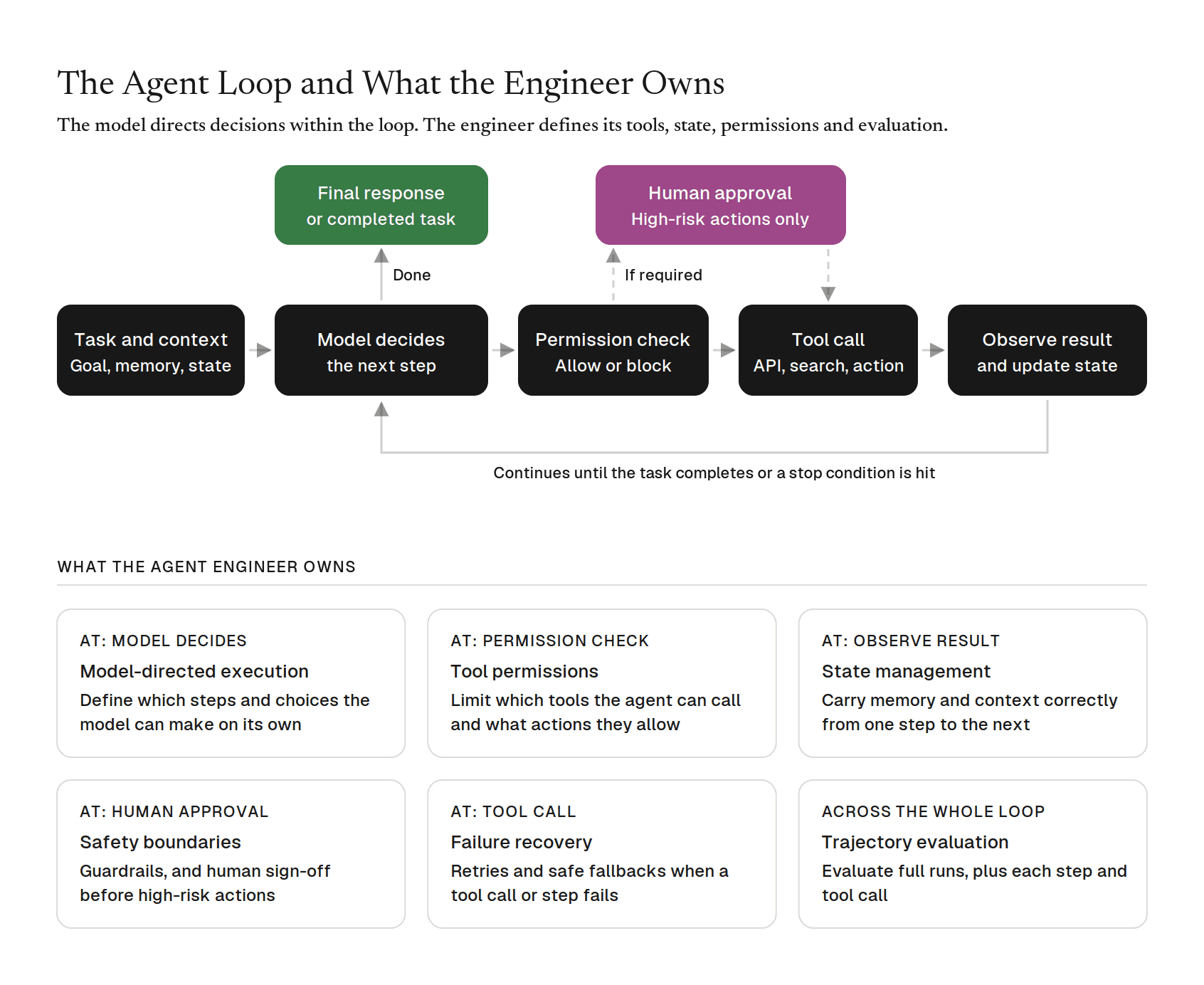
In LangChain’s article “What is an AI agent?”, agents are described as LLM-driven systems in which the model directs application control flow, selects tools, observes results, and determines subsequent actions. From these descriptions, an AI agent engineer is responsible for implementing and controlling this decision loop in real products.
Decagon’s June 5, 2025 article, “Introducing the Agent Engineer: Where AI meets real-world impact,” describes agent engineers as taking full ownership of designing, building, and deploying AI agents. The documented responsibilities include:
- workflow discovery
- LLM and API integration
- prompt and behavior design
- routing logic and safe fallbacks
- production iteration
- cross-functional collaboration
These responsibilities show why the work extends beyond prompt writing.
Across these named postings and company descriptions, a working definition emerges. An AI agent engineer develops and operates LLM-powered systems that interact with tools, maintain relevant context through memory, and execute tasks or workflows within defined boundaries. Responsibilities can include architecture, tool calling, context management, evaluation, and production operations. The precise combination varies by employer.
AI Agent Engineer Job Titles in Real Listings
Agent-focused roles appear under both exact and adjacent titles. This section uses an October 2026 sample of agent-related roles on Fonzi, alongside named public postings, to show the naming patterns.
The Fonzi sample consists of 14 open engineering and research roles focused on agents or agentic platforms at 12 startups, listed on Fonzi in October 2026. Twelve of the 14 have “agent” or “agentic” in the title. The table below compares four named public postings from outside the sample. Hedra’s posting has since closed and is included for its description of the work.
The title patterns in the Fonzi sample break down as follows.
Agent Engineer Job Title Patterns in a 14-Role Startup Sample
Title pattern | Number of roles |
Contains "Agent Engineer" | 1 |
Contains "agentic" | 6 |
Contains "agent platform" | 2 |
Member of Technical Staff | 2 |
Other titles containing "agent" | 3 |
Based on 14 engineering and research roles focused on agents or agentic platforms, listed on Fonzi as of October 8, 2026. Treat this as an illustrative sample rather than a market-wide survey.
Only one role in fourteen used the exact title. A search limited to “agent engineer” would have missed the other 13.
How Companies Describe AI Agent Engineering Work
While job titles vary, role descriptions converge on a few core responsibilities for building AI agents and operating them in production.
First AI’s AI Agent Engineer career page describes a pathway in which every hire starts as an AI Adoption Manager. Engineers then specialize in agent development: designing and deploying agents with Microsoft Copilot Studio, building LLM-powered workflows, and developing scalable AI-enabled business processes. This illustrates a pattern in which AI agents automate complex, cross-functional processes in enterprises.
micro1’s AI/ML Engineer, Internal Platforms role focuses on building a next-generation AI recruiting agent, experimenting with LLMs and agent frameworks, and improving agent performance, reliability, and usefulness. The engineer builds backend services and APIs while deploying scalable AI systems in production.
Hedra’s Agentic Engineer posting requires architecting production agent infrastructure, handling tool and function calling, designing multi-agent orchestration, and conducting trajectory evaluation and benchmarking. Unlike micro1’s internal-platform focus, Hedra’s responsibilities emphasize integrating agentic systems into user-facing products and evaluating complete agent trajectories.
Recurring themes across these descriptions include end-to-end ownership of agentic AI features, responsibility for reliability and evaluation, and close collaboration with the product or adoption teams who define business workflows.
AI Agent Engineering Skills Employers Ask For
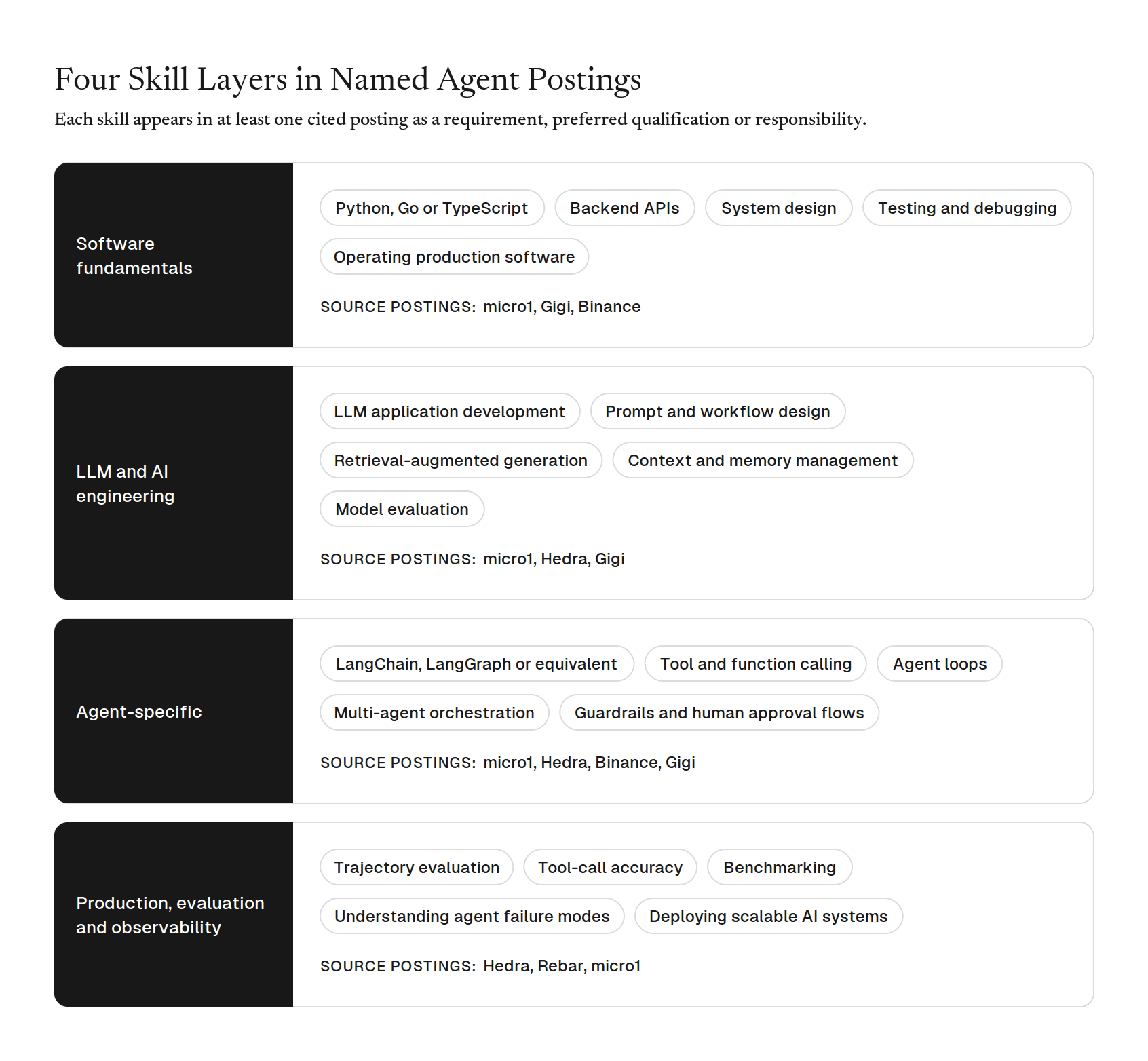
The skills in this section come from named public job postings. No capability is listed unless at least one named posting explicitly lists it as a requirement, a preferred qualification, or a responsibility, and the section labels which is which.
Software development fundamentals
- micro1: the AI/ML Engineer, Internal Platforms role requires Python, backend APIs, and deploying scalable AI systems in production.
- Gigi: the AI Agent Engineer role lists backend or full-stack software development, system design, API design, data models, testing, debugging, and operating production software as core responsibilities.
- Binance: the internship requires programming fundamentals in Python, Go, TypeScript, or similar languages, plus data structures, algorithms, and version control.
LLM and AI engineering skills
- micro1: lists LLM application development, AI APIs, prompt and workflow design, retrieval-augmented generation, and model evaluation.
- Hedra: requires experience building agentic systems on foundation models and hands-on agent evaluation, and lists conversation memory and context window management as preferred qualifications.
- Gigi: lists tool use, context, retrieval, and production evaluation as responsibilities.
Agent-specific skills
- micro1: asks for familiarity with LangChain, LangGraph, or LlamaIndex.
- Hedra: requires LangChain, LangGraph, PydanticAI or equivalent frameworks, tool calling and function calling, agent loops, and multi-agent orchestration.
- Binance: asks for working knowledge of any AI agent framework, with examples including OpenClaw, hermes-agent, LangChain, CrewAI, and AutoGen.
- Gigi: lists designing tools, retrieval, memory, orchestration, guardrails, and human approval flows as responsibilities, and expects strong engineers to learn these on the job.
Production operations, evaluation, and observability
- Hedra: requires trajectory evaluation, tool-call accuracy, and benchmarking.
- Rebar: its published Software Engineer, Agentic Workflows job description called for building backend and orchestration services that support agentic workflows, understanding agent failure modes, and measuring system quality through evaluations.
- micro1: lists deploying scalable AI systems and evaluating model performance as responsibilities.
AI Agent Engineering vs. Applied AI Engineering
Many engineers considering agent-focused roles come from applied AI or ML engineering backgrounds. This section compares the two without restating full definitions of either discipline.
Applied AI engineering broadly involves building and operating applications on foundation models, including LLM integration, retrieval, tool calling, evaluation, and sometimes agentic workflows. AI agent engineering emphasizes the implementation and control of multi-step, model-directed execution. The two disciplines overlap substantially. For how these roles compare with LLM, ML, and AI infrastructure engineering, see this breakdown of LLM engineer vs ML engineer vs AI infra roles.
AI agent engineering differs by focusing on agentic systems that own their own control flow, choose tools at runtime, and manage state across multiple steps. LangChain’s published explanation describes agents as systems that decide which tools to call and in what order.
AI agent engineering is a specialization that overlaps with applied AI engineering, not a universally separate or higher-level discipline. Its key engineering challenges involve:
- model-directed execution
- tool permissions
- state management
- safety boundaries
- failure recovery
- evaluation of complete agent trajectories
How much each matters depends on the specific system and employer.
How AI Agent Engineers Work With Tool Calling and Multi-Agent Systems
The AI agent engineer role connects to broader concepts like agentic systems, agentic AI, and multi-agent systems. This is a conceptual overview of how these concepts appear in role descriptions, not a tutorial on building AI agents.
Agent-focused postings describe tool calling and function calling as central capabilities. Agents use tool calling to interact with external systems and APIs, whether that means retrieving data, executing transactions, or triggering workflows. Hedra’s Agentic Engineer posting requires tool and function calling expertise. Rebar’s Software Engineer, Agentic Workflows role describes building the orchestration services and tool execution behind production agentic workflows.
Some postings mention multi-agent systems or orchestration between multiple agents. Hedra explicitly requires multi-agent orchestration, and Binance’s internship involves working with senior engineers on multi-agent orchestration and deployment. Multiple agents increase the demands on system design and observability.
Safety and permissions show up directly in the postings. Gigi’s AI Agent Engineer posting includes deciding which actions an agent can take autonomously and which require human approval, along with building guardrails around agents that act inside real advertising accounts. Each choice about autonomy and tool access is a trade-off between efficiency and risk.
Engineers with experience in distributed systems, event-driven architectures, or workflow engines will recognize parallels in the design challenges of agentic systems. Mapping those practices to agent development is a practical way to build expertise in this space.
Where AI Agent Engineers Work Across Teams
Agent engineering work sits inside product, platform, or research organizations, depending on the company. There is no single standard placement, but named postings show several patterns.
- Embedded with business-facing teams. First AI’s description shows AI Agent Engineers partnering closely with AI Adoption Managers on end-to-end AI transformation programs. Here the agent engineer acts as the technical counterpart to adoption and process leads.
- Internal AI capabilities. micro1’s AI/ML Engineer, Internal Platforms posting describes developing the company’s AI recruiting agent, building backend services, and collaborating with product and engineering teams. The role focuses on internal AI capabilities rather than a customer-facing agent platform.
- Technical leadership. Clera’s Staff Engineer, Agentic AI posting describes a role reporting to the CTO and collaborating with engineers, product teams, integration specialists, customers, and domain experts. This is one documented arrangement, not a standard structure that most teams follow.
Agent engineering cuts across software development, AI engineering, and product integration rather than being an isolated specialty. In the postings above, the agent engineer works cross-functionally and is expected to architect solutions and carry them through production deployment.
Agent Engineer Seniority, Work Modes, and Pay
The Fonzi sample provides one view of seniority, work-mode, and pay patterns, and public postings outside the sample add important contrast.
Seniority. In the Fonzi sample from October 8, 2026, all 14 agent-related engineering and research roles were listed at senior level or above. Candidates approaching this field from mid-level roles may need to show substantial production experience, as junior vs senior AI engineer comparison explains. However, early-career openings exist outside the sample. Binance’s Accelerator Program internship targets current university students and recent graduates. Gigi’s posting emphasizes shipped production software and expects strong engineers to learn agent-specific tools on the job.
Work modes. Of the 14 Fonzi roles, 10 were in person, 2 were hybrid, and 2 were remote. Candidates targeting fully remote work may need to scan descriptions for agent responsibilities even when “agent” is not in the title. Public postings outside the sample vary too: Binance’s internship lists Hong Kong and Taipei as locations and mentions a work-from-home arrangement that varies by team, while Gigi’s role is on-site in Toronto.
Pay. Among the 14 roles in the Fonzi sample, 12 listed salary bands. Across those 12 bands, the median floor was $182,500 and the median ceiling was $300,000 in USD base salary, with a median midpoint of $235,000, and pay varied by location and company stage. This reflects a small set of startups hiring through Fonzi, not a definitive benchmark.
Because the roles in the Fonzi sample are senior, candidates should prepare examples of production software development, LLM integration, system design, agent evaluation, and technical trade-offs. This is preparation advice, not a description of a standardized interview process. For common question types, see these AI engineer interview questions.
How to Spot AI Agent Engineer Roles Under Other Titles
Engineers interested in agent work often need to look past the exact phrase “AI agent engineer” and scan postings for descriptions of agentic AI responsibilities.
Named public postings reveal recognizable terminology:
- micro1’s posting references an “AI recruiting agent” and “agent orchestration.”
- Hedra describes “multi-agent orchestration.”
- Gigi discusses “tool use” and “human approval flows.”
When these phrases appear in a job description, the role is likely focused on building AI agents, regardless of the title.
Adjacent titles like micro1’s “AI/ML Engineer, Internal Platforms” and Hedra’s “Agentic Engineer” involve responsibilities that overlap with Gigi’s AI Agent Engineer role: LLM-powered applications, agent workflows, tool integration, and evaluation. Rather than assuming different titles describe the same job, compare the responsibilities section of each posting.
Read the “What you will do” or “Responsibilities” section to confirm whether the role involves building agents that select tools at runtime, maintain state, and run in production. Single-call model integrations are a different concept from the closed-loop systems that define agent engineering.
Startup Demand for AI Agent Engineers in 2026
The demand snapshot here is limited to startups that list roles through Fonzi and a few named public postings from other companies.
As of October 8, 2026, there were 14 senior-level engineering and research roles focused on agents or agentic platforms across 12 startups on Fonzi, so multiple early-stage and growth-stage companies are staffing agent-focused teams. Many of these roles reference building agent platforms, agentic AI products, or internal tooling for autonomous agents. That aligns with the published descriptions of agent engineering from Sierra and Decagon.
On other job platforms and startup career pages, look for terms like “agentic,” “automated workflows,” “multi-step reasoning,” or “agent orchestration” in descriptions.
How to Become an AI Agent Engineer
Applied AI engineers should emphasize their experience with LLM integration, evaluation, and production incident response. These map directly to the skills public postings ask for.
ML and infrastructure engineers should highlight transferable experience in distributed systems, production operations, observability, failure recovery, and safety controls. Gigi’s posting emphasizes operating production software and guarded tool execution, and Rebar’s role involves orchestration and evals work.
Portfolio work can help. Open-source contributions to agent frameworks named in postings are valuable, and so are small projects demonstrating tool calling, multi-step workflows, and evaluation harnesses.
Benchmark your skills against one or two of the named postings in this article, and use their job descriptions as a checklist for gaps and strengths. That is more reliable than generic advice about what to learn.
How Fonzi Can Help Engineers Find AI Agent Engineer Roles
AI agent engineer roles are hard to find by title. In the Fonzi sample, 13 of 14 agent-focused roles used some other name. A keyword search for “agent engineer” misses most of the jobs where engineers actually build agents.
Fonzi is a curated AI engineering hiring marketplace that connects AI agent engineers and other AI and software engineers with startups and growth-stage companies. Through Match Day, companies send salary-backed interview requests directly to engineers, and each request shows the role and base salary up front. For engineers with production LLM and agent experience, it adds one more channel alongside startup career pages and job boards.
AI Agent Engineer Roles in 2026: The Short Version
An AI agent engineer develops and operates LLM-powered systems that use tools, maintain context, and execute multi-step tasks within defined boundaries. Gigi and Binance use the exact title, while Sierra and Decagon have published their own definitions of the agent engineer role. Most agent-focused jobs carry other titles: only 1 of 14 agent-related roles listed on Fonzi in October 2026 used “Agent Engineer.” In the same sample, the 12 roles that listed salary bands had a median USD base salary floor of $182,500 and a median ceiling of $300,000.
Employers hiring for AI agent engineering ask for production software skills, LLM application experience, agent frameworks, tool calling, and evaluation. These requirements build on the broader set of AI engineer skills used across applied AI work. The work overlaps heavily with applied AI engineering, with more weight on model-directed execution, tool permissions, and evaluating complete agent trajectories. All 14 roles in the Fonzi sample were senior, but early-career paths exist through programs like Binance’s internship. Reading the responsibilities section of each posting identifies agent work more reliably than reading the title.
FAQ
Is "AI Agent Engineer" a real job title that companies are using?
Yes, but rarely. In a sample of 14 engineering and research roles focused on agents or agentic platforms, listed on Fonzi as of October 8, 2026, only 1 used the exact title “Agent Engineer.” Others used patterns like “agentic” or “agent platform.” The exact title does appear in public postings outside the sample, such as Gigi’s AI Agent Engineer role and Binance’s Binance Accelerator Program AI Agent Engineer internship.
What seniority level are AI agent engineering roles hiring for right now?
Mostly senior. Among agent-related engineering roles listed on Fonzi in October 2026, all 14 were posted at senior level or above, though that sample only covers startups hiring through Fonzi. Early-career openings exist elsewhere, such as Binance’s AI Agent Engineer internship for current students and recent graduates.
Are AI agent engineering roles mostly in-person, hybrid, or remote in 2026?
In the Fonzi sample from October 8, 2026, 10 roles were in person, 2 were hybrid, and 2 were remote. Candidates targeting remote agent-focused work should read job descriptions carefully, since the label “agent” in a title says nothing about work mode.
Which skills should I focus on if I want to move from applied AI engineering into agent engineering?
Prioritize strong software engineering foundations, LLM integration experience, and at least one agent framework or tool-calling pattern that appears in public job postings. Map your experience to concrete requirements, such as Gigi’s tools, retrieval, memory, and human approval flows, or Binance’s agent framework and benchmark dataset work.
Where can I find open AI agent engineering roles at startups today?
Fonzi listed 14 senior agent-related engineering and research roles across 12 companies on October 8, 2026. Individual startup career pages and general job boards also list them. Search for “AI Agent Engineer,” “Agent Engineer,” and “agentic” titles, then check descriptions for tool calling, orchestration, evaluation, and production agent development.