AI Product Engineer: The Role vs a Software Engineer
By Samara Garcia
An AI product engineer owns a user-facing AI feature from problem discovery through design, implementation, and iteration in production. The role has spread as startups and technology companies build large language models directly into their products. It’s defined by end-to-end product ownership and judgment, not by a particular model, framework, or programming language. Seven of the 37 product engineer roles that companies are hiring for through Fonzi in October 2026 carried “AI” in the title.
The product engineer vs software engineer distinction comes down to who decides what to build, who ships it end to end, and who owns how an AI feature behaves in production. In AI product engineer jobs, that last part covers evaluations, fallback handling, and monitoring after launch.
Key Takeaways
- AI product engineers are defined by ownership of user-facing outcomes, not by a specific tech stack. Compared with software engineering roles centered on implementation, product engineering postings put more explicit weight on deciding what to build, shipping it end to end, and owning how the AI feature behaves in production.
- Public product engineering postings, including Linear’s Senior / Staff Product Engineer, Applied AI role, emphasize end-to-end feature ownership, collaboration with product and design, and the ability to help shape the problem rather than just implement a solution.
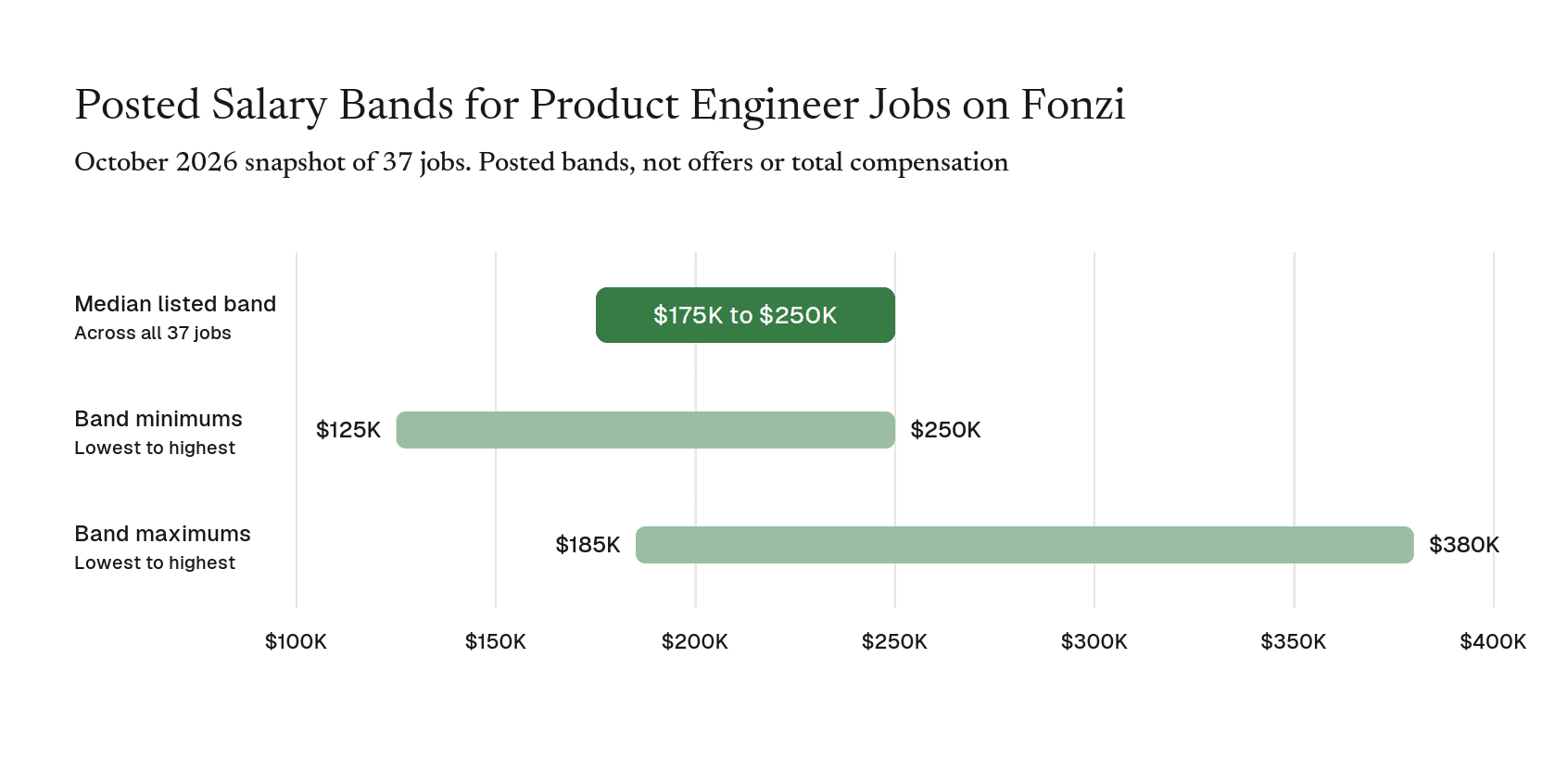
- In an October 2026 snapshot of 37 product engineer jobs on Fonzi, 30 were senior-level and 28 were full-stack roles, with a median salary band of $175,000 to $250,000.
What Is an AI Product Engineer?
An AI product engineer is a person who owns a user-facing AI outcome from problem discovery through design, implementation, and iteration in production. Product engineers combine software engineering skills with product development responsibilities, acting as hands-on builders rather than coordinators. An AI product engineer connects machine learning capabilities to end-user applications. The role generally focuses on integrating existing AI models into user-facing products and optimizing their behavior rather than developing new models from scratch.
Linear’s Senior / Staff Product Engineer, Applied AI posting illustrates this well. It asks for someone who can build “AI-powered product features that feel native, fast, and delightful to use.” The role also includes designing backend services for natural language interfaces and agentic workloads, optimizing prompts and evaluating performance, and working with product and design on intelligent workflows. It spans idea to shipped feature, combining product judgment with technical execution across the full stack.
In practice, AI product engineers handle retrieval, prompt optimization, fallback handling, and evaluations that help AI features perform reliably in production.
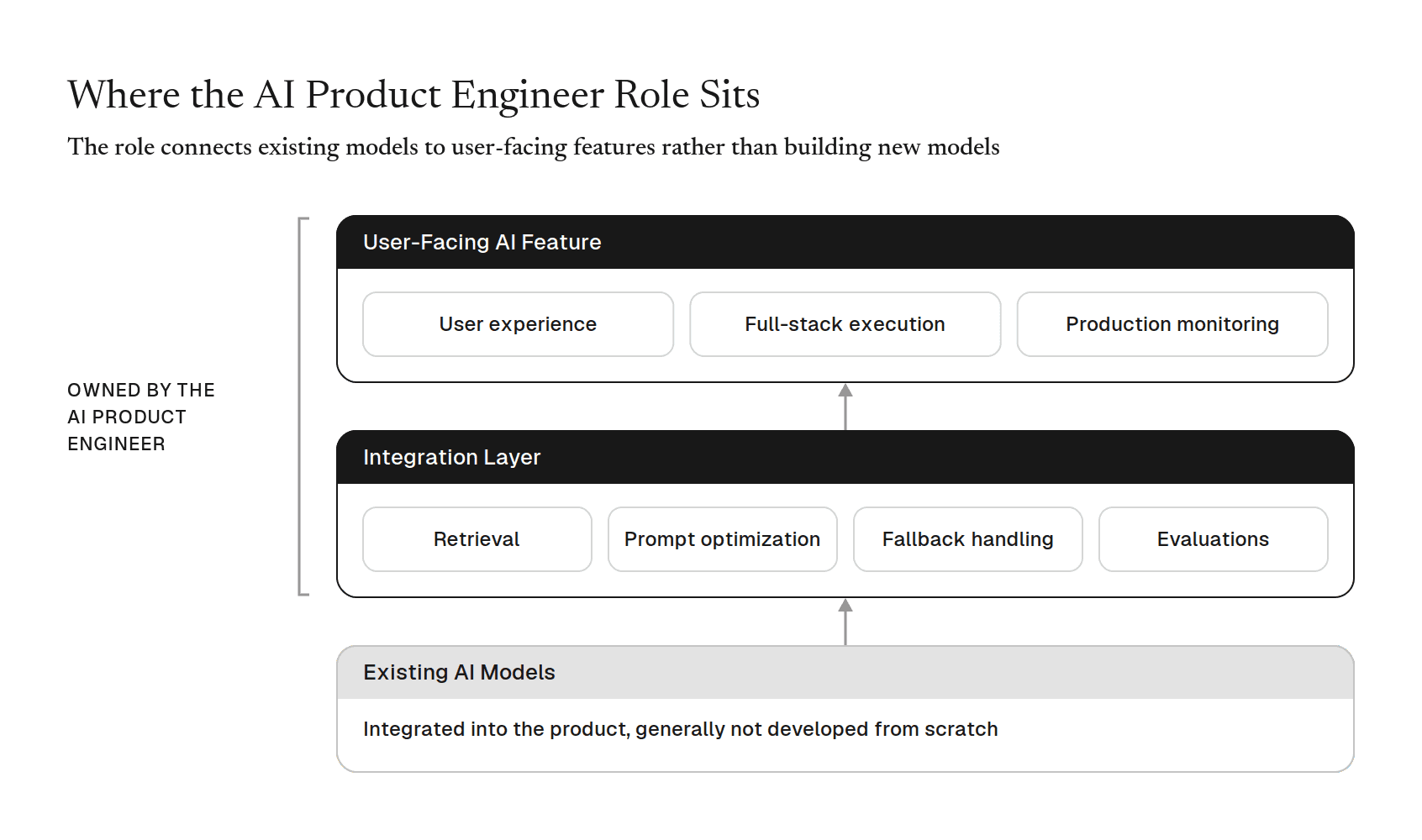
Companies use related titles such as “AI Product Engineer,” “Product Engineer,” and “Founding Product Engineer,” but responsibilities have to be read from each job description, not inferred from the title alone. Some postings emphasize user experience and end-to-end product ownership. AI-specific roles also involve model behavior, evaluation, and production monitoring. This role is distinct from the AI agent engineer, applied AI engineer, and AI product manager positions, each of which is compared later in this article.
Product Engineer vs Software Engineer: Ownership, Work, and Expectations
The difference between product engineer and software engineer is primarily a distinction in scope, decision-making, and ownership rather than coding ability. Many software engineers already take part in requirements discovery, architectural decisions, and product collaboration. Engineers with backgrounds in software engineering, ML engineering, or infrastructure bring relevant technical skills to AI product engineering, and the degree of product ownership varies by company and role.
The central distinction is where the emphasis falls. Software development roles can and do include collaboration with product managers and design decisions. Product engineering descriptions, however, place more explicit responsibility on shaping user problems, influencing product decisions, and delivering an end-to-end experience. They also expect engineers to help define what to build rather than only receive requirements. Linear’s posting says the engineer should be “comfortable working without heavy PM overhead; you can help to shape the problem, not just implement a solution.” Product managers, by contrast, focus on user needs and project management, not coding.
Code quality, reliability, maintainability, and testing are responsibilities in both engineering roles. Product engineering descriptions also emphasize user experience, feature adoption, product judgment, and end-to-end ownership. Success may be measured by whether a shipped feature moved a product metric, not only whether the code met its specification. User feedback and data analysis feed directly into how AI product engineers evaluate their work.
The table below summarizes where the two roles differ in emphasis.
Dimension | AI Product Engineer | Software Engineer |
Primary scope | User problem and product outcome | System, service, or component |
Day-to-day responsibilities | Prototyping, shipping code, prompt tuning, user research, iteration | Writing code, code review, debugging, performance optimization |
Decision authority | Helps define what to build and why | Usually focuses on how to implement a defined solution |
Collaboration with users | Direct (interviews, pilots, customer problems) | Indirect (via PM or support) |
Required skills | Full stack, product sense, AI evaluation, data analysis | Deep specialization, system design, technical constraints |
Measures of success | Feature adoption, user satisfaction, business goals | System health, uptime, code quality |
AI-specific responsibilities | Prompt design, model selection, guardrails, eval pipelines | Infrastructure, APIs, reliability |
In practice, these categories overlap. The product engineer mindset is about expanding scope from technical implementation toward product outcomes, not abandoning the rigor of software engineering.
What Do AI Product Engineers Do Day to Day?
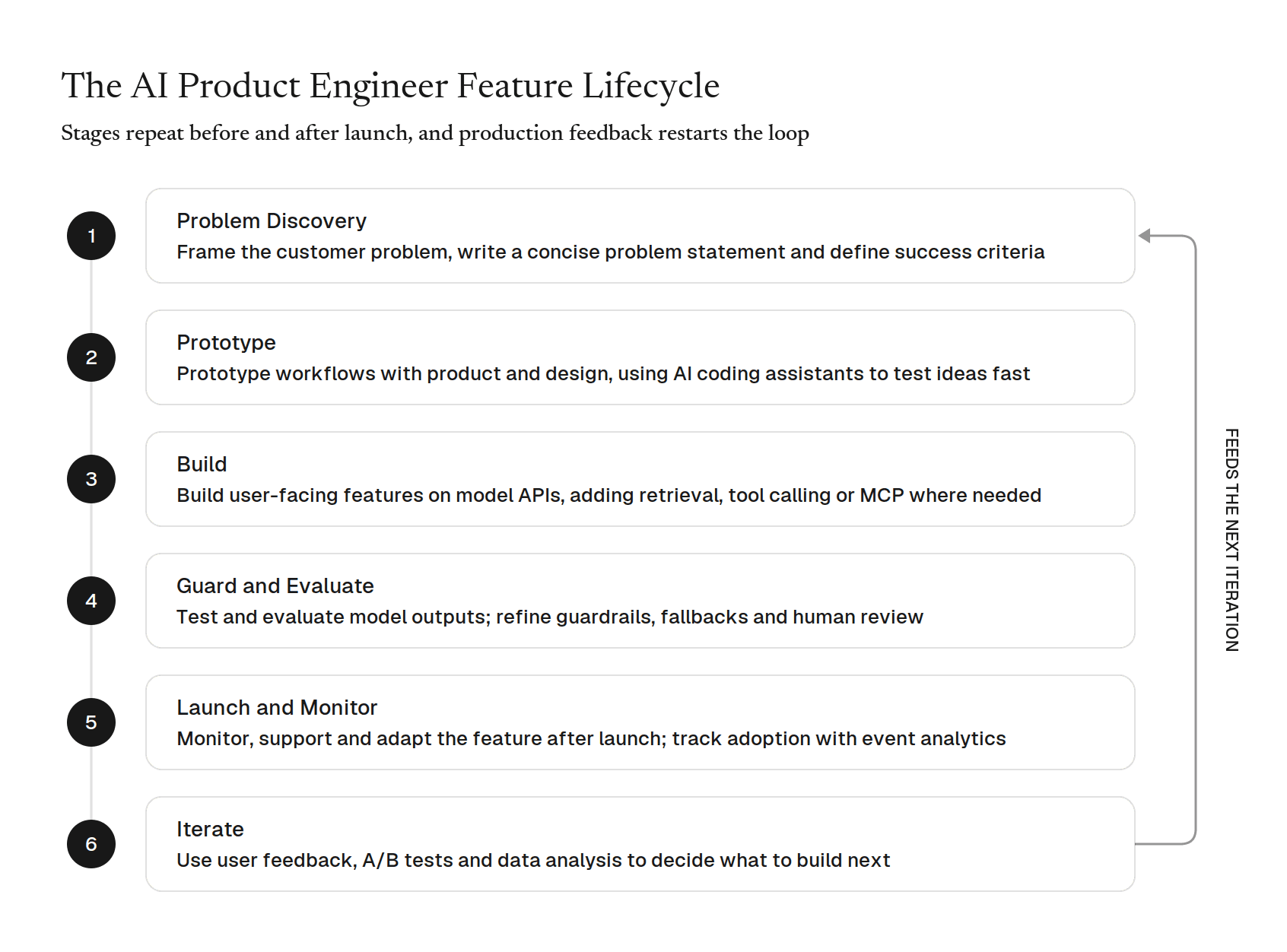
What do product engineers do when they build on top of AI models? The activities documented in public job descriptions center on collaboration, implementation, and continuous iteration.
Linear’s posting lists working with product and design to prototype intelligent workflows, designing backend services for natural language interfaces and agentic workloads, and optimizing prompts and evaluating model behavior. The Texas Tribune’s AI-focused full-stack engineer posting describes developing and maintaining audience- and newsroom-facing AI features in the Tribune’s publishing platforms, primarily WordPress, as part of a multidisciplinary product team. In both roles, AI product engineers collaborate with teams from other domains, such as editorial, data, and design.
Core responsibilities include rapid prototyping. Klarity’s Senior AI Product Engineer posting said AI coding assistants let engineers “validate 10 ideas in the time it used to take to build one.” Engineers also:
- build retrieval-augmented generation (RAG) pipelines
- implement tool calling and Model Context Protocol (MCP) integrations
- create guardrails or fallback behaviors for non-deterministic model outputs
Monitoring AI features after launch is a key responsibility, and the Texas Tribune’s posting asks the engineer to monitor, support, and adapt AI-driven features post-launch. The City and County of San Francisco’s 2025 Senior AI Product Engineer posting centered on prototyping and shipping applied AI tools for City departments, such as chat interfaces, knowledge assistants, and workflow integrations. Some AI product engineering roles explicitly tie technical decisions to product outcomes. In those roles, engineers help define success criteria, select appropriate AI capabilities, and evaluate whether shipped features meet user needs.
How AI Changes Product Engineering: Evaluation, UX, and Production
Building user-facing products on top of AI models changes the risk profile, iteration cycles, and evaluation methods compared with classic software engineering. Language models produce non-deterministic outputs, so AI product engineers have to think beyond unit tests and integration tests. They also need evaluation data sets, human-in-the-loop review processes, and qualitative feedback. Designing AI interactions requires attention to transparency and trust, especially when surfacing model-generated content to users.
AI coding tools also speed up prototyping. That speed makes judgment about “what should we build” and “is this experience good enough to ship” more important than raw implementation speed. When an idea can become a prototype in hours, deciding which idea to build becomes the bottleneck.
AI Product Engineer Skills: Technical, Product, and Data
AI product engineers are software engineers first, hired for a combination of full-stack implementation ability, product sense, and comfort working with data.
Technical skills. AI product engineers work in languages like Python and TypeScript. Linear’s posting asks for strong React and TypeScript fundamentals, plus full-stack experience with Node, GraphQL, and PostgreSQL, and 5+ years of building customer-facing products. API integration is critical for an AI product engineer, spanning LLM APIs, RAG flows, tool calling, and MCP integrations. AI coding assistants also come up directly: Klarity’s posting named Cursor, Claude Code, and Replit for rapid prototyping.
Product skills. These matter equally. Expected skills include:
- framing customer problems
- writing concise problem statements
- defining and tracking product metrics
- partially substituting for a product manager
The Texas Tribune’s posting asks engineers to “confidently communicate AI concepts and decisions to non-specialists,” which shows how much the role depends on explaining technical choices.
Data skills. Event analytics tools such as Amplitude, Mixpanel, or PostHog, the ability to query data on feature impact, and basic A/B experiment design for AI-powered flows all support informed product decisions. Engineers who can evaluate model behavior in production, track adoption, and iterate on the product roadmap based on data are especially valuable.
AI Product Engineer Jobs: Seniority, Scope, and Salary Bands
AI product engineer jobs appear at startups and growth-stage tech companies building AI-powered user experiences, and also in the public sector and journalism. The title “product engineer” historically appeared in mechanical engineering, where product engineers design physical products and coordinate manufacturing. In technology, the title has a different focus entirely.
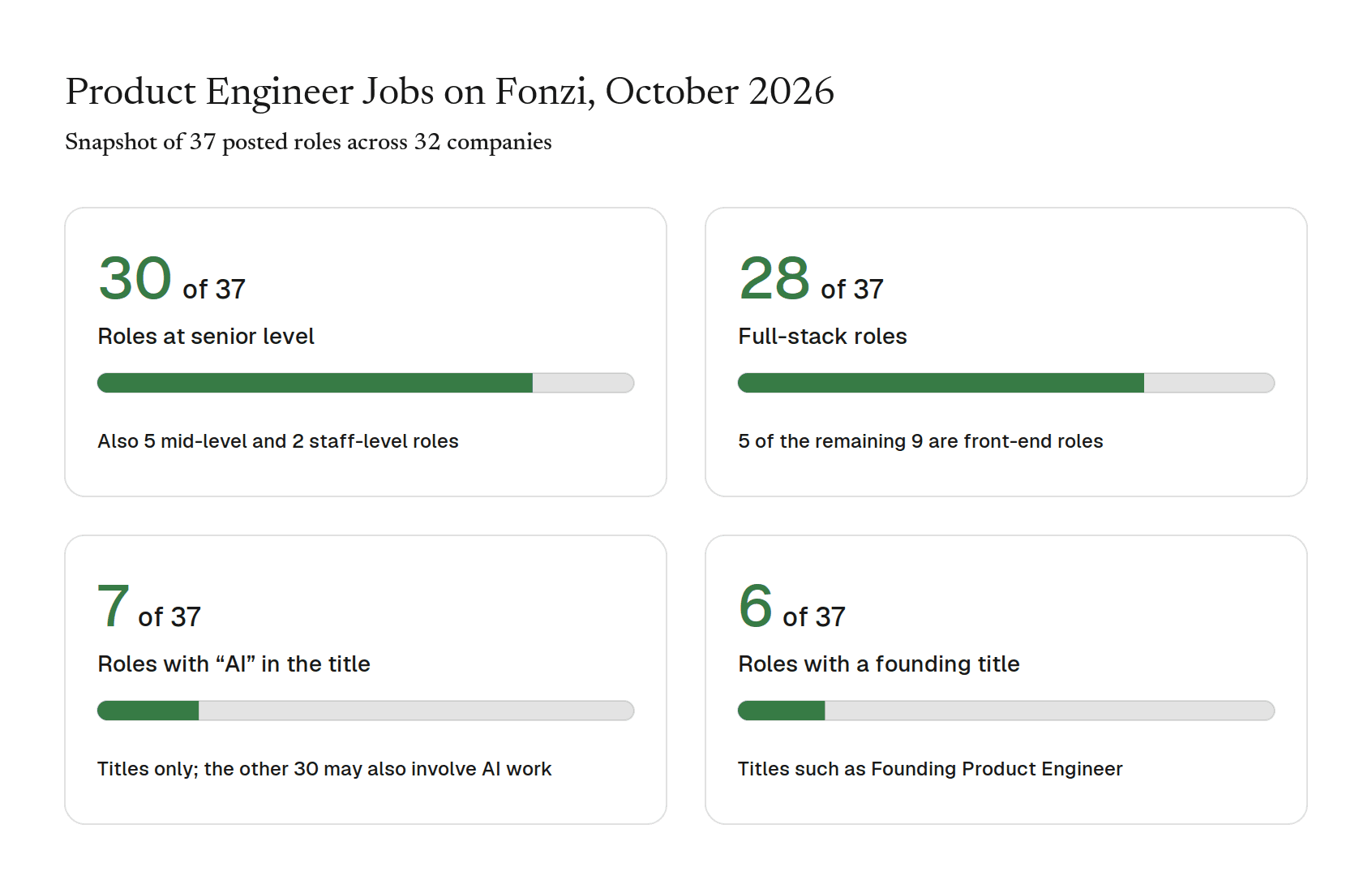
An October 2026 snapshot of product engineer roles that companies are hiring for through Fonzi contained 37 roles across 32 companies: 30 at senior level, 5 at mid level, and 2 at staff level. Among these, 28 were full-stack roles, and 5 were front-end roles, which fits the cross-functional implementation work described in public product engineer postings. Seven of the 37 jobs had “AI” in the title, such as AI Product Engineer. The data doesn’t capture whether the remaining roles involved AI-powered products.
Companies set a median salary band of $175,000 to $250,000 for these 37 roles. Band minimums ranged from $125,000 to $250,000, and band maximums from $185,000 to $380,000. These are the salary bands companies set for the roles, not offers or total compensation. For a public-sector comparison, the City and County of San Francisco’s November 2025 Senior AI Product Engineer posting listed an annual salary range of $153,686 to $193,388.
Founding Product Engineer Roles at AI Startups
Some AI startups advertise founding product engineer positions to recruit engineers who will help build early product capabilities. Six of the 37 product engineer jobs in this dataset used a founding title, such as Founding Product Engineer. The founding designation can signal broader responsibility for early product development. That includes working directly with a co-founder, making architectural choices, and defining new features before product requirements are fully set.
These roles suit engineers who want ambiguous, product-shaped problems. Founding product engineers may carry responsibilities that span business strategy, product design, and shipping code, with equity as part of the reward structure. The risk is proportional: less defined support, higher ownership, and outcomes that depend on your ability to lead across technology and user experience at the same time.
How to Position Yourself for AI Product Engineer Roles
If you are an experienced software engineer, ML engineer, or infrastructure engineer evaluating AI product engineer roles, the transition depends on showing product ownership alongside technical depth. Postings ask for evidence of shipped work: Klarity’s posting, for example, asked for candidates who had shipped AI-native features to production.
On your resume, highlight shipped AI features. Name the user problem, describe the feature’s behavior, and include outcome metrics like adoption or latency improvements. Show product ownership by mentioning user interviews attended, decisions made about what not to build, experiment design, and contributions to product roadmap discussions. These details belong in your “Experience” bullets, not a generic skills list. Frame your experience around the solutions you shaped, not just the code you wrote.
In interviews, prepare a walkthrough of one AI feature from problem definition to post-launch iteration. Be ready to discuss trade-offs between different models or providers, and to explain how you evaluated the quality and safety of AI outputs. If you come from a backend or infrastructure background, bridge the gap by taking ownership of at least one user-facing surface. Work directly with product managers instead of waiting for fully defined tickets.
AI Product Engineer vs Adjacent AI Roles
AI product engineer is one of several AI-focused engineering roles. Understanding the boundaries helps you match your preferences to the right path:
- AI agent engineer: focuses on orchestrating tools, autonomous workflows, and multi-step reasoning systems.
- Applied AI engineer: may emphasize model evaluation, experimentation, and infrastructure.
- AI product manager: accountable for business strategy and cross-functional alignment, with hands-on coding a lower priority.
- AI product engineer: a builder who owns code, UX, and outcomes together.
If you want to shape products through product management rather than implementation, the PM path may fit better. If you want to build and ship what users touch, product engineering is the right focus, and it sits alongside the LLM, ML, and AI infrastructure engineering roles that make up the rest of the AI engineering field.
AI Product Engineer vs Software Engineer: The Bottom Line
An AI product engineer owns a user-facing AI feature end to end, from deciding what to build with users to shipping it and owning how it behaves in production. The product engineer vs software engineer difference is one of scope and ownership rather than coding ability. Public postings from Linear, the Texas Tribune, and the City and County of San Francisco illustrate how AI product engineering combines hands-on development, product judgment, and collaboration across technical and nontechnical teams, with specific responsibilities varying by employer.
Day to day, AI product engineers prototype features, build retrieval pipelines and guardrails, and monitor how AI features behave after launch. Postings ask for full-stack skills in languages like TypeScript and Python, product sense, and comfort with event analytics and A/B tests.
In Fonzi’s October 2026 snapshot of 37 product engineer jobs, 30 were senior-level, 28 were full-stack roles, only 7 carried “AI” in the title, and 6 carried founding titles, with a median salary band of $175,000 to $250,000. Engineers moving into AI product engineer jobs should show shipped AI features, product decisions, and measurable impact on their resumes and in interviews.
FAQ
How much of an AI product engineer's time is spent coding?
A substantial share, since the role stays hands-on. The balance between writing code, product discovery, design collaboration, and evaluation varies by team and position. Linear’s posting, for example, lists responsibilities spanning backend services, prompt optimization, and UX iteration. All of these involve substantial implementation work alongside product judgment.
What salary bands have companies set for product engineer jobs?
In an October 2026 snapshot of 37 product engineer roles that companies on Fonzi are hiring for, the median salary band was $175,000 to $250,000. Band minimums ranged from $125,000 to $250,000, and maximums from $185,000 to $380,000. The dataset includes senior, mid-level, and staff-level roles, and these figures are the salary bands companies set for the roles, not guaranteed offers or total compensation.
Do I need prior AI or ML research experience to get an AI product engineer job?
Not necessarily. Linear’s Senior / Staff Product Engineer, Applied AI posting emphasizes software engineering fundamentals, customer-facing product experience, shipped production features, and practical work with model behavior and evaluation. Compare your applied AI experience against the requirements of individual job descriptions.
Can infrastructure or backend-focused engineers move into AI product engineer roles?
Yes. Infrastructure and backend engineers can transition by taking ownership of at least one user-facing surface and working directly with product managers and designers. Their resume should then show that they made product decisions, not only delivered internal services.
How can I demonstrate product ownership if my current title is software engineer?
Show it through concrete experience rather than your job title. Highlight decisions about user problems, shipped features, cross-functional collaboration, and measurable outcomes on your resume or portfolio. Prior employment under the title “Product Engineer” is not necessary.