Anthropic CodeSignal Interview: Format, Questions and Prep
By Samara Garcia
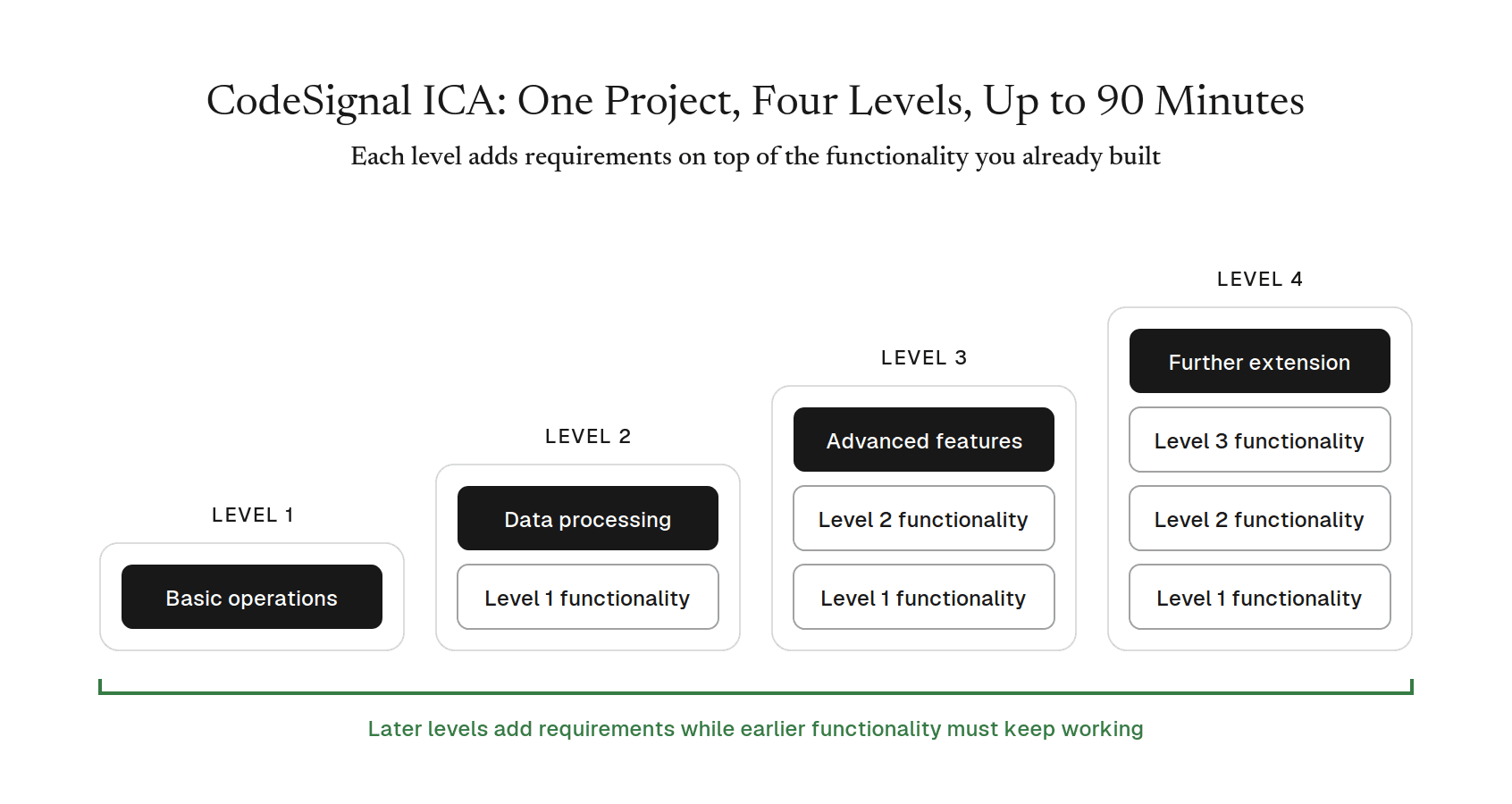
The Anthropic CodeSignal assessment is a 90-minute online screening test that some software engineer candidates take early in the hiring process. Unlike traditional algorithmic puzzles, the assessment mirrors real-world software evolution: candidates build a small system across four escalating levels, with each level extending the one before it rather than presenting a fresh, standalone problem.
Anthropic publishes little about its CodeSignal assessment. The official details come from CodeSignal's documentation for its Industry Coding Assessment and from Anthropic's candidate AI guidance, while question types and score expectations come from candidate reports on Blind and Reddit.
Key Takeaways
- Public candidate reports describe a system-style CodeSignal assessment (a banking system, file system simulator, or in-memory database, most commonly) that emphasizes data structures, stateful logic, and edge case handling, consistent with CodeSignal's Industry Coding Assessment rather than isolated algorithm puzzles.
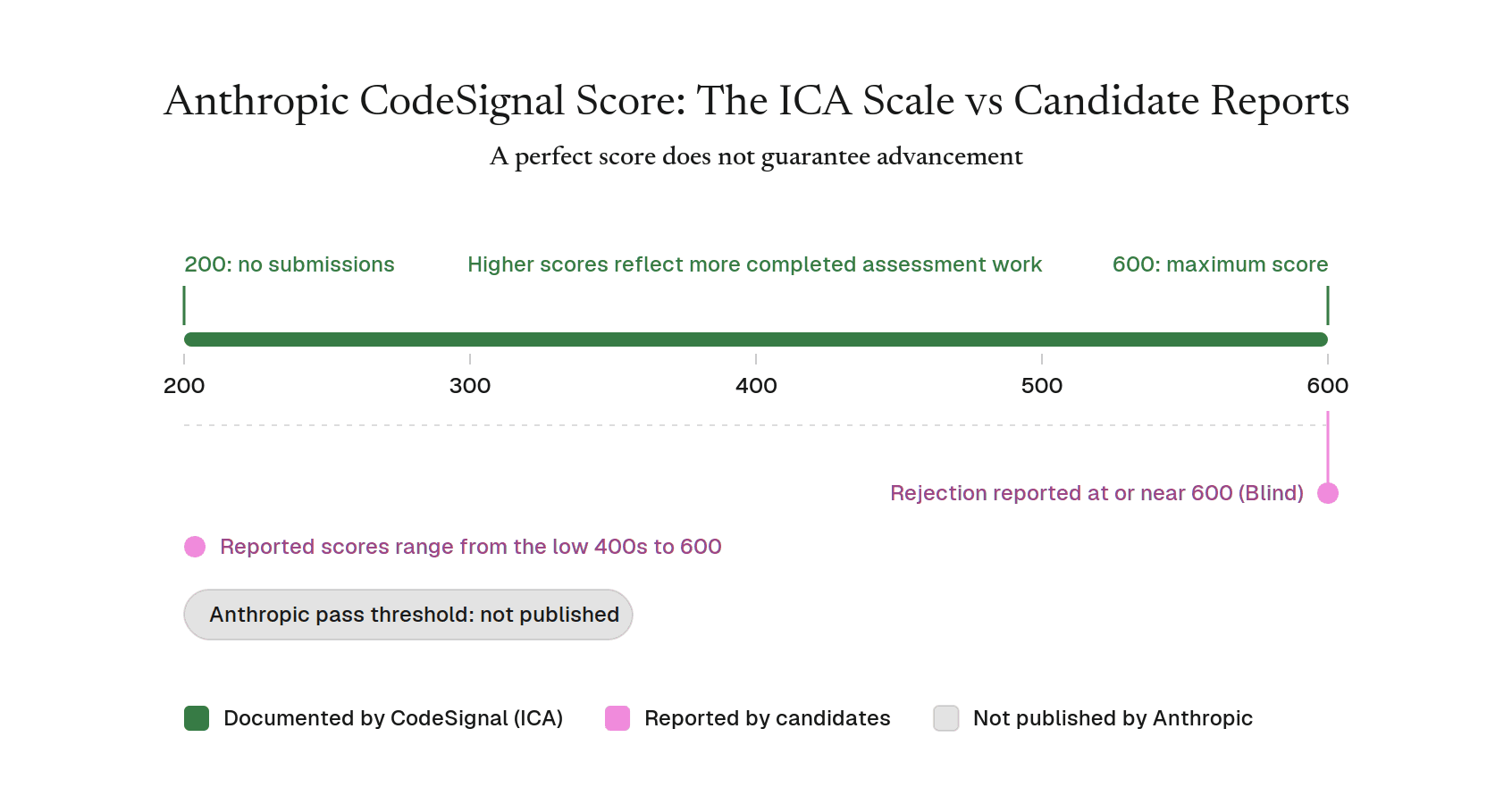
- CodeSignal's ICA uses a 200 to 600 scoring scale. Public candidate reports include rejection after a perfect score, so the maximum score does not guarantee advancement.
- Anthropic's published candidate guidance says take-homes should be completed without Claude unless candidates are told otherwise, so plan to complete the CodeSignal without AI assistance. Each level builds on the last, so extensible code scores better than hardcoded outputs that break when requirements change.
Anthropic CodeSignal: Where It Fits in the Hiring Process
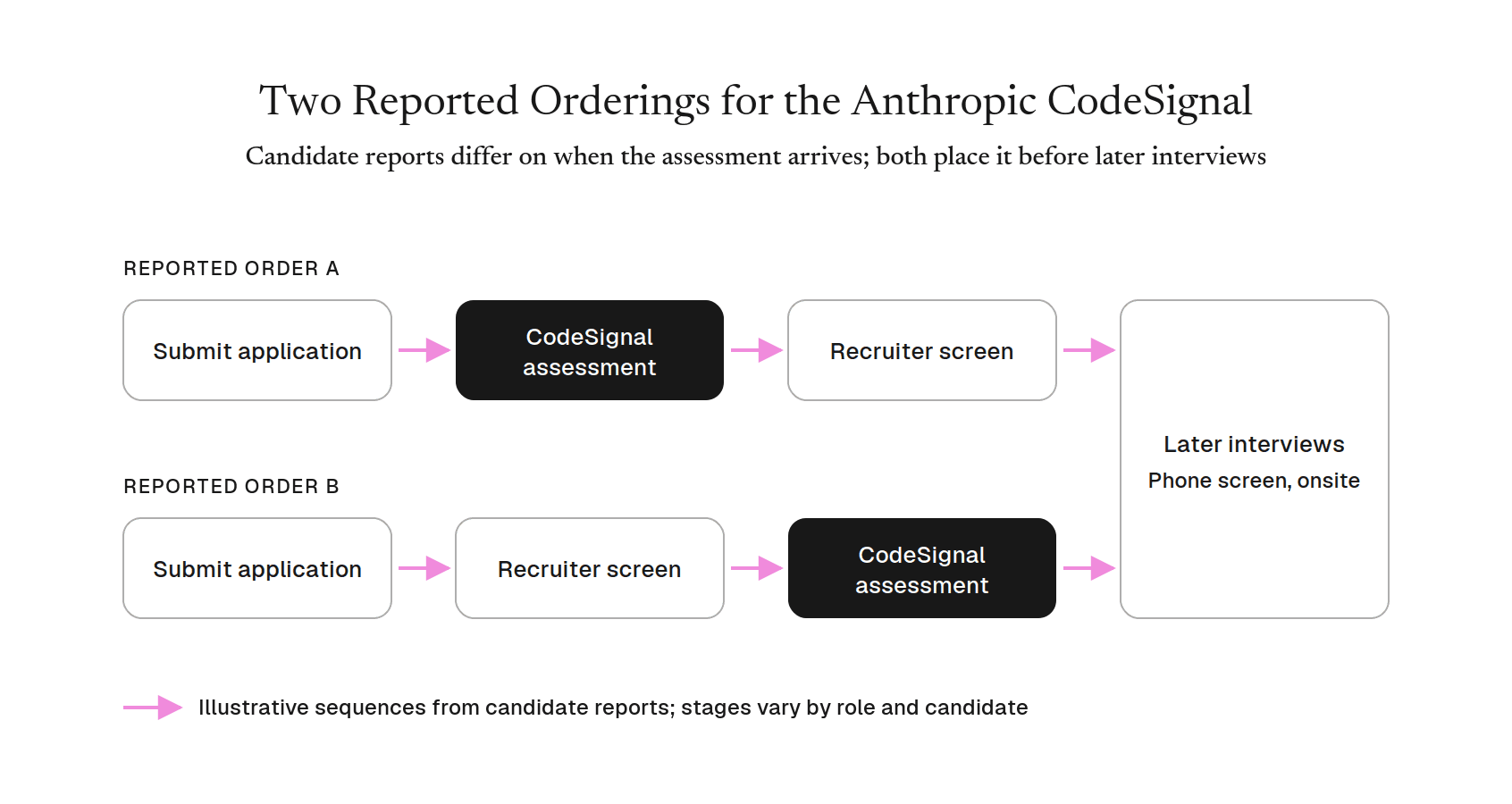
Candidate reports place the Anthropic CodeSignal assessment early in some software engineering hiring processes, although its timing varies.
Multiple Blind threads describe the CodeSignal arriving before any recruiter conversation ("Applied on their site, did CodeSignal, full score, then recruiter, phone, onsite" and "Applied back in December, started the loop in February, CodeSignal OA, recruiter call, phone screen" both describe this ordering), while other candidates report a recruiter screen first. In both cases, Anthropic screens candidates before they reach a hiring manager or onsite rounds. For a complete walkthrough of the stages that follow, Fonzi's Anthropic interview process guide covers the full loop in more depth.
Candidate reports cover software engineer positions and some ML or applied engineering roles, but Anthropic doesn't publish a role-by-role matrix for CodeSignal usage. Accounts from 2025 and 2026 describe the assessment as an important gate that strongly influences whether a candidate proceeds to the next stage.
Anthropic CodeSignal Format and Reported Structure
Public accounts describe the Anthropic CodeSignal assessment as building a small system, a banking system or file system simulator most commonly, consistent with CodeSignal's Industry Coding Assessment (ICA) or an Anthropic-specific configuration of it.
Key structural details from CodeSignal's own documentation and candidate reports:
- CodeSignal's ICA officially consists of one project-based question broken into four levels, with a maximum duration of 90 minutes. Each level extends the previous implementation, and Anthropic candidate reports describe a matching format.
- Candidates report that later levels build directly on earlier ones, though whether a level unlocks only after the previous level's tests pass may depend on the assessment configuration.
- Candidates who work in Python report access to the standard library only, with no external packages, so practice without them.
- Candidate reports describe Anthropic's assessment as following the ICA's single-project format rather than the General Coding Assessment (GCA), which uses separate standalone tasks. Confirm the assessment name in your own invitation, since formats can change.
- CodeSignal runs in a browser-based IDE with test execution, and some assessments also use remote proctoring (camera, microphone, and screen recording) depending on configuration. You can't rely on your usual editor setup or an external IDE.
- Candidates typically report a window of several days to complete the assessment; check the deadline in your invitation.
Anthropic CodeSignal Questions: Reported Problem Styles
This section synthesizes recurring themes from public candidate writeups and discussion threads about Anthropic CodeSignal questions; no proprietary prompts are reproduced here. Candidates face several problem families, all designed to test how they write code for stateful, evolving systems.
- Banking system. A candidate report on Blind describes a problem involving account creation, deposits, transfers, accepting transfers, sorting accounts by transaction history volume, and merging accounts. Later levels add complexity such as transfer timeouts, refunds, and maintaining historical events across merged entities. The data model must support filtered scans of transaction history without breaking under new requirements.
- File system simulator. Some candidates report a file system problem requiring implementation of operations like creating directories, moving large files, managing user permissions, and computing available space. This tests recursive tree-like data structures, string path parsing, and careful error handling when paths are invalid.
- In-memory database. Reports describe key-value stores with time-to-live (TTL) expiration, requiring candidates to handle state across operations, serialization, and explicit timestamp management, with time complexity for basic operations like get and set expected to be O(1).
- Worker time-tracking system and others. Some reported instances include a worker time-tracking system problem, where candidates implement scheduling, logging, and querying of time-based events. Web crawler problems have also been mentioned, though less commonly than the families above.
Multi-level problems commonly add features like permissions, rate limiting, promotions, or TTL-style expiration in later levels, testing whether candidates design extensible data models from the start rather than writing hardcoded outputs tied to initial test cases. Build systems, job schedulers, rate limiters, a package manager with version constraints, and log aggregators make useful additional ICA-style practice problems but haven't been as widely reported specifically as Anthropic CodeSignal questions.
What the Anthropic CodeSignal Assessment Tests
Based on reported question families and the ICA's design, the assessment tests practical engineering fundamentals: data structure choice, stateful logic, edge case handling, and extensible code, aligning with what it takes to build reliable production systems.
- Data structures and system design. The assessment stresses core data structures (maps, sets, lists, queues, occasionally trees or graphs for a file system) chosen to fit a small system design. Candidates are expected to justify these choices in later interview stages, even if not explicitly during the CodeSignal.
- Stateful logic and correctness over time. Candidates must handle historical states and edge cases to simulate real production environments, ensuring a banking system remains consistent after many transfers, a file system tree responds correctly after operations on large files, or a build system respects dependency ordering.
- Edge case handling. The tests surface how candidates handle edge cases such as duplicate operations, invalid paths, transfers involving missing accounts, expired TTL keys, or boundary timestamps. Missing such details is a common failure mode in candidate reports.
- Clean architecture and readability. While time complexity still matters, many accounts suggest clear class structure, readable code, and maintainability carry significant weight, because later levels require extending earlier code.
Anthropic CodeSignal Score: What Is Publicly Known
- CodeSignal officially scores certified assessments, including the ICA, on a 200 to 600 scale, where 200 means nothing was submitted and higher scores mean more of the assessment was completed. Base points build up as candidates complete more questions within a module, and bonus points are awarded only when a module is fully completed.
- Candidate reports on Blind describe scores ranging widely, from the low 400s up through perfect scores, with some candidates reporting rejection even after scoring at or near the maximum.
- One prep guide drawing on Reddit and Blind threads describes an anecdotal advancing line around 520 out of 600, but treat this as a loose pattern rather than a confirmed cutoff since Anthropic doesn't publish one and companies can change expectations over time.
- CodeSignal allows two ICA attempts within a 180-day rolling window, provided the company sends a new invitation.
- Hiring teams can review submitted code and coding replays in CodeSignal, but these capabilities do not establish Anthropic's review criteria beyond the score.
Treat the score primarily as feedback on your own performance and focus preparation on robust, extensible code rather than chasing a specific number.
Can You Use AI on the Anthropic CodeSignal Assessment?
- Anthropic's Guidance on Candidates' AI Usage page sets the default as no AI assistance during take-home assessments and live interviews unless the candidate is explicitly told otherwise: "Complete these without Claude unless we indicate otherwise" for take-homes, and "no AI assistance unless we indicate otherwise" for live interviews.
- The same guidance notes Anthropic uses Claude internally for parts of its own hiring process (drafting job descriptions and interview questions, transcribing interviews) but states plainly that candidate data isn't used to train Claude and that Claude doesn't make hiring decisions.
- Anthropic's AI rules do vary by specific assessment: the performance engineering team's take-home has permitted AI tools from the start, to mirror how the team actually works, and the team has redesigned it several times as newer Claude models caught up with top candidates. This is exactly why candidates should follow the instructions for their specific assessment rather than assuming one universal rule applies everywhere.
- Candidates are expected to abide by both Anthropic's policy and CodeSignal's own proctoring rules, which can involve browser monitoring, webcam recording, and environment checks, and CodeSignal records sessions to flag integrity violations.
- Using prohibited AI tools violates Anthropic's candidate guidance; separately, hardcoded or test-specific solutions are technically brittle on their own merits and tend to fail hidden tests and later levels regardless of how they were produced.
How to Prepare for the Anthropic CodeSignal Assessment
Preparation is organized around the reported Anthropic CodeSignal question patterns, targeting the specific skills these problems stress. Practice under timed conditions and sketch class structures before coding to build a clean, extensible foundation.
Reported Question Type | What It Tests | How to Practice |
Banking system | Stateful logic, transaction history, filtered scans, edge cases (negative balances, timeouts, refunds) | Implement an account ledger with transfers, merges, and an append-only log using dictionaries and lists. Include a rate limiter for transfer frequency. |
File system simulator | Recursive tree structures, path parsing, permissions, error handling for invalid operations | Build mkdir, ls, mv, and permission checks in a tree representation. Practice handling large files and nested paths. |
In-memory database (key-value store with TTL) | Hash maps, time-to-live expiration, serialization, timestamp management | Implement a dictionary keyed by strings with explicit timestamp handling. Add an LRU cache eviction policy. Practice O(1) lookups. |
Worker time-tracking / task scheduling | Events, state transitions, time-based queries | Build a scheduler that logs events and supports filtered queries by time range. |
Additional practice: build system or job scheduler | Graph reasoning, dependency resolution, topological ordering | Implement topological sort over a dependency graph and cache build artifacts. Practice a text editor with collaborative editing or a package manager with version constraints. |
Plan 10 to 15 minutes for the first level of any practice problem and aim for a working solution before moving deeper; levels 3 and 4 carry the bulk of the difficulty, so most candidates should reserve extra time for them. Sketch class structures before coding each practice problem, since a clean first level is what makes later levels tractable.
Practice in an in-browser IDE or minimal editor, not your usual external IDE with plugins, to mirror CodeSignal's constraints. Write from-scratch implementations emphasizing correctness, data structures, and explicit handling of edge cases in the problem statement. Avoid leaked solutions; they rarely match the actual assessment and undermine genuine preparation. Alternate between implementation sessions and short review sessions where you refactor code for clarity and extensibility, since Anthropic engineers may scrutinize design decisions during later interview rounds, and clean architecture matters beyond just passing tests.
Why Candidates Fail the Anthropic CodeSignal Assessment
This section distills patterns from public accounts about where candidates struggle on the Anthropic CodeSignal assessment. Understanding these pitfalls lets you avoid them proactively rather than discovering them under time pressure.
- Missed edge cases. Many candidates report failing primarily due to missed edge cases in stateful systems, such as repeated operations, missing accounts, or expired keys, which then cause multiple hidden tests to fail. Visible sample test cases can mask a large number of hidden tests checking boundary conditions.
- Hardcoded outputs. Hardcoded or overly test-specific logic may pass visible examples but fail hidden tests or break when later levels add new requirements. Candidates fail when they optimize for a single line of expected output rather than writing generalizable logic.
- Pacing and time management. Spending too long perfecting early levels, or rewriting large portions of the solution near the end, leads to incomplete later levels. Treat early stages as the foundation and optimize only after your own tests pass.
- Unfamiliar environment. Unfamiliarity with the online IDE, or over-reliance on personal editor shortcuts from an external IDE, costs time. Part of preparation should include several full sessions in a browser-based environment similar to CodeSignal.
- Integrity issues. Using AI tools or outside help where the instructions don't allow it violates Anthropic's published candidate guidance, and CodeSignal's proctoring can flag it.
Anthropic Fellows CodeSignal: Is There a Distinct Track?
Anthropic runs a Fellows Program that provides funding and mentorship to promising technical talent, regardless of previous experience. Some candidates have asked whether there's a separate Anthropic Fellows CodeSignal format.
Official Fellows materials describe the process as an application and reference check, technical assessments and interviews, and a research discussion, without naming CodeSignal specifically. One forum thread mentions a candidate asking about a CodeSignal assessment for the Fellows Program, described as having five parts and a 90-minute duration, but this is a single anecdotal report rather than confirmed documentation, and older candidate reports mentioning CodeSignal for Fellows should be treated as historical rather than current.
Candidates interested in the Fellows Program should rely primarily on Anthropic's official Fellows page and any linked candidate preparation resources, treating this section as a pointer rather than an authoritative specification.
Anthropic CodeSignal Prep Plan in Three Phases
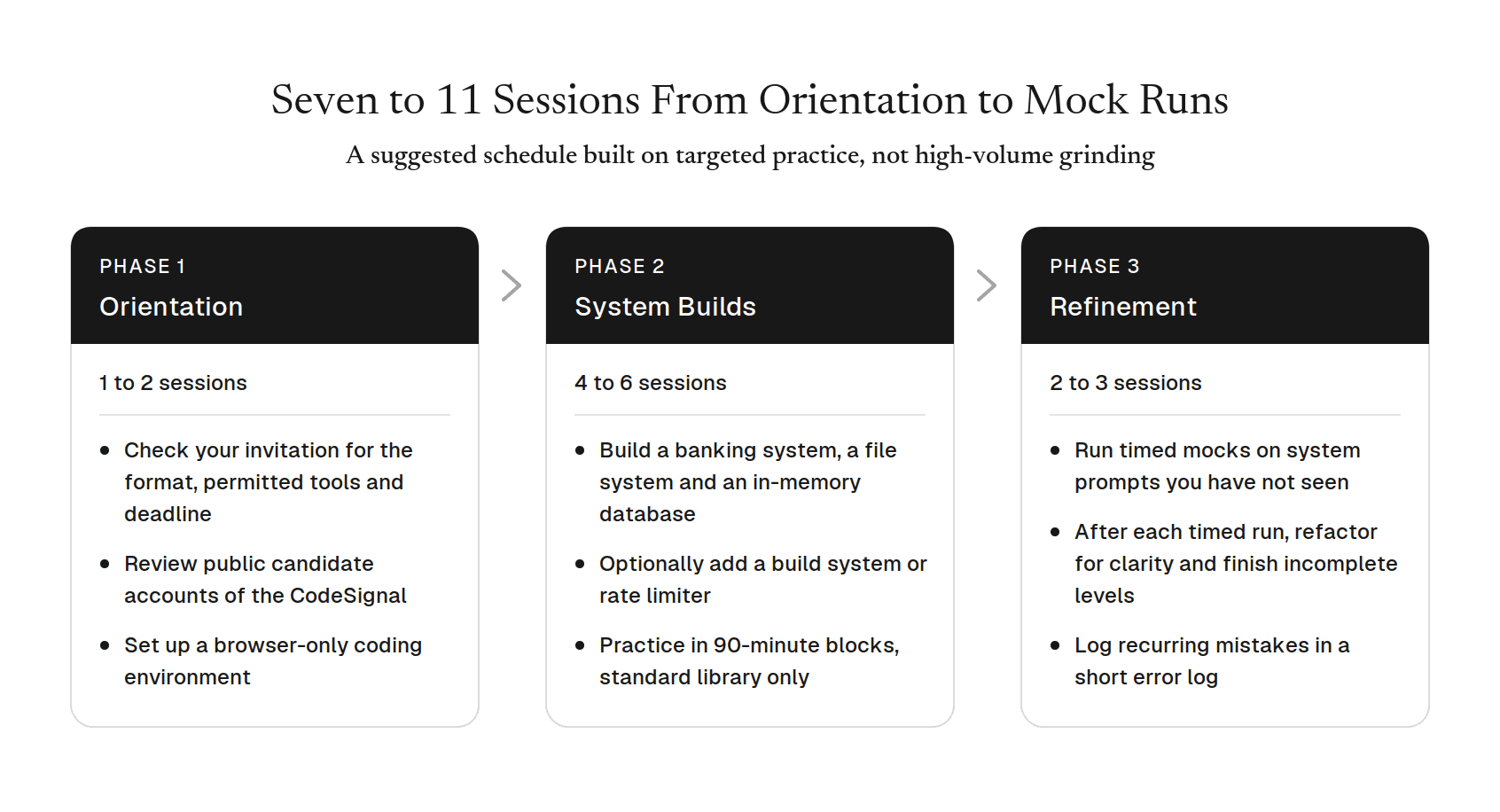
An experienced software engineer can structure preparation around an existing workload by focusing on targeted practice sessions and post-mortem reviews rather than high-volume grinding. The goal isn't to memorize interview questions but to build fluency with stateful system construction under constraints.
Phase 1, orientation (1 to 2 sessions): Understand Anthropic's mission and values by reading public engineering materials. Review public CodeSignal accounts from other candidates. Set up a browser-only coding environment.
Phase 2, system builds (4 to 6 sessions): Implement small systems from the preparation table: a banking system, a file system, an in-memory database, and optionally a build system or rate limiter. Time-box each session to 90 minutes, using the Python standard library only.
Phase 3, refinement (2 to 3 sessions): Run time-boxed mock runs on new system prompts you haven't seen before. After each run, refactor for clarity and complete any unfinished levels. Track mistakes in a lightweight error log, focusing on recurring themes such as mishandled edge cases, brittle data structures, or incomplete handling of API contracts.
Preparation should emphasize honest problem solving, careful reading, and comfort with stateful systems over memorizing any particular solution.
Beyond the Anthropic CodeSignal: Support From Interview Prep to Offer
Clean architecture, edge case coverage and extensibility under new requirements separate a passing CodeSignal submission from a failing one, and the same skills carry into live technical interviews.
If your Anthropic CodeSignal preparation is part of a broader job search, Fonzi connects engineers with startups and growth-stage tech companies through Match Day. Participating companies send salary-backed interview requests, and Fonzi supports candidates from interview prep through offer negotiation.
Anthropic CodeSignal Assessment: What to Remember
The Anthropic CodeSignal assessment, as described in public sources, centers on building one small, stateful system across four levels in 90 minutes. CodeSignal scores it on a 200 to 600 scale. Anthropic publishes no pass threshold, and some candidates report rejection after a perfect score. Anthropic's candidate guidance says to complete take-homes without Claude unless you are told otherwise.
Engineers who build preparation around data structures, file system or banking simulators, and disciplined edge case handling will be better positioned to perform well even if Anthropic adjusts specific prompts or formats. Fellows applicants should follow their cohort instructions, since official Fellows materials do not name CodeSignal. Pick one system-style problem, such as a banking system with transfers and merges or a key-value store with TTL expiration, and implement it end to end in a browser IDE this week.
FAQ
At what stage does the Anthropic CodeSignal interview happen?
Placement varies by role and candidate: some Blind threads describe the CodeSignal arriving before any recruiter conversation, while others describe it after an initial recruiter screen, but in both cases it happens before live technical rounds.
What kinds of Anthropic CodeSignal questions should I practice for as an experienced engineer?
Focus on reported system-style problems like a banking system, file system simulator, or in-memory key-value store, and consider a build system or job scheduler as additional practice. All of these emphasize data structures, stateful logic, and edge case handling over isolated algorithm puzzles.
How transparent is the Anthropic CodeSignal score and what should I aim for?
CodeSignal scores the assessment on a 200 to 600 scale, but Anthropic does not publish a pass threshold. Engineers should treat anecdotal thresholds cautiously and focus on clean, extensible solutions rather than chasing a specific number.
Can I use AI coding assistants during the Anthropic CodeSignal assessment?
Anthropic's candidate guidance says take-home assessments should be completed without Claude unless candidates are told otherwise. Candidates should follow any proctoring and reference rules shown in the CodeSignal instructions, and using AI assistance in ways the instructions don't allow violates that guidance.
Is there a different Anthropic CodeSignal format for the Anthropic Fellows Program?
Official Fellows materials list technical assessments and interviews but do not specify CodeSignal or any particular format. Candidates should not assume a specific assessment and should follow the instructions provided for their current cohort.