How to Prepare for Codesignal Assessments
By
Samara Garcia
•

CodeSignal assessments have become a common filter in AI and infrastructure hiring since around 2021, especially at product-led tech companies. Even senior AI engineers, ML researchers, and LLM specialists now encounter a CodeSignal assessment as part of multi-stage hiring pipelines. In this blog, we’ll talk about how experienced practitioners can prepare for CodeSignal assessments.
Key Takeaways
Senior candidates should treat CodeSignal as a high-signal, time-boxed problem-solving evaluation, not a beginner coding quiz.
Targeted practice tests help calibrate speed, correctness, and debugging under the 70-minute, 4-question format.
Companies combine CodeSignal scores with human judgment, portfolio work, open-source contributions, and live interviews.
A strong score can help candidates advance faster, while a weak score can slow progress even with a strong track record.
How CodeSignal Assessments Fit Into Modern AI Hiring
A CodeSignal assessment is an online skills evaluation platform used by employers to objectively measure a candidate’s technical capabilities, problem-solving skills, and job readiness. The General Coding Assessment typically includes four coding questions that candidates must complete within a 70-minute time frame, with automated grading and partial credit. CodeSignal allows companies to score candidates against a consistent global standard through certified assessments, and candidates can share verified scores from CodeSignal assessments with multiple companies, which saves time in the application process.
AI-focused teams building LLM tooling, ML platforms, inference infrastructure, and data systems often use CodeSignal assessments to validate coding fundamentals before moving candidates into deeper technical interviews. The platform is widely used for software engineering, data science, and product roles to standardize evaluations and reduce reliance on resume screening alone.
Companies also use CodeSignal for live technical screenings and collaborative coding exercises that simulate real-world work environments. While AI tools review assessment patterns and submission history, human interviewers still make final decisions, especially for unconventional solutions or borderline scores. Platforms like Fonzi also help reduce surprise assessments by setting clearer expectations around technical evaluations for candidates.
Understanding CodeSignal’s Question Types and Scoring
CodeSignal assessments consist of multiple coding tasks of varying complexity, including simple logic, data manipulation, and advanced algorithms. Most CodeSignal questions are implementation-heavy and focus on data structures, algorithm reasoning, array manipulation, strings, hash maps, and matrix traversal rather than deep ML theory.
Candidates are often presented with a mix of question difficulties, where the first question is generally easy, and the last question is typically the hardest. The usual pattern is straightforward at the start, then increasingly challenging as hidden edge cases and constraints matter more.
Slot | Typical difficulty | Common topics | Recommended time |
Q1 | Easy | Simple logic, array, strings | 8 to 10 minutes |
Q2 | Easy to medium | Hash maps, frequency counts, sliding windows | 12 to 18 minutes |
Q3 | Medium to hard | 2D matrix manipulation, simulation, prefix sums | 18 to 25 minutes |
Q4 | Hard | Advanced algorithms, stream logic, complex constraints | Remaining time |
The scoring system for CodeSignal assessments is designed to resemble a credit score, providing a numerical representation of a candidate’s performance. CodeSignal now uses a 200–600 point scale, replacing the old 300–850 system, so precision on early questions is vital. Scoring during the assessment is based on code correctness, execution speed, code efficiency, and overall implementation quality, with automated unit tests and points for passing test subsets.
Not all test takers are expected to solve every problem correctly. Setting manageable goals and expectations during the assessment can help alleviate anxiety, especially when Q4 is intentionally difficult. For many candidates, clean Q1 and Q2 solutions, strong Q3 progress, and disciplined partial Q4 work beat an unfinished perfect solution to one hard problem.
Sandbox practice tests can be taken repeatedly, but the official Certified GCA has strict cooldown rules. CodeSignal states that candidates are limited to a maximum of 2 attempts per rolling 30-day window, with additional longer-window limits, so do not treat retakes as disposable. You can review the current CodeSignal cooldown policy before scheduling.
Preparation Strategies for AI, ML, and Infra Engineers
Experienced AI and ML practitioners might feel rusty with interview-style coding despite years of production or research work. The goal is focused skills development, not relearning computer science from scratch.
Practice using the CodeSignal platform can help candidates familiarize themselves with the coding environment and improve their performance in assessments. Familiarizing yourself with the CodeSignal platform and IDE can help you prepare for the actual assessment environment, including accessing the test page, choosing a programming language, reading displayed results, and understanding how submissions are saved or deleted.
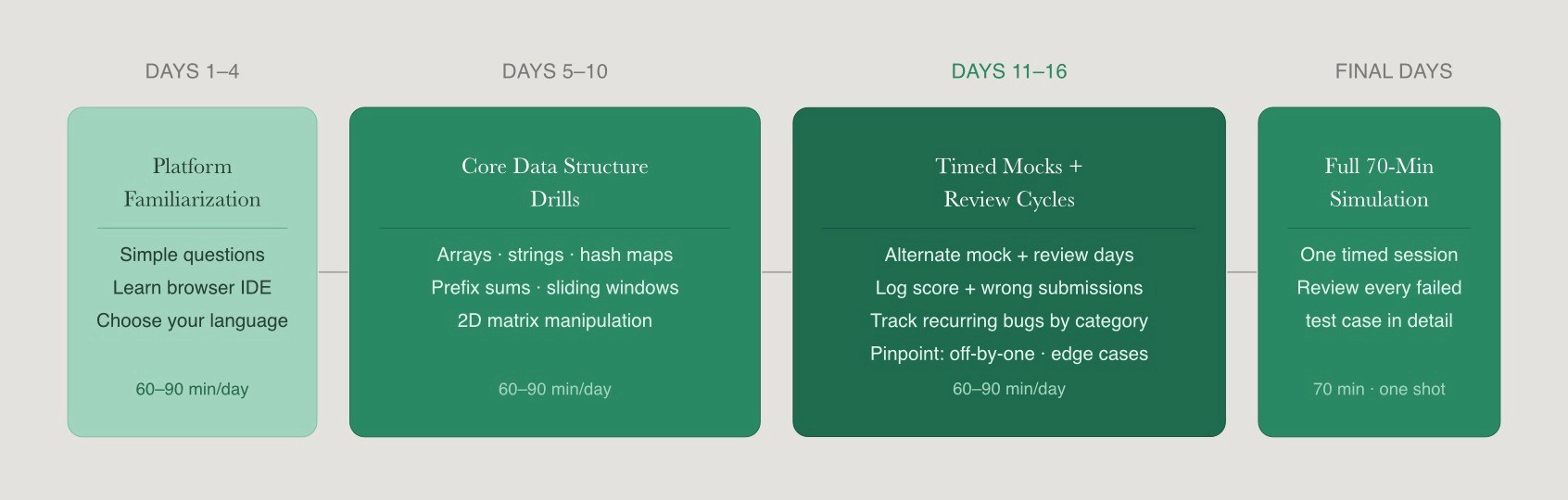
A practical plan is 60 to 90 minutes per day for 2 to 3 weeks:
Days 1 to 4: Complete simple questions in your preferred language, such as Python, Java, C++, or JavaScript, and learn the browser IDE.
Days 5 to 10: Drill arrays, string manipulation, hash maps, prefix sums, 2D matrix manipulation, hash map tracking, and sliding windows.
Days 11 to 16: Alternate full practice tests with review, logging score, wrong submissions, and recurring bugs.
Final days: Run one timed 70-minute session, then review every failed test case in detail.
Use a lightweight log to track progress. Record the problem category, difficulty, failure mode, and final solution. This helps you pinpoint the same signal repeatedly: off-by-one errors, weak boundary checks, overbuilt abstractions, or poor time-boxing.
Practicing realistic problem solving means reading the prompt once slowly, paraphrasing constraints in comments, sketching edge cases, and then writing code. Test empty arrays, single elements, negative numbers, maximum constraints, and unexpected input order. If documentation is allowed, use it only for syntax reference, not algorithm advice, and never use a bot unless the assessment explicitly permits AI tools.
Some candidates also discover better-suited opportunities through structured environments, including Fonzi, where assessments are coordinated with company expectations and seniority level.
Technical and Environmental Setup for a High-Quality Session
For senior candidates, losing points to setup issues is avoidable overhead. Prepare your machine, browser, and room in advance so the assessment measures skills rather than friction.
Setup item | What to check |
Hardware | Laptop plugged in, keyboard reliable, camera working |
Internet | Stable connection, backup hotspot available |
Browser | Updated browser, cookies enabled, no blocking extensions |
Workspace | Quiet desk, phone away, minimal distractions |
Proctoring | ID ready, microphone and screen sharing permissions enabled |
Verify proctoring requirements before the session, since webcam access, microphone checks, ID verification, room scans, and screen sharing are now common. Close unrelated tabs, silence notifications, and create a quiet environment before the assessment begins.
Treat the session like a production incident: stay calm, prioritize problems, and avoid panicking over a failing test case. Simple preparation, including hydration, a short walk, or breathing exercises, can help reduce stress and improve focus during the assessment.
How Fonzi helps candidates navigate technical assessments
Fonzi AI works with experienced AI engineers, ML practitioners, and infrastructure candidates navigating technical hiring. The core idea is matching candidates with companies whose interview processes actually reflect the candidate's seniority and background, rather than running everyone through the same funnel regardless of fit.
One concrete problem this addresses: a senior ML engineer getting screened with a process designed for a new grad. A LeetCode-heavy assessment can be a reasonable signal for someone early in their career. For someone with five years of production model training or infra ownership, it mostly filters the wrong people.
Fonzi evaluates candidates on a broader set of technical signals alongside any formal assessment: production experience, open source contributions, research work, infrastructure ownership, real-world problem-solving. Tools like CodeSignal stay common in hiring pipelines and Fonzi doesn't ignore them. They're part of a structured process that also includes human judgment rather than the whole process.
Summary
CodeSignal is standard in AI and infrastructure hiring now, including for senior engineers and ML specialists. The 70-minute, four-question format focuses on algorithms, arrays, strings, hash maps, and matrix manipulation, and knowing how to prepare for CodeSignal assessments specifically means practicing in the actual environment, not just grinding LeetCode. Timed full-session mocks, tested setup, and familiarity with the scoring system matter as much as the underlying problem-solving skills.
A strong score helps, but the companies worth working for treat it as one signal among several. Production experience, open source work, and research contributions all factor in alongside the number. Fonzi matches experienced AI and engineering candidates with companies whose hiring reflects that balance.
FAQ
What programming language should I choose for a CodeSignal assessment?
How much does a CodeSignal score matter compared with my research papers or open-source work?
Can I use AI coding assistants during CodeSignal assessments?
How should I prepare if I have not done algorithmic interview practice since before 2020?
How many CodeSignal attempts are reasonable before I change my strategy?