
Slow hiring cycles, intense competition for AI talent, and complex equity offers make cap table literacy a core leadership skill for anyone involved in building engineering teams. Hiring managers and talent leaders routinely discuss equity with candidates but often lack a clear grasp of how the capitalization table constrains or enables offers. This article focuses on how cap tables are structured, how they evolve from seed to Series A, and how that impacts recruiting and retention decisions.
Key Takeaways
A capitalization table tracks company ownership across founders, investors, and the employee stock option pool at each stage of funding, and hiring leaders need to understand it to evaluate equity offers and alignment.
A clean, accurate cap table builds investor trust and supports faster hiring and due diligence, while messy records can slow down offers and create ownership risks or disputes.
Investors rely on cap tables to assess dilution and ownership impact across funding rounds, and most companies move to cap table management software once they have multiple rounds, SAFEs, or many option holders.
Cap Table Fundamentals: What A Capitalization Table Actually Shows
A cap table is a structured record of who owns what in a startup. It includes common shares held by founders, preferred shares issued to investors, employee stock options, warrants, and convertible securities like SAFEs or convertible notes. A well-maintained cap table allows for scenario modeling to understand how new funding or hiring will impact ownership stakes, which is important for managing dilution strategically.
A basic pre-seed cap table might show only two or three founders and a small employee stock option pool. For example, with 10,000,000 total authorized shares at incorporation, two co-founders might each hold 3,500,000 common shares, with 1,430,000 shares reserved for the initial option pool.
A well-structured cap table includes sections for shareholder information, types of equity and share classes, number of shares, ownership percentages, and valuation information, which are essential for understanding equity distribution. Core data fields include:
Stakeholder name
Type of security (common stock, preferred stock, options, warrants)
Number of shares or option equivalents
Price per share
Percentage ownership on a basic and fully diluted basis
The “fully diluted” calculation matters because it accounts for all outstanding equity plus unexercised options, reserved option pools, and convertible instruments expected to convert in a future round. Ignoring this can mislead stakeholders on how much equity they actually hold.
Cap tables are usually created in Excel or Google Sheets at incorporation, but founders are encouraged to move to automated equity management platforms as soon as there are outside investors or more than 10 option holders.
Key Components Of A Startup Cap Table
Hiring and compensation decisions rely on understanding each component of a cap table in context. Common components of a cap table include ownership details, types of equity, transaction history, and valuations, which provide a comprehensive view of the company’s equity structure.
Founders’ Common Shares
Founders typically hold common stock with vesting schedules that protect the company if someone leaves early. A typical split might be 40/40/20 for three co-founders, with 4-year vesting and a 1-year cliff. The cap table also tracks vesting schedules of employee stock options, ensuring that equity is earned over time rather than granted upfront.
Investor Preferred Stock
Angel investors, seed funds, and Series A funds receive preferred stock with liquidation preferences. These shares are labeled by round (Series Seed Preferred, Series A Preferred) and include rights that common shareholders do not have. Preferred shareholders typically get paid first in an exit scenario.
Employee Stock Option Pool
Early-stage startups usually reserve 10% to 15% of the company on a fully diluted basis for employee stock options. A grant of 50,000 options from a total of 10,000,000 shares represents 0.5% ownership. The option pool is critical for attracting future employees, especially senior engineers and AI researchers.
Convertible Notes and SAFEs
These instruments represent future equity and must be tracked even though they are not yet shares. Accurate, up-to-date cap table records are required for legal compliance and 409A valuations. Convertible securities will convert into preferred stock at the next priced round, diluting existing shareholders.
Common Formats And A Simple Cap Table Example
Early-stage companies often use a single worksheet sorted by stakeholder and class of security. Later stages may separate pre-money and post-money views.
Consider a 2026 AI startup with 8,000,000 issued shares, 2 founders, a 1,000,000 share option pool, and a $3.5 million seed round at a $15 million pre-money valuation. The company’s post-money valuation would be $18.5 million. Each founder holds 3,000,000 common shares (approximately 37.5% fully diluted before the round). After the seed round issues roughly 1,000,000 preferred shares to new investors, they hold about 12.5% fully diluted, and the option pool represents 12.5%.
This cap table example keeps the numbers high level while reflecting realistic valuations for AI startups in the current market.
How To Build And Maintain A Startup Cap Table From Incorporation To Series A
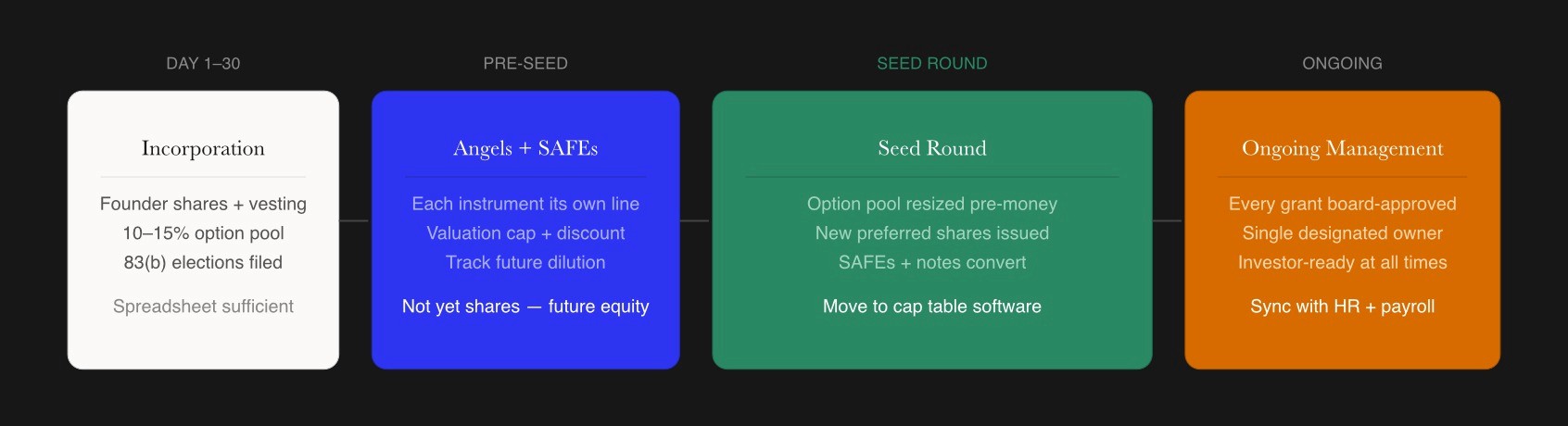
Founders should build a clean cap table in the first 30 days after incorporation. Hiring leaders should ask to see a summary before joining or recommending senior hires. This section walks through initial setup, adding investors, creating and resizing the employee stock option pool, and keeping the cap table updated after every grant or round.
Initial Setup: Founders, Authorized Shares, And First Option Pool
The first step is choosing an authorized share count. Most Delaware corporations authorize 10,000,000 shares at $0.0001 par value, issuing a portion to founders and leaving room for future options and investors.
The cap table should record for each founder:
Number of shares issued
Price per share (often $0.0001 at founding)
Vesting schedule (typically 4 years with 1-year cliff)
Date of issuance
An initial employee stock option pool of 10% to 15% of the company on a fully diluted basis should be reserved for early engineers, AI researchers, and first sales hires. In the United States, founders should file 83(b) elections within 30 days for restricted stock. The cap table should flag these elections for reference by finance and legal teams. Failure to file can result in significant tax consequences, with gains taxed at higher future values.
Adding Angel Investors, SAFEs, And Convertible Notes
A 2026 pre-seed round might be structured with $500,000 raised via SAFEs or convertible notes. Each instrument has a valuation cap and discount that must be documented on the cap table.
Each instrument should have its own line with:
Investor name
Principal amount
Valuation cap
Discount rate
Interest rate (for convertible notes)
Estimated share count at an assumed next round price
The timing of option pool increases and the conversion of convertible notes can impact valuation and ownership percentages during funding rounds, affecting founder dilution. Although SAFEs and notes are not yet shares, they represent future dilution and should be included when reviewing offers with senior engineering or AI leaders.
Messy or undocumented convertible instruments often create friction during due diligence and can delay both funding and senior hires. An organized cap table allows founders to negotiate term sheets more effectively by reflecting the company’s overall ownership structure.
Recording A Seed Round And Resizing The Employee Stock Option Pool
Consider a $4 million seed round at a $16 million pre-money valuation in late 2026, resulting in a $20 million post-money valuation. Funding rounds can significantly dilute existing shareholders as new shares are issued to investors.
The cap table must calculate new preferred shares to issue.To calculate the new shares to issue for a targeted investor ownership percentage, the formula is: New Shares = Old Shares × [ Target Ownership Percentage / (1 - Target Ownership Percentage) ], where Old Shares represents the existing outstanding shares before the funding round, and Target Ownership Percentage represents the post-round ownership goal of the new investor expressed as a decimal. After calculating, update all ownership percentages post-financing.
Investors often require an increased employee stock option pool, for instance from 10% to 15%, created “pre-money.” This means the pool increase dilutes founders rather than new investors. Hiring leaders should understand that an expanded option pool signals planned hiring for engineers and AI specialists and directly affects equity available for key hires.
Ongoing Cap Table Management And Delegated Ownership
A single owner should be designated for cap table management, often the CFO, head of finance, or an experienced operations leader once the team passes 30 to 40 people. Regularly updating the cap table is essential; it should reflect every new stock grant, transfer, or funding round to remain investor-ready.
The cap table provides a transparent single source of truth for investors and founders to visualize company valuation, employee option pools, and ownership structure. Many growing startups outgrow spreadsheets by Series A and move to cap table management software to reduce errors and provide investor and employee portals.
Hiring managers and recruiters should request a current, fully diluted cap table summary when negotiating executive or senior engineering offers involving large grants.
Cap Tables, Equity Offers, And Competing For Engineering And AI Talent
Equity is often a decisive factor for senior engineers and machine learning leaders choosing between offers. Understanding the cap table allows hiring leaders to translate option grants into real ownership percentages and potential value.
The size and health of the employee stock option pool affects the ability to close candidates, especially in the current hiring market where early-stage engineering and AI specialists often look at a startup cap table to evaluate offers, expecting 0.5% to 1.5% for foundational staff and principal roles.
Platforms such as Fonzi, which connect software engineers with AI startups, often help candidates interpret equity structures. Employers benefit from being transparent and organized when sharing shareholder details with candidates and investors.
Reading A Cap Table From A Candidate’s Perspective
A senior AI engineer evaluating an offer might look for:
Founder ownership percentages (ideally 20% to 40% post-seed for control)
Presence of high-quality angel investors or venture capitalists
Sufficient remaining option pool for future hires (5% to 10% remaining)
Founders holding very low ownership after early rounds, or fragmented cap tables with many small angel checks, can raise concerns about future decision making and follow-on funding. Investors review cap tables during due diligence to understand existing equity, potential dilution, and the impact of new investments.
Hiring teams should prepare a simple equity overview derived from the cap table to share during final interviews. This should include total fully diluted shares and what a grant represents as a percentage. Hiring managers should be prepared to answer basic cap table questions without deferring everything to finance.
Structuring Employee Stock Options And Avoiding Common Pitfalls
Typical early engineering vesting terms include 4-year vesting with a 1-year cliff, with unvested and vested portions tracked on the cap table.
Common pitfalls include over-promising equity, mismatches between verbal offers and issued grants, excessive early dilution of the option pool, and “dead equity” held by departed employees.
Maintaining an accurate cap table is critical for compliance, investor trust, and hiring efficiency. Companies should document every grant with board approval and ensure cap table software stays synchronized with employment records and equity issuances.
Using Cap Table Data To Align Hiring, Compensation, And Fundraising
Founders and talent leaders should review the cap table before each new funding round to understand how much equity can be reserved for key hires without exceeding dilution targets. A healthy cap table helps companies model dilution scenarios for future hiring plans.
Clean, investor-ready cap tables also reduce the time legal teams spend during background checks for senior hires, since equity records are easier to verify. Some recruiting partners and marketplaces request cap table summaries before presenting candidates, which encourages better alignment on role seniority and equity budget.
Cap Table Management Tools, Spreadsheets, And When To Upgrade
Small teams can begin with spreadsheets, but complexity rises quickly with multiple rounds, SAFEs, international hires, and different vesting schedules. Using a single source of truth for your cap table helps eliminate confusion and reduces the risk of errors that can lead to financial consequences.
Employing cap table management software can automate updates and minimize errors, making it easier to manage equity structures as a startup grows. These tools centralize data, support scenario modeling, and often integrate with HR and payroll systems.
Spreadsheets Versus Cap Table Software For Growing Startups
This table summarizes the tradeoffs hiring and finance leaders should consider as the organization scales.
Factor | Early-Stage Spreadsheet | Dedicated Cap Table Software | Hiring Impact |
Data Accuracy | High risk of manual formula and version-control errors in complex sheets | Automated calculations and validation | Reduces errors in candidate offer letters |
Scenario Modeling | Manual, error-prone | Built-in what-if analysis | Faster equity budget planning for roles |
Access Control | Shared files with limited permissions | Role-based permissions | Protects sensitive investor contributions |
Audit History | Version history only | Immutable transaction logs | Supports legal documents and compliance |
Employee Visibility | Manual equity summaries | Self-service portals | Candidates can verify grants independently |
Report Generation | Days of manual work | Minutes with automated exports | Speeds candidate closes significantly |
Choosing Cap Table Software And Integrations
High-level criteria for evaluating cap table software include:
Jurisdiction support (especially for US and international hires)
Ease of importing historical data from spreadsheets
Permissions management for founders, investors, and employees
Support for common instruments like SAFEs and convertible notes
HRIS and ATS integrations help option grants and employment data stay synchronized for engineering and AI teams spread across time zones. Talent leaders should join the selection process to confirm that recruiters can easily generate candidate-friendly offer summaries from the system.
How Cap Tables Evolve From Seed To Series A And Beyond
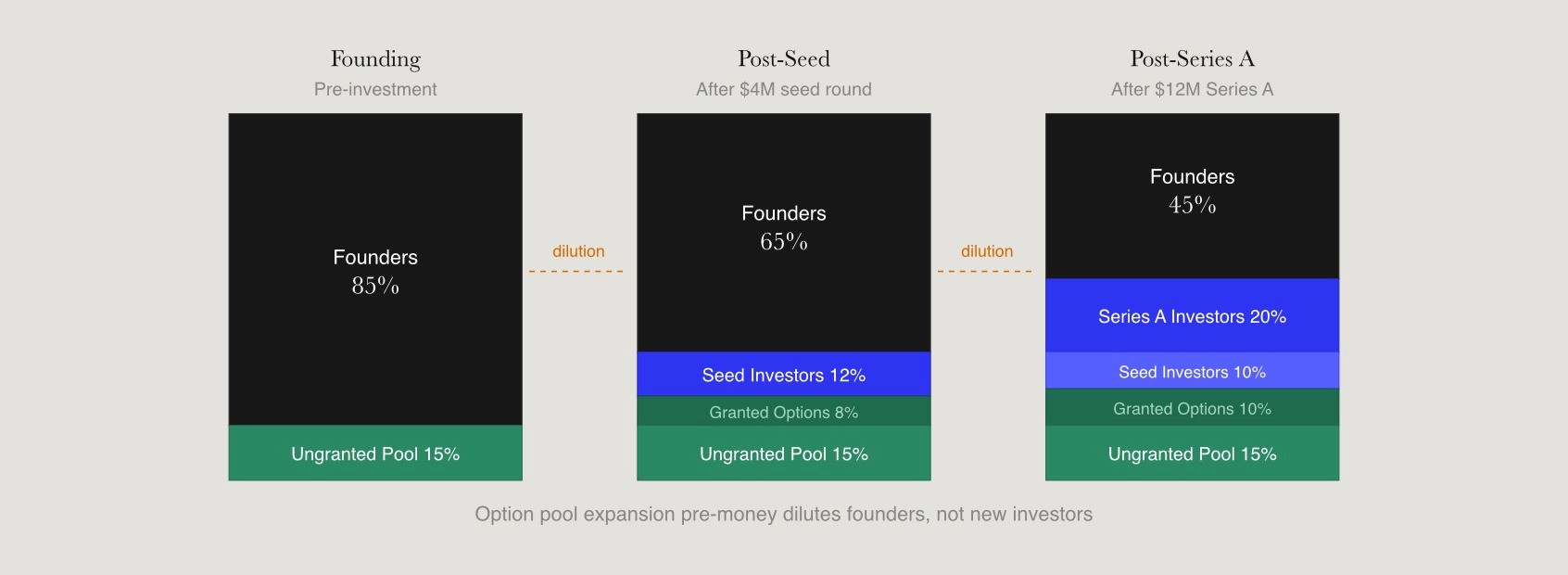
The structure of a cap table can evolve from a simple record of founders’ shares into a more complex document that includes funding rounds, employee equity plans, and convertible instruments as the company matures. Understanding this evolution helps hiring leaders set expectations with candidates about future dilution, refresh grants, and long-term upside.
From Founding To Seed: Simple Structures And First Employees
The typical early cap table shows only founders for the first 6 to 12 months, then introduces a small option pool for the first engineer, designer, or ML researcher. Pre-seed and seed investors often expect a clean, easily interpretable cap table with clear documentation for any prior friends-and-family or angel investments.
Talent leaders joining at this stage will usually see relatively high equity percentages for early technical hires, since dilution has not yet accumulated. Regular scenario modeling at this phase can help prevent over-dilution of founders or excessive dead equity held by departed team members.
A well-maintained cap table can also help attract investors by providing clear visibility into ownership structure and changes since prior funding rounds.
Series A And Growth: Multiple Rounds, Larger Teams, And Dilution Planning
By Series A, the cap table may include several preferred classes, a larger option pool, and converted SAFEs and notes. When new shares are issued to investors or employees, the ownership percentage of existing shareholders decreases, a phenomenon known as dilution. Companies often grant refresh options to retain high-performing engineers and AI specialists as the company grows.
Hiring and finance leaders should coordinate to budget equity for future leadership hires so that late-stage candidates still receive meaningful grants despite cumulative dilution. Complex cap tables with multiple investor protections, secondary transactions, and multiple employee pools require disciplined management and clear communication to new hires.
Exits, Liquidity Events, And How Proceeds Flow Through The Cap Table
An acquisition or initial public offering uses the cap table to determine how proceeds or public shares are allocated among founders, investors, and employees. The cap table also clarifies voting power, which is important when selling the business, issuing new shares, or approving major company decisions.
Liquidation preferences and participation rights influence payout order. Preferred shareholders typically receive their investment amount before common shareholders see any proceeds. At a fixed-price exit, equity distribution follows the waterfall established in legal agreements from each financing round.
Transparent cap table management from the early stages reduces conflict and misalignment during exits. Leaders should ensure senior staff understand the basics so expectations remain realistic as the company grows and approaches major strategic events.
Conclusion
The cap table is not just a finance artifact but a strategic tool that shapes hiring, retention, and long-term value creation. An accurate cap table enables leaders to track ownership precisely, delegate equity decisions, and manage equity across the organization.
Review your current cap table with finance, clean up outdated entries, and align future hiring plans with the remaining employee stock option pool. Consider sharing a simplified cap table summary with trusted recruiting partners or talent marketplaces like Fonzi to improve offer quality and candidate trust.
FAQ
What is a cap table and why does every startup need one?
What should a startup cap table include and how do I set one up?
What are the best cap table management tools for startups?
What common cap table mistakes do founders make that hurt them during fundraising?
How does the cap table change after a seed round or Series A?


