Hiring software engineers in 2026 costs significantly more than the base salary listed on a job posting. Between recruiting expenses, employer overhead, time lost to unfilled roles, and the risk of a bad hire, the true cost of bringing an engineer onto your development team often runs 20 to 50 percent above the number on an offer letter. This article breaks down the real costs, compares hiring models, and outlines a structured hiring process that helps you find the right talent without overspending.
Key Takeaways
Hiring software engineers in 2026 remains difficult because top software engineering talent remains in high demand while software developers represent only about 1% of the US workforce. A structured hiring process with clear evaluation criteria, consistent interview questions, and a shared scorecard leads to better outcomes and lower total cost.
There is no single best way to hire software engineers. The right approach depends on project scope, budget, timelines, and internal capabilities. Teams can combine full-time hires, freelancers, consultancies, and remote engineers to cover different stages of their product roadmap.
Successful hiring balances technical depth, problem-solving, and communication skills with cultural fit and long-term potential.
Why Hiring Software Engineers Is So Difficult Today
The demand for software engineers continues to accelerate. The U.S. Bureau of Labor Statistics projects that employment among software developers, quality assurance analysts, and testers will grow about 15% from 2024 to 2034, translating to roughly 129,200 new openings per year. Software development is needed across nearly all industries today, which means every company, from healthcare to logistics to fintech, competes for the same talent pool.
Many enterprise companies struggle because they chase experienced engineers from brand-name employers, underestimating the outsized influence of communication skills and ownership mindset on long-term success. Vague role definitions and misaligned expectations between an engineering manager and recruiters prolong the hiring process, sometimes pushing timelines past 90 days for senior engineers. Remote engineers introduce additional complexity around asynchronous collaboration, onboarding, and performance management. When a company does not define clear job requirements upfront, the result is wasted interviewer time, frustrated candidates, and higher costs.
Define the Role Before You Hire Software Engineers
Precise role definition is the foundation of any cost-effective hiring process. When a team skips this step, they end up interviewing candidates who do not match the actual need, which inflates cost per hire and extends timelines. Software engineers need strong foundational programming skills and should be proficient in the programming languages most relevant to the role. Before posting a job, the project manager, engineering manager, and team lead should align on what the new hire will own.
Break down the role by type and seniority:
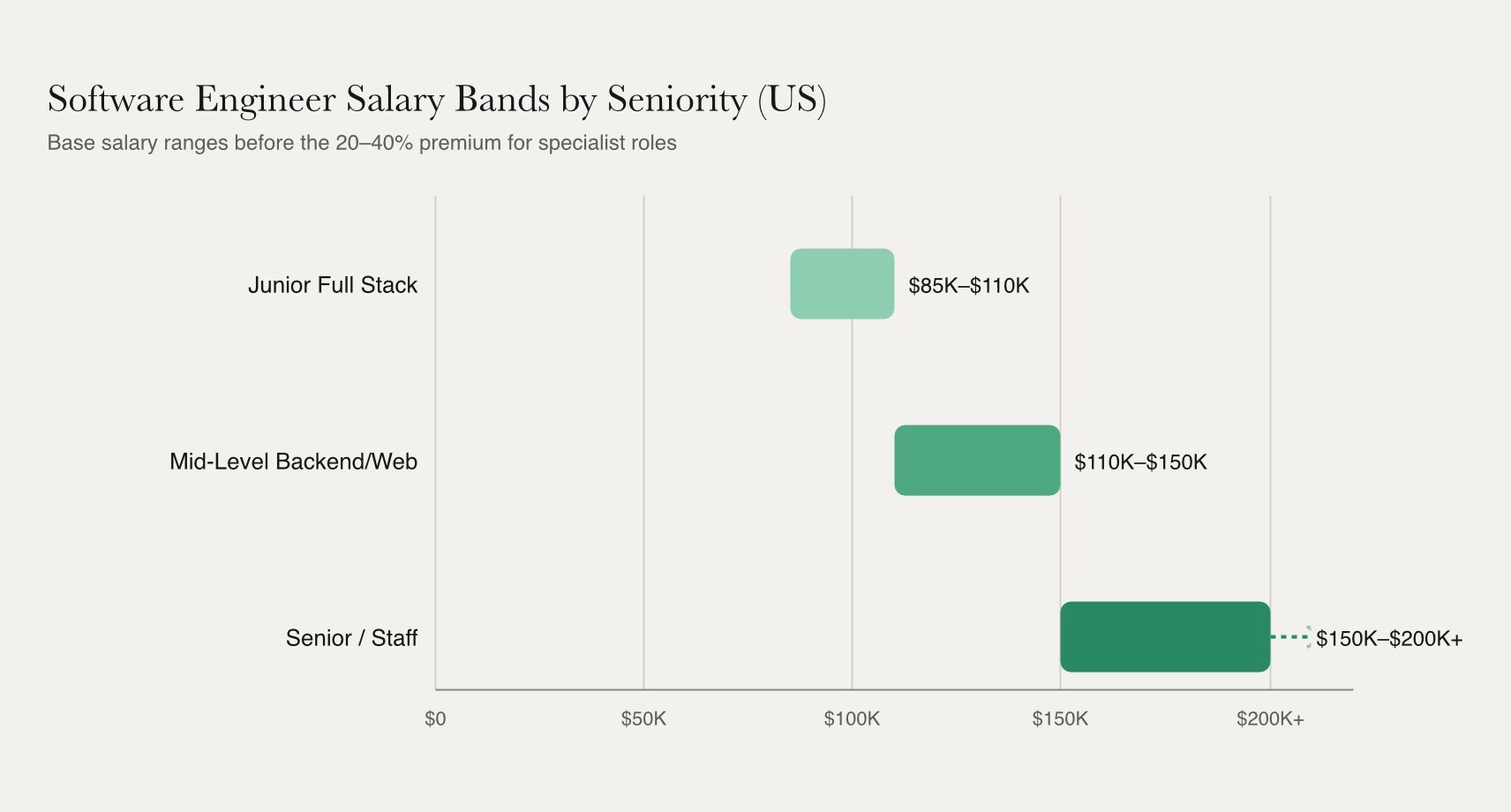
A junior full stack developer in the US typically earns $85,000 to $110,000 in base salary, depending heavily on the local market and industry sector
A mid-level backend or web development engineer runs $110,000 to $150,000
Senior engineers and staff-level roles command $150,000 to $200,000 or more
Specialists in machine learning, data engineering, or security command a 20 to 40% premium above those ranges
Leadership and project management skills are important for senior software engineers, especially those acting as a project lead or working closely with product leaders. Define success metrics for the first 90 days and first 12 months so that interviewers can assess whether a candidate is the right fit. Also decide early whether the role must be on-site, hybrid, or fully remote. Remote roles expand the global talent pool but add costs in legal compliance, security, and equipment provisioning.
Choosing the Right Hiring Model for Your Engineering Needs
Companies typically mix three models to hire software engineers in 2026: full-time employees, freelancers or contractors, and software consultancies or staff augmentation partners. Each model carries different cost profiles, and the right choice depends on project goals, budget, and how quickly you need resources in place. The global IT outsourcing market is expected to grow to $806.55 billion by 2030, reflecting how many businesses are shifting toward flexible models.
Full-time employees provide long-term stability for software development and are best suited to core product work, architecture decisions, and roles requiring deep context. However, hiring full-time employees can be costly and inflexible when factoring in benefits, overhead (typically 8 to 15% above base salary), and onboarding. Freelancers are typically cheaper than full-time engineers and offer on-demand talent without lengthy commitments. However, freelance developers may lack continuity for ongoing projects, and managing multiple contractors adds coordination overhead. Consultancies and staff augmentation partners provide stability and long-term support for projects while offering the flexibility to scale headcount as needs evolve.
For remote engineers across regions like North America, Eastern Europe, and Latin America, consider legal employment setup (employer of record arrangements), security practices, and communication expectations. Hiring remote engineers can save costs on office space and access talent at competitive rates compared to local markets.
Comparison of Common Ways to Hire Software Engineers
Busy managers benefit from a quick visual summary when deciding how to hire software engineers for upcoming initiatives. The table below compares the primary models:
Dimension | Full-Time Employee | Freelancer / Contractor | Consultancy / Staff Augmentation |
Cost predictability | High (salary + benefits + overhead) | Variable (hourly rates, project-based) | Moderate (monthly retainer or fee) |
Time to hire | 6 to 12 weeks average | 1 to 4 weeks | 1 to 2 weeks via pre-vetted networks |
Control over roadmap | Full control | Limited, scope-based | Moderate, depends on engagement model |
Flexibility | Low, difficult to scale down | High, end contract anytime | High, scale up or down as needed |
Continuity | Strong, deep product knowledge | Weak, context loss between engagements | Moderate to strong, dedicated engineers |
Best use cases | Core product, long-term architecture | MVP builds, short sprints, specialized integrations | Scaling teams, filling skill gaps, time-sensitive projects |
Most fast-growing teams use a hybrid approach instead of relying on a single model. For example, a company might maintain a core development team of full-time engineers while using staff augmentation to bring in a DevOps engineer or mobile app developer for specific initiatives.
Designing a Structured Hiring Process for Software Engineers
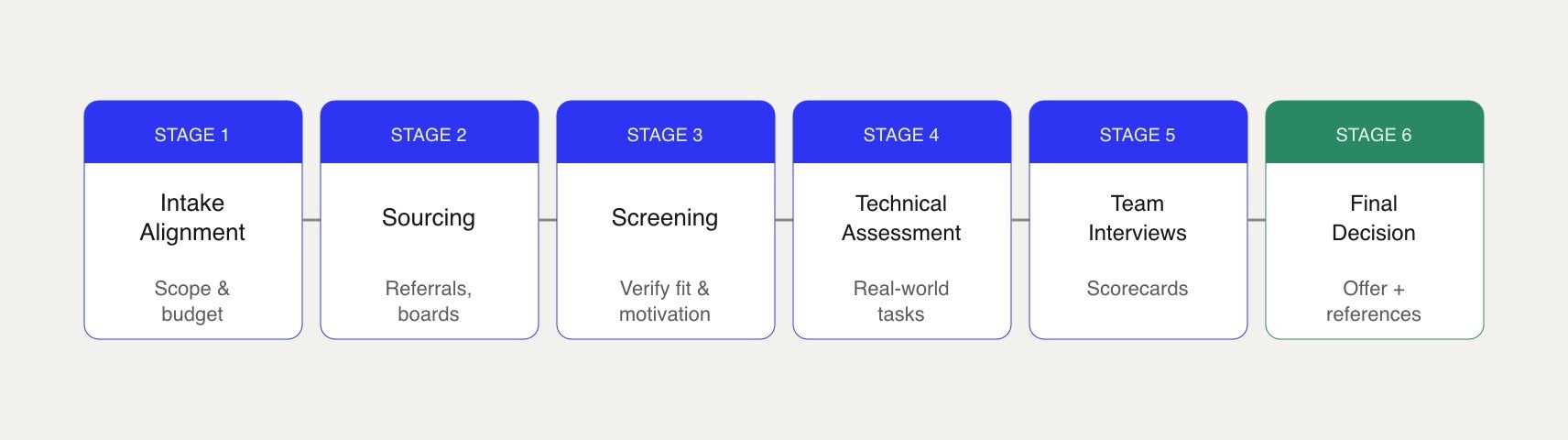
A repeatable hiring process helps compare candidates fairly, shortens the hiring cycle, and improves the candidate's experience. The software engineering hiring process typically includes multiple stages: intake alignment, sourcing, screening, technical assessment, team interviews, and a final decision with references. According to SHRM's 2025 benchmarking data, the average cost per hire for a nonexecutive role in the US is about $5,475, excluding salary, and the average time to fill is approximately 45 days. Streamlining the recruitment cycle to 2 to 3 weeks is advisable to secure top candidates before competitors do.
The intake meeting should align hiring managers, recruiters, and the project manager on role requirements, timeline, budget, and the ideal candidate profile. Strong sourcing channels include employee referrals, curated talent marketplaces like Fonzi, GitHub, LinkedIn, developer communities on Discord and Slack, and targeted job boards.
Initial calls verify qualifications, communication skills, motivation, and high-level problem-solving. Structured interviews and scorecards help ensure consistent evaluations, while final hiring decisions typically come from the hiring manager or a committee. Offers should clearly outline salary, bonuses, equity, and benefits.
Technical Assessments That Reflect Real Work
Assessments should mirror actual day-to-day tasks instead of relying only on whiteboard coding or abstract brainteasers. Effective software engineering recruitment requires skill-based technical assessments. Evaluating problem-solving skills is a critical component of the software engineer hiring process.
Practical formats include:
Focused take-home assignments with a strict time limit (2 to 4 hours)
Live coding sessions on realistic tasks using the team's actual technologies
Pairing on a small bug fix in a simplified codebase
System design interviews for senior engineers covering scalability, trade-offs, and stakeholder communication
Data structures and algorithms are commonly tested in coding exercises, and coding proficiency is often evaluated through test platforms or live screens. However, overreliance on abstract puzzles correlates poorly with real-product work. Assess problem-solving, debugging approach, code clarity, knowledge of version control, and communication under time constraints. Always provide clear instructions, time expectations, and feedback to candidates.
Evaluating Communication Skills and Team Fit
Communication skills are essential for software engineers, especially those working remotely or cross-functionally with designers, managers, and stakeholders. Soft skills like collaboration, conflict resolution, and the ability to explain complex software systems to non-technical audiences have an outsized influence on team performance.
Use behavioral interview questions that reveal collaboration style:
"Describe a time you disagreed with a technical decision. How did you handle it?"
"Walk us through a project where requirements changed mid-sprint."
"How do you communicate trade-offs to a non-technical project manager?"
Probe for ownership and initiative by asking about previous projects, trade-off decisions, and examples of working with incomplete requirements. Have candidates meet multiple team members across engineering, product, and customer-facing roles. Use standardized rating scales for cultural fit to avoid decisions based on vague impressions or similarity bias.
Finding and Attracting the Best Software Engineers
Strong hiring outcomes depend on continuous sourcing, not only posting a requisition when a role opens. To identify the top 1% of AI engineering talent, companies need a targeted approach. A well-written job description that uses specific titles (such as Senior Backend Engineer, Machine Learning Engineer, or Full Stack TypeScript Developer) attracts more relevant applicants from the right talent pool. Candidates also appreciate clarity on which technical skills are essential versus nice-to-have, along with competitive compensation and comprehensive benefits.
Tactics that help you access the best talent include personal outreach from engineering leaders, engaging in technical communities, sponsoring meetups, and contributing to open-source projects. Curated marketplaces such as Fonzi can connect hiring managers with pre-vetted software engineers who are already interested in AI startups and modern tech companies. A transparent and swift hiring process helps avoid losing candidates. Employers who offer within 10 business days of a final interview see acceptance rates around 90%.
Hiring Remote Engineers Across Time Zones
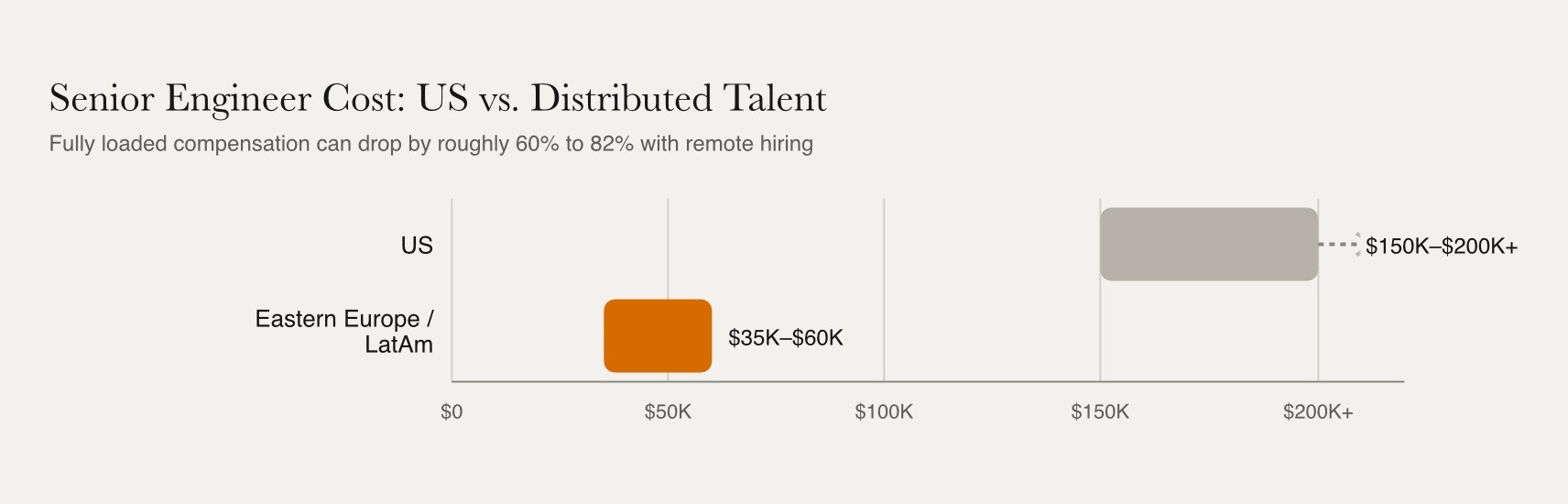
Distributed engineering teams across the US, Europe, and Latin America continue to grow as companies tap into a broader global talent pool of experienced engineers. Hiring remote engineers can save costs on office space and reduce fully loaded compensation by as much as 52% compared to local hires in high-cost markets. A senior full-stack developer in Eastern Europe or Latin America may cost $35,000 to $60,000 per year versus $150,000 to $200,000 or more in the US.
When hiring remote engineers, ensure at least 4 hours of shared working time for core meetings and pair programming. Assess self-management and autonomy in interviews, since remote roles require engineers who can drive progress without management support or micromanagement. Key considerations include security practices, equipment policies, documentation standards, and expectations for written communication. Platforms like Fonzi can help identify remote engineers with proven track records in asynchronous collaboration and English communication proficiency.
Common Mistakes When Hiring Software Engineers (and How to Avoid Them)
Even experienced hiring leaders repeat avoidable mistakes that slow down hiring and increase attrition risk. Here are the most common and costly errors:
Overvaluing brand names. Focusing only on candidates from well-known companies can extend timelines and cost without necessarily bringing better outcomes. A candidate's experience at a lesser-known company may be more relevant to your project and skill set needs.
Using assessments that do not match real work. Generic coding tests on abstract algorithms filter out good candidates and provide low signal. Assess based on the actual programming language and tools your team uses.
Ignoring the learning process. Focusing only on current tech stack experience causes teams to miss high-potential candidates with strong fundamentals and the ability to learn new technologies and resources quickly.
Running unstructured interviews. When each interviewer asks different questions and provides subjective feedback, there is no shared rubric, and decisions become inconsistent.
Treating reference checks as a formality. Targeted reference questions about reliability, communication, and ownership reveal a fair bit about how an engineer actually performs day-to-day. Ask former managers whether the engineer went the extra mile and whether they would work closely with them again.
Rushing to fill a seat. Hiring the wrong person costs far more than waiting a few extra weeks for the right software engineers.
Fonzi: AI-Powered Software Engineer Hiring
Hiring software engineers is often slowed by sourcing challenges, lengthy screening processes, and identifying candidates with both strong technical skills and long-term potential. Fonzi uses AI to streamline recruiting by matching companies with pre-vetted software engineers based on technical expertise, experience, and role requirements.
The platform is particularly useful for organizations hiring software engineers in competitive areas like AI, machine learning, backend development, and full-stack engineering. AI-powered matching, structured candidate profiles, and Match Day events help recruiters quickly identify engineers who align with their technical and business needs while reducing time spent reviewing unqualified applicants. For companies looking to shorten hiring timelines without sacrificing quality, Fonzi complements a structured hiring process by making sourcing more efficient and improving access to high-quality software engineering talent.
Summary
The total cost to hire a software engineer extends well beyond base salary. It includes recruiting expenses, employer overhead, interviewer time, vacancy costs, and the risk of a mismatch. The best software engineers combine technical excellence, problem-solving, communication skills, and alignment with your company mission. A clear role definition, a structured hiring process, and thoughtful selection among full-time, freelance, and staff augmentation models are the most reliable ways to control costs while securing the right talent.
Audit your current hiring process this quarter. Identify one bottleneck, whether it is role definition, sourcing, assessment design, or decision speed, and fix it before your next hire.
FAQ
How long should a typical hiring process for a software engineer take?
When is it better to hire a junior engineer instead of a senior one?
How can I effectively evaluate machine learning engineers during interviews?
What is a reasonable ratio of technical to behavioral questions in interviews?
How can I assess communication skills for remote software engineers?