
By 2026, many fast-growing tech companies describe themselves as “AI first,” but far fewer operate as truly AI-native organizations at the team, workflow, and architecture level. There is often a substantial gap between marketing language and operational reality. Hiring leaders are being asked to deliver AI-powered products quickly while navigating tight talent markets, longer hiring cycles, and increasingly noisy candidate pools. As a result, building an AI-native engineering organization has become as much a hiring and organizational challenge as it is a technical one.
Drawing on hiring patterns and AI infrastructure trends from 2024 through 2026, we’ll examine practical guidance for senior recruiting leaders, engineering managers, and AI executives responsible for delivering measurable outcomes. Platforms like Fonzi have emerged as part of this shift by helping companies evaluate technical talent through more structured, high-signal workflows that better reflect the realities of modern AI engineering and product development.
Key Takeaways
An AI native engineering team is fundamentally different from a traditional or merely AI-enabled team. These teams are structured around AI systems, AI agents, and continuous learning loops. The architecture, the workflows, and the products they build all depend on artificial intelligence as a core component rather than an enhancement.
AI native teams build systems where removing AI would break core product value. This mirrors how AI native companies differ from AI-enabled ones. The key distinction is that AI native products cannot function without their intelligence layer, whereas AI-first products can still deliver some value even if AI is removed, albeit at a degraded level.
Hiring for AI native requires a different mix of skills, evaluation methods, and interview structure than hiring for legacy software engineering roles in 2026. Engineers must think probabilistically, design guardrails for AI models, and manage AI systems over time.
AI should assist hiring, not replace human judgment. Concerns about bias, transparency, and governance in AI-powered recruiting tools are valid and must be addressed through careful tool selection and human oversight.
Key Challenges in Hiring for AI Native Engineering Roles
Hiring for AI native teams in the 2026 market presents distinct frictions compared to traditional backend or frontend hiring. The talent pool is smaller, evaluation is more complex, and the competitive landscape is more intense.
Slow hiring cycles create significant drag on AI native team building:
Sourcing bottlenecks occur because candidates with genuine AI native experience are rare. Many engineers claim machine learning experience but lack depth in production AI systems.
Overloaded recruiters often lack domain expertise to differentiate between candidates who have built AI agents and those who have only wrapped APIs.
Extended decision timelines for senior AI profiles, often running 3 to 6 months, create the risk of losing candidates to competing offers.
Recruiter bandwidth constraints compound these issues. Technical recruiters struggle to interpret the depth of machine learning and AI systems experience from incomplete resumes or LinkedIn profiles. A candidate might describe “AI experience” that ranges from tutorial projects to shipping production multi-agent systems.
Inconsistent candidate evaluation plagues many hiring processes. Unstructured interviews, ad hoc take-home tasks, and misaligned expectations between product leaders, CTOs, and recruiters lead to poor signal quality. One interviewer focuses on algorithm questions while another probes production experience, making candidate comparison difficult.
The added complexity of distinguishing between AI native experience and AI-enabled experience makes evaluation harder. True AI native experience involves owning agents, orchestration, and data pipelines. An AI-enabled experience typically means wrapping APIs or adding isolated models to existing systems.
Integrating AI native systems into existing infrastructures often requires replacing or augmenting existing functionalities with AI capabilities, ensuring backward compatibility with legacy systems. Adopting AI also requires a cultural change, as it can disrupt established employee workflows and requires a change-ready mindset.
These problems create real risk in 2026. AI native architecture and execution speed decide whether a company becomes an industry leader or falls behind competitors.
What “AI Native” Means for Teams, Not Just Products
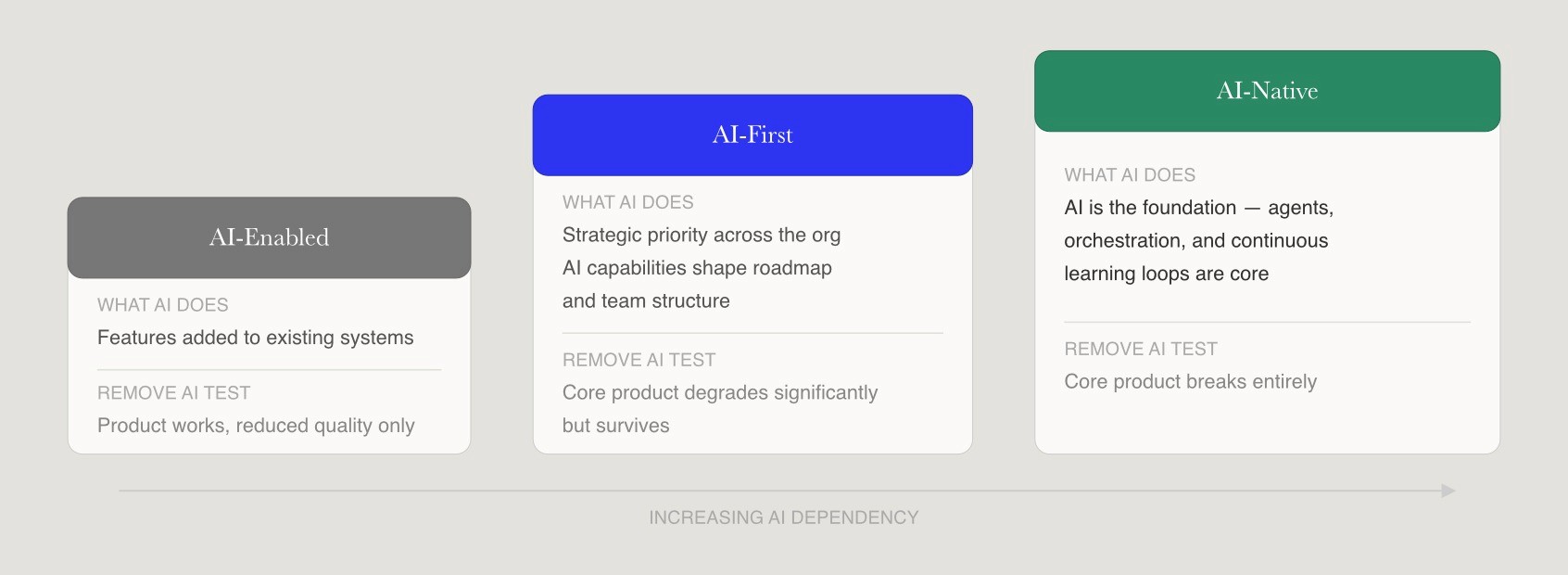
AI native in organizational terms, means that intelligence is integrated throughout the entire system rather than being limited to specific features or components. AI native architecture, AI agents, and continuous learning loops shape how teams work every day, not just how products function.
Understanding the distinction between AI native vs AI enabled vs AI first at the team level:
AI-enabled teams add AI features to existing systems. Removing AI would reduce functionality, but the product could still work.
AI-first teams treat AI as a strategic priority and organize around AI capabilities, but may not have rebuilt architecture and processes around AI.
AI native teams build systems where AI is the foundation. The “remove the AI” test applies: if removing AI would fundamentally break core product value, the team is AI native.
AI native organizations structure their entire business model and value proposition around AI, while AI-first companies enhance their products and operations with AI capabilities without necessarily being built around AI from the start.
AI native teams organize around data infrastructure, model orchestration, and AI agents rather than around traditional service boundaries only. Data pipelines become first-class concerns. Model evaluation and monitoring are continuous processes. Continuous learning and adaptation are key characteristics, allowing systems to improve over time without manual updates. They follow a cycle of data collection, pattern recognition, automatic adjustment, and validation.
AI native architectures enable zero-touch autonomous operations, where systems can manage routine tasks such as scaling resources and optimizing performance without human intervention. Automation is a central part of how these systems function.
AI native maturity affects hiring directly. You need engineers who think probabilistically, design guardrails, and manage AI systems over time. AI native companies can disrupt established markets by operating faster and more efficiently, often using AI agents to redefine work. Adopting an AI native strategy drives faster innovation, superior operational efficiency, and enhanced customer experiences. AI native organizations can scale with computing power rather than linear headcount growth.
AI native structures allow for rapid experimentation and the creation of business models that were previously impossible. Examples from 2023 to 2026 include Cursor for AI native developer tools, Cognition with Devin as an AI software engineer, and Magic.dev for AI-powered development. AI native fintechs use real-time decision engines for lending, fraud detection, and trading.
Hiring leaders should calibrate their hiring strategy to the level of AI native ambition in their own business model, instead of using generic “ML engineer” or “full stack” templates.
Core Roles and Skills in an AI Native Engineering Team
Building an AI native company rather than just AI-enabled features requires specific roles, skills, and responsibilities that differ from traditional software engineering teams.
Foundational roles include:
AI Platform Engineer: Builds infrastructure, tools, and abstractions that enable other engineers to develop, deploy, and monitor AI systems.
Machine Learning Engineer: Develops, trains, evaluates, and refines models with a focus on continuous evaluation and feedback loops from production.
Data Engineer: Designs data architectures optimized for machine learning, including feature engineering, feature serving, and data quality assurance.
AI Product Engineer: Bridges product management and engineering, focusing on how AI capabilities are exposed to end users.
Evaluation Engineer: Designs metrics, benchmarks, and testing frameworks to assess AI system performance, including bias, fairness, and hallucination rates.
AI Reliability Engineer: Focuses on operational reliability, monitoring, and incident response for AI systems.
Cross-functional roles matter equally. AI product managers need to understand AI capabilities, limitations, data requirements, and how to communicate AI system uncertainty to customers. Technical recruiters who understand AI native architecture, AI systems design, and long-term data strategy can source more effectively.
AI native architectures necessitate advanced data observability and management functions, such as data pre-processing, feature engineering, and model lifecycle management, to effectively handle AI workloads.
Skills that differentiate AI native engineers from traditional engineers:
Comfort with probabilistic systems and uncertainty in outputs
Experience with Model Context Protocol and Multi-Agent Systems
Rigorous model evaluation and experimentation practices
Data governance and data quality management
Soft skills matter in 2026. Engineers need rigorous experimentation mindsets, the ability to design continuous learning pipelines, and the skill in communicating about AI risk and limitations with nontechnical leaders. AI requires large volumes of high-quality data, introducing risks including potential data breaches, privacy concerns, and biases.
Comparing Traditional and AI Native Engineering Profiles
A comparison table clarifies how responsibilities and hiring signals differ between traditional software roles and AI native roles.
Role Type | Primary Focus | Key Skills | Evaluation Signals |
Backend Engineer (Traditional) | Service logic, APIs, databases | System design, language proficiency, reliability | Architecture whiteboard, coding tests |
AI Native Platform Engineer | Model serving, feature stores, orchestration | Distributed systems, MLOps, observability | Designing multi-agent workflows, managing context windows |
Data Engineer (Traditional) | Data warehouses, ETL pipelines | SQL, batch processing, data modeling | Pipeline design, data handling |
AI Native ML/Agentic Systems Engineer | Production AI agents, retrieval pipelines | Vector stores, evaluation frameworks, MAS | Shipping AI-powered features to production, setting up evaluation for hallucination and bias |
The biggest difference in evaluation is that assessment must shift from pure algorithm questions to system thinking, data ownership, and applied AI delivery. Traditional technical interviews often miss whether a candidate can manage intelligent systems in production over time.
Designing an Interview Process for AI Native Engineering Talent
Hiring managers need structured, repeatable evaluations for AI native roles because generic software interviews often miss true AI systems expertise.
Scope roles clearly upfront. Determine whether the team is building AI native architecture, AI agents, or AI-enabled features. This affects interview loops, stakeholders involved, and evaluation criteria. Different systems require different competencies.
Recommended interview structure:
Initial screen: Assess basic fit and understanding of the role, including exposure to AI tools and data strategy.
Technical deep dive: Focus on AI systems thinking. How have candidates built, evaluated, and maintained AI systems in production?
Practical exercise: Design exercise on AI native architecture or agents rather than generic algorithm problems.
Cross-functional round: Include product thinking and ethical considerations for AI-driven decision making.
Evaluate a continuous learning mindset. Ask candidates how they have built feedback loops and monitoring around models in past roles. Strong candidates describe setting up metrics, detecting model degradation, and designing retraining processes. They understand real-time data requirements and user flows for AI apps.
Use practical take-home tasks. Design exercises around AI agents and retrieval workflows instead of generic algorithmic tests. Keep them small and relevant to the company’s domain. Ask candidates to fine-tune a prompt or evaluate failure modes in a given scenario.
Curated marketplaces like Fonzi can help surface candidates who have already shipped AI native systems, but internal interview rigor is still required to validate fit and assess whether past experience translates to the current role.
Using AI to Support, Not Replace, Hiring Decisions
AI systems are increasingly used in technical recruiting to reduce manual work, but human oversight remains essential in 2026. Building trust in AI outputs is a significant challenge, especially in high-stakes industries like hiring.
Specific AI applications in hiring:
Automated resume triage and candidate matching for first pass screening
Code sample and portfolio analysis for quality assessment
Fraud detection for portfolios or GitHub accounts to identify misrepresentation
Structured interview note summarization for evaluation consistency
Address bias and transparency concerns directly. Review how AI tools make recommendations, what training data they use, and how outputs can be audited or overridden. Deep integration of AI increases risks related to algorithmic bias, data privacy, and transparency, requiring governance by design from day one.
AI adds the most value in first-pass candidate matching and structured evaluation consistency. Human judgment must stay central for final hiring decisions, compensation design, and culture fit assessment. Execute functions like offer letters and onboarding through standard processes with human approval.
Some marketplaces and platforms, including Fonzi, use AI-assisted matching to reduce time to shortlist while maintaining human curation.
A Practical Framework for Building an AI Native Engineering Org
This step-by-step framework helps hiring leaders move from intent to execution when building an AI native engineering team in 2026.
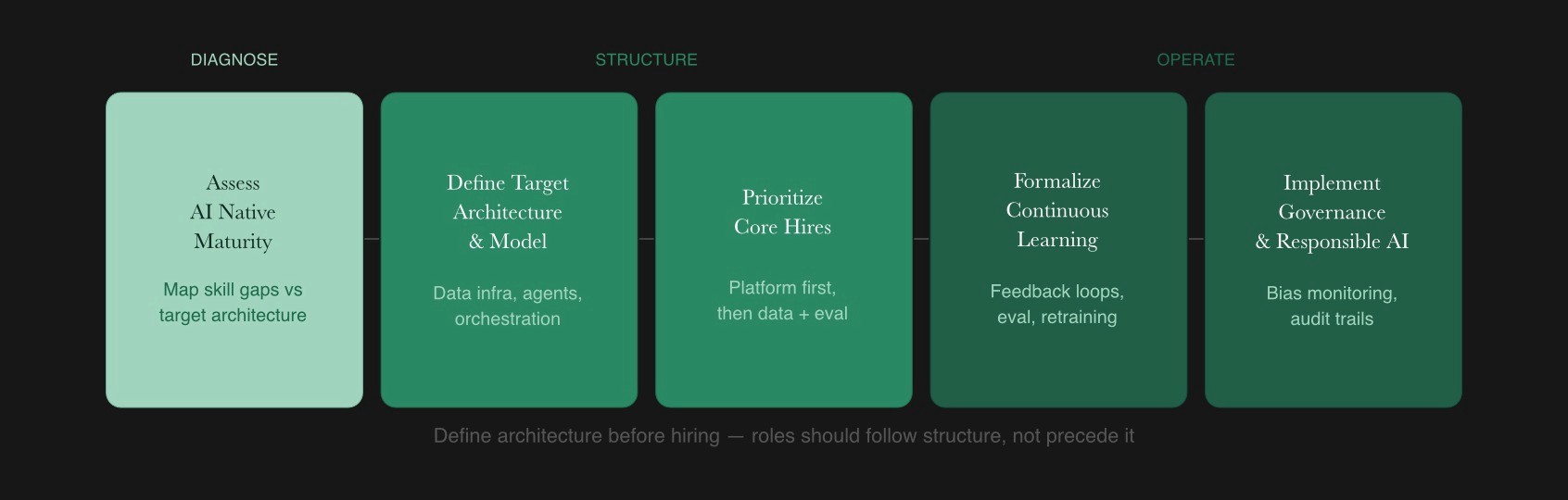
Step 1: Assess current AI native maturity. Determine whether the company is AI-enabled, AI-first, or genuinely AI native in architecture and business model. Map current skill gaps. The AI native maturity model consists of a matrix of five levels, with an additional level of zero signifying not being AI native. For each level, there are several dimensions such as architecture, collaboration, and data ingestion. This model can establish a baseline assessment of where a product is in regard to its AI native journey and set a target of AI nativeness and milestones.
Step 2: Define target AI native architecture and operating model. This includes data infrastructure, AI agents, orchestration layers, and how engineering, data, and product teams will collaborate. Implementing an AI native strategy requires significant effort in data pipelining, model orchestration, and low-latency data architecture. AI native systems require a distributed data infrastructure that supports real-time data generation and consumption across various locations, enabling model training and execution at the network edge.
Step 3: Prioritize core hires and sequencing. Hire a senior AI platform or ML systems engineer first, who can shape the overall architecture. Follow with data engineering, then AI product engineering and evaluation roles. This is not a one-and-done project but an ongoing investment.
Step 4: Formalize processes for continuous learning. Implement experiment tracking, post-release evaluation of AI systems, feedback loops from customers, and regular model or agent updates. Boost productivity through systematic iteration on model training and native technologies.
Step 5: Implement governance and responsible AI practices. Include clear guidelines for AI use, bias monitoring, and documentation of AI decisions. The data infrastructure for AI native systems must include strong security requirements and an optimal mix of multi-cloud resources to ensure data availability and integrity. Data security and a strong data foundation matter from day one.
To reach a minimal level of AI nativeness, an implementation should achieve level 1 on dimensions such as architecture, data ingestion, storage and processing, model lifecycle management, and security.
Transitioning to an AI native architecture involves overcoming challenges such as legacy integration, technical complexity, and ensuring data quality and governance throughout the integration process. AI native integration emphasizes the need for a distributed data infrastructure that supports real-time data processing and model training across various environments, including edge computing. A distributed processing architecture is fundamental, allowing processing to occur where it is most efficient.
External partners, including specialized recruiters or platforms like Fonzi, can supplement this framework when hiring for rare AI native profiles in competitive markets. All this requires alignment between tech stack decisions, data flows, and hiring priorities.
Early-stage founders and established companies alike face similar opportunity cost calculations when deciding how aggressively to pursue AI native capabilities versus proprietary data advantages.
Conclusion
AI-native engineering teams are fundamentally built around data systems, machine learning workflows, and continuous model iteration, which means they require different structures, skill sets, and evaluation methods than traditional software organizations. The distinction between “AI-enabled” and truly “AI-native” is more than marketing terminology. It directly affects how teams design products, organize infrastructure, hire talent, and scale operationally. Engineers in these environments are not just writing code; they are managing intelligent systems, monitoring model behavior, responding to follow-up questions and edge cases, and aligning technical decisions with evolving business goals.
The same principle applies to recruiting. AI-assisted hiring tools can improve consistency and speed, but only when paired with strong human oversight, transparent evaluation criteria, and clear governance around decision-making. For hiring leaders, a practical next step is to review one current or upcoming hiring plan through the AI-native framework discussed in this article and adjust role definitions, interview design, or tooling accordingly. Platforms like Fonzi are increasingly valuable in this environment because they help companies evaluate AI and engineering talent through structured, high-signal workflows that better reflect the realities of modern AI-native product development.
FAQ
What does AI-native mean and how is it different from AI-enabled?
What makes a company or product truly considered AI native?
How do you build an AI native engineering team from scratch?
What skills and roles do AI-native teams need that traditional engineering teams do not?
What are examples of AI-native companies and what sets their engineering apart?


