Is It Bad to Reschedule an Interview?
By
Ethan Fahey
•

Rescheduling a job interview is usually not viewed as unprofessional when it is handled promptly, respectfully, and with a legitimate reason. Most employers understand that unexpected situations, including illness, family emergencies, or unavoidable scheduling conflicts, can happen. What matters most is how quickly the candidate communicates the issue, how professionally they handle the request, and whether they offer clear alternative times to keep the process moving forward.
For recruiters and hiring managers, the response to a scheduling conflict often says more about a candidate’s professionalism and communication style than the conflict itself. In fast-moving engineering and AI hiring environments, where interview coordination is already complex, clear communication and flexibility are essential on both sides. Platforms like Fonzi help streamline these interactions by supporting more structured and transparent hiring workflows, making it easier for both candidates and companies to manage scheduling, expectations, and high-signal conversations throughout the recruiting process.
Key Takeaways
Rescheduling a job interview is acceptable when you have a valid reason and communicate professionally with as much notice as possible.
AI and ML hiring processes involve coordinated panels across time zones, so giving 24 to 48 hours of notice matters more than in many other fields.
Commonly accepted valid reasons include illness, family emergencies, scheduling conflicts with current job responsibilities, and technical issues during virtual interviews.
Rescheduling more than once is viewed as a major red flag for reliability by employers, especially in senior AI and infra roles where execution under constraints is a core signal.
Offering two or three specific alternative times and expressing continued interest keeps the relationship positive and the interview process moving forward.
Is It Bad To Reschedule A Job Interview In AI And ML Hiring?
In modern tech hiring, including AI, ML, and infrastructure roles, a single reschedule is normal if handled professionally. The most important thing is not the act of rescheduling itself but how and why you do it. Hiring managers, including engineering leaders and research leads, typically only see a reschedule as a red flag when it is last-minute without explanation, repeated multiple times, or paired with inconsistent communication.
Many companies use structured hiring processes and scheduling tools like Greenhouse, Lever, or Ashby. These systems coordinate interview slots across multiple interviewers and calendars, often spanning global time zones. A Greenhouse study found that 68% of tech recruiters report reschedules disrupt two to three additional stakeholders. This is why giving enough notice and being clear about your situation matters significantly.
Curated marketplaces like Fonzi, which pre-align interview windows between candidates and AI-focused companies, can reduce friction when interviews need to move. However, even with such tools, the candidate still needs to send a thoughtful human message. For serious AI and ML candidates, it is better to reschedule a job interview and show up fully prepared than to force a meeting that leads to a weak performance.
Valid And Risky Reasons To Reschedule An Interview
Not all reasons carry the same weight with a potential employer. Senior technical candidates are judged partly on judgment and signal management. This section clearly separates legitimate reasons from weak ones that can damage your credibility. Explanations should be honest but concise, and providing too much detail is unnecessary for maintaining trust.
Valid Reasons Hiring Managers Commonly Accept
Medical issues, including sudden illness or caring for an ill child on the morning of a 2026-06-15 onsite, are widely accepted reasons to reschedule a job interview if communicated quickly. If you are sick, it is considerate to reschedule your interview to avoid spreading illness to others, and most hiring managers are understanding in such cases. A 2025 Indeed survey found that 92% of hiring managers accept illness reschedules when notified 24 or more hours ahead.
Family emergencies, such as a hospitalization of a close relative or an unexpected bereavement, are universally recognized as situations requiring immediate attention. Most hiring managers will prioritize your well-being and gladly pick a new interview time. These situations demonstrate that things happen beyond your control.
Current job conflicts represent another category of acceptable reasons. Unexpected work obligations, such as last-minute meetings, project deadlines, or a production incident, can also serve as valid reasons for needing to reschedule an interview. For senior AI infra engineers expected to protect their existing team, a scheduling conflict with a critical outage reflects positively on their reliability in their current role.
External logistics, like car trouble on the way to a 9:00 a.m. onsite or network outages before a remote coding assessment, are acceptable reasons, as long as candidates show they attempted alternatives and notified the company immediately. In structured processes, providing 24 to 48 hours of notice, or as much notice as you reasonably can, almost always keeps relationships positive.
Reason Category | Acceptance Rate | Notice Required |
Illness | 92% | 24+ hours ideal |
Family Emergency | 95%+ | As soon as known |
Current Job Conflict | High (P0 incidents valued) | Same day acceptable |
Transportation Issues | 85% | Immediate notification |
Risky Reasons That Can Become A Red Flag
Saying you are not prepared for the interview is an excuse to avoid, as it may signal a lack of commitment to the opportunity. Rescheduling an interview because you forgot about it is considered a bad reason and can reflect poorly on your reliability. Both scenarios suggest poor planning to a hiring manager.
Rescheduling due to a leisure activity that you would rather do is viewed negatively and can damage your professional reputation. Indecisiveness about the job itself is a poor reason to reschedule, as it may indicate a lack of genuine interest in the position. If your underlying issue is low interest in the role or company, it is more respectful to cancel cleanly rather than push the interview forward without real intent to attend.
Frequent rescheduling or poor communication can lead employers to perceive a candidate as disorganized or uninterested. Repeatedly citing vague personal reasons without pattern breaks, especially more than once, can lead hiring managers to question reliability and long-term execution. Fabricating excuses is particularly risky in technical communities that are relatively small, since reputational damage can persist between companies and hiring managers.
How To Reschedule A Job Interview Professionally
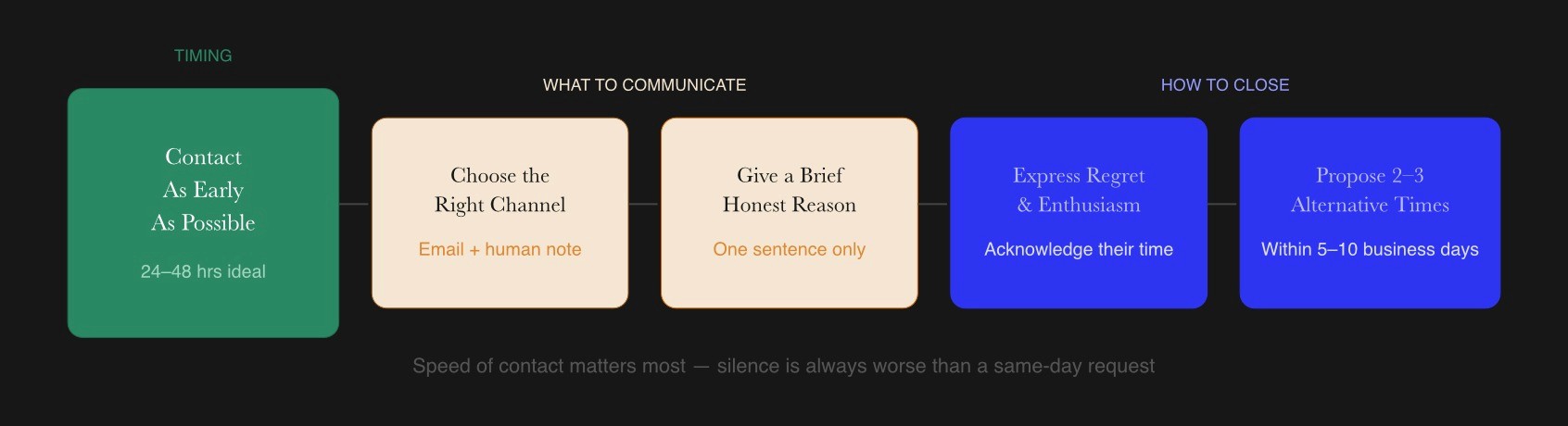
The mechanics of rescheduling matter as much as the reason, especially in AI hiring processes that coordinate engineers, PMs, and researchers across time zones. Communication quality, tone, and speed provide a preview of how you will collaborate with distributed teams and stakeholders if hired.
Contact The Hiring Manager Or Recruiter As Early As Possible
As soon as you know you need to reschedule, whether 24 to 48 hours of notice before a virtual interview or at 7:30 a.m. on the day of a 10:00 a.m. onsite, you should inform the recruiter with as much notice as you can. Contact your interviewer as soon as you know you need to reschedule to minimize inconvenience and maintain professionalism.
Early communication gives hiring managers a chance to reassign your slot to another candidate or internal meeting, which reduces disruption and demonstrates respect for their time. Giving less than 24 hours' notice for rescheduling is considered unprofessional unless there is a true emergency. Last-minute silence followed by a missed interview is significantly worse than a same-day reschedule request that includes a clear explanation and an apology.
Choose A Direct And Appropriate Channel
If you have a direct email thread or Slack connection with the recruiter, use that first, supplemented by a calendar update. Phone calls are suitable for truly urgent same-day changes at short notice. Avoid rescheduling solely through automated calendar links without any context, because senior hiring managers appreciate a short human note that acknowledges the interviewer’s time.
Mention the specific interview stage, such as research manager conversation or live coding with the infra team, so the coordinator can quickly identify which schedule to update.
Give A Brief, Honest Reason Without Oversharing
Providing a brief and honest reason for rescheduling is recommended. A single clear sentence, such as stating that you have a production outage at your current job or a family emergency that requires your attention, is usually enough for a hiring manager. Oversharing can seem like making excuses.
Avoid sharing sensitive medical details, internal company secrets, or emotionally heavy narratives. The goal is clarity rather than full disclosure. Consistency between your reason and your availability window reinforces trust and helps maintain a positive relationship.
Express Regret And Maintain A Positive Tone
Apologizing sincerely for the inconvenience caused by rescheduling is crucial, as it demonstrates professionalism and respect for the interviewer’s time. Include a concise apology that acknowledges the inconvenience caused, for example, noting that you understand it may require rearranging multiple interviewers’ calendars. Apologizing for the inconvenience shows respect and maintains a positive relationship.
Expressing enthusiasm for the role when rescheduling shows that you are not taking the decision lightly and helps maintain a positive relationship with the hiring manager. Close with a brief statement of continued interest for the role, especially for competitive AI positions where the company has many candidates in parallel.
Propose Specific Alternative Interview Times
When rescheduling, always suggest two or three alternative times to make it easier for the hiring manager to accommodate your request. Offering alternative times when requesting to reschedule an interview shows initiative and respect for the interviewer’s schedule. For example, offer windows such as anytime after 2 p.m. PST on Tuesday or Wednesday, or morning slots on Thursday or Friday.
Proposing a window within the next 5 to 10 business days keeps momentum in the interview process, which is important when processes involve multiple stages such as coding, system design, and research deep dives. Pushing the process several weeks out without a strong reason can unintentionally signal low interest compared with other dates, as other candidates are moving forward quickly.
Rescheduling Etiquette In Modern AI Hiring Processes
AI and ML roles often use standardized loops, assessment tooling, and coordinated panels, so even a single schedule change can ripple across multiple calendars. Thoughtful rescheduling can actually send positive signals about how you prioritize commitments, manage load, and respect human time. This is valuable in high-velocity engineering environments.
How Many Times Can You Reschedule Before It Hurts You?
One reschedule, handled professionally in a professional manner, is typically acceptable. Rescheduling more than once is viewed as a major red flag for reliability by employers. Data shows the first reschedule is neutral, with 80% of candidates proceeding, while a second reschedule drops continuation to 50%.
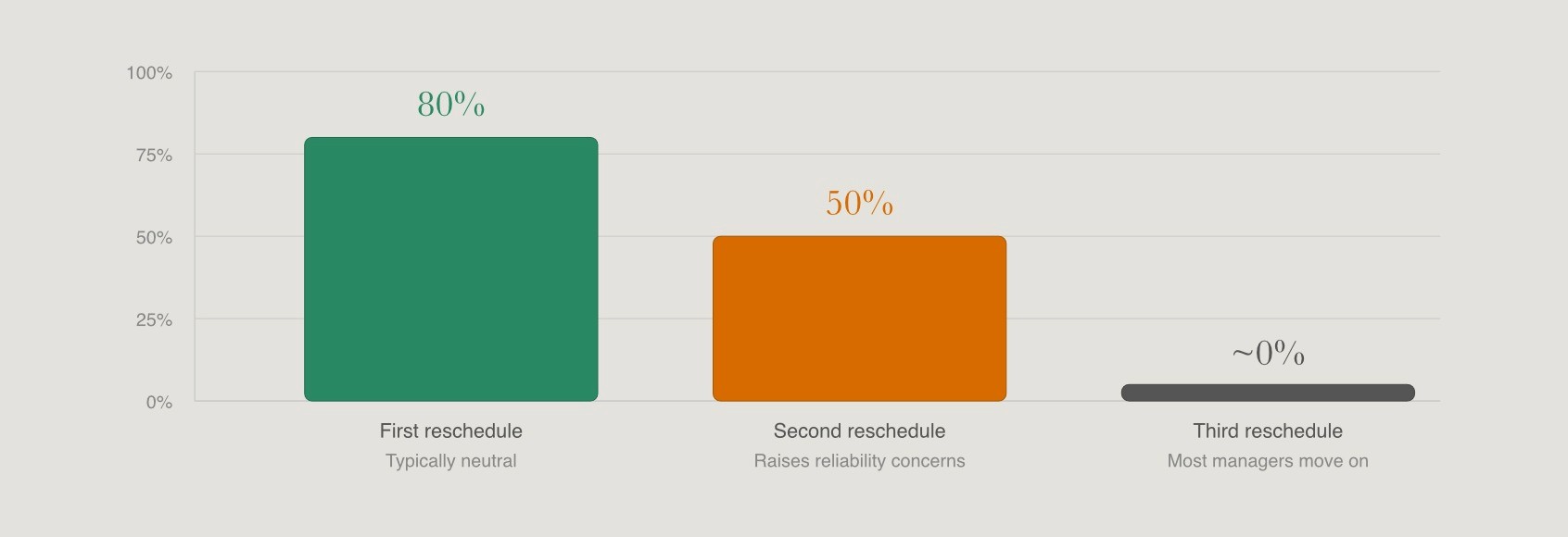
By the third attempt, most hiring managers or technical leads will decide to move on. The pattern suggests misalignment in priorities or risk in long-term reliability. After one rescheduled interview, treat the new date as fixed and adjust other obligations around it to avoid further changes. Impressions matter in competitive hiring.
Balancing Rescheduling With Your Current Job Responsibilities
AI engineers and researchers often have production responsibilities, on-call rotations, or critical experiments running that can conflict with interview windows. Protect your reputation in your current role and be transparent with recruiters that you will not compromise active incident response for interviews.
Practical approaches include booking early morning or late afternoon interview times, using personal days for intensive onsite loops, and sharing preferred windows at the outset. Platforms like Fonzi pre-align these windows, reducing changes by approximately 25% according to internal metrics.
Remote Versus Onsite Interview Rescheduling Considerations
Rescheduling a 60-minute remote job interview is generally easier than changing a full-day onsite that involves travel, office access, and multiple stakeholders. Avoid last-minute changes for onsite loops unless there is a genuine emergency. Give at least 3 to 5 business days of notice, where possible, for on-sites.
For remote interviews, still respect the scheduled time, test your setup in advance, and only reschedule for issues you cannot reasonably mitigate, like severe network outages. The planned time still involves coordination.
AI Tools, Automation, And Human Judgment In Scheduling
Many companies now use AI-assisted tools to propose interview slots, manage interviewer load, and send reminders. This can make schedule changes look easy from the outside. However, the ultimate decision about whether a reschedule is acceptable still rests with human hiring managers and coordinators who assess patterns of behavior.
AI should free recruiters and engineering leaders to focus on substantive conversations. Candidates who are transparent and respectful help achieve that goal. This human-centered view ensures that technology supports rather than replaces genuine interest and judgment.
Practical Templates And Examples For Rescheduling
Senior technical candidates appreciate concrete patterns they can adapt quickly rather than generic advice. These examples reflect the tone of a peer-to-peer conversation with a recruiter or hiring manager, not overly formal legalistic text.
Rescheduling Due To Illness Or Health Issues
Start by thanking the recruiter for the opportunity. Note that an unexpected situation with your health prevents effective participation in the scheduled technical interview. Apologize sincerely if the illness develops within 24 hours. Propose specific other dates later in the same week or the following week. Close by expressing genuine interest in discussing the role once you can participate fully. Best regards and a professional sign-off complete the message.
Rescheduling Because Of A Family Emergency
Briefly state that a family emergency requires your immediate attention on the interview date without sharing private details. Acknowledge the disruption and ask whether the interview can be moved to a defined time window in the next 7 to 10 days. End with appreciation for understanding and reaffirmation that the role remains a priority once life stabilizes. This demonstrates respect while being honest.
Rescheduling To Handle A Critical Production Issue At Your Current Job
Explain that a severe production incident or customer-impacting bug at your current job conflicts with the interview time. This explanation can reflect positively since it shows you honor existing commitments while seeking new opportunities. Suggest a nearby window, such as the same slot one or two days later, to maintain momentum. This approach shows you hope to move forward without burning bridges.
Rescheduling Due To Logistics Like Car Trouble Or Travel Issues
State clearly that unexpected car trouble, canceled trains, or flight delays prevent arrival by the scheduled onsite start time. Mention any attempts to find alternate transportation. Request a new interview date, prioritizing the soonest realistic travel date you can commit to. Reinforce that you value in-person interaction with the team. This talk shows a genuine commitment to the position and can make all the difference in how your request is received.
Conclusion
Rescheduling a job interview is not automatically a negative signal, especially in fast-moving AI and ML hiring processes where schedules can shift quickly on both sides. What matters most is how candidates handle the situation: timing, transparency, professionalism, and follow-through are usually far more important than the reschedule itself. A single, well-communicated change is unlikely to hurt a strong candidate, but repeated last-minute adjustments with vague explanations can quickly raise concerns, particularly for senior engineering or leadership roles where reliability and coordination matter heavily.
A useful approach is to establish your own clear guidelines for when it makes sense to reschedule, prepare professional communication templates ahead of time, and respond quickly when conflicts arise. Candidates who manage scheduling professionally often create stronger impressions even before technical interviews begin. Structured hiring environments can also reduce unnecessary friction by creating clearer expectations and timelines for both sides. Platforms like Fonzi support this by helping companies and senior technical candidates engage through more organized, high-signal hiring workflows that respect time, communication, and process quality throughout the recruiting experience.
FAQ
Is it unprofessional to reschedule a job interview?
What are good reasons for rescheduling an interview that employers accept?
How do I reschedule an interview without hurting my chances of getting the job?
How far in advance should I reschedule an interview to keep it professional?
How many times can I reschedule an interview before it becomes a red flag?


