What Is an Exploding Offer?
By
Samara Garcia
•

An exploding offer is a job offer with a very tight time limit, often used by employers to accelerate hiring and avoid becoming a fallback option while a candidate weighs other opportunities. Since the AI talent surge of 2023-2024, these offers have become significantly more common in high-demand markets like San Francisco, New York, Austin, and Paris. This article is written for experienced AI engineers, ML researchers, infra engineers, and LLM specialists evaluating multiple opportunities. The focus is on practical navigation of exploding offers in a competitive job market, not generic job search advice.
Key Takeaways
An exploding job offer is a proposal with a compressed decision window, typically 24 to 72 hours, that has become increasingly common in AI hiring since the talent surge of 2023-2024, especially in markets like San Francisco, New York, Austin, and Paris.
Exploding offers fit into late-stage interview processes for AI engineers, ML researchers, infra engineers, and LLM specialists, often appearing when companies compete for the same candidates or face budget deadlines.
A tight deadline is not automatically a red flag. Evaluate whether the company provides transparency, responds to reasonable extension requests, and demonstrates respect throughout the process.
Concrete tactics exist for asking for more time, coordinating multiple pipelines, and using deadlines professionally without burning bridges.
Senior technical candidates can apply a simple framework to decide whether to accept, decline, or walk away based on role fit, compensation, culture, and risk tolerance.
What Is an Exploding Offer in the Hiring Process?
An exploding offer is a job offer that expires within a compressed timeframe, typically 24 to 72 hours, and sometimes under one week, with explicit or implicit pressure to decide before other interviews conclude. Employers may set arbitrary deadlines for expiring offers, which, if not met, result in the offer being rescinded. This distinguishes them from standard job offers that allow one to two weeks for a decision-making process, which remains common practice at large tech companies and research labs between 2023 and 2026.
These offers are frequently used in tech, consulting, finance, and startups to lock in talent amidst competitive hiring. In the AI space specifically, exploding offers appear most often at growth-stage startups, small AI product companies, and occasionally big-tech teams racing to fill niche AI or infra roles ahead of budget cycles or product launches. Some exploding offers may come with a sliding-scale signing bonus that decreases over time, adding financial pressure to accept quickly.
Signals that an offer is exploding include:
A hard expiration date communicated in writing
Verbal pressure from a hiring manager or founder to decide immediately
Threats that the offer will be automatically withdrawn if the candidate continues other interviews
Language suggesting the position must be filled by a specific date
Why Companies Use Exploding Job Offers in the AI Market
Employers use exploding offers to push candidates into making fast decisions before they can compare opportunities. In the AI hiring market, companies compete with major tech firms like Meta, Apple, Microsoft, Alphabet, and Amazon, where compensation for senior AI talent can be extremely competitive.
Hiring teams often use tight deadlines to speed up recruiting, reduce offer-shopping, and avoid losing candidates to competitors. Some founders also view quick decisions as a signal of commitment, though this approach remains controversial for senior technical roles.
These tactics can backfire. Candidates who feel pressured may keep interviewing elsewhere, disengage after joining, or leave quickly. High-pressure hiring can also damage a company’s reputation and make it harder to attract strong candidates in the future.
Evaluating Whether an Exploding Offer Is a Red Flag
Not every tight deadline is toxic. Senior AI candidates should evaluate specifics like timeline, transparency, and flexibility rather than react only to the label-expanding offer. Context matters significantly, including the company stage, location, role type, and whether the hiring team has been transparent about deadlines from the start of the interview process.
AI-heavy organizations structure hiring differently from traditional tech companies. Technical deep-dive loops often include 4 to 6 rounds covering coding assessments, ML evaluations, agentic pair-programming or live system-design sessions, and trial projects. These extended processes can affect timing pressures on offers. A 24-hour deadline after a single onsite round is more suspect than a 48-hour deadline following a comprehensive multi-week evaluation.
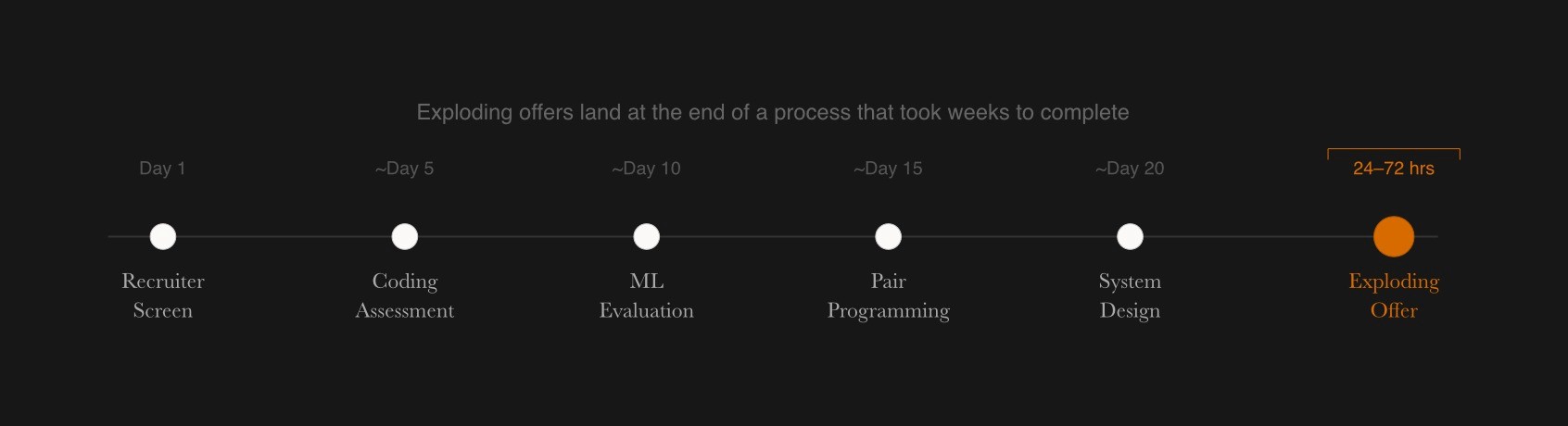
Exploding offers are often criticized as a strategy that can damage long-term employment relationships. Exploding offers can create significant pressure and uncertainty for candidates, often leading to rushed decisions that may not align with their best interests.
Red flag signals include:
Dismissive responses to reasonable questions about role scope
Lack of clarity around equity and compensation, which can represent 50 to 70 percent of total compensation for AI roles
Hostility when a candidate requests a few extra days to compare other options
More benign signals include a clear explanation that the company needed to finalize headcount before a specific date, or transparency that another final-round candidate is also involved, provided communication remains consistent and respectful.
Reasonable Deadlines vs Exploding Offers
Type of Offer | Typical Deadline | Common Context | Candidate Experience |
Standard (e.g., Google DeepMind) | 7-10 business days | Post-full technical loop | Positive, time for comparison |
Firm but Reasonable (e.g., scale-up AI infra) | 5 business days | Budget cycle tied | Respectful if explained |
Aggressive Exploding (e.g., seed AI startup) | 24-48 hours | Post-single onsite | High pressure, rushed feel |
Marketplace/Curated (e.g., Fonzi) | 3-5 business days | Pre-aligned expectations | Low surprise, fair process |
How to Respond When You Receive an Exploding Offer
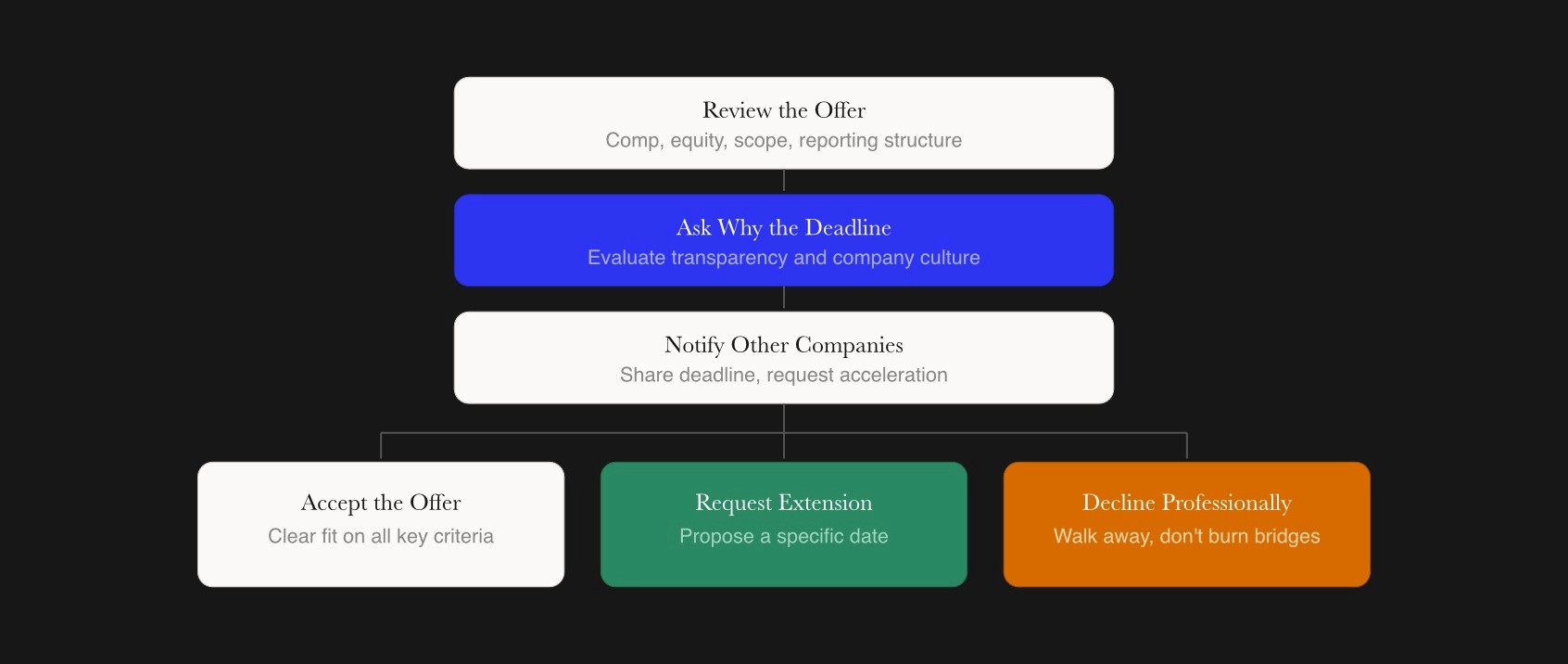
Receiving a 24 to 72-hour exploding offer while still interviewing elsewhere creates significant pressure, especially for senior AI and infra roles. Start by reviewing compensation, equity, scope, reporting structure, and any unclear terms in the offer.
It is also important to ask why the company is using a short deadline, since the answer can reveal either legitimate urgency or potential cultural red flags. Notify other companies where you are in late-stage interviews and share the deadline to see whether they can accelerate their process.
Candidates can often negotiate for more time or additional clarity around equity, remote policies, or research expectations. Some curated platforms like Fonzi also help candidates coordinate timelines across multiple hiring processes.
Scripts and Phrases for Pushing Back on Deadlines
If you need more time to consider an exploding offer, communicate openly with the hiring team about your situation and set realistic expectations for how much time you need.
Requesting an extension:
“I am enthusiastic about the role and team. To make a fully informed decision aligning with my commitment to long-term success here, could we extend to [specific date]? This allows necessary due diligence while respecting your timeline.”
Expressing enthusiasm while negotiating: Expressing enthusiasm for the parts of an exploding offer that you like can help you negotiate for more time to make your decision without indicating disinterest. For example:
“The technical challenges and team structure are exactly what I am looking for. I want to ensure I can commit fully, which requires a few additional days to wrap up my other interviews.”
Walking away professionally:
“Thank you for the offer. After review, the timeline does not permit the consideration required for me to accept with confidence, so I must respectfully decline.”
Notifying other companies:
“I have received an offer with a deadline of [date]. Can you provide an update on your timeline, and is there any possibility to accelerate the final decision?”
Structured Hiring and Match Day Coordination
Fonzi helps AI companies and engineers navigate competitive hiring timelines with more transparency and structure, reducing many of the issues that lead to exploding offers in the first place. Through curated matching and Match Day events, candidates can connect with multiple AI startups and high-growth engineering teams within a more coordinated hiring window rather than juggling disconnected interview processes with unpredictable deadlines.
For engineers, this creates a middle ground between fully independent job searching and high-pressure recruiting funnels. Instead of relying only on rushed timelines or generic recruiter outreach, Fonzi focuses on structured matching based on technical background, role preferences, infrastructure experience, and long-term fit. This approach can help reduce bias in recruitment while improving signal quality for both candidates and companies.
As AI hiring becomes more competitive, companies are increasingly looking for ways to evaluate engineers beyond resume keywords or rushed decision-making. Structured marketplaces and coordinated hiring events allow teams to move quickly without creating unnecessary pressure, while giving candidates more visibility into compensation, role scope, and engineering culture before making important career decisions.
Coordinating Multiple Interview Processes in a Competitive AI Job Market
Exploding offers are often a symptom of poor coordination across multiple interview pipelines. Proactive timeline management starting from the first recruiter screen significantly reduces the risk of last-minute pressure.
Best practices for coordination:
Share a high-level decision target date with each company early in the process, specifying that you aim to make a final decision between two specific calendar weeks
Sequence interviews for different role types, including research-focused positions at labs, infra-heavy roles on platform teams, and applied AI or LLM product roles at startups, to converge decisions within a narrow time window
Track each process with concrete dates, including scheduled technical screens, onsite loops, and expected decision milestones
Anticipate where exploding offers are most likely to appear based on company stage and hiring velocity
Match-based or curated marketplaces can help synchronize these timelines by batching introductions and aligning expectations on when offers will be extended and how long they will remain open.
Framework for Deciding Whether to Accept or Decline
Under time pressure, use a simple decision framework with these criteria:
Criterion | Questions to Ask | Weight |
Role Fit | Does the work match your technical interests and career goals? | High |
Impact and Learning | Will you publish, scale systems, or build meaningful products? | High |
Compensation and Equity | Does total compensation meet your floor, such as $500K+ for senior roles? | High |
Culture and Flexibility | Are there signals of respect, autonomy, and reasonable expectations? | Medium |
Risk Tolerance | What is the startup burn rate? Is the equity realistic? | Medium |
Score each active opportunity against these criteria. Pay attention to any significant negative signals unique to the exploding-offer company. If the exploding offer clearly dominates other realistic options on most criteria, acceptance can be reasonable even with a short deadline, provided you are not sacrificing critical non-negotiables like location, bandwidth for research, or compensation floor.
Summary
Exploding offers are job offers with extremely short deadlines, usually 24 to 72 hours, that pressure candidates to make fast decisions before completing other interviews. They have become more common in AI and engineering hiring as companies compete aggressively for specialized talent. While some reflect real hiring urgency, others can signal concerns around transparency or company culture.
Candidates should carefully evaluate compensation, equity, role fit, and long-term growth before accepting. Communicating proactively with recruiters and requesting reasonable extensions can often help reduce pressure. Platforms like Fonzi also help create more transparent hiring timelines and structured matching between engineers and AI companies.
FAQ
What is an exploding offer, and what does it mean in the hiring process?
Why do companies give exploding job offers?
Is an exploding offer a red flag or a normal part of hiring?
How do I ask for more time on an exploding offer without losing it?
Should I accept an exploding offer if I am still waiting on other interviews?


