How to Prepare for Coding Aptitude Tests
By
Samara Garcia
•

Since around 2022, coding aptitude tests have become a default filter for AI and infra roles at companies like Google, Anthropic, OpenAI, and high-growth startups building agentic systems. For AI engineers, ML researchers, and LLM specialists, these tests are often the first rigorous signal recruiters see beyond a CV or GitHub profile. This article focuses on how experienced practitioners can prepare strategically, treating aptitude tests as a targeted signal rather than a bureaucratic hurdle.
Key Takeaways
Modern coding aptitude tests in the 2026-2027 AI hiring landscape integrate coding tasks with logical reasoning and abstract reasoning to evaluate problem-solving depth, not just syntax recall.
Strong preparation emphasizes pattern recognition in dynamic programming and graph traversals, critical thinking on ambiguous specs, and systems design abstractions rather than memorizing MCQ questions.
AI-assisted recruiting tools can generate or grade aptitude tests, but hiring managers still rely on human judgment for final hiring decisions.
Using programming aptitude tests can reduce mis-hires by up to 30% and improve interview-to-selection ratios by 62%.
Curated, match-based platforms such as Fonzi increasingly use standardized aptitude assessment signals to reduce noise for both candidates and companies.
Understanding Coding Aptitude Tests: What They Actually Measure
A coding aptitude test is a structured aptitude assessment that measures logical reasoning, algorithmic thinking, and practical coding skill under constraints. These tests are usually automated, online assessments with built-in coding editors featuring timer constraints and automatic evaluation.
Major dimensions being measured include:
Logical reasoning through sequences and multi-step constraints
Numerical reasoning with complex calculations
Abstract reasoning via pattern mapping
Critical thinking on ambiguous specifications
Language-agnostic problem solving
Common test formats used from 2023 to 2026 include browser-based IDE coding tasks, timed MCQ questions, code review and debugging snippets, and mini system design prompts. Platforms like Adaface typically use 35-minute assessments combining 8 technical items with 1 coding exercise at moderate difficulty.
These tests differ significantly by role. AI research roles emphasize math and probabilistic reasoning. Infra engineers encounter concurrency and performance questions. LLM specialists might see prompt engineering or tokenization tasks simulating inference constraints. Hiring managers use scores as a coarse filter (top 20-30% advance), as calibration input for onsite difficulty, or to benchmark candidates relative to historical cohorts.
Core Skills Evaluated By Modern Coding Aptitude Tests
Beyond language syntax, tests are optimized to probe skills that generalize across technology stacks and model families. Programming aptitude tests evaluate core skills such as logical reasoning, algorithmic thinking, and mathematical aptitude, which are essential for success in software development.
Many platforms now include non-coding aptitude tests alongside coding tasks, such as numerical reasoning or situational judgment, especially for senior and lead roles. This cluster of skills helps predict long-term performance for AI Software Engineers, Agentic Systems Engineers, AI infra engineers, and ML researchers more reliably than resume keywords.
Problem Decomposition and Logical Reasoning
Tests frequently assess how candidates break down messy requirements into smaller subproblems before writing code. Key components of coding aptitude tests include algorithmic problem-solving, statistical engineering, data structure proficiency, debugging, and logical reasoning.
Typical items include array and graph problems that require structuring intermediate representations, identifying invariants, and arguing about time and space complexity. Many graders score the approach as well as the final answer, so seasoned engineers should explicitly show their reasoning, including edge case exploration and trade-off analysis.
Logical reasoning questions often resemble classic aptitude tests, featuring sequences, pattern recognition, or multi-step constraints. These surface general cognitive agility rather than domain trivia. These tests evaluate a candidate’s ability to solve complex programming problems using logical reasoning, mathematical skills, and coding knowledge.
Abstract Reasoning, Data Structures, and Algorithms
Abstract reasoning questions test the ability to map new problems onto familiar patterns like dynamic programming, greedy algorithms, or union find. Senior candidates are expected to fluently move between concrete implementation and higher-level abstractions, such as representing attention masks as sparse matrices or routing requests through a service mesh.
Canonical data structures that commonly appear in 2025-2026 include:
Heaps for priority queues
Hash maps for caching
Tries for prefix searches
Segment trees for range queries
Basic graph representations for BFS/DFS traversals
Core data structures to focus on include arrays, strings, hash maps, stacks, queues, trees, and graphs. Essential algorithms to master include sorting algorithms, binary search, recursion, greedy algorithms, and basic dynamic programming.
For AI engineers, aptitude tests may weave in probability, linear algebra, or complexity arguments about training loops and inference pipelines as an additional layer of abstraction.
Debugging, Code Quality, and Critical Thinking
Debugging style questions present small code snippets where candidates must identify off-by-one errors, race conditions, or numerical stability issues. These items reveal practical engineering instincts, including defensive programming, clear naming, and safe handling of external inputs and timeouts.
Critical thinking tasks ask candidates to evaluate multiple candidate solutions, compare trade-offs, or reason about failure modes in distributed or GPU-heavy environments. LLM and AI infra roles often include questions about monitoring, observability, and data quality checks, which indirectly probe systematic thinking about production systems.
Communication, Collaboration, and Human Factors
Some coding aptitude tests now incorporate written explanations or short-form justifications, allowing hiring managers to evaluate clarity of communication alongside technical ability. Adding structured communication interview questions and hiring assessments can further help teams evaluate how candidates handle collaboration, conflict resolution, and cross-functional decision-making. Situational judgment tests or scenario MCQs may also appear, asking how candidates would prioritize work, manage incident response, or disagree with a product manager.
At senior levels, being able to articulate trade-offs clearly often matters as much as achieving an optimal solution in record time. These human factors are central for cross-functional AI teams where engineers collaborate with research, product, legal, and policy stakeholders.
How Companies Use Coding Aptitude Tests In AI Hiring Pipelines
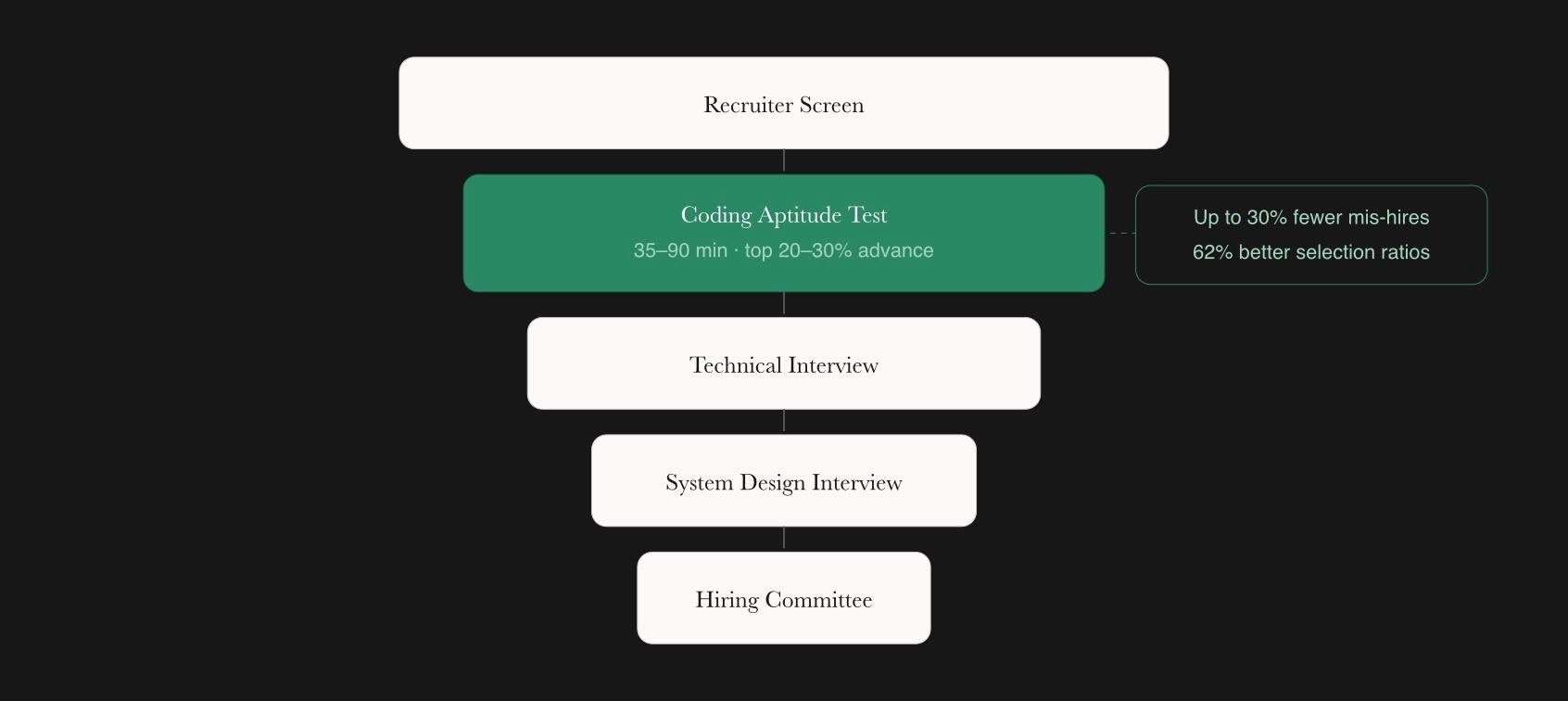
Companies have standardized around structured hiring funnels that typically include an aptitude assessment stage before onsite or research deep dives. Employers typically use coding aptitude tests as a high-volume screening tool early in the recruitment cycle.
A typical funnel for AI roles follows this sequence:
Recruiter screen
Coding aptitude test (35-90 minutes)
Virtual technical interview
System design or research presentation
Final hiring committee review
Coding aptitude tests often serve as the first round after a resume review to filter out candidates who lack basic programming or logical skills. High scorers on coding aptitude tests are typically invited to more intensive stages, such as pair programming or system design interviews.
These tests provide a fair, data-driven way to compare applicants and reduce unconscious bias. Aptitude assessments can identify candidates with the potential to learn and excel in programming, regardless of their existing coding background. For entry-level or junior roles, coding aptitude tests identify raw talent in candidates who may not have long resumes but possess the cognitive ability to pick up complex skills quickly.
AI tooling is now used to generate coding challenges, auto-grade submissions, and flag potential plagiarism, though human review remains essential.
How Hiring Managers Interpret Aptitude Scores
Scores are rarely used in isolation. Hiring managers contextualize them with experience level, portfolio quality, and references. Aptitude tests help hiring managers make better decisions by providing insights that allow for objective comparisons of candidates based on their skills rather than resumes, which can be unreliable.
Percentile rankings, subscore breakdowns (logic versus coding speed), and historical benchmarks influence hiring decisions across large organizations. Some hiring managers treat high scores as evidence of strong raw ability and are then more flexible on specific tool or framework experience.
Strategic Preparation For Coding Aptitude Tests As A Senior Engineer
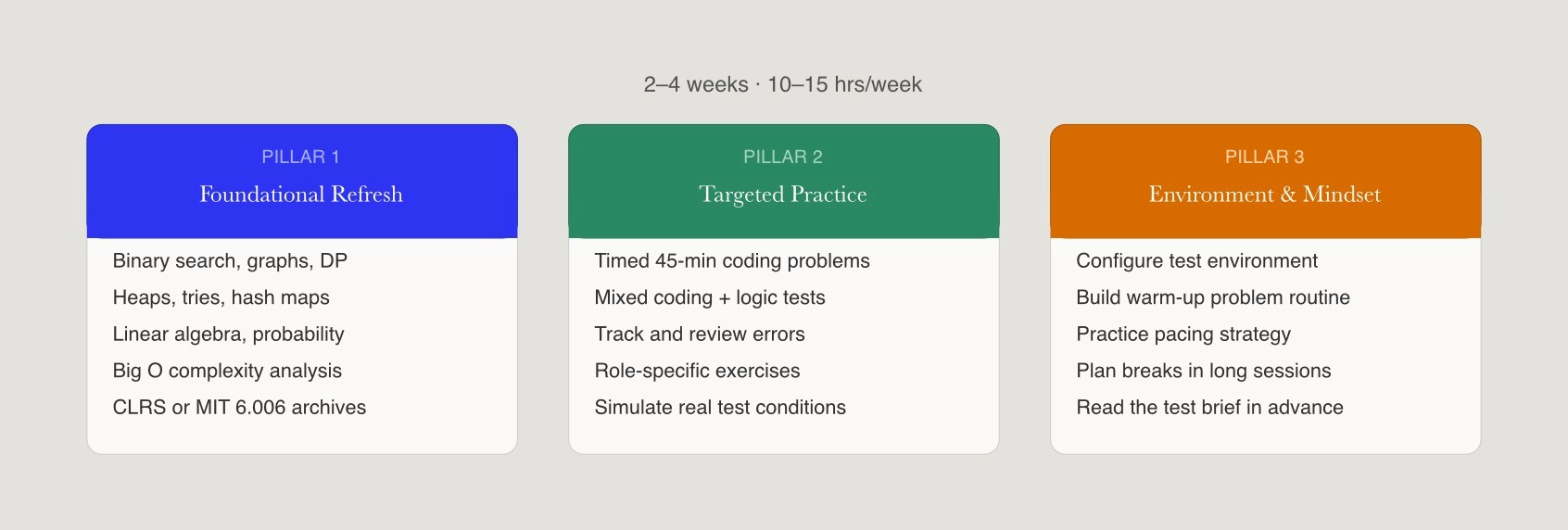
Experienced AI practitioners often have less time and different constraints than early career candidates, so preparation must be focused and efficient. Preparing for a coding aptitude test requires a mix of fundamental computer science knowledge, structured practice, and strategic time management.
Preparation should cover three pillars: foundational skills refresh, targeted practice tests, and environment and mindset tuning. A realistic preparation window is 2 to 4 weeks before an interview cycle, allocating 10-15 hours per week.
Refreshing Core CS And Math Foundations
Allocate time to revisit essential algorithms and data structures, prioritizing those that frequently appear in aptitude tests like binary search, graphs, dynamic programming, and queue-based BFS or DFS. Understanding Big O notation is important for analyzing and optimizing solutions in coding aptitude tests.
Cover math topics relevant to AI roles, including linear algebra operations (eigenvectors, matrix decomposition), basic probability (Bayes theorem), and complexity analysis of training and inference loops.
Specific resources worth considering:
LeetCode (10,000+ problems with discussion)
Introduction to Algorithms (CLRS 3rd edition)
MIT 6.006 course notes from 2022-2026 archives
University-hosted algorithm problem archives
Encourage short, focused sessions of 45 minutes that work through complete problems end to end with explicit analysis of correctness and performance.
Deliberate Practice With Aptitude Style Problems
Use practice tests effectively by simulating real constraints, mixing coding and non-coding aptitude tests, and spacing sessions to avoid burnout. Practicing solving problem questions within a set time limit is critical for preparation.
Advise practicing in the language most likely to appear in the assessment, typically Python, C++, Java, or Rust, and treating the environment as close to the real test as possible. Most coding aptitude tests are conducted through online platforms and include different types of assessments.
Track patterns across missed questions. Common issues include recurring off-by-one errors in array problems, misreading constraints in logical reasoning questions, or over-complicating simple tasks. Using practice tests tailored to specific skills can significantly enhance a candidate’s performance in programming aptitude assessments.
Preparation Focus By Role Type
Use the following table to align your preparation with your target role:
Focus Area | AI Research Scientist | LLM Product Engineer | Infra/Platform Engineer |
Core Algorithms | Graphs, DP, optimization | Strings, tries, DP | Graphs, queues, heaps |
Math/Theory | Linear algebra, probability | Tokenization, statistics | Concurrency theory |
System Topics | Optimization loops, training | Inference pipelines | Distributed caching |
Test Formats | Math-heavy MCQs, coding | Prompt/debug tasks | System sims, debugging |
A comprehensive programming aptitude test can include various components such as logic puzzles, hands-on coding exercises, and theoretical questions to assess a candidate’s potential for technical roles. Common question types in programming aptitude tests include coding exercises, multiple-choice questions, debugging tasks, and problem-solving scenarios.
How Structured Hiring Platforms Are Changing AI Recruiting
By 2026, many AI-focused companies will use structured platforms, internal or external, to organize hiring pipelines and surface the next generation of engineering talent. Curated marketplaces and match-based models centralize aptitude tests and portfolio reviews, reducing the need for candidates to repeat the same assessments for every company.
Fonzi is one example of a curated marketplace where engineers can complete standardized coding aptitude assessments once and share those signals with multiple AI startups actively hiring. This structure reduces noise for hiring managers by creating more consistent and comparable evaluations, while candidates spend more time on meaningful technical conversations instead of repetitive screening rounds. Fonzi’s Match Day events also help connect pre-vetted engineers with startups hiring for AI, infrastructure, and LLM roles.
As AI hiring becomes more competitive, structured platforms are increasingly being used to reduce bias in recruitment and improve consistency across technical evaluations. Standardized assessments combined with human review, project analysis, and deeper technical interviews help companies focus on real engineering ability rather than resume formatting or keyword matching alone.
Summary
Coding aptitude tests are now a standard part of hiring for AI, infrastructure, and software engineering roles. Modern assessments evaluate more than coding syntax, testing logical reasoning, algorithms, debugging, problem solving, and communication under time constraints. Companies use these tests early in the hiring process to compare candidates consistently, reduce bias in recruitment, and identify engineers with strong technical fundamentals and real-world problem-solving ability.
Strong preparation focuses on refreshing core computer science concepts, practicing timed coding problems, and improving structured thinking rather than memorizing answers. Engineers should focus on algorithms, data structures, debugging, and role-specific topics like distributed systems or machine learning fundamentals. Platforms like Fonzi are also helping streamline AI hiring by allowing candidates to complete standardized technical evaluations that can be shared with multiple startups and engineering teams.
FAQ
What is a coding aptitude test, and what does it measure?
What types of questions show up on coding aptitude tests?
Where can I practice coding aptitude tests for free?
How do I prepare for a coding aptitude test if I am not a strong test taker?
Do coding aptitude tests actually predict job performance for engineering roles?


