
The topgrading interview is a rigorous hiring methodology created by Brad Smart in the 1990s, designed specifically to identify top performers he calls “A players.” This article focuses on practical, usable topgrading interview questions and how to plug them into an end-to-end interview process. Topgrading interviews are now common in executive and high-stakes hiring, including for engineers and AI roles, not only for C-level positions. Some teams, such as curated talent marketplaces like Fonzi, use elements of topgrading to screen software engineers for fast-growing startups. The rest of this article will walk through structure, question types, and implementation tips rather than promoting any specific tool or platform.
Key Takeaways
A topgrading interview is a structured, chronological deep dive into a candidate’s full work history, usually covering back to roughly 2010 to 2015 for mid-career professionals.
Topgrading interview questions differ from a standard competency-based interview by tying every answer to measurable outcomes, boss relationships, and reasons for leaving each position.
Hiring managers can use work history forms, screening interviews, and reference calls together as one integrated topgrading interview process for maximum accuracy.
Sample topgrading interview questions for each stage, from quick screens to four-hour career history sessions, can be adapted and copied directly into interview guides.
Executive summaries and post-hire coaching turn insights uncovered during topgrading interviews into actionable development plans for every new hire.
What Is a Topgrading Interview and How Does the Process Work
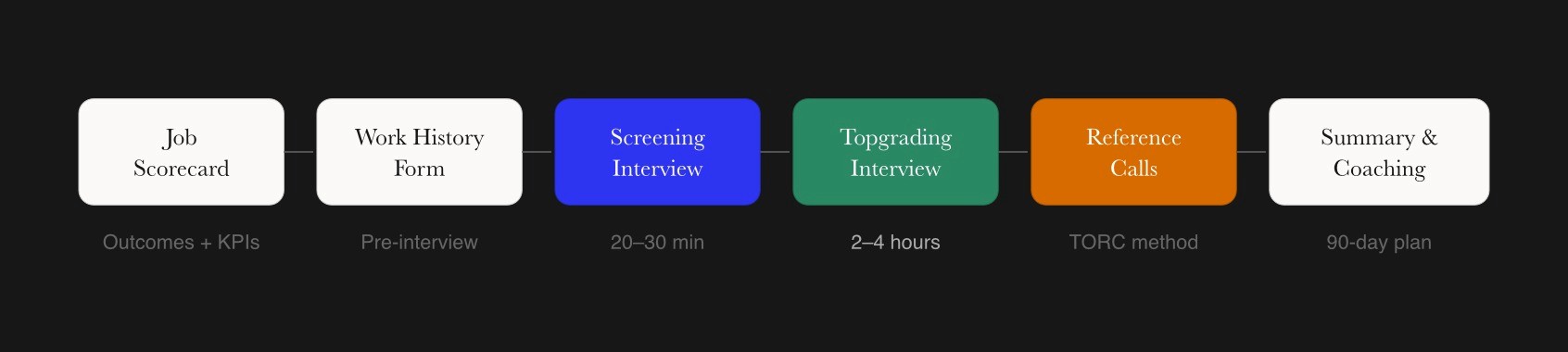
The topgrading interview process consists of a strategic 12-step method that can be reordered and modified to meet specific hiring needs. At its core is the in-depth, chronological topgrading interview where interviewers explore a candidate’s entire career rather than sampling a few recent experiences.
The full topgrading process usually includes preparation, a work history form, a screening interview, a long-form topgrading interview, reference calls, and new hire coaching. The topgrading interview involves a comprehensive, chronological exploration of a candidate’s job history, focusing on their decisions and behaviors over the past 15 years to predict future performance.
The topgrading process categorizes applicants into A, B, and C players, defining A players as the top 10 percent of talent available for a role at a given salary tier, B players as the next 25 percent, and C players as the remaining 65 percent. While standard hiring practices typically yield only a 25 percent success rate, implementing the Topgrading methodology improves an organization's hiring success rate to 75 to 90 percent. Topgrading is a methodology designed to identify high-quality candidates, referred to as “A players,” by examining their detailed work history and performance track rec
Unlike a regular competency-based or behavioral interview that samples two or three STAR stories, topgrading requires reviewing entire careers. The scope covers every job, while the depth demands specific facts, ratings, and verifiable metrics. Identifying patterns in a candidate’s past performance is crucial for predicting their future success, as people tend to exhibit consistent behaviors over time.
A job scorecard anchors all interview questions and assessments, listing clear outcomes, KPIs, and competencies for the role. Even if a company does not follow all 12 steps, adopting the structured interview questions and reference discipline can significantly improve hiring decisions.
Core Components of the Topgrading Interview Process
Strong results come from treating topgrading as a sequence of connected steps, not a single long interview. This section covers preparation, work history forms, screening interviews, and the main topgrading interview in enough detail for any hiring manager to start using them.
Each component should produce written notes that feed into an executive summary and final hiring decision. The examples and sample topgrading interview questions below provide clarity for each stage.
Preparation, Job Scorecards, and Role Definition
Start by defining the role in a one-page job scorecard that lists outcomes, competencies, and cultural traits. For example, an outcome might read: “Ship v1 of the new analytics dashboard by Q4 2026 with 99.9 percent uptime.”
A strong scorecard includes:
5 to 8 measurable outcomes tied to business goals
6 to 10 core competencies rated on a consistent scale
3 to 5 explicit values alignment criteria matching the company’s core values
This preparation step typically involves the hiring manager, HR, and sometimes an executive sponsor for senior roles. Having a scorecard in place keeps interview questions consistent across multiple interviewers and reduces bias.
Using a Work History Form to Prime the Topgrading Interview
The work history form is a structured document that candidates complete before interviews, covering all roles back to early career with dates, titles, managers, responsibilities, achievements, and reasons for leaving. The topgrading methodology emphasizes the importance of understanding a candidate’s detailed work history and skillset to make informed hiring decisions.
Key fields the form should capture:
Field | Details |
Employment dates | Exact month and year for start and end |
Compensation | Starting and ending salary in USD ($) |
Manager information | Names, titles, contact details |
Team size | Direct and indirect reports |
Accomplishments | 3 to 5 with specific metrics |
Self-rated performance | A, B, or C rating with explanation |
Reason for leaving | Honest account of departure |
The form serves as both a screening tool and the backbone of the later topgrading interview, saving 20 to 30 percent of interview time. For technical roles, the work history form can also ask about specific tech stacks, code ownership, systems scale, and incident history.
Screening Interview and Competency-Based Interview Stages
The screening interview is usually a 20 to 30-minute phone or video call focused on obvious fit issues, such as location, salary range in USD ($), and baseline qualifications.
Sample topgrading-style screening questions:
“What was your most important achievement in your last job, and what metric proves it?”
“How would your most recent manager rate your performance on a 1 to 10 scale?”
“Why do you think they would give you that score?”
“Why are you considering leaving your current position?”
The competency interview is a 45 to 90-minute conversation that zooms in on specific skills from the job scorecard. Topgrading interviews utilize competency-based questions focused on a candidate’s entire career history to assess patterns of success and failure.
Competency-based interview question example for stakeholder management:
“Describe your biggest influence win with a senior stakeholder. What was the measurable result? How would your manager rate your performance on a 1 to 10 scale, and why not a 10?”
The Long Form Topgrading Interview Structure
The topgrading interview typically involves detailed discussions of a candidate’s education history and every job they have held, lasting around four hours. For mid-level positions, expect 2 to 3 hours. Sessions are often augmented by AI-assisted transcription for senior roles and are ideally led by two interviewers for calibration.
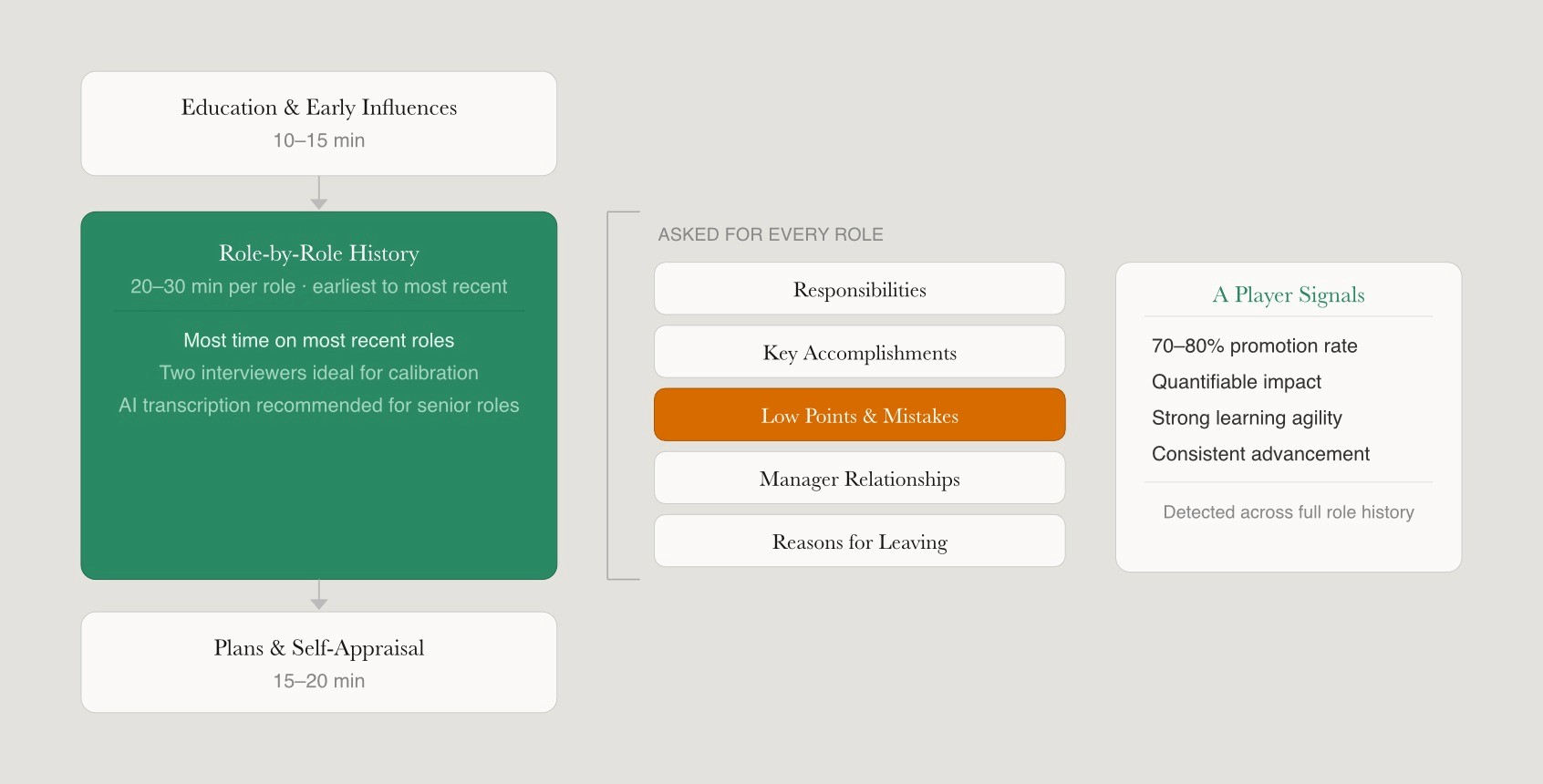
The chronological structure proceeds as follows:
Education and early influences (10 to 15 minutes)
Each job from earliest to most recent (20 to 30 minutes per role, more time for recent positions)
Plans and self-appraisal (15 to 20 minutes)
For each role, interviewers consistently explore responsibilities, key accomplishments, low points or mistakes, relationships with managers and peers, and reasons for leaving. Some teams, including specialized marketplaces like Fonzi, adapt this structure into shorter, modular sessions while keeping the same sequence of questions.
Topgrading Interview Questions You Can Use Today
This section provides a practical library of sample topgrading interview questions that readers can plug into their own interview guides immediately. Questions are grouped into categories: early life and education, role-by-role history, competency probes, plans, and self-appraisal. Adjust wording to match your company's language while preserving the intent of each question.
Opening, Context Setting, and Early Life Questions
Start the interview by explaining the agenda, the chronological format, the length of the session, and that the company will likely talk to former managers later. Effective Topgrading interview questions explore the candidate’s role, their accomplishments, failures, team dynamics, and reasons for leaving past jobs.
Sample opening questions about early influences:
“What were the major influences that shaped your work ethic and career direction?”
“Tell me about your first job or part-time work. What were you hired to do, and what are you most proud of from that time?”
“Why did you choose your degree? What alternatives did you consider, and who were the most influential people in that decision?”
Keep these questions conversational and brief so that most time is saved for recent roles.
Role by Role Sample Topgrading Interview Questions
For each job in the last 10 to 15 years, ask the same core set of questions to build a comparable data set. Topgrading employs structured, pattern-seeking questions to verify competencies and eliminate hiring mistakes.
Responsibilities questions:
“What were you hired to do in this role?”
“What were the main KPIs or targets you were responsible for?”
“How did your role change over time?”
Accomplishment questions:
“What are you most proud of accomplishing in this position?”
“What were the measurable results of your success?”
“Who else was involved, and what was your specific contribution?”
Low points and challenge questions:
“What were the biggest mistakes you made in this job?”
“What would you do differently if you could go back?”
“How did your manager respond to these low points?”
Relationship questions:
“How would your manager at that time rate your performance on a 1 to 10 scale?”
“What would they say you should do more or less of?”
“Can you spell your supervisor’s name, and what were your relationships like with peers?”
Departure questions:
“Why did you leave this position?”
“When did you first start thinking about leaving?”
“What did your manager do when you resigned?”
Competency Deep Dives and Technical Examples
After covering basic facts for each role, add deeper questions on competencies that matter most for the open position. Asking targeted questions in a technical interview can help hiring teams evaluate problem-solving ability, communication skills, system design thinking, and real-world technical judgment beyond surface-level experience.
Leadership questions:
“Tell me about a specific hiring decision you made. How did you source the candidate, and what was the outcome?”
“Describe a time you had to provide feedback to an underperforming team member. What happened?”
“Walk me through a complex project that went off track. How did you diagnose the root cause, and what did you do to fix it?”
Technical questions for engineers:
“Describe your experience with AI-agent oversight and incident response history. What systems were affected, and how did you resolve the issue?”
“Tell me about an architecture decision you now regret. What would you change?”
“Walk me through a performance optimization you led. What were the before and after metrics?”
Future Plans, Self Appraisal, and Closing Questions
Future-focused questions help determine fit and long-term career goals:
“What are your career goals for the next 3 to 5 years?”
“What types of work and managers energize you most?”
Self-appraisal prompts reveal honest self-awareness:
“What patterns do you see in your strengths and weaknesses across your career?”
“How would you rate yourself compared with peers in similar roles, and why?”
Close by inviting candidates to discuss any concerns about mutual fit and ask questions about the team, culture, and position.
From Interview Notes to Executive Summary, Reference Calls, and New Hire Success
The value of a long topgrading interview depends on how well the data is synthesized and validated after the conversation. After conducting the topgrading interview, interviewers share feedback to identify effective techniques and areas needing improvement, which is crucial for refining the interview process.
Writing an Effective Executive Summary After Topgrading Interviews
The executive summary is a concise 1 to 3-page document that distills the entire interview process into patterns, strengths, risks, and a recommended decision.
Typical sections include:
Section | Content |
Work history snapshot | Table with role, dates, accomplishments, rating |
Key themes | Consistent promotion patterns, leadership style |
Scorecard ratings | 1 to 5 ratings on critical competencies |
Gaps and risks | Areas where the candidate falls short |
Recommendation | Hire, do not hire, or further evaluation needed |
Include verbatim quotes from the candidate where useful, and have multiple interviewers review and sign off before a final offer decision.
Running Structured Reference Calls
A core component of Topgrading is the Threat of Reference Check (TORC), where candidates must arrange reference calls with former managers to ensure honesty during the interview process. This tests relationships and transparency.
Reference call questions that mirror the interview:
“On a 1 to 10 scale, how would you rate this person’s performance?”
“Would you rehire them without hesitation?”
“What were their top strengths and improvement areas?”
“Can you verify (specific metric or project ownership)?”
Keep a standard reference call template so notes can be compared directly across multiple referees and quality candidates.
Using Insights for New Hire Onboarding and Coaching
The executive summary can double as a coaching document for the first 90 days of an employee’s tenure. Incorporating a structured employee onboarding process helps align expectations, reinforce strengths, and identify likely growth areas early in the role.
Schedule early check-ins at 30, 60, and 90 days, focused on themes uncovered in the topgrading interview. This follow-through reinforces candidate trust and turns the hiring process into a foundation for long-term performance.
Practical Tips for Hiring Managers Using Topgrading Interviews
These real-world tips help teams adopt topgrading interview techniques without overwhelming candidates or interviewers. Many organizations start with one or two critical roles before rolling out topgrading more widely. A curated marketplace like Fonzi can handle some of the heavy lifting for topgrading-style screening when startups have limited internal recruiting capacity.
Training Interviewers and Maintaining Consistency
Run internal training sessions where hiring managers practice topgrading questions with each other and calibrate scoring using sample profiles. Create shared interview guides with the exact questions to ask for each role. Recording early topgrading interviews, with candidate consent, helps new interviewers study pacing and follow-up techniques. Schedule debrief meetings after each interview to identify missed questions and refine the process.
Managing Time, Candidate Experience, and Legal Considerations
Set expectations with interviewees about the length and structure of a topgrading interview, including breaks for longer sessions. Focus more time on the last 5 to 7 years of experience while treating earlier roles at a higher level to keep the total duration manageable. Avoid questions that touch on protected characteristics or personal topics unrelated to the job. Send candidates a brief overview of the topgrading process in advance, along with the work history form, to reduce stress and improve answer quality.
Adapting Topgrading for Technical and Remote Hiring
For engineers, topgrading questions should explicitly probe code ownership, system impact, and measurable reliability improvements. Combine topgrading interviews with live coding or system design exercises scheduled as separate sessions that still connect back to the job scorecard.
For video interviews, schedule multiple shorter blocks, share an agenda, and use a real-time interview intelligence platform for notes. Distributed teams involving multiple time zones need clear communication about stages and coordination of phone interviews and later-stage sessions.
Topgrading Interviews for Engineering and AI Hiring
Fonzi uses elements of topgrading-style interviewing to help startups and AI companies evaluate engineers beyond surface-level resumes or generic technical screens. Rather than relying only on short interviews or automated filters, structured interview processes focused on measurable outcomes, project ownership, problem solving, and career progression can give hiring teams a clearer view of how candidates actually perform in real-world engineering environments. Fonzi also hosts Match Day events that connect pre-vetted engineers with AI startups and high-growth companies, helping hiring teams move from sourcing to interviews faster while maintaining strong technical evaluation standards.
As technical hiring becomes more competitive, companies are increasingly looking for ways to reduce bias in recruitment and improve signal quality during interviews. Structured topgrading-style questions help create more consistent evaluations across candidates while uncovering deeper insights into leadership, execution, communication, and long-term performance patterns. For AI and software engineering roles, especially, this approach can improve hiring accuracy while helping teams identify candidates with strong technical depth and practical experience.
Summary
Topgrading is a structured interview methodology designed to identify high performers through a detailed, chronological review of a candidate’s career. Unlike standard behavioral interviews that focus on a few examples, topgrading explores every major role, emphasizing measurable outcomes, leadership, mistakes, manager relationships, and reasons for leaving. The process typically includes job scorecards, work history forms, screening interviews, long-form interviews, reference calls, and executive summaries to create a more complete and consistent evaluation process.
Companies increasingly use topgrading-style interviews for engineering, AI, and leadership hiring because they help uncover real patterns in execution, problem-solving, and long-term performance. Structured questions tied to KPIs, project ownership, technical decisions, and collaboration can improve hiring accuracy while reducing bias in recruitment. Platforms like Fonzi also apply elements of topgrading to help startups evaluate engineers beyond surface-level resumes, combining structured evaluations with curated matching for AI and high-growth technical roles.
FAQ
What is a topgrading interview, and how is it different from a regular interview?
What are the most important topgrading interview questions to ask candidates?
How should candidates prepare for and answer topgrading interview questions?
How long does a topgrading interview typically take?
Is the topgrading method effective for hiring engineers and technical roles?


