Senior Engineer: Job Description, Duties & Salary Guide (2026)
By
Liz Fujiwara
•

You have been building production systems for six years. You have deployed ML models, migrated services to Kubernetes, mentored new hires, and led a refactor that cut latency by 40 percent. Yet when you browse job listings, you see very different expectations for a “senior engineer” across startups, large tech companies, and AI labs. Are you actually a senior?
This question drives thousands of experienced engineers to search “what is a senior engineer” every month. The answer used to be simple. In 2026, it will not be.
In this article, we cover what defines a senior engineer, the responsibilities that matter in 2026, how AI is shaping hiring, and how Fonzi AI Match Day helps candidates navigate the market, with a focus on software and AI and ML roles.
Key Takeaways
A senior engineer in 2026 is defined by impact, ownership, and system-level thinking, with responsibility for end-to-end delivery of production systems in AI, ML, infrastructure, and LLM-focused roles.
Compensation varies by region and specialization, with US-based senior AI and ML engineers earning roughly $220k to $280k or more in major markets, while general senior software engineers typically earn $150k to $220k.
Fonzi AI Match Day is a 48-hour hiring event where pre-vetted senior engineers connect with AI-first companies through a structured process with upfront salary transparency and faster decisions.
What Is a Senior Engineer? A Modern Definition

The old view was straightforward: work for 10 or more years, and you become senior. That definition is outdated. In 2026, seniority is about demonstrated impact, ownership, and system-level thinking, not calendar time.
A senior engineer is someone who can independently own complex problems end-to-end. This includes understanding the business context, designing the system, shipping production-grade solutions, and supporting them in real environments. You do not wait for detailed specs. You identify what needs to be built, make trade-offs explicit, and execute with minimal guidance.
Typical scope for a senior engineer includes owning a critical service or domain, driving multi-sprint initiatives, and being the go-to problem solver when issues arise. In AI and ML contexts, this could mean leading deployment of an LLM-powered recommendation system, redesigning a data pipeline to support real-time inference, or building evaluation frameworks for model outputs.
How does “senior engineer” compare to adjacent job titles? A senior software engineer, senior ML engineer, and senior data engineer operate at similar levels of responsibility, with the main difference being domain expertise. A senior ML engineer focuses on model development and deployment, while a senior infrastructure engineer focuses on scalability and reliability. Leadership capabilities and ownership expectations are parallel.
Core Responsibilities of a Senior Engineer
Senior engineers spend their days across coding, design, collaboration, mentoring, and reliability, not just writing code. The balance shifts depending on team size, company stage, and domain, but the core responsibilities remain consistent.
Key responsibilities include:
System design and technical ownership: Architecting solutions that scale, making trade-offs between latency, cost, and accuracy, and aligning designs with long-term product goals.
Implementation and code quality: Writing production-ready code, refactoring legacy systems, and maintaining technical excellence through code review and standards enforcement.
Technical leadership: Providing technical direction on projects, leading design reviews, and making decisive calls when the engineering team faces ambiguity.
Mentoring and collaboration: Pairing with junior engineers, reviewing design documents, and helping others navigate complex systems.
Reliability and operations: Monitoring production systems, participating in on-call rotations, and conducting root cause analysis after incidents.
Cross-functional collaboration: Working with product managers, data scientists, and other stakeholders to translate business requirements into technical plans.
For AI and ML roles, senior engineers are often responsible for evaluating model performance, overseeing A/B tests, and ensuring responsible AI practices. For infrastructure roles, there is more emphasis on SRE-like duties, including observability, capacity planning, and incident response.
Technical Ownership and System Design
A senior engineer working in a modern tech company typically owns one or more services or systems, such as a recommendation engine, an LLM-based customer support bot, or a payments microservice. This ownership means you are accountable for the system’s health, performance, and evolution.
System design expectations include creating technical design documents that make trade-offs explicit. Should you optimize for latency or cost, accuracy or speed? These decisions shape the architecture. You are expected to align designs with the long-term technical direction while solving immediate problems.
Tangible examples include designing a retrieval-augmented generation (RAG) pipeline for an AI product, migrating from a monolith to microservices, or introducing feature flags for safer releases. Senior engineers often lead design reviews, challenge risky approaches, and choose appropriate tools such as Kubernetes versus managed PaaS or OpenAI API versus self-hosted models.
Coding, Code Quality, and Technical Excellence
Senior engineers still write code in 2026 regularly. However, the percentage of time spent coding may drop to 50 to 70 percent as you take on more design and mentorship responsibilities. The code you write tends to be higher-stakes, such as core infrastructure, complex integrations, or performance-critical paths.
Expectations include writing production-ready code, refactoring legacy systems, improving performance, and paying down technical debt strategically. You are not just shipping features; you are raising the bar for the whole team.
Code review is a core duty. You review high-risk changes, enforce standards, and provide feedback that helps other engineers improve. Effective communication during reviews matters as much as technical correctness.
In 2026, senior engineers are expected to use AI coding assistants effectively for boilerplate, tests, or refactors while maintaining strong judgment about correctness and security. The tools accelerate work, but they do not replace your expertise.
Mentoring, Collaboration, and Influence
Mentoring is a significant responsibility. This includes pairing with junior engineers, providing feedback on design documents, and helping others navigate the codebase and system architecture. Mentorship happens through day-to-day collaboration rather than formal training sessions.
Cross-functional collaboration means working with project managers, data scientists, ML researchers, and designers to translate business requirements into technical plans. Examples include aligning on success metrics for a new ranking model, negotiating scope for an MVP, or educating stakeholders on realistic AI capabilities and limitations.
Senior engineers are often culture carriers. They influence team norms around incident response, documentation, experimentation, and ethical AI practices. Your leadership shapes how the software engineering team operates even if you do not have direct reports.
Reliability, Security, and Responsible AI Practices
Senior engineers are accountable for reliability in production. This includes monitoring, alerting, on-call rotations, and root cause analysis after incidents. When systems fail, you are expected to lead the response and implement the fix.
In AI and ML systems, senior engineers often evaluate drift, data quality issues, and fairness of models in real-world use. You track model performance and flag when retraining or intervention is needed.
Security expectations include protecting PII, managing access to model APIs and data stores, and following secure coding and deployment practices. For AI products, you help define guardrails such as content filters, abuse detection, and human-in-the-loop reviews, and ensure compliance with internal governance and regulations.
Key Skills of a Senior Engineer in 2026
Seniority is defined at the intersection of technical depth, breadth across the software lifecycle, and strong communication and leadership skills. In 2026, AI tools raise the bar, and senior engineers are expected to focus on higher-order design, correctness, and product impact rather than raw output volume.
For each skill cluster below, ask yourself whether you can own this responsibility with minimal oversight. If yes, you are operating at a senior level.
Technical and Domain Expertise
Core technical skills for senior software engineers include:
Strong proficiency in at least one major language (Python, TypeScript/JavaScript, Go, Java)
Deep understanding of databases (SQL and NoSQL), REST/gRPC APIs, testing frameworks, and CI/CD pipelines
Experience with cloud providers (AWS, GCP, Azure) and containerization (Docker, Kubernetes)
For senior AI/ML engineers, add:
Modeling fundamentals and modern deep learning frameworks (PyTorch, TensorFlow)
Vector databases and RAG architectures for LLM-based systems
Prompt engineering and evaluation frameworks for large language models
MLOps practices: model versioning, deployment, monitoring
For infra/SRE specialists:
Kubernetes and cloud-native architecture
Observability stacks (Prometheus, Grafana, OpenTelemetry)
Scaling stateful and stateless services under load
Depth in one area (recommender systems, ML ops, high-throughput APIs) plus solid breadth across the stack is typical at senior level.
System Design and Product Thinking
Senior engineers must design systems that are evolvable, cost-aware, and aligned with product goals. This includes decomposing problems into services, defining interfaces and contracts, and designing data models that support analytics and ML use cases.
Examples include designing feature stores, experimentation platforms, or multi-tenant architectures for SaaS products. Senior engineers consider how today’s decisions affect next year’s scalability.
Product thinking is essential. Senior engineers understand user journeys, success metrics such as retention, latency, and model accuracy, and how technical decisions move those metrics. They solve the right problems, not just any problem.
Communication, Leadership, and Stakeholder Management
Effective communication includes writing clear design documents, RFCs, and postmortems that non-experts can understand. You explain technical concepts to product managers and executives while maintaining accuracy.
Examples include explaining LLM limitations to a non-technical founder, summarizing trade-offs to leadership, or aligning a cross-team project roadmap. Strong communication enables execution across the organization.
Leadership involves identifying risks, driving consensus across teams, and supporting psychological safety in code reviews and incidents. Many senior engineers do not manage people directly but lead through influence, mentoring, and technical guidance.
Ownership, Reliability, and Continuous Learning
Ownership means taking responsibility for the outcome, not just code. You monitor metrics, fix issues, and iterate based on real-world feedback. When something breaks at 2 AM, you are the person who knows the system well enough to diagnose it.
Reliability expectations include writing runbooks, automating recovery where possible, and ensuring systems have adequate test coverage and observability.
Continuous learning is essential. In 2026, senior engineers track rapid changes in AI tooling, frameworks, and cloud services. They update architectures accordingly, read research summaries, experiment with new LLM providers, and contribute to open-source infrastructure or ML tooling when it makes sense.
Senior Engineer Salary Guide (2026)

Senior engineer compensation is highly variable, particularly between early-stage startups and large public companies, and between general software roles and specialized AI or ML roles. Geography, company stage, and domain expertise all play significant roles.
The figures below represent 2026 market data ranges, rounded for clarity. Actual compensation varies based on equity, bonuses, and local cost of living. Fonzi AI focuses on roles that are typically at or above market in terms of salary transparency and total compensation, especially at venture-backed AI startups.
Senior Engineer Salary Comparison by Region and Specialization
Region | Role Type | Typical Base Salary (2026) | Common Bonus/Equity Structure | Notes on Market |
US (SF Bay Area) | Senior AI/ML Engineer | $220k–$280k | Equity (0.1-0.5%) + 15-25% bonus | Highest premiums for LLM/infra specialists |
US (NYC/Seattle) | Senior AI/ML Engineer | $200k–$260k | Equity + 15-20% bonus | Strong demand from AI-first companies |
US (National Avg) | Senior Software Engineer | $150k–$220k | Equity varies + 10-20% bonus | Tier-1 firms reach $250k+ total comp |
Canada (Toronto/Vancouver) | Senior AI/ML Engineer | CAD $160k–$220k | Equity + 10-15% bonus | Growing AI hub with competitive packages |
UK (London) | Senior AI/ML Engineer | £100k–£150k | Equity + bonus varies | Top AI labs pay at US-adjacent rates |
Western Europe (Berlin/Amsterdam) | Senior Software Engineer | €85k–€130k | Equity less common; bonus 10-15% | Salary transparency increasing |
Remote-First Startups | Senior AI/ML Engineer | $180k–$260k | Higher equity (0.2-1%) typical | Location-agnostic pay gaining traction |
Early-stage startups may offer lower cash but higher equity stakes, while large tech firms offer higher cash plus more structured bonus programs.
Factors That Affect Senior Engineer Compensation
Main factors influencing your average salary include:
Geography: Bay Area and NYC still pay highest cash, though remote work is changing this
Company stage and funding: Series B+ startups often pay competitively; seed-stage companies lean on equity
Business model: B2B infrastructure companies often pay more than consumer apps
Specialization: AI, ML, LLM infra, and data engineering command premiums over general web development
Track record: Impact at brand-name companies or shipped AI products increases leverage
Remote work in 2026 affects compensation in complex ways. Some companies use location-adjusted bands, while others pay top market rates regardless of city. Salary transparency is increasingly common, especially on platforms like Fonzi AI, where companies commit to ranges before interviewing.
Evaluate total compensation including base, bonus, equity, benefits, and learning opportunities. A lower base with strong equity at a high-growth AI startup may outperform a higher base at a slower-growing enterprise.
Senior vs. Mid-Level vs. Staff/Principal: How Levels Actually Differ

The common career ladder runs mid-level engineer → senior engineer → staff or principal engineer. Titles vary, but the progression follows a pattern of expanding scope and impact.
The biggest leap is usually from mid-level to senior. This shift moves you from executing tasks to owning outcomes and influencing other engineers. Staff and principal roles expand scope further across multiple teams, organizations, or product areas with less individual coding and more technical strategy.
Senior Engineer vs. Mid-Level Engineer
Mid-level engineers reliably deliver features within established systems. Senior engineers define what should be built, how it should be architected, and how to make it robust. The distinction is about scope and autonomy:
Autonomy: Mid-levels need regular check-ins and clarification; seniors navigate ambiguity independently
Scope: Mid-levels own tasks and features; seniors own systems and outcomes
Influence: Mid-levels contribute to discussions; seniors drive technical direction
Problem solving: Mid-levels implement solutions; seniors identify problems before they’re assigned
Senior engineers typically need less supervision, foresee edge cases, and can debug production incidents without guidance. Promotion from mid-level to senior often happens around four to seven years of experience but can be faster in high-growth environments where engineers demonstrate ownership on critical systems.
Senior Engineer vs. Staff/Principal Engineer
Staff and principal engineers are force multipliers across teams, while senior engineers are force multipliers within one team or area. The scope expands significantly.
Staff and principal engineers drive long-term technical vision, such as company-wide ML platform strategy, global reliability architecture, or organization-wide coding standards. They spend less time on individual project execution and more time on strategic planning and cross-team influence.
In small startups, a senior engineer may informally act at staff level by owning cross-cutting concerns such as security, AI platforms, or observability, even if the title has not changed. The work expands before the title does.
Choose your path based on whether you prefer deep technical impact on the individual contributor track or people management on the engineering manager track. Some companies offer hybrid leadership roles like tech lead manager that combine both.
How AI Is Changing Senior Engineer Hiring
Between 2024 and 2026, AI-driven hiring tools have become normalized. Resume screeners, automated coding tests, and AI interview tools are now standard at many companies. This shift has benefits, including faster screening and more data-driven decisions, and risks, such as over-filtering, biased data, and opaque scoring.
For senior engineers, especially those with non-traditional backgrounds, these tools can be a double-edged sword. Automated systems might miss context that a human would catch, such as a career pivot, an open-source contribution, or a startup that did not succeed but provided valuable lessons.
Senior engineers are increasingly evaluated on their ability to leverage AI tools effectively rather than on raw memorization of syntax or trivia. Companies want to see that you can use AI assistants productively while maintaining strong judgment.
Fonzi AI’s stance is that AI should serve candidates and recruiters by improving signal, reducing noise and bias, and protecting human decision-making. AI is a tool, not a replacement.
Common AI-Driven Hiring Tools (and What They Mean for You)
Concrete examples of AI in hiring include:
Automated resume parsers: Extract skills and experience using keyword matching and pattern recognition
AI-generated coding challenges: Create personalized assessments based on role requirements
Asynchronous video screening: Use AI transcription and scoring to evaluate communication
AI-assisted reference checking: Automate outreach and summarize feedback
These tools typically work through keyword matching and model-based pattern recognition. They can misinterpret non-standard career paths or overlook domain expertise that is not explicitly stated.
Quick candidate guidance includes structuring your resume clearly, mentioning concrete metrics and systems, and explicitly listing tools and domains. Ensure your LinkedIn matches your resume. Strong portfolios, including GitHub, publications, and open-source contributions, and clear impact stories matter more than keyword stuffing.
How Fonzi AI Uses AI Responsibly for Senior Engineer Hiring
Fonzi AI’s philosophy is clear. AI surfaces signal, detects fraud, and reduces bias but never fully automates hiring decisions or replaces human judgment.
We apply bias-audited evaluation flows so that candidate scoring is continually checked for disparate impact across demographics. Our internal tools include automatic consistency checks between résumé and LinkedIn, detection of AI-generated or plagiarized coding samples, and structured scoring rubrics that focus on demonstrated impact rather than proxies like brand names.
Candidates always interact with real humans. Fonzi’s concierge recruiters use AI insights as decision support, not as the final verdict. This approach keeps the process efficient while maintaining the human-centered experience that senior engineers deserve.
How Fonzi AI’s Match Day Helps Senior Engineers Get Hired Faster
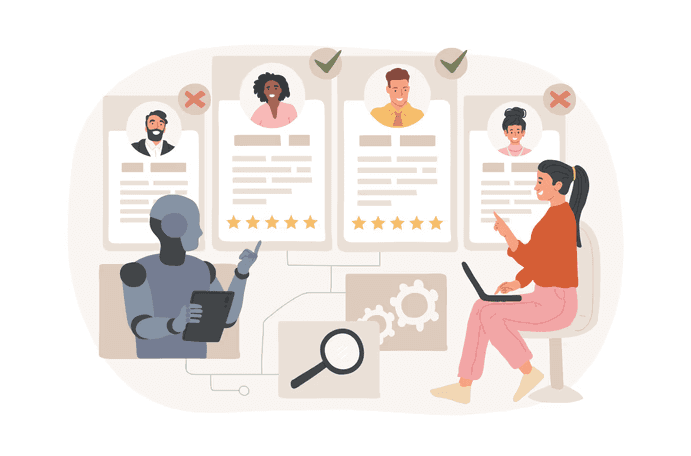
Match Day is Fonzi AI’s hiring event, a time-boxed 48-hour window where pre-vetted engineers and committed companies connect. This format is intended for senior engineers who value high-signal opportunities, clear compensation ranges, and minimal scheduling friction.
Match Days focus on AI and engineering roles, including senior AI engineers, ML researchers, backend leads, infrastructure and SRE specialists, LLM product engineers, and senior full-stack developers. Companies come prepared with roles and salary bands, and candidates know what to expect before conversations begin.
How Match Day Works for Senior Candidates
The flow works like this:
Apply once: Submit your profile through Fonzi AI
Pass vetting: We review your portfolio, skills, and experience for fit with our partner companies
Get matched: You’re included in an upcoming Match Day based on your expertise and preferences
Receive interest signals: Companies indicate interest before the event begins
48-hour sprint: Focused interviews with multiple companies during the Match Day window
Rapid offers: Many offers extend within days of Match Day
Pre-Match Day preparation includes Fonzi helping polish your profile, clarify your target compensation, and align on preferred roles such as senior ML infra or LLM product engineer. During Match Day, companies have predefined salary bands, and candidates see ranges upfront to avoid misaligned conversations. This process is significantly faster than typical multi-week, multi-round hiring processes at traditional companies.
Why Senior Engineers Prefer Match Day Over Traditional Job Boards
The curated aspect matters. Fonzi only works with vetted companies and candidates, reducing low-quality inbound and spammy outreach. You are not competing with thousands of applicants, but are in a focused pool of qualified engineers.
Salary transparency is built-in. Companies commit to compensation ranges before they see candidate names or start conversations, so you avoid discovering after several rounds that the budget is below expectations.
Concierge recruiter support means Fonzi coordinates interviews, manages feedback, and helps negotiate offers. Senior engineers stay focused on current work and preparation rather than scheduling logistics.
Fonzi automations handle matching logic and logistics, while humans handle nuance, ensuring a human-centered experience that respects your time and expertise.
How to Prepare for Senior Engineer Interviews in an AI-Driven Market
Senior-level interviews in 2026 typically include system design, advanced coding, behavioral questions, and role-specific AI, ML, or infrastructure problem solving. Preparation is straightforward if you focus on the right areas.
Align your preparation to job descriptions. Focus on skills and domains explicitly mentioned, such as LLMs, data pipelines, distributed systems, and on-call experience. Fonzi AI often shares company-specific prep guidance before Match Day to tailor your efforts.
Sharpening Your Technical and System Design Skills
Practice realistic senior-level problems such as designing high-scale APIs, data platforms, ML training or inference infrastructure, and RAG pipelines for LLM applications. These are the solutions companies expect seniors to propose.
Combine coding practice with open-ended design questions that reflect modern stacks. Think beyond LeetCode: how would you design a feature store? How would you scale a vector database for real-time retrieval? What observability would you add to an LLM inference service?
Consider creating one to two fresh, small but production-like engineering projects that showcase relevant skills, such as an LLM-powered internal tool, a scalable event-driven service, or observability improvements. These demonstrate you can lead projects from idea to execution.
Be able to explain trade-offs, not just produce solutions. Why choose one design over another? How would you evolve it as traffic or data grows? This is where deep technical knowledge shows.
Telling Strong Senior-Level Impact Stories
Senior interviews heavily evaluate past impact. Prepare 4-6 detailed stories following a clear framework: situation, task, action, result, reflection.
Effective stories demonstrate:
Scope: Multi-team projects, company-wide refactors, cross-functional initiatives
Ownership: Taking responsibility for outcomes, not just assigned tasks
Resilience: Handling incidents, pivots, or failed experiments with the successful completion of lessons learned
Using AI Tools Wisely During Preparation
Use AI assistants to generate practice questions, review solutions, and propose alternative designs, but deeply understand and validate any AI-generated output. The tools accelerate learning but do not replace it.
AI can help draft or refine resumes, LinkedIn summaries, and portfolio descriptions. Follow up with manual editing to maintain authenticity and clarity.
During practical assessments, companies expect senior engineers to demonstrate independent reasoning and debugging skills. Over-reliance on AI tools is a red flag. In 2026, senior engineers succeed by combining AI efficiency with strong judgment, not by outsourcing their thinking to models.
Conclusion
Senior engineers own complex systems, blend technical depth with leadership, and are evaluated on impact and responsibility rather than just years of experience. Whether you are working on LLM applications, cloud infrastructure, or data pipelines, the expectations are the same: deliver outcomes, support your team, and build systems that last.
AI is reshaping both engineering work and hiring, but human skills such as communication, judgment, and mentoring are more valuable than ever at senior levels. The tools change, but the fundamentals do not.
Ready to find your next senior role? Apply to Fonzi AI, join an upcoming Match Day, or speak with a Fonzi recruiter to map your path from mid-level to senior or from senior to staff. Your expertise deserves a hiring process that respects your time and matches your ambition.
FAQ
What are the primary duties and responsibilities of a senior software engineer compared to a mid-level role?
How many years of experience are typically required to reach a senior engineer position in the current tech market?
What does a typical job description of a senior engineer look like for a Tier-1 tech company?
How much of a senior engineer’s time is spent coding versus system design and mentoring junior developers?
What technical and soft skills are most important for someone transitioning into a senior engineer role in 2026?


