
It’s 2026, and a Series B AI startup in San Francisco needs three senior ML engineers before their next funding milestone. Despite strong branding and recruiters working nonstop, time-to-fill sits at 45+ days, interview notes are inconsistent, and top candidates take other offers. The root problem: evaluation is chaotic, with each interviewer using different criteria, leading to lost candidates and decisions that don’t learn from data.
Candidate review forms create a fair, repeatable, data-driven loop by guiding interviewers to assess predefined competencies, document evidence, and make comparable recommendations. Fonzi, a talent marketplace for AI and engineering roles, structures candidate data before humans review it, normalizing skills, flagging inconsistencies, and generating evaluation-ready summaries so hiring managers can focus on deep conversations and final decisions.
This article provides templates, feedback examples, and practical practices to standardize reviews and integrate AI into your hiring process to evaluate engineering skills.
Key Takeaways
Standardized candidate review forms reduce bias, improve signal quality, and enable faster, more confident hiring decisions for engineering, ML, and AI roles.
AI, such as Fonzi’s multi-agent system, can automate screening, fraud detection, and evaluation prep while keeping final decisions and human candidate interaction in the hands of hiring managers.
Structured forms encourage evidence-based feedback, ensure fair comparisons for non-traditional candidates, and this article provides templates, sample language, process comparisons, and rollout guidance.
What Is a Candidate Review Form? Core Components & Purpose
A candidate review form is a structured document used to evaluate candidates against predefined criteria rather than personal intuition, turning subjective impressions into documented, comparable assessments.
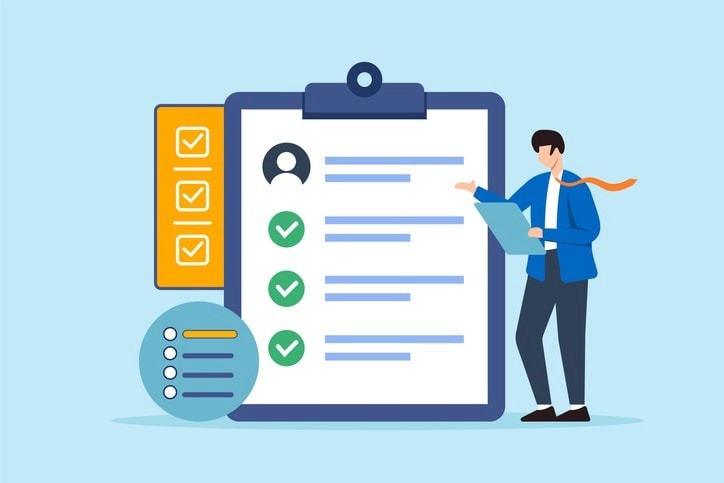
Effective tech review forms typically include:
Role scorecard: Competencies and skills required for success, derived from a pre-sourcing job analysis.
Interview context: Stage of the interview, date, and interviewer name.
Rating scales: Numeric or descriptive scales with behavioral anchors showing what each level looks like in practice.
Evidence-based notes: Specific examples or observations supporting each rating.
Hire/no-hire recommendation: Clear final call with confidence level and caveats.
Standardized forms improve fairness and signal quality, allowing objective comparisons across candidates, especially for underrepresented or non-traditional talent. Leading tech firms use 1–4 scales, “strong hire” to “strong no” descriptors, and anchored behaviors to guide ratings. Later sections provide concrete form questions and rubrics for AI, ML, and senior backend roles.
Key Elements to Include in a Candidate Review Form
Here’s what a real candidate review form must contain for engineering and AI hiring:
Candidate and Role Metadata
Candidate name and email
Role title (e.g., Senior ML Engineer, Staff Backend Engineer, Data Platform Lead)
Interview stage (phone screen, take-home review, on-site system design, culture fit)
Date of interview
Interviewer name and role
Competency Sections
For technical roles, your form should assess:
Technical depth: Proficiency in relevant programming languages, frameworks, and tools (Python, distributed systems, transformers, Kubernetes)
Problem-solving: Ability to decompose complex problems, identify trade-offs, and adapt approaches when stuck
System design: Understanding of scalable architectures, data pipelines, and failure modes
Communication: Clarity in explaining technical concepts, active listening, and responsiveness to questions
Collaboration and ownership: Track record of working across teams, taking initiative, and driving projects to completion
Culture and values alignment: Fit with company working style, remote/async norms, and team dynamics
Rating Scales with Behavioral Anchors
Each rating level should be defined with observable behaviors. For example:
Rating | Description |
1 – Strong No | Clear evidence the candidate is unsuitable in this area; significant gaps |
2 – Lean No | Concerns outweigh strengths; would require substantial support |
3 – Lean Yes | More strengths than concerns; meets bar with some development areas |
4 – Strong Yes | Exceeds bar; independently designs scalable solutions and anticipates edge cases |
Evidence-Backed Notes
Interviewers should record:
Specific examples shared by the candidate
Quotes or paraphrased responses
Observations from coding tasks, whiteboard exercises, or live debugging sessions
Concrete behaviors, not personality judgments (e.g., “explained the trade-off between latency and throughput” vs. “seemed smart”)
Flags and Risks Section
Include any concerns such as:
Potential plagiarism in take-home exercises
Unclear ownership claims on past projects
Conflicting feedback from different panelists
Gaps in experience that require further verification
Inconsistencies between resume and interview performance
Final Decision Section
Document the final recommendation and context:
Recommendation: Hire / No hire / Hold for another role
Confidence level: High / Medium / Low
Recommended band or level: E.g., L5 vs L6, or IC4 vs IC5
Urgency and role fit notes: How quickly could this candidate start and whether they are better suited for a different open role
Examples: Candidate Review Form Templates & Feedback Snippets

This section provides concrete form examples and sample language you can adapt for your team.
Example 1: General Software Engineer Candidate Review Form
Header
Candidate: [Name]
Role: Senior Backend Engineer
Stage: On-site System Design
Interviewer: [Your Name]
Date: [Date]
Technical Assessment (Rating: 1–4)
Rating: _
Evidence: [Describe how the candidate approached the design problem, what trade-offs they identified, and how they responded to follow-up questions]
Coding Quality (Rating: 1–4)
Rating: _
Evidence: [Note code organization, clarity, testing approach, and how they handled edge cases]
Collaboration (Rating: 1–4)
Rating: _
Evidence: [Describe how they engaged with the interviewer, asked clarifying questions, and incorporated feedback]
Final Recommendation
[ ] Strong Hire
[ ] Hire
[ ] No Hire
[ ] Strong No
Summary: [2–3 sentences on key strengths, concerns, and overall fit for the role]
Example 2: ML/AI Engineer Candidate Review Form
Header
Candidate: [Name]
Role: Senior ML Engineer
Stage: Technical Deep Dive
Interviewer: [Your Name]
Date: [Date]
Model Design (Rating: 1–4)
Rating: _
Evidence: [How did they approach the modeling problem? Did they consider multiple architectures? How did they handle constraints like latency or data availability?]
Experimentation Rigor (Rating: 1–4)
Rating: _
Evidence: [Did they describe a clear experimental setup? How did they validate results and handle false positives?]
Data Intuition (Rating: 1–4)
Rating: _
Evidence: [How did they reason about data quality, feature engineering, and potential biases in the training data?]
Ethical Considerations (Rating: 1–4)
Rating: _
Evidence: [Did they proactively mention fairness, explainability, or potential harms of their model in production?]
Final Recommendation
[ ] Strong Hire
[ ] Hire
[ ] No Hire
[ ] Strong No
Summary: [Key strengths, concerns, and fit for ML roadmap]
Sample Feedback Sentences by Dimension
System Design:
“Candidate proposed a microservices architecture with clear service boundaries but didn’t initially consider database sharding; when prompted, they quickly adapted and explained trade-offs.”
“Struggled to articulate how the system would handle 10x traffic growth; response lacked depth on caching and load balancing.”
Coding Quality:
“Code was clean and well-organized with meaningful variable names; wrote unit tests without being asked.”
“Solution worked but had several off-by-one errors; candidate caught one but missed others.”
Product Thinking:
“Asked clarifying questions about user needs before jumping into implementation; demonstrated clear sense of why we’re building this feature.”
“Focused entirely on technical implementation without considering how the feature would be used.”
Borderline Candidate Example
Sometimes you’ll encounter candidates with mixed strengths and weaknesses. Structured forms push reviewers to articulate trade-offs:
Candidate Summary: “Strong technical depth in ML fundamentals; explained transformer architectures fluently and proposed a novel approach to feature engineering. However, communication was uneven: clear when discussing technical details, but vague when asked about past project ownership. Reference check recommended to verify leadership claims. Recommend: Hire at L4 (not L5) with close mentorship for first 90 days.”
This kind of nuanced feedback is only possible when reviewers are prompted by a structured form rather than writing free-form impressions.
Using AI to Streamline Candidate Reviews (Featuring Fonzi)

AI is now essential for managing application volume, assessing complex AI and engineering skills, and reducing fraud risks, but it only adds value when it supports human judgment rather than making autonomous decisions.
CV Parsing and Normalization Agent: Extracts structured data from resumes, LinkedIn profiles, and portfolios, normalizing job titles, skills, and experience to match your role scorecard.
Skills Inference Agent: Infers skills from project descriptions, GitHub activity, and work samples, capturing capabilities that may not appear as explicit keywords.
Fraud Detection Agent: Cross-checks GitHub activity, portfolios, tech stacks, and interviews to flag inconsistencies, plagiarism, or suspicious proxy activity.
Structured Evaluation Prep Agent: Generates candidate summaries mapped to review forms with skills matrices, experience highlights, and red/amber/green flags for each competency.
The key point: AI does not make final hiring decisions. Instead, it prepares a complete, bias-aware, and comparable candidate dossier so humans can focus on deep evaluation and relationship-building.
What this means for your team:
Recruiters spend less time manually reviewing CVs and formatting feedback
Hiring managers receive structured summaries instead of raw data
Interviewers enter conversations with context already prepared
Fraud signals are surfaced before interviews
All candidates are evaluated against the same criteria, improving fairness
This approach enhances recruiter focus on high-touch work: closing top candidates, selling the opportunity, and building relationships.
Manual vs AI-Augmented Candidate Review Process
The following table compares traditional candidate review workflows with an AI-augmented workflow using Fonzi. These estimates are based on typical mid-size tech teams hiring for engineering and AI roles.
Step | Manual Process | AI-Augmented with Fonzi | Impact |
Resume Screening | 20–30 minutes per resume; recruiter scans for keywords and pedigree signals | AI pre-screen in seconds; ranked shortlist with skills mapped to role scorecard | 80–90% reduction in screening time; less pedigree bias |
Technical Screening | Recruiter coordinates take-home or live coding; manual review of submissions | AI agent parses code submissions, flags plagiarism, scores against rubric | Faster turnaround; fraud detection built in |
Interview Feedback Collection | Emails to interviewers; follow-ups for missing scorecards; 2–5 day delays | Structured forms with AI-generated prompts; real-time completion tracking | Feedback delivered within 24 hours; higher completion rates |
Fraud Checks | No systematic fraud signals; relies on interviewer intuition | AI agent cross-verifies GitHub, portfolio, and interview outputs; flags anomalies | Reduced risk of bad hires; verification successful before offer stage |
Final Debrief Prep | Hiring manager reads multiple long emails; synthesizes manually | AI-generated summary: key strengths, risks, evidence by competency | Faster decisions; debriefs grounded in documented evidence |
Source Analysis | Manual export from ATS; spreadsheet analysis | AI tracks pass-through rates by candidate source in real-time | Data-driven sourcing; resources allocated to high-yield channels |
This table shows how AI shifts recruiter and hiring manager time from low-leverage operational tasks to high-value human judgment. The hiring process becomes faster and more consistent without sacrificing human control over final decisions.
Best Practices for Standardizing Candidate Reviews Across Teams

Tools and forms fail without consistent usage and alignment across interviewers, hiring managers, and regions. Here’s how to make standardization stick:
Define a Role Scorecard Before Sourcing Begins
Co-create it with managers, engineers, and recruiters to specify must-have vs nice-to-have skills, behavioral competencies, weights for technical depth, collaboration, and ownership, and what bar level looks like for each competency. This scorecard guides every candidate review form for the role.
Run Interviewer Calibration Sessions
Practice with sample profiles, have interviewers rate mock candidates independently, then compare ratings and discuss differences. This aligns bar levels and ensures distributed teams share a common standard of “strong hire.”
Enforce Time-Bound Feedback SLAs
Require that review forms be submitted within 24 hours of the interview. Delayed feedback leads to bias (interviewers remember impressions, not details) and slows down the entire hiring process.
Make completion visible: track who submits on time and follow up immediately with those who don’t.
Train Interviewers on Evidence-Based Writing
Focus on observed behavior rather than personality judgments. For example, write “clearly explained the trade-off between consistency and availability in system design” instead of “seemed confident.”
Address DEI and Bias Reduction
Use standard questions for each interview loop so every candidate is evaluated on the same dimensions
Consider anonymizing or masking details that aren’t job-relevant (names, photos, university names) during initial screening
Structured forms reduce “gut feel” reliance, which is where unconscious bias often enters
Use Fonzi’s Structured Output as a Foundation
Candidate summaries with skills matrices, experience highlights, and flags give interviewers a consistent starting point, increasing trust and enabling meaningful cross-candidate comparisons.
Conclusion
Great hiring decisions come from structured inputs combined with experienced human judgment, not guesswork or fully automated processes. Broken candidate reviews cost time, top talent, and team alignment, while standardized review forms improve fairness, signal quality, and speed. AI, like Fonzi’s multi-agent system, amplifies recruiter and manager effectiveness without replacing them. Start small by standardizing one role’s scorecard or running an AI-augmented process for a quarter and measure results. The future of hiring favors teams that evaluate rigorously, document with evidence, and use AI to support, not replace, human judgment.
FAQ
How do you properly review candidates during the hiring process?
What should be included in a candidate review form?
What are good candidate review examples and templates?
How do you conduct an effective candidate source review?
What’s the best way to structure and standardize candidate reviews?


