
Demand for senior technology leadership has surged due to the AI boom, while full-time chief technology officer hiring has become slower and more expensive. Fast-growing companies, especially those building AI products, increasingly turn to fractional CTOs to fill leadership gaps without immediately committing to a permanent executive. This article is written for hiring managers, recruiters, and talent leaders who need to understand what a fractional CTO actually is before adding the role to a hiring plan or job description.
Key Takeaways
A fractional chief technology officer is a senior technology leader who provides strategic guidance on a part-time basis, typically working 10 to 25 hours per week, helping companies achieve technology goals without committing to a full-time executive hire.
Fractional CTOs differ from full-time CTOs, interim CTOs, advisors, and VP of Engineering roles in scope, time commitment, and engagement structure, with typical US costs ranging from USD 15,000 to 35,000 per month compared to USD 250,000 to 425,000+ annually for full-time CTO compensation.
The role is especially valuable for companies with 5 to 40 engineers, growing AI roadmaps, or ongoing challenges with delivery predictability, architecture decisions, and hiring, though success depends on clear expectations, defined outcomes, and strong integration with existing leadership teams.
What Is a Fractional CTO? Definition, Scope, and Engagement Models
A fractional chief technology officer is an experienced CTO-level leader who works part-time or on a limited-scope basis, usually across multiple clients, providing high-level technology leadership without a full-time contract. The primary responsibilities of a fractional CTO include overseeing technology strategy, managing technology teams, and ensuring that technical decisions align with business objectives, while not being involved in day-to-day coding or ticket management.
Core responsibilities center on technology strategy, architecture decisions, technical roadmap ownership, AI strategy, risk management, security posture, and executive-level communication with the CEO and board. Fractional CTOs often serve as a bridge between product and engineering teams, ensuring alignment and effective communication, which is important for minimizing wasted development resources and achieving strategic goals.
Typical weekly commitment runs 1 to 3 days per week (10 to 25 hours), with most fractional CTO engagements lasting 3 to 12 months. Unlike traditional consulting, fractional CTO work emphasizes ongoing ownership of outcomes through regular cadence, standing meetings, and OKR responsibility rather than purely advisory sessions.
Many organizations pair a fractional CTO with fractional heads of data, AI, or security for targeted initiatives, creating a fractional leadership model that addresses specialized knowledge gaps. Fractional CTOs often work alongside internal engineering managers, staff engineers, and external partners rather than replacing them, which hiring managers need to reflect in role design.
Fractional CTO vs Full-Time CTO vs Interim CTO vs Advisor
Many job descriptions blur these roles, which leads to mismatched expectations and poor hiring outcomes. Understanding the distinctions helps hiring managers scope positions correctly.
A full-time CTO is a permanent executive working 40+ hours per week, deeply embedded in company operations with direct responsibility for engineering teams, architecture, org design, hiring, and long-term technology strategy.
An interim CTO is a temporary full-time leader, often brought in during transitions such as leadership changes, crises, or post-acquisition integration, typically serving for 3 to 9 months before handing off to a permanent CTO.
A fractional CTO provides ongoing, part-time executive leadership, often for early-stage or scaling companies that do not yet need a full-time CTO. They focus on strategic guidance rather than full-time execution, while a VP of Engineering focuses more on delivery and team management, and a technology advisor typically provides guidance without owning outcomes or execution.
Common Fractional CTO Engagement Patterns
Three typical models define most fractional CTO engagements:
Assessment plus roadmap: A 4 to 6 week diagnostic producing a prioritized action plan
Ongoing retainer: Fixed number of days per month with clear deliverables
Time-boxed execution: Specific milestones such as a funding round, SOC 2 audit, or technical due diligence
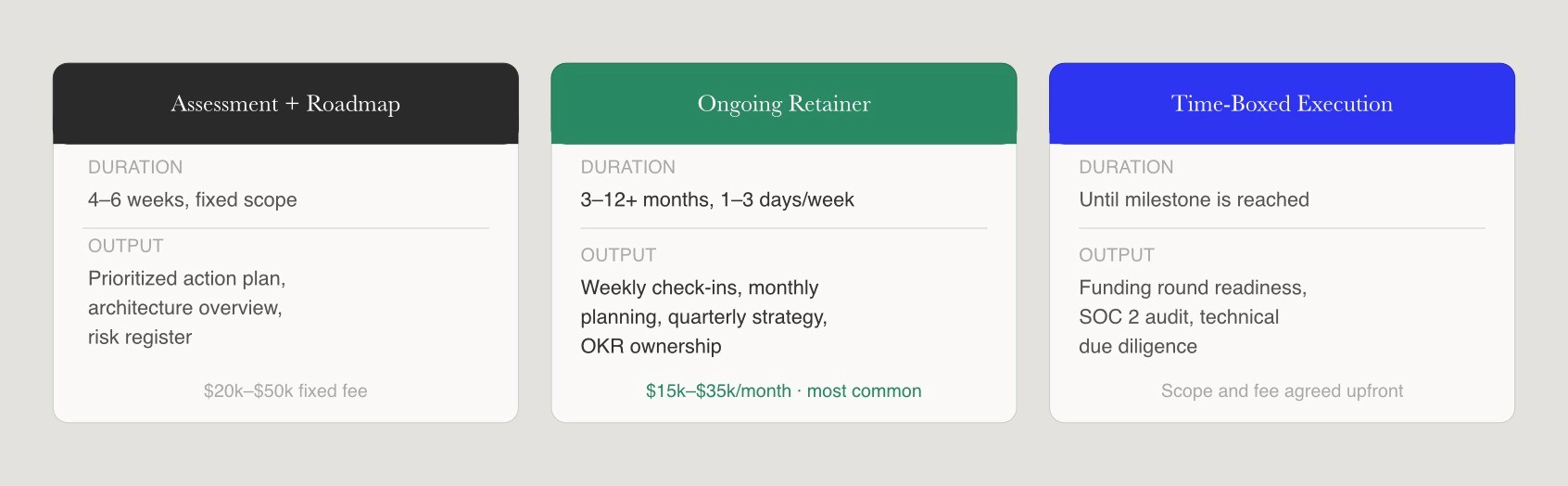
Most engagements begin with a short discovery phase where expectations, reporting lines, and decision rights are agreed with the CEO and existing tech leadership. Many fractional CTOs then establish a regular cadence of weekly check-ins, monthly planning, and quarterly strategy reviews.
In 2026, remote-first engagements are the norm, with on-site visits reserved for planning sessions, board meetings, or key workshops.
What Fractional CTOs Actually Do for Fast-Growing Tech and AI Teams
Titles alone are not enough. Hiring managers need to understand specific responsibilities and outputs to scope the role correctly. Fractional CTO work typically spans product and technology strategy, architecture and technical debt, team design and hiring, AI strategy and implementation, and governance including security, compliance, and risk.
The exact mix depends on the company stage. Early-stage AI startups often focus on roadmap clarity, while post-Series B companies with 40+ engineers tend to prioritize scaling, debt reduction, and organizational structure. Fractional CTOs are especially valuable during high-pressure periods like rapid hiring, re-architecture, AI launches, or investor due diligence.
Strategic Technology and Product Direction
Fractional CTOs translate 12 to 24 month business goals into a prioritized technology roadmap aligned with revenue and funding milestones. Deliverables often include architecture overviews, multi-quarter roadmaps, and a monthly risk register.
A growing part of this work in 2026 is deciding where AI creates real product value versus where simpler automation is sufficient. This often results in phased plans covering data pipelines, model hosting, and product integration.
Architecture, Technical Debt, and Platform Scalability
Fractional CTOs typically conduct architecture and system reviews within the first 4 to 6 weeks to identify bottlenecks in performance, reliability, and maintainability. This includes reviewing service boundaries, cloud costs, observability gaps, and incident history.
A common output is a prioritized technical debt plan tied to metrics like latency, error rate, and release frequency. For AI-heavy products, this also includes evaluating data pipelines, model hosting, and LLM dependency risks.
Hiring, Team Structure, and Talent Evaluation
Fractional CTOs often support hiring by defining role scopes, interview processes, and evaluation rubrics for senior engineering and AI roles. They may write technical scorecards, design exercises, and participate in final interviews to calibrate seniority and compensation.
Some organizations also use fractional CTOs to shape their broader hiring standards before scaling recruiting efforts through internal teams or platforms like Fonzi. They may also coach existing technical leaders or a VP of Engineering to take on more responsibility over time.
AI Strategy, Tooling, and Risk Management
In 2026, AI strategy is no longer optional for most software companies. Fractional CTOs are often brought in specifically to define or course-correct that strategy. They evaluate where to use generative AI or large language models, for example, internal developer productivity tools, support automation, or product features like personalized recommendations.
Concrete tasks include selecting model providers (Anthropic vs. GPT), assessing data privacy implications, introducing evaluation benchmarks (ROUGE/BLEU), and setting guardrails to avoid AI-related security or compliance breaches. Vector databases like Pinecone or Weaviate often factor into architecture decisions.
Responsible AI adoption always includes human oversight, clear documentation, and key metrics visible to both engineering teams and business leadership. A fractional CTO is particularly useful for non-technical founder teams who need technology leadership to make informed decisions about artificial intelligence integration.
Governance, Security, and Stakeholder Communication
Fractional CTOs often establish clear ownership of risk areas that are poorly managed in early-stage companies, including security posture, data governance, and compliance obligations like SOC 2 or ISO 27001 preparation. Hiring a fractional CTO can be a strategic move when a company is preparing for investment, acquisition, or an audit, as they can lead technical due diligence and ensure documentation is in order.
Typical activities include conducting a security gap analysis, implementing basic controls, and creating a transition plan toward audits that investors and enterprise customers expect. Fractional CTOs can meaningfully accelerate compliance timelines by establishing clear audit preparation plans from the outset.
The communication aspect includes preparing materials for board meetings, answering technical questions from investors during funding rounds, and translating complex issues into business language for non-technical executives. In many 2026 fundraises, investors explicitly ask who owns AI risk and security, and fractional CTOs often become the named executive responsible.
The Economics of Fractional CTOs: Cost, Value, and When It Makes Sense
Hiring managers and talent leaders need clear benchmarks for fractional CTO cost and the value of that investment compared with a full-time CTO. Value is not measured only in hours worked. Instead, it is measured in risk reduction, speed of decision-making, and improvements in hiring quality and engineering throughput.
Fractional CTO pricing reflects payment for concentrated senior judgment and pattern recognition, not a scaled-down version of a salary divided by hours. The flexibility of fractional CTOs allows businesses to scale their technology leadership up or down based on current needs, providing strategic guidance during critical phases without the overhead of a permanent CTO.
Typical Rates and Cost Structures in 2026
In the US, fractional CTO rates are often between USD 15,000 and 35,000 per month for 1 to 3 days per week. In Western Europe, typical monthly retainers run between EUR 7,000 and 22,000.
In the UK, fractional CTO rates generally range from £6,000 to £16,000 per month, while full-time CTO salaries can reach £150,000 to £220,000, with additional employer costs pushing the total to 25 to 35% above base salary.
Common structures include:
Flat monthly retainers with an agreed time budget
Assessment projects with fixed fees ($20,000 to $50,000 for 4 to 6 weeks)
Equity components for very early-stage startups
Ultimately, standard market rates scale upward when an engagement demands highly specialized technical execution, proven implementation experience within heavily regulated industries, or the management of multi-team architecture transitions.
Comparison Table: Fractional CTO vs Full-Time CTO vs Interim CTO
Role Type | Time Commitment | Typical Monthly Cost (US, 2026) | Engagement Length | Best Fit Scenario |
Full-Time CTO | 40+ hours/week | $20,000 to $35,000 (base only) | Permanent | 40+ engineers, tech is core competitive advantage |
Interim CTO | Full-time | $25,000 to $40,000 | 3 to 9 months | Transitions, crises, leadership gap |
Fractional CTO | 10 to 25 hours/week | $15,000 to $35,000 | 3 to 12+ months | 5 to 40 engineers, AI scaling, budget constraints |
When a Fractional CTO Is the Right Choice
Concrete triggers for considering a fractional CTO include:
Engineering team of 5 to 40 developers
Growing AI roadmap requiring experienced tech leader oversight
Repeated problems with delivery predictability, architecture decisions, or hiring calibration
Budget constraints that prevent full-time executive hire
Need to stabilize technology function before making a permanent executive hire
Choose a fractional CTO when you need expert strategy without a high-level executive salary. Choose a full-time CTO when the technology is the core competitive advantage or the company is rapidly scaling beyond 40 engineers with daily executive ownership requirements.
A fractional CTO can fill a leadership gap when a permanent CTO has left, helping maintain team morale and project momentum while a search for a full-time replacement is conducted. Some companies use fractional CTOs as a bridge with the explicit intention of hiring a full-time CTO within 12 to 24 months, sometimes asking the fractional leader to help run that search.
How to Hire and Work Effectively with a Fractional CTO
Outcomes from fractional leadership depend heavily on how the role is scoped, evaluated, and embedded into existing senior leadership structures. Hiring managers and recruiters must be precise about responsibilities, decision rights, reporting lines, and success metrics. Otherwise, there is a risk of the fractional CTO becoming an expensive advisor with limited impact on the organization.
Companies sometimes source fractional CTOs via existing networks, specialist firms, or curated talent platforms like Fonzi that connect startups with senior engineers and AI leaders.
Scoping the Fractional CTO Role and Setting Expectations
Start with a written one-page brief covering:
Company stage and current tech team structure
AI and product roadmap for the next 12 to 18 months
Specific problems the fractional CTO is expected to solve
Key questions to address include: Who does the fractional CTO report to? What technology decisions can they make independently? What key metrics define success? How will they interact with existing leadership team members like a VP of Engineering or Head of Product Management?
Limit initial scope to a small number of clearly defined outcomes such as “stabilize incident rate,” “design AI strategy,” or “build a hiring framework for senior engineers” to avoid scope creep. Clarity on minimum and maximum time commitment per month helps avoid tension during crunch periods.
Evaluating Candidates for Fractional Tech Leadership
Prioritize candidates with prior operating experience as a CTO, VP of Engineering, or equivalent senior role where they owned both delivery and hiring, ideally across multiple companies of similar stage and domain. An experienced CTO who has worked across various industries can adapt quickly to a company’s technology vision and operational needs, delivering tailored guidance.
Evaluation techniques include:
Reviewing a sample technology roadmap they authored
Asking for examples of AI-related initiatives they led between 2022 and 2026
Probing how they handled incidents or major architectural shifts
Structured interview focused on hiring judgment for product development team roles
Reference former CEOs, founders, or heads of product who worked with the candidate and can comment on communication, transparency, and collaboration with non-technical stakeholders. Culture fit remains important even for part-time roles because fractional leadership often requires influencing multiple teams without direct line authority.
Setting Up the First 90 Days
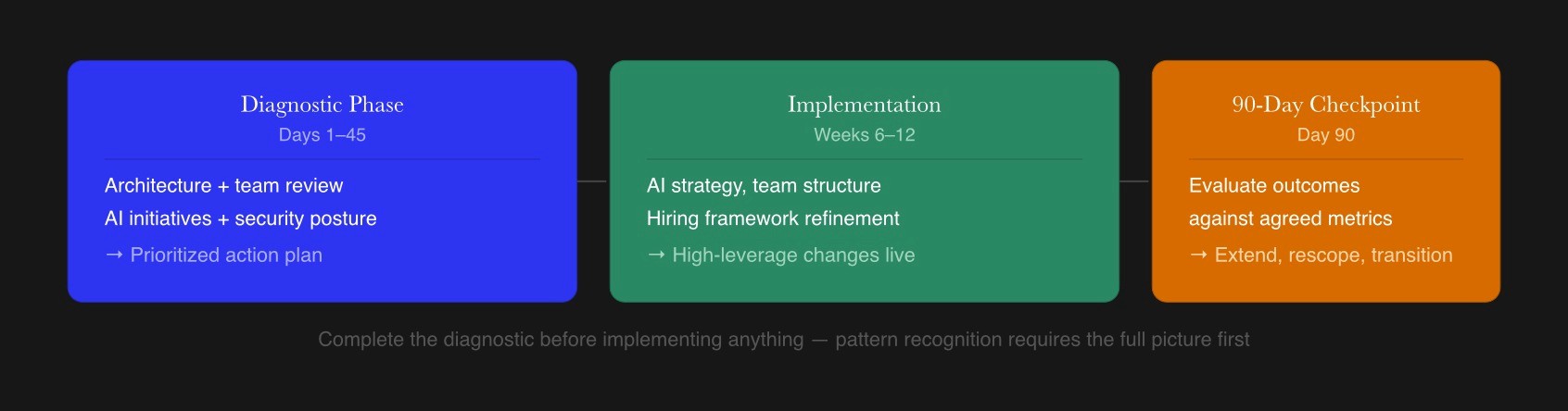
Begin the engagement with a 30 to 45 day diagnostic phase covering:
Architecture review
Team structure assessment
Hiring gaps
AI initiatives evaluation
Security posture analysis
This produces a short, prioritized action plan. Weeks 6 to 12 should focus on implementing a few high-leverage changes such as introducing a basic AI strategy document, adjusting team responsibilities, or refining technical direction in the hiring process.
Schedule a formal checkpoint at 90 days to evaluate progress against agreed outcomes and decide whether to extend, change scope, or transition to hiring a full-time chief technology officer. Invite recruiting and people teams to early planning sessions so they can align headcount plans, job descriptions, and interview processes with the fractional CTO’s recommendations.
Conclusion
Fractional CTOs provide a cost-effective way to access senior technology leadership, especially for AI-heavy products and fast-growing teams not yet ready for a full-time CTO. They are best suited for companies that need executive-level guidance without the commitment of a permanent hire.
Success depends on clear scoping, strong candidate evaluation, and well-defined outcomes, cost, and time commitment. Companies should assess their current leadership gaps, hiring process, and AI roadmap to decide whether fractional leadership, a full-time CTO, or coaching is the right fit.
FAQ
What is a fractional CTO and what do they actually do?
How much does a fractional CTO cost and what are typical rates?
When does a startup need a fractional CTO vs hiring a full-time CTO?
How do I find fractional CTO jobs or become one as a senior engineer?
What should a startup look for when hiring a fractional CTO?


