What Does Member of Technical Staff Mean?
By
Ethan Fahey
•

Between 2020 and 2026, AI labs, LLM platform companies, and infrastructure-focused organizations significantly expanded the use of the “Member of Technical Staff” (MTS) title across engineering career tracks. As a result, senior software engineers, ML researchers, and infrastructure specialists increasingly encounter MTS roles in job postings that can vary widely in scope, seniority, compensation, and expectations. In some organizations, MTS maps closely to senior or staff-level engineering work, while in others it represents highly specialized research or systems roles tied directly to AI product development and platform scalability.
For recruiters and hiring leaders, understanding how MTS titles map to real responsibilities has become increasingly important as AI companies compete aggressively for specialized talent. Platforms like Fonzi are helping reduce some of this ambiguity by enabling companies to evaluate engineers through structured, skills-focused workflows that better reflect real technical depth, systems thinking, and applied engineering impact beyond inconsistent job titles alone.
Key Takeaways
Member of Technical Staff (MTS) is a broad technical staff title used by companies like Anthropic, NVIDIA, and VMware to group senior software engineers, ML researchers, and infra engineers under one band.
The same MTS title can span multiple internal levels, from mid-senior to staff engineer and principal engineer equivalent, depending on the company.
MTS roles in 2026 and beyond are especially common in AI-first, infra-heavy, and research-driven organizations that prefer flatter title structures.
Candidates should focus on scope, ownership, and compensation bands rather than assuming that Member of Technical Staff maps cleanly to a single standard level.
MTS typically requires a proven track record of shipping software or leading complex technical projects with 4 to 5 or more years of relevant industry experience.
Origin and Evolution of the Member of Technical Staff Title
The term Member of Technical Staff originated at Bell Labs, a prestigious research institution in the 20th century, where it was used to emphasize collective expertise rather than hierarchical titles. From the 1940s onward, Bell Labs formalized the Member of Technical Staff title to unify physicists, mathematicians, and engineers under a non-hierarchical banner during landmark developments like the transistor, a culture that later supported the creation of UNIX. Claude Shannon held the MTS designation in 1948, and Nobel laureate John Bardeen, co-inventor of the transistor, was also recognized as a Distinguished MTS.
At Bell Labs, MTS covered a spectrum from early-career PhD hires to world-class researchers. Internal distinctions included MTS, Senior MTS, and Distinguished MTS, with advancement based on peer-reviewed contributions rather than management tracks. Other research institutions and hardware companies in the 1980s and 1990s adopted similar technical staff nomenclature. HP Labs and IBM Research used variants of the title for roles spanning hardware and software development convergence.
From roughly 2010 to 2020, the title re-emerged in cloud and infrastructure companies like VMware and Oracle, often mapping to senior software engineer or staff engineer levels. After 2018, AI and LLM-focused organizations, including OpenAI and some NVIDIA teams, adopted the single Member of Technical Staff label for engineers and researchers working on frontier systems.
How Companies Use the Member of Technical Staff Title Today
The same public MTS title may correspond to different internal levels, such as L4 through L6 or senior, staff, and principal equivalents, depending on the company. MTS frequently spans multiple disciplines, including software engineering, ML research, data engineering, reliability, and infrastructure, under a unified technical staff band. The MTS title allows engineers to work fluidly across different domains without being confined to traditional software engineering roles, reflecting a shift towards flatter organizational structures in modern tech companies.
Company | Public Title | Typical Internal Level Range | Example Domains | Notes on Culture or Structure |
OpenAI | Member of Technical Staff | L4-L6 (mid to staff) | LLM serving, eval harnesses, agent infra | Flat structure, no public levels, internal MTS-1/2/3 distinctions |
NVIDIA | Member of Technical Staff | L5-L7 (senior to principal) | GPU optimization, CUDA kernels, simulation infra | Hardware-software blend, levels hidden externally |
Snowflake | Member of Technical Staff | MTS-1 to MTS-3 (mid to principal) | Query engines, data platforms, reliability | Research-driven, internal ladders documented |
VMware | Member of Technical Staff | Senior to Staff equivalent | Virtualization, cloud infra, networking | Enterprise focus, maps to IC4-IC6 |
2026 AI Startup (xAI, Perplexity) | Member of Technical Staff | L5-L7 (senior+) | RAG architecture, inference optimization, vector databases | Mission-flat, equity-heavy (0.1-1%) |
Common Motivations for Using the MTS Title
Companies in 2026 adopt the MTS designation for several strategic reasons that align with their technical team structures and hiring needs.
Organizations use MTS to de-emphasize status-driven title changes and keep senior technical staff focused on impact and mission rather than climbing title ladders.
A unified MTS title simplifies external branding and hiring when companies recruit across AI engineering, ML research, and infrastructure engineering simultaneously.
Some organizations pair the single MTS label with clear internal leveling guidelines, career paths, and compensation bands that are not always public.
For AI and LLM-heavy engineering teams, MTS can reflect hybrid responsibilities that cross traditional software engineer and ML research engineer boundaries.
MTS often works across products and infrastructure to solve complex, ambiguous problems, and they are often viewed as the glue connecting various teams and defining technical direction.
Variants: Senior, Staff, and Principal Member of Technical Staff
Common variants include Senior Member of Technical Staff, Staff Member of Technical Staff, Principal Member of Technical Staff, and Distinguished Member of Technical Staff. Senior MTS often aligns with a strong senior engineer or senior ML engineer, typically representing the 70th to 80th percentile of seniority within an organization. Staff MTS tends to align with staff engineer scope and cross-team influence, while Principal or Distinguished MTS roles usually map to high-impact technical leads who define architecture, research direction, or large-scale infrastructure strategy.
Per Levels.fyi data, Senior MTS averages approximately $320K total compensation in San Francisco, Staff MTS around $450K, and Principal MTS $600K or higher. Candidates should look for explicit leveling guidance in job descriptions, such as “equivalent to L6 or staff engineer,” rather than relying only on the presence of Senior or Principal in the MTS title.
Member of Technical Staff vs Software Engineer and Staff Engineer
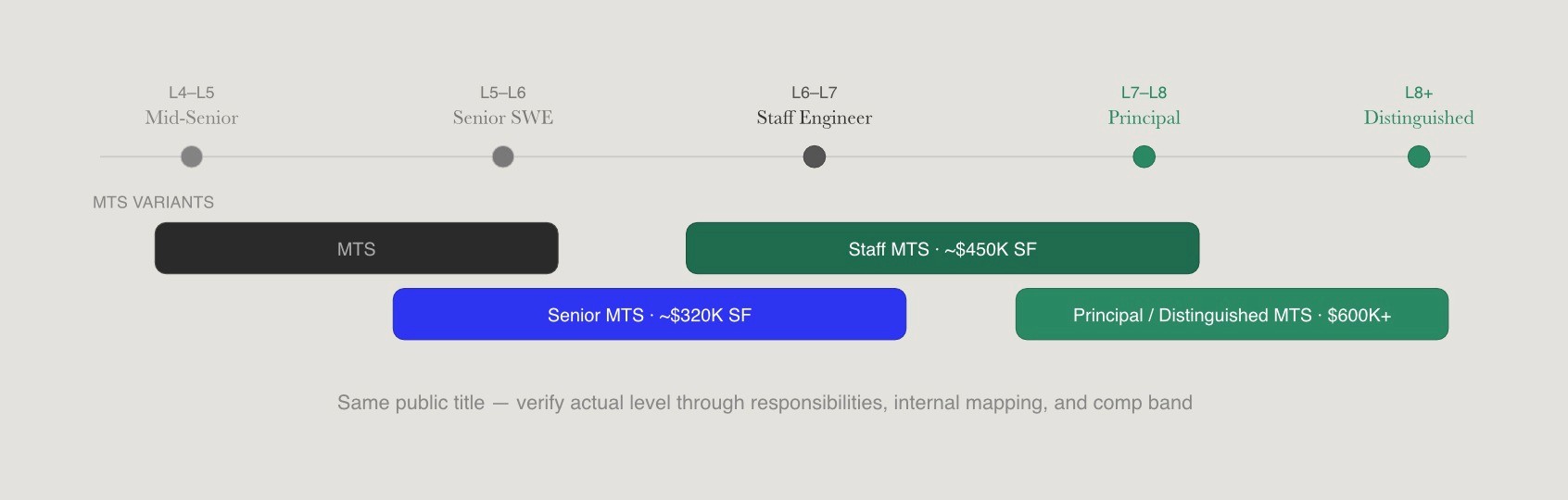
The comparison between MTS and traditional engineering titles matters for career positioning and compensation expectations. Traditional titles like Software Engineer II, Senior Software Engineer, and Staff Engineer have relatively predictable level mappings at tech companies like Google, Meta, and Microsoft. MTS is typically used by organizations that want flexibility across domains, so one MTS posting may involve research-heavy work while another focuses on core infrastructure or product development.
The scope of MTS roles often resembles that of senior software engineers or staff engineers, with ownership of critical systems, mentorship of junior team members, and cross-team collaboration. Candidates should evaluate the described responsibilities, technical stack, and cross-functional impact rather than assuming MTS is always above or below a staff engineer.
Consider concrete examples from 2025 to 2026 job postings. A typical Senior Software Engineer posting at Meta might specify “optimize feed ranking for engagement metrics” with a narrow, well-defined scope. An MTS posting at Anthropic might describe “build scalable RAG architecture for agentic workflows,” blending research innovation with production systems. Similarly, a Google Staff Software Engineer role might focus on “infrastructure platform leadership,” while a Snowflake MTS role covers a similar scope but with domain-agnostic expectations.
Skill and Responsibility Profile for Modern MTS Roles
A Member of Technical Staff is responsible for designing, building, and maintaining complex software systems, infrastructure, or research projects. MTS roles usually require a minimum of 4 to 7 or more years of experience in production engineering environments.
Core technical skills include:
Strong systems design capabilities for distributed systems handling high throughput
Production-grade coding proficiency, with Python dominating MTS role requirements, particularly in AI and ML-focused positions, and Go, Rust, and C++ common in infrastructure and systems roles.
MTS typically requires proficiency in backend and system languages like Java, Python, C++, or Go
Essential skills include proficiency in coding, API development, and expertise in building scalable, secure, and maintainable systems
Familiarity with distributed systems, data structures, and GPU-heavy workloads for AI applications
Domain-specific skills for AI engineers and LLM specialists include serving and evaluating large language models, optimizing inference systems, and instrumenting data and feedback loops. Members of Technical Staff own complex technical systems, drive architectural decisions, and contribute to product and research goals across engineering organizations.
Non-technical expectations include mentoring other software engineers, influencing architecture decisions across engineering teams, and communicating tradeoffs clearly to product managers, research, and technical leadership. Key skills for a Member of Technical Staff include strong technical proficiency in programming, system architecture, analytical thinking, effective communication, collaboration, and adaptability to evolving technologies.
How Recruiters and Hiring Managers Assess MTS Candidates
MTS candidates in 2026 often face a heavier emphasis on system design, architecture tradeoffs, or end-to-end ML lifecycle discussions compared to mid-level software engineer loops. Assessments may include deep dives into prior production systems, research-to-production case studies, or owning a critical migration or optimization in a distributed system.
Many companies now use AI-assisted screening to triage large applicant pools, but final MTS evaluations still rely heavily on human judgment and technical conversation. MTS candidates are typically assessed on system design judgment, production ownership, cross-team architectural influence, and the ability to drive technical decisions under ambiguity.
Showcasing scope, sustained impact, and cross-team collaboration is often more decisive for MTS selection than pure algorithmic problem solving alone.
AI in Hiring and What It Means for Technical Staff Candidates
Since the 2023 AI inflection point, hiring processes have transformed significantly. Many companies now use AI tools to filter resumes, summarize candidate histories, and prioritize profiles that match specific technical staff skill patterns. Many modern recruiting teams now leverage automated hiring tools and AI systems to help filter and prioritize high volumes of resumes before human review.
The rise of curated or match-based marketplaces around 2023 to 2026 has changed how software engineers and MTS-caliber candidates connect with AI startups and infrastructure companies. Platforms like Fonzi, when used as a curated talent marketplace, can reduce noise for both candidates and hiring teams by pre-vetting skills and aligning expectations around level and scope.
AI-driven recruiting systems work best when they surface better matches and free time for human interviewers to deeply evaluate technical judgment and team fit. However, overreliance on automated filters can accidentally screen out non-traditional backgrounds, so senior candidates should present clear, structured evidence of impact to avoid misclassification.
Structured Hiring for Member of Technical Staff Roles
Structured hiring practices help both companies and candidates navigate MTS evaluations more effectively. Key elements include:
Standardized technical rubrics with explicit criteria for systems design, coding, and domain expertise
Consistent interview loops for all MTS candidates at a given level
Explicit mappings between interview performance and internal levels
Curated marketplaces and match-based systems can encourage structured hiring by requiring companies to define target skills, levels, and compensation bands upfront for MTS roles. Benefits for candidates include fewer random recruiter messages, better alignment between role expectations and actual work, and faster clarity on whether the MTS position is truly senior or staff engineer equivalent.
Well-run processes keep AI in a supporting role, for example, summarizing feedback or identifying pattern gaps, while preserving final decisions for human engineering managers and technical leads.
Presenting Your Profile So AI and Humans Both Understand It
Senior candidates should describe projects using clear, structured language that includes scale, latency targets, reliability metrics, and quantifiable impact on customers or internal users. For example, “Owned LLM inference serving for 500k QPS, reduced p99 latency to 200ms, saved $2M in GPU costs annually.”
Explicitly tag domains and stacks, such as “LLM inference,” “vector search infra,” “model evaluation harness,” “agentic orchestration and RAG architecture,” or “Kubernetes and service mesh,” so both AI tools and human reviewers pick up the relevant signals. Frame experience in terms of ownership and technical leadership, such as “technical lead for X” or “staff engineer-equivalent responsibilities,” when applying to generic MTS or technical staff postings.
Continuous learning and staying updated on emerging technologies are essential for MTS professionals to navigate the ever-evolving landscape of technical advancements. Encourage alignment between resumes, online profiles, and any structured marketplace profiles to avoid inconsistent signals that confuse automated matching systems.
How to Prepare for Member of Technical Staff Interviews
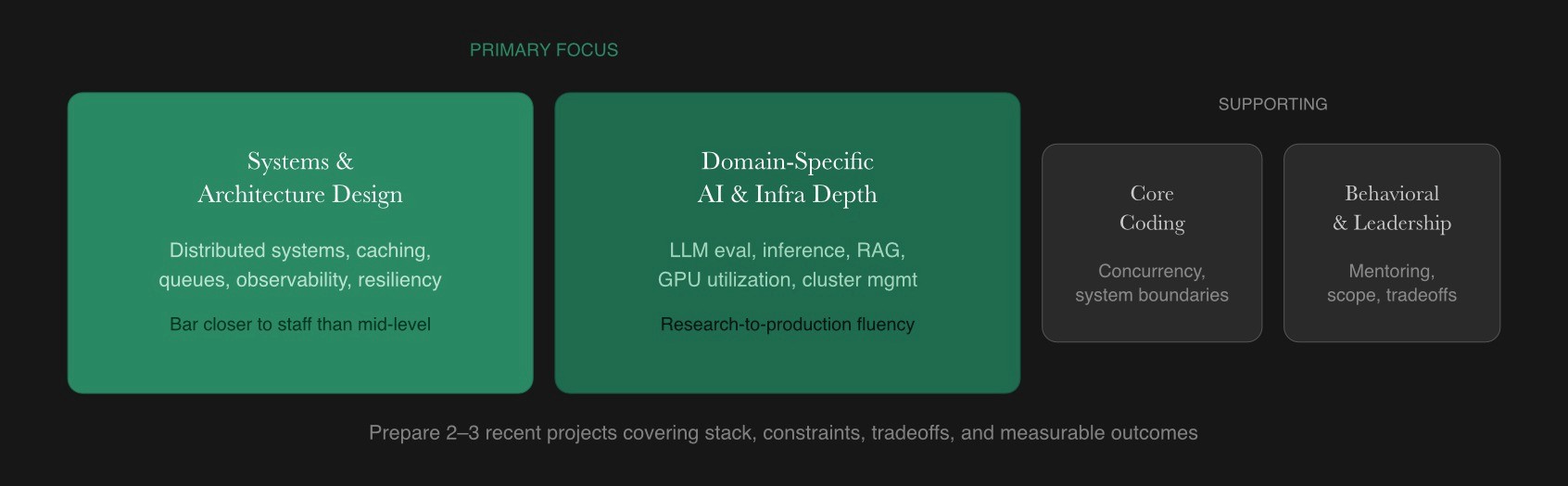
Preparation for MTS roles in 2026 requires a mix of systems depth, practical AI or infrastructure knowledge, and strong communication. The bar for MTS is closer to a staff engineer than to a mid-level software engineer at many AI and infrastructure companies.
Preparation should cover four main dimensions:
Core coding with realistic problems
Systems and architecture design
Domain-specific expertise (LLMs, compound AI systems, infrastructure)
Behavioral and leadership signals
Review 2 to 3 recent high-impact projects in detail and be ready to walk through the technical stack, constraints, tradeoffs, and measurable outcomes.
Technical Preparation: Coding, Systems Design, and AI or Infra Depth
Refresh fundamental coding skills using realistic problems that involve data structures, concurrency, and system boundaries, not just toy algorithm puzzles. Many MTS loops include unit testing expectations and analysis of automated tests within production contexts.
Dedicate time to systems design practice covering distributed systems, caching, queues, observability, and resiliency, using examples like compound AI systems and inference optimization or large-scale API gateways. Practical proficiency with distributed systems and cloud infrastructure, including tools like Terraform and environments like Kubernetes, is expected.
AI engineers and ML researchers targeting MTS roles should prepare to discuss model training, evaluation, and deployment lifecycles, including offline metrics, online experiments, and safety or reliability considerations. Infrastructure-oriented candidates should be ready to speak about cluster management, cost optimization, GPU utilization, storage systems, and incident response for critical services.
Communicating Scope, Impact, and Technical Judgment
Communication skills are crucial in an MTS role, allowing the individual to convey complex concepts to technical and non-technical stakeholders. Use concrete metrics when describing impact, such as latency reductions, reliability improvements (SLOs and error budgets), or cost savings on GPU clusters or storage.
Explain past decisions in terms of tradeoffs, constraints, and alternatives considered to demonstrate mature technical judgment valued in MTS and staff engineer roles. Discuss cross-functional collaboration with research, product, security, and operations, since MTS roles often anchor communication across multiple specialties.
Prepare concise stories that show mentoring of junior engineers, unblocking teams, and driving long-term architectural or research direction, not only writing high-quality code. Problem-solving capabilities and the ability to develop solutions under ambiguity are key differentiators.
Using Curated Marketplaces and Networks Strategically
Curated talent platforms like Fonzi can help senior software engineers and ML specialists surface MTS and staff engineer roles at AI startups and infrastructure companies without cold outreach. Combine marketplace participation with direct networking, open source contributions, and conference talks, which often map directly to MTS expectations for community and technical leadership.
Even when AI systems help match candidates to roles, personal conversations with hiring managers and technical leads remain essential to validate scope, expectations, and cultural fit. Treat marketplace profiles, resumes, and public technical work as a unified portfolio that clearly signals readiness for MTS-level responsibility across new technologies and innovation domains.
Conclusion
The Member of Technical Staff title has become increasingly flexible across AI labs, infrastructure companies, and fast-growing engineering organizations, often covering responsibilities that align with senior, staff, or even principal-level roles. Because the title varies so widely between companies, engineers and recruiters should evaluate each MTS opportunity based on actual scope, technical ownership, domain complexity, and compensation rather than assuming it maps cleanly to a standard software engineering ladder. In AI-heavy organizations, especially, MTS roles frequently combine deep technical execution with system design, research collaboration, and long-term architectural influence.
For experienced engineers pursuing these roles, it is important to present impact clearly through measurable outcomes, technical leadership examples, and evidence of systems-level thinking. Recruiters and hiring leaders also benefit from structured evaluation frameworks that focus on real capability rather than inconsistent titles alone. Platforms like Fonzi are increasingly useful in this environment because they help companies and senior technical candidates connect through more signal-focused hiring workflows that better capture engineering depth, AI expertise, and long-term role alignment. These principles are particularly valuable for engineers preparing for staff-level conversations, performance reviews, or highly specialized AI infrastructure and platform roles.
FAQ
What does Member of Technical Staff (MTS) mean as a job title?
How is a Member of Technical Staff different from a software engineer?
What companies use the MTS title and why?
What is the typical salary and level for a Member of Technical Staff role?
Is Member of Technical Staff a more senior title than software engineer?


