Staff Software Engineer Jobs: Remote and On-Site Roles
By
Samara Garcia
•

The period from 2025 into 2026 has seen staff software engineer roles expand rapidly across AI infrastructure, LLM platforms, and cloud-native systems. Staff software engineer jobs now function as high-leverage technical leadership positions that bridge architecture, implementation, and organizational alignment. This article covers both remote staff software engineer positions and on-site roles, with specific attention to organizations focused on AI and ML.
Key Takeaways
Staff software engineer jobs have evolved since roughly 2020 from senior IC coding roles into positions requiring architectural ownership, mentoring team members, and cross-organizational influence across AI, infrastructure, and full-stack software domains.
These roles now span remote, hybrid and on-site models, with remote staff software engineer positions increasingly common at AI-first companies like Grafana Labs, Pinecone, and Lattice.
Top skills go beyond generic software engineer jobs competencies to include large-scale distributed systems, ML infrastructure, observability, and practical AI tooling, with Go, Python, and Java among the most demanded languages.
Companies are utilizing AI tools and structured hiring funnels to filter candidates, which changes how senior engineers should present portfolios and prepare for interviews.
AI in hiring is most effective when it augments human judgment, and curated marketplaces like Fonzi are one example of a more structured, candidate-friendly approach that surfaces high-signal profiles.
How Staff Software Engineer Roles Differ from Senior and Principal Titles
In most modern engineering ladders, including those at companies like Google, Meta, and Stripe, staff software engineer sits as a distinct level between senior engineer and principal (or architect). Staff engineers are typically required to have at least 8 years of software engineering experience, though demonstrated scope matters more than exact tenure. Staff Software Engineers lead technical direction and architectural decisions, and they are essential for stability and long-term technical strategy within an organization.
Staff Software Engineers own multi-team initiatives, set technical direction for core services, and lead complex migrations without direct people management. They solve cross-functional problems that extend beyond the defined scope of senior engineering roles.
Senior Staff Engineers typically drive cross-organizational architecture and mentor other senior engineers, while Principal Engineers often shape company-wide technical strategy. Because titles vary across companies, candidates should evaluate roles based on scope, impact, and responsibilities rather than title alone.

Remote Staff Software Engineer Jobs vs On-Site Roles
Remote Staff Software Engineer jobs have grown significantly since 2020, particularly in AI tooling, LLM infrastructure, and data platform companies. Many employers now offer fully remote or hybrid roles, giving engineers greater flexibility in where they work. Staff Software Engineers remain among the highest-paid individual contributors in software engineering, with compensation typically including a competitive base salary, equity, bonuses, and comprehensive benefits. Because compensation varies by location, company size, and industry, candidates should evaluate the entire compensation package.
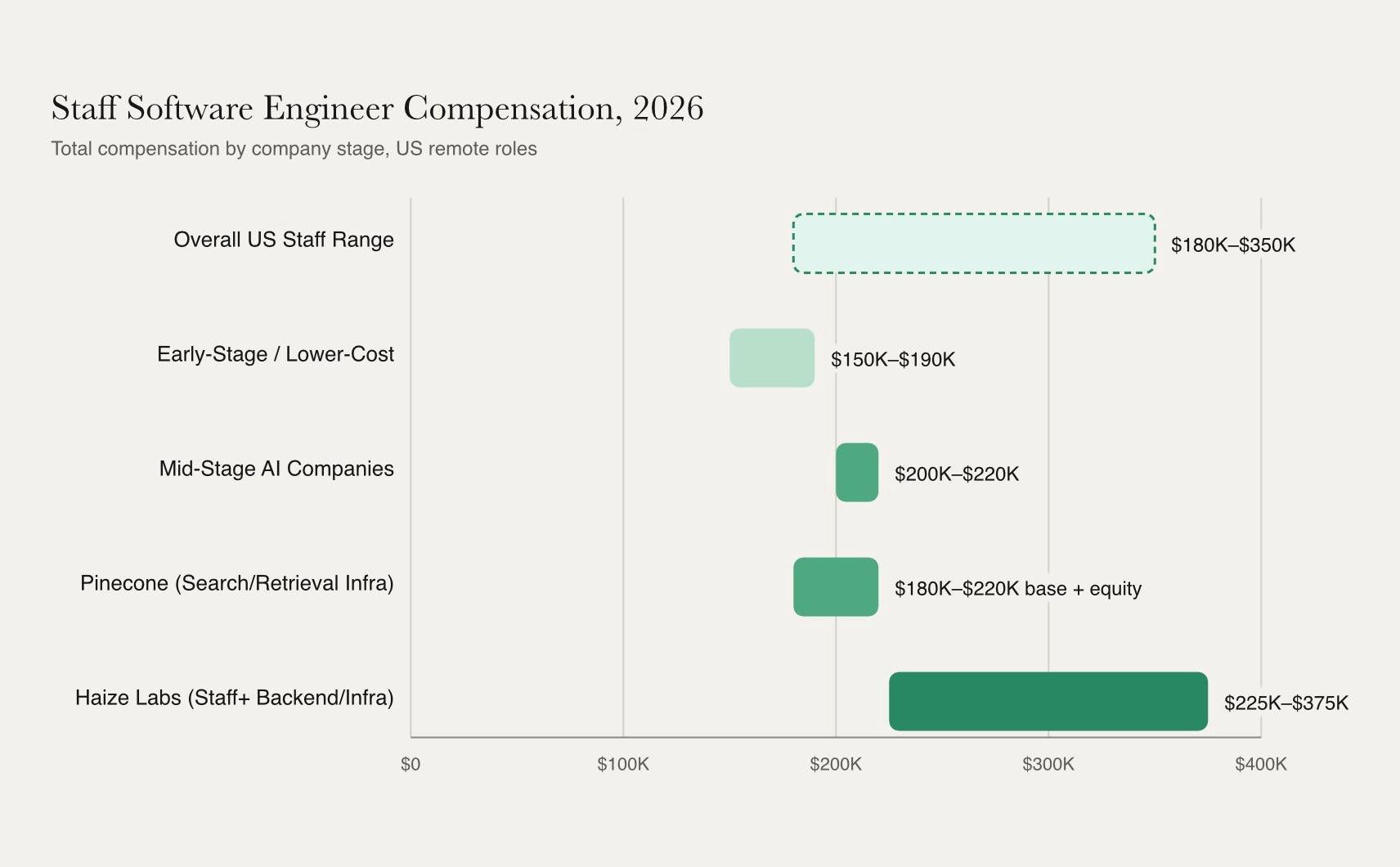
Compensation bands for remote roles differ by region. As of 2026, total compensation in the United States for experienced staff-level talent ranges from roughly 180K to 350K depending on company stage and equity structure. For example, Haize Labs offers US$225,000 to US$375,000 for a Staff+ Backend and Infra role, while Pinecone lists US$180,000-220,000 base plus equity for a remote Search and Retrieval Infrastructure position. Some roles, especially those involving 200k-250k annually base ranges, also include RSUs, bonuses, and travel stipends. Other listings in the 150k-190k annually range tend to appear at earlier-stage startups or in lower-cost regions, while roles advertised at 200k-220k annually are common at mid-stage AI companies.
Top remote staff software roles require very strong written communication, design documentation, and asynchronous decision-making skills. Some companies hiring remote staff engineers expect periodic on-site visits, for example, quarterly architecture summits or annual planning sessions.
Key Skills for Remote Staff Software Engineer Effectiveness
Remote staff engineers must lead distributed teams, facilitate architecture reviews over video, and drive design consensus in shared documents. Technical competencies that frequently appear in remote staff software engineer job descriptions include Kubernetes, multi-region cloud deployments, ML infra, the ability to design scalable data pipelines, and observability tooling. Familiarity with Kubernetes and Docker is highly sought after across nearly every listing.
Leadership skills like mentoring across time zones, driving incident postmortems remotely, and influencing product strategy without in-person presence are critical. Advanced English proficiency and clear written reasoning often serve as differentiators in global remote engineer jobs, particularly for roles that require coordinating engineering teams spanning multiple time zones.
Core Technical and Leadership Skills for Modern Staff Software Engineers
Staff software engineering requires deep technical expertise combined with systems-level leadership. Staff Software Engineers design scalable distributed systems, APIs, microservices, and cloud infrastructure while solving complex cross-team challenges. Experience with AWS or GCP, performance optimization, database scaling, and managing technical debt is essential.
AI and ML skills are increasingly valuable, including LLM integration, model serving, scalable data pipelines, and AI infrastructure. Beyond technical expertise, staff engineers define technical strategy, write design docs, mentor engineers, and align roadmaps across teams. Strong backend skills in Go, Python, or Java are common, while React and other JavaScript frameworks are useful for full-stack development.
Skill Focus Across Different Staff Software Engineer Profiles
The table below compares the common archetypes to help readers map their background to different staff software engineer jobs and hiring paths.
Profile | Primary Focus | Typical Tech Stack | Example Responsibilities |
Infra Staff Engineer | Scalable systems, reliability, deployment automation | Go, Rust, Kubernetes, Terraform, AWS/GCP | Operate large-scale production infrastructure, code backend services, lead architectural initiatives, continuous integration team ownership |
ML Platform Staff Engineer | Model serving, training pipelines, evaluation frameworks | Python, PyTorch, Ray, Kafka, Docker | Design scalable data pipelines, lead technical projects involving model lifecycle, support team quality for ML outputs |
Full Stack Staff Engineer (AI-adjacent) | End-to-end product integration with AI services | TypeScript, React, Node.js, Python, REST/gRPC APIs | Build user-facing AI features, lead technical efforts across frontend and backend, define technical vision for product surfaces |
Non-Technical Skills That Differentiate Staff-Level Candidates
Ownership mindset is critical. Staff engineers drive ambiguous problems from initial problem statement to stable, observable solutions without continuous direction. They solve strategic challenges that span organizational boundaries and lead major projects that require alignment across cross-functional teams.
Exceptional communication, emotional intelligence, and business acumen distinguish successful staff engineers. They align technical decisions with business goals, mentor engineers, participate in design discussions, and advocate for engineering best practices.
How AI Is Changing Staff Software Engineer Hiring
From 2023 onward, many companies integrated AI into resume screening, sourcing, and coding assessment workflows for engineer jobs, including staff roles. For senior and staff software engineer jobs, AI is usually used to prioritize candidates and summarize profiles, while final decisions remain heavily human-driven. Automated screeners rely on concrete signals such as impact metrics, specific technologies, and explicit leadership examples.
Structured hiring practices, including curated marketplaces like Fonzi, use matching models to reduce noise and present high-signal profiles to hiring managers more quickly. AI should reduce manual filtering so recruiters can spend more time on meaningful candidate conversations, not replace human judgment about technical and cultural fit.
Fonzi: AI Matching for Staff Software Engineer Roles
Finding staff software engineer jobs can be challenging because many of the strongest opportunities are filled through curated hiring pipelines rather than public job boards. Fonzi is an AI-powered hiring marketplace that connects experienced software engineers with companies hiring for staff, senior, and principal-level roles.
Its AI matching evaluates technical expertise, architectural experience, and leadership scope to surface opportunities that align with a candidate's background instead of relying on keyword matching alone. Match Day events introduce employers to a curated group of pre-vetted engineers simultaneously, helping both sides move through the hiring process more efficiently. For experienced engineers targeting AI infrastructure, distributed systems, ML platforms, or cloud-native architecture roles, Fonzi provides a structured way to discover high-impact staff-level opportunities while reducing noise in the hiring process.
Navigating the Market: Where to Find Remote and On-Site Staff Software Roles
Staff Software Engineer opportunities continue to grow across AI, cloud infrastructure, fintech, healthtech, big data, cybersecurity, and blockchain companies. Demand is especially strong for engineers who can build scalable distributed systems, AI infrastructure, cloud platforms, and developer tools. Many organizations now offer both remote and hybrid roles, expanding opportunities for candidates beyond traditional tech hubs.
While public job boards list thousands of openings, staff-level candidates often have better success through targeted searches, curated talent marketplaces, employee referrals, and professional networks. Technical conferences, AI and cloud meetups, open-source communities, and industry groups remain valuable sources of high-impact opportunities. Rather than applying broadly, maintain a focused shortlist of companies and monitor searches such as Staff Software Engineer, Remote Staff Software Engineer, and Senior Staff Software Engineer across multiple hiring platforms.
Evaluating Companies Hiring Remote Staff Software Engineers
Review engineering blogs, open source activity, and incident transparency reports to understand a company's technical maturity. Ask about ownership of key AI or infra systems, on-call policies, and expectations for staff-level impact within the first 6 to 12 months. According to the AgileFever AI Salary Report, year-over-year growth of 22-35% in pay for ML and GenAI roles underscores the value companies place on top remote staff software talent.
Clarify growth paths beyond staff, including transitions to principal roles or technical leadership in new product lines launched around 2026 or later. Staff candidates should be selective about environments where they can maintain deep technical engagement instead of drifting into informal management without clear support.
Summary
Staff software engineer roles have evolved into technical leadership positions focused on architecture, cross-team collaboration, and AI-driven systems. Opportunities are growing across remote, hybrid, and on-site environments, particularly in AI, cloud infrastructure, and distributed systems. Success requires deep expertise in scalable systems alongside strong communication, mentoring, and technical strategy.
Landing these roles depends on demonstrating measurable technical impact, architectural ownership, and leadership beyond coding. Companies increasingly use AI-assisted hiring to streamline sourcing, while referrals, specialized talent platforms, and professional networks often provide better opportunities than traditional job boards. Candidates should prioritize organizations with strong engineering cultures, clear career progression, and opportunities to shape high-impact technical decisions.
FAQ
How many years of experience are typically required for staff software engineer roles in 2026?
Does working as a remote staff software engineer limit promotion to principal or architect roles?
How is AI affecting hiring timelines for senior and staff engineer jobs?
What is the most effective way to showcase staff-level leadership on a resume or profile?
Should staff software engineers in AI and ML specialties maintain hands-on coding, or focus mainly on architecture?


