Hiring skilled software engineers has become increasingly competitive, especially for AI, machine learning, and other specialized technical roles. Companies must compete for a limited pool of qualified candidates while navigating longer hiring cycles and higher compensation expectations.
Finding top talent requires more than posting jobs on traditional job boards. Successful hiring teams combine targeted sourcing, structured technical evaluations, and efficient interview processes to identify and secure the best candidates. This guide explores practical strategies for attracting, assessing, and hiring software engineers more effectively.
Key Takeaways
Sourcing the best software engineers requires a repeatable recruiting process that blends referrals, targeted outbound, and a sharp employer brand, not reliance on a single channel or job board.
Defining a precise role profile and calibrated interview process upfront is the fastest way to reduce time to hire software engineers while improving quality.
Specialized communities, technical platforms, and curated marketplaces like Fonzi often yield more qualified candidates than generic job boards alone.
Structured evaluation, code assessments, and consistent interview panels are essential to distinguish truly high-performing engineers from merely qualified candidates.
Clarify What "High-Performing" Means Before You Start the Hiring Process
Before writing job postings or contacting potential candidates, you must define what success looks like for the role. Sourcing top-tier software engineers requires a multi-channel approach, but none of those channels will work if the team cannot agree on what "high-performing" actually means for this specific position.
Start by specifying concrete responsibilities and expected outcomes in the first 6 to 12 months. For example, a senior backend engineer might be expected to own a service end-to-end, reduce latency by a measurable target, or build a mentoring culture within the team. Translate these expectations into a hiring scorecard that covers technical skills (proficiency in specific tech stack components such as TypeScript, Python, React, or Kubernetes), domain expertise (security, ML pipelines, web development, data science), past project impact, and core behaviors like ownership and communication. Include soft skills alongside hard requirements. This scorecard becomes the single reference document that informs sourcing outreach, interview questions, and final hiring decisions.
A clear definition of "high-performing" also enables better use of AI tools by giving them precise criteria for matching and ranking candidates rather than relying on keyword frequency.
Align Hiring Managers, Recruiters, and Interviewers Around a Role Profile
Misalignment between hiring managers, recruiters, and interviewers is one of the most common causes of slow, frustrating recruitment processes. When stakeholders disagree on what "qualified" means, the funnel leaks at every stage.
Hold a brief working session between engineering leaders, product, and talent to finalize required skills, seniority level, and must-have experience. Document the following in a shared role brief:
Non-negotiables: specific software development stacks, years of production experience, ability to lead cross-team projects
Nice-to-haves: familiarity with new technologies, open source software contributions, experience at startups
Deal-breakers: lack of production experience, unwillingness to collaborate, mismatched seniority expectations
This alignment step reduces back-and-forth for candidates entering the pipeline and shortens the overall recruiting process significantly.
Build a Strong Top-of-Funnel: Referrals, Communities, and Targeted Job Postings
The most reliable way to hire software engineers is to build a diversified candidate pipeline supported by strong candidate relationship management. Relying on a single channel is a common mistake. Instead, combine referrals, developer communities, and well-crafted job postings to create a steady flow of high-quality candidates.
Channel | Conversion Rate | Best For | Key Limitation |
Referrals | 3 to 5x higher than job boards | Senior developers, culture fit | Can limit diversity if not managed |
Developer Communities (GitHub, Stack Overflow, meetups) | Moderate, but high signal | Deep expertise, passive candidates | Requires long-term relationship building |
Job Boards (Wellfound, Dice, Indeed) | Low per-applicant, high volume | Active job seekers, broad reach | High noise, many unqualified applicants |
Curated Marketplaces (e.g., Fonzi) | Higher than generic boards | Pre-screened engineers, AI and startup roles | Smaller total candidate pool |
Hiring managers should track metrics such as response rate, interview-to-offer ratio, and time to hire across channels to understand which investments yield the right talent.
Use Referrals and Alumni Networks to Find Qualified Candidates
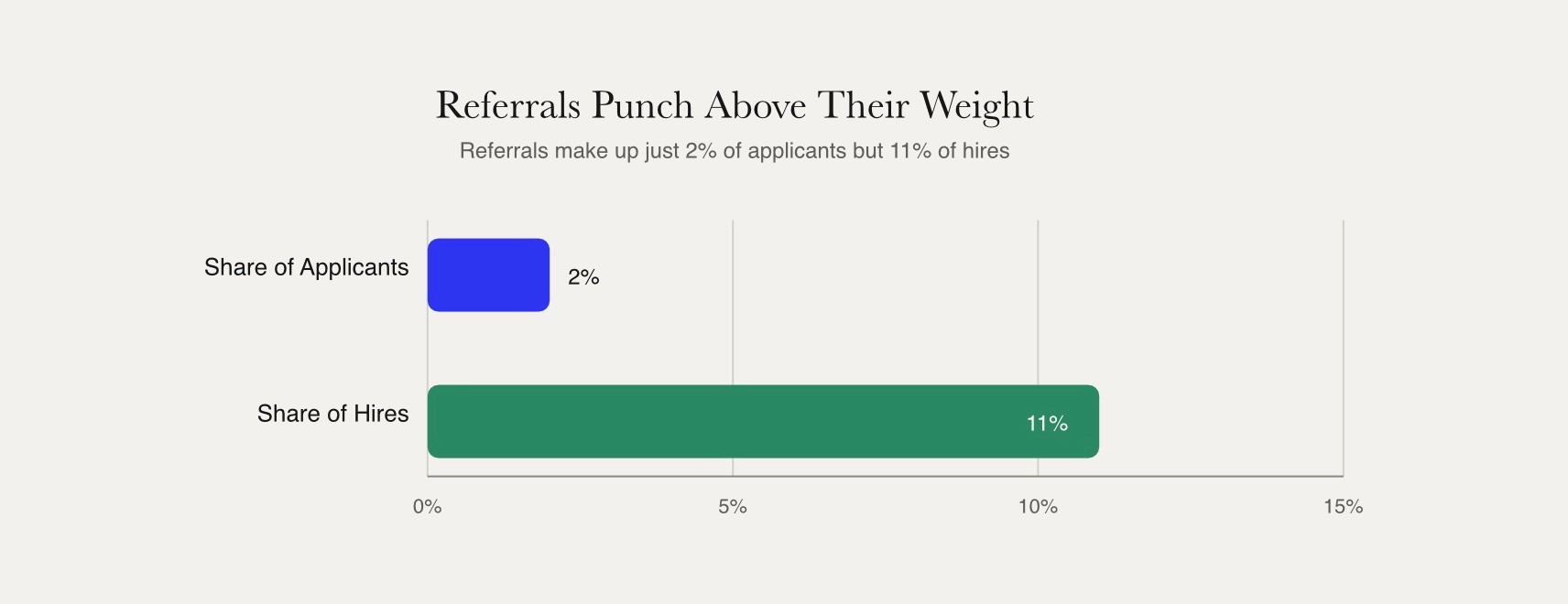
Referrals are one of the most effective sourcing techniques for finding candidates. Data from CareerPlug's 2025 Recruiting Metrics Report shows that while referrals account for just 2 percent of applicants, they make up 11 percent of hires, making them significantly more likely to be hired than a typical job board applicant. An internal employee referral program is effective for hiring top tech talent at every level.
Concrete referral sources include existing employees, former colleagues, investors, advisors, and alumni from prior companies. Employees can refer candidates from their broader networks, not just close contacts. In fact, weak ties often yield the best job referrals because they connect you to circles outside your immediate network. Every new hire expands your referral network further.
To generate more referrals, set up a simple program with clear incentives (financial bonus or public recognition), transparent status updates, and quarterly reminders. Use LinkedIn and alumni directories to reconnect with engineers who shipped important work in the past. Campus recruiting starts in August for students graduating the following spring, so plan early for new-grad pipelines.
To avoid homogeneity, deliberately seek referrals from different locations and communities, not just close friends in one city.
Engage Developer Communities and Events Where the Best Engineers Already Contribute
Online and offline communities are where many of the best software engineers spend their time outside of work. Platforms like GitHub, Stack Overflow, local meetups, and domain-specific conferences provide strong signals of engineering quality. Referrals increase the likelihood of candidate engagement, and so does authentic community participation.
You can identify high-performing engineers through open source contributions, which provide visible proof of candidates' talents. Technical blogs can showcase candidates' skills and projects publicly, and high-quality answers on Stack Overflow reveal deep knowledge in specific areas. Stack Overflow had over 90,000 respondents in its 2019 survey, underscoring its reach among other developers in the industry.
Engage in niche communities to find software engineers authentically. Sponsor meetups, give technical talks, and offer mentorship rather than only posting job listings. Technical leaders who build credibility over 6 to 12 months will find that outreach to community members becomes much more effective. Track promising contributors in a simple CRM or spreadsheet for ongoing recruiting process follow-up.
Create High-Intent Job Postings That Attract the Right Job Seekers
Job postings still matter for reaching active job seekers, but they must be written for experienced software engineers. A well-crafted job ad foregrounds impact, tech stack, reporting lines, and the key features of the role instead of buzzwords. Highlight specific problems your team is solving in the job description to attract engineers who prioritize technical environments and problem-solving opportunities.
Publish roles on your own careers page first, then syndicate thoughtfully. Dice is specifically for jobs in software development and IT. Indeed allows job searches by title, keyword, or company. WeWorkRemotely claims to be the biggest remote job board.
Include realistic salary ranges, location expectations, and interview process steps to filter out poor fits early. Strong job postings, combined with referral outreach, significantly reduce unqualified inbound applications and save time for recruiters. The goal is to make every job listing a magnet for the right talent rather than a source of noise.
Go Direct: Targeted Outbound Sourcing on Technical and Social Platforms
Many of the best software engineers are not actively looking for new opportunities. They are passive candidates who must be approached directly. Speed is critical in the hiring process for software engineers, and proactive outbound sourcing is the fastest way to reach top talent who would otherwise never see your job postings.
Personalization matters enormously. Sourcing benchmark data from Pin shows cold outreach reply rates hover around 3.43 percent. Generic templates perform poorly. Instead, reference recent work, open source software contributions, or talks to demonstrate genuine interest.
LinkedIn: Structured Searches for Relevant and Available Engineers
LinkedIn is the largest structured database of software development career histories worldwide. Use Boolean search strategies combining titles, skills, companies, and geography to identify qualified candidates. Refine by activity signals like recent posts, job-seeking indicators, or "open to work" badges.
Craft outreach that references a candidate's specific projects, shared connections, and why the role is relevant in 2026. Use InMail or mutual introductions, and always respect candidate time to maintain a positive employer reputation. Over 40 percent of developers have under five years of experience, so LinkedIn is also a strong channel for identifying rising mid-level talent alongside senior developers.
GitHub, Stack Overflow, and Niche Communities for Technical Signal
GitHub repositories, Stack Overflow answers, and specialized forums reveal real-world engineering skill far better than a resume alone. On GitHub, look for consistent commit history, thoughtful documentation, tests, and impactful pull requests. Open source contributions also demonstrate a candidate's ability to collaborate with other developers on complex problems.
Utilize platforms like GitHub and Stack Overflow to identify engineers with deep expertise. Stack Overflow user profiles, tags, and reputation scores help you find subject-matter experts in distributed systems, data science, or web development. On Reddit and topic-specific communities, focus on contributors who show thoughtful participation rather than self-promotion.
Respect community norms, read licenses, and avoid spammy behavior. Engineers remember when recruiters disrespect their communities, and that reputation travels fast across the market.
Use AI and Sourcing Tools Responsibly to Scale Outreach
AI tools can search across LinkedIn, GitHub, X (formerly Twitter), and other platforms, then shortlist candidates who fit the hiring criteria. AI-based matching, knowledge graphs, and predictive signals (such as likely-to-move scores) can speed up initial targeting. Pin reports that AI-assisted recruitment can cut time-to-fill by around 26 percent for many roles.
However, human review of AI suggestions remains essential. AI produces false positives from keyword matches, outdated experience, or skill mismatches. Limit daily outbound volume to a level where every message can be customized meaningfully. AI should not replace the recruiter's expertise and knowledge of the role, but it can dramatically reduce the time they spend on initial sourcing. Fonzi, for example, is a curated marketplace that uses structured profiles and screening to reduce sourcing effort for AI and software roles, illustrating a hybrid human-and-AI approach.
Design a Structured, Candidate-Friendly Interview Process That Surfaces True High Performers
Sourcing is only effective if the interview process can accurately identify high-performing engineers. Candidates remember how they felt during the interview process, and a positive interview experience encourages candidates to reapply later, even if they do not receive an offer the first time. Streamlining the interview process reduces time to hire and improves the experience for everyone involved.
Time-to-hire benchmarks from ClarityHire show that mid-level roles close in roughly 38 to 50 days, while senior and staff roles can take 64 days or more. Top-decile teams cut those numbers nearly in half by pre-blocking interview slots, running same-day debriefs, and approving compensation bands ahead of time.
Assessment Format | Strengths | Best For | Limitation |
Take-home project | Realistic, shows design thinking | Mid to senior engineers | Time burden on candidates |
Live coding/pair programming | Real-time collaboration signal | Mid-level and new-hire candidates | Performance anxiety, artificial setting |
Systems design interview | Architectural judgment, trade-offs | Senior developers, staff roles | Hard to standardize scoring |
Code review exercise | Communication, code quality focus | All levels | Requires well-prepared materials |
Standardize Evaluation to Reduce Bias and Improve Signal
Use structured interview scorecards with anchored ratings for problem-solving, code quality, communication, and ownership. Apply the same questions and rubrics to all candidates at a given level to eliminate bias in recruitment, improve fairness, and make hiring decisions more consistent.
Train interviewers to probe without leading, take objective notes, and avoid "gut feel" decisions. Bias is a real concern in both human and AI evaluation, so companies should regularly review hiring outcomes across demographic groups. Structured, bias-aware evaluation leads to stronger hiring decisions and lower attrition during the first 12 to 18 months.
Close High-Performing Engineers with Competitive Compensation and Growth
Winning the best talent requires competitive compensation and a clear progression path. Top software engineers expect competitive salaries and benefits, including health coverage and stock options. Base salary, equity, bonus, remote work policies, and professional development budgets all factor into the decision.
Use current salary data from reputable sources such as Levels.fyi and local cost-of-living benchmarks to calibrate offers by region and seniority. Flexible work arrangements attract software engineering talent across the industry. Top candidates prioritize continuous learning and challenging technical problems, so providing training reimbursement can enhance employee retention. Offering mentorship programs can keep software engineers engaged, and promoting career advancement opportunities is crucial for retention.
Transparent leveling frameworks and promotion criteria are a strong selling point. Flexible project scopes can help retain talented engineers over time, as engineers value the ability to grow into new technologies and take on more jobs with increasing scope. Fast decision cycles prevent you from losing candidates to faster-moving competitors offering stronger compensation and benefits.
Where AI Fits in the Modern Hiring Process for Software Engineers
AI is being applied to sourcing, screening, fraud detection, and candidate matching across tech companies in 2026. The focus below is on practical applications, not abstract hype. No single tool is a game-changer on its own, but the right combination of AI and human oversight can meaningfully improve the hiring process.
AI Use Case | Benefit | Human Oversight Required |
Resume parsing and skill extraction | Faster screening, reduced manual review | Validate extracted skills against actual project experience |
Candidate matching to role scorecard | Surfaces relevant profiles from large pools | Confirm fit through interview, not algorithm alone |
Fraud detection (fake profiles, copied repos) | Flags inconsistencies early | Human review of flagged cases before rejection |
Interview scheduling automation | Reduces coordination delays | Monitor for candidate experience issues |
Automated code grading | Speeds early-stage filtering | Senior engineers review borderline or complex cases |
AI-Assisted, Human-Led Technical Evaluation
AI can speed up grading, plagiarism checks, and pattern detection across submissions, and it can also maintain interview logs and generate debrief summaries, but it shouldn't replace human judgment for architectural and system-design evaluation.
Mitigating Bias and Preserving Transparency When Using AI in Recruiting
Leaders are rightly concerned about reinforcing bias and losing control when AI is introduced into the recruitment process. Lawsuits such as the Workday case in California show that both employers and vendors may be held accountable for discriminatory screening practices.
Practical safeguards include evaluating models on diverse candidate sets, regularly auditing outcomes by demographic group, and ensuring sensitive attributes are excluded from scoring. Give candidates a brief explanation of where AI is used (for example, initial screening) and how final decisions are made by humans. Monitor data privacy, retention periods, and compliance with regulations when using AI tools on candidate data. Frame AI as an assistant that supports fair, consistent decision-making, not an autonomous decision-maker.
Fonzi: AI-Powered Software Engineer Sourcing
Finding high-performing software engineers often requires more than traditional job boards and outbound recruiting. Fonzi is a curated AI hiring marketplace that helps companies discover pre-vetted software engineers based on technical skills, experience, and role requirements. Its AI-powered matching reduces sourcing time, while structured candidate profiles make it easier to evaluate qualified engineers.
Match Day events introduce employers to a curated pool of interview-ready candidates at the same time, helping teams move from sourcing to interviews faster. For companies hiring AI, machine learning, backend, or full-stack engineers, Fonzi complements referrals and direct sourcing by improving access to high-quality technical talent and shortening the hiring process.
Summary
Hiring high-performing software engineers requires more than posting jobs. Successful teams combine referrals, developer communities, targeted outreach, and structured interviews with clear role definitions to attract and identify the right candidates faster.
AI can streamline sourcing and screening, but human evaluation remains essential for technical and hiring decisions. Pairing efficient processes with competitive compensation, career growth opportunities, and a strong candidate experience helps companies consistently hire and retain top engineering talent.
FAQ
How many candidates do we need at the top of the funnel to hire one senior software engineer?
How can a smaller company compete with large tech firms for the best software engineers?
When should we change the role requirements or compensation range during a search?
How do we know if our AI-assisted sourcing or screening tools are actually working?
What is the most important thing to fix first in a struggling engineering hiring process?