
The software engineering hiring market is competitive for both companies and candidates. According to recent developer and hiring market data, a large percentage of experienced engineers now receive multiple job opportunities each year, while remote hiring has expanded access to a truly global talent pool. At the same time, compensation expectations continue to rise sharply, especially for AI and machine learning specialists, where total compensation packages regularly exceed traditional software engineering benchmarks. Senior engineers on the US West Coast often command base salaries between $180K and $250K, while companies increasingly compare those costs against international hiring markets in Eastern Europe and beyond. In this blog, we’ll talk about how to hire software engineers through more structured, high-signal workflows that reduce noise, improve candidate quality, and accelerate hiring decisions without lowering the bar.
Key Takeaways
Hiring software engineers has changed dramatically, with remote work normalization and AI-driven specialization making speed and quality of hire more critical than volume.
A repeatable hiring process must balance technical assessment, communication skills, and cultural fit for both software and AI-focused roles, using structured interviews and clear evaluation rubrics.
Experienced engineers care as much about company culture, exciting projects, and continuous learning opportunities as they do about compensation.
Structured interviews outperform unstructured ones by 2x in predicting on-job performance, and realistic work samples provide a better signal than abstract whiteboard puzzles.
Curated talent networks and modern hiring tools, such as Fonzi as a curated marketplace, can extend reach but cannot replace thoughtful human judgment in final decisions.
Clarify What You Need Before You Start Hiring
Most hiring mistakes come from starting the recruitment process without a precise understanding of what kind of engineer is needed and why. Translate business goals into concrete engineering profiles. If your goal is to scale payments to 1M transactions per second, you need a backend engineer skilled in Rust or Go for distributed systems. If you are building AI-powered recommendations handling 10TB datasets, you need an ML engineer proficient in PyTorch.
Defining must-have versus nice-to-have skills:
Core programming languages
Frameworks (React and Node for full-stack, Kubernetes for infrastructure)
System types (microservices versus monoliths)
Domain knowledge (fintech compliance, healthcare HIPAA requirements)
Nice-to-haves: niche skills like LangChain for AI agents
Deciding between junior, mid-level, or senior engineers:
Juniors (0 to 2 years, $120K to $160K): Fast ramp time but require high supervision. Ideal for non-core tasks.
Mids (3 to 5 years, $160K to $220K): Balanced cost and speed, suitable for feature development.
Senior engineers (6+ years, $220K to $300K+): Strategic ownership for architecture, but expect 2 to 3 month ramp time. They often allow engineering organizations to scale complex product systems efficiently without linearly multiplying their developer headcount.
Hiring software engineers can be approached through three primary models: full-time employees, freelance engineers, and software consultancies. Freelance software engineers provide on-demand talent and are typically more cost-effective than full-time employees, making them suitable for short-term projects. Software consultancies offer a hybrid approach, providing the flexibility of freelancers while ensuring the commitment level of in-house teams. The global IT outsourcing market, which includes hiring software engineers through consultancies, is expected to grow from $588.38 billion in 2025 to $806.55 billion by 2030, at a compound annual growth rate of 6.51%.
Document responsibilities and outcomes clearly using OKRs such as “Own 3 quarterly features end-to-end, reduce latency 40%.” The job description should reflect real daily work and the innovative projects engineers will own. Align with stakeholders (product, data, security) early via a pre-hiring workshop so hiring managers avoid conflicting expectations later in the hiring process.
Design a Structured Hiring Process for Software Engineers
A structured hiring process, as outlined in Google's re:Work framework, significantly mitigates cognitive hiring bias while saving interviewers an average of 40 minutes per session through standardized evaluation rubrics. A structured, multi-stage hiring process for software engineers focuses on technical proficiency, problem-solving, and cultural alignment.
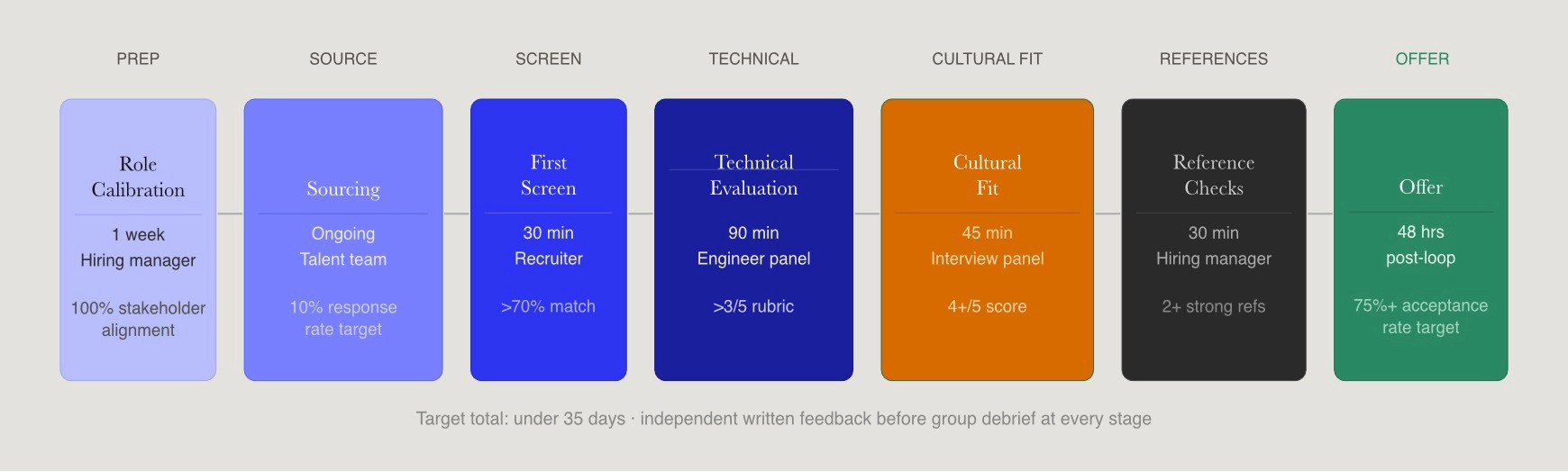
Essential stages most fast-growing tech companies should include:
Intake and role definition (1 week)
Sourcing (ongoing)
Initial screen (30 minutes)
Technical assessment (1 to 2 hours)
Cultural fit conversations (45 minutes)
References (3 contacts)
Offer (48 hours post-loop)
Setting service level agreements is critical. Responding to candidates quickly protects your brand and dramatically lowers candidate drop-off rates during competitive hiring loops. An efficient and engaging interview process can significantly improve your chances of hiring top software engineers, which includes streamlining the interview process and ensuring it is tailored to assess both technical and soft skills.
Core competencies for your hiring rubric:
Problem solving (decomposes ambiguity)
Coding ability (clean, testable code)
System design (scalability trade-offs)
Communication skills (explains concepts to non-technical stakeholders)
Company culture alignment (ownership examples)
AI tools can assist with scheduling (Clara achieves 95% accuracy), resume triage (80% match rates), and note-taking, but human interviewers must remain accountable for final hiring decisions to prevent automated bias from filtering out qualified candidates from non-traditional backgrounds.
Map Each Stage of the Interview Loop
Key steps in hiring software engineers include initial recruiter screening, hands-on technical assessment, and behavioral interviews to ensure long-term fit.
Recruiter or hiring manager screen (30 minutes, video call): Focus on career narrative, motivation (“Why now?”), and a high-level skills overview. Pass criteria: 3+ years relevant experience.
Technical screen (60 minutes, CoderPad or similar): Live algorithm and debugging. Pass criteria: 80% correct, efficient solutions. Employing live coding challenges evaluates a candidate’s problem-solving thought process as opposed to just their syntax knowledge.
On-site or multi-interviewer loop (3 to 4 hours, 4 interviewers): Coding, systems, behavioral, and values assessment. Use standardized questions such as “Design a URL shortener: what are the trade-offs?”
Final leadership discussion (30 minutes): Vision alignment and answering candidate questions.
Interviews should feel like collaborative discussions that mirror real engineering work, rather than high-pressure interrogations. Every interviewer should submit independent written feedback before group debriefs to minimize groupthink and ensure fair candidate evaluation. Candidates with a history of staying in jobs for a long time and strong references are often seen as more reliable, making reliability a key trait to assess.
Use a Simple Table to Define Stages and Ownership
Stage | Owner | Duration | Focus Areas | Pass/Fail Criteria |
Role calibration | Hiring manager, Engineering lead | 2 to 4 hours | Define rubric, write job description | 100% stakeholder alignment |
Sourcing | Talent team | Ongoing | 50+ touches per week | 10% response rate |
First screen | Recruiter | 30 minutes | Fit, motivation | Greater than 70% match |
Technical evaluation | Engineer | 90 minutes | Coding, systems | Greater than 3/5 rubric score |
Cultural fit | Interview panel | 45 minutes | Values, behavior | 4+/5 score |
Reference checks | Hiring manager | 30 minutes | Verify claims | 2+ strong references |
Sourcing Strategies to Reach the Right Software Engineers
Strong hiring outcomes start with a strong top of funnel, especially when targeting talented engineers in competitive markets like the US, Western Europe, and India. Industry data shows that building a targeted, recruiter-sourced talent pipeline yields three times more hires than relying on generic job boards alone.
Top talent for software engineering roles is typically sourced via LinkedIn, referrals, and niche platforms like GitHub. However, LinkedIn cold InMail response rates have fallen to 8%, and generic job boards perform even worse. To find top talent, utilize multiple channels for sourcing candidates, including job boards, professional networking sites, tech forums, and employee referrals.
Building a long-term referral engine:
Formal employee referral programs with 10 to 20% bonuses ($5K to $10K per successful referral)
Alumni networks (Airbnb’s alumni Slack fills 30% of roles)
Connections with former colleagues via ATS tags
Engaging with engineering communities:
Conferences in 2026 to 2027 (NeurIPS, ICML, local PyCons)
GitHub OSS contributors (focusing on developers who demonstrate active repository ownership and consistent code contributions
Specialized Slack or Discord groups (Reactiflux has 50K members, PySlackers)
Platforms such as Fonzi, which curate software engineers for AI startups and tech companies, can be used as one sourcing channel among several for 20 to 30% faster fills on AI roles.
A strong employer brand is vital to attract and recruit the best software engineering talent, as it influences job candidates’ perceptions and decisions. Companies that invest in employer branding can significantly reduce hiring costs and improve employee retention rates, as a positive brand attracts candidates who align with the company's values. Engineering blogs, open-source presence, and public talks improve response rates and make it easier to hire software engineers effectively over time.
Write Job Descriptions That Attract, Not Repel, Engineers
A compelling job listing should outline the tools and languages the candidate should know, the projects they will work on, and as much information about day-to-day expectations as is reasonable. Data from recruitment benchmarks shows that confusing job application processes and ambiguous requirements drive an average 70% candidate drop-off rate before completion.
Use plain language: “Build RAG pipeline for 1M QPS search using PyTorch and LangChain, collaborating with PMs and data scientists.”
Include specific technologies (Kubernetes, Postgres), example projects (“Shipped routing optimization similar to Uber”), and team context (“6 engineers, async remote”).
Be transparent about salary ranges ($180K to $220K base), remote or hybrid expectations, time zones, and on-call responsibilities. Senior engineers expect this information up front.
Weave in company culture, professional development opportunities, and exciting projects. Highlighting a positive work environment, inclusive culture, and work-life balance in employer branding efforts can appeal to software developers seeking a supportive workplace.
Balance Outbound and Inbound Outreach
Inbound applications convert at 10 to 15%, while personalized outbound sourcing converts at 25%.
For outbound campaigns, use short personalized messages referencing specific work: “Saw your FastAPI contribution. We are scaling similar infrastructure for AI inference. Thoughts on chatting?” AI tools like Lavender boost reply rates by 40%, but humans should review messages to maintain authenticity.
Track response rates and iterate. If you are below 15%, A/B test subject lines and messaging. Research industry standards for your engineering persona to understand what resonates.
Evaluate Technical Skills and Communication Without Burning Everyone Out
The goal of a technical assessment is to approximate real work conditions while respecting the candidate’s time and minimizing stress. Proficiency in core programming languages, data structures, algorithm complexity, database management, version control, and CI/CD tools is critical for software engineers.
Common methods and when to use them:
Live coding (55% predictive per Hackerrank 2026, but stressful)
Take-home projects (2 hours, 70% predictive)
Pair programming (realistic, 80% predictive per PairProg study)
System design interviews (verbal, best for senior engineers)
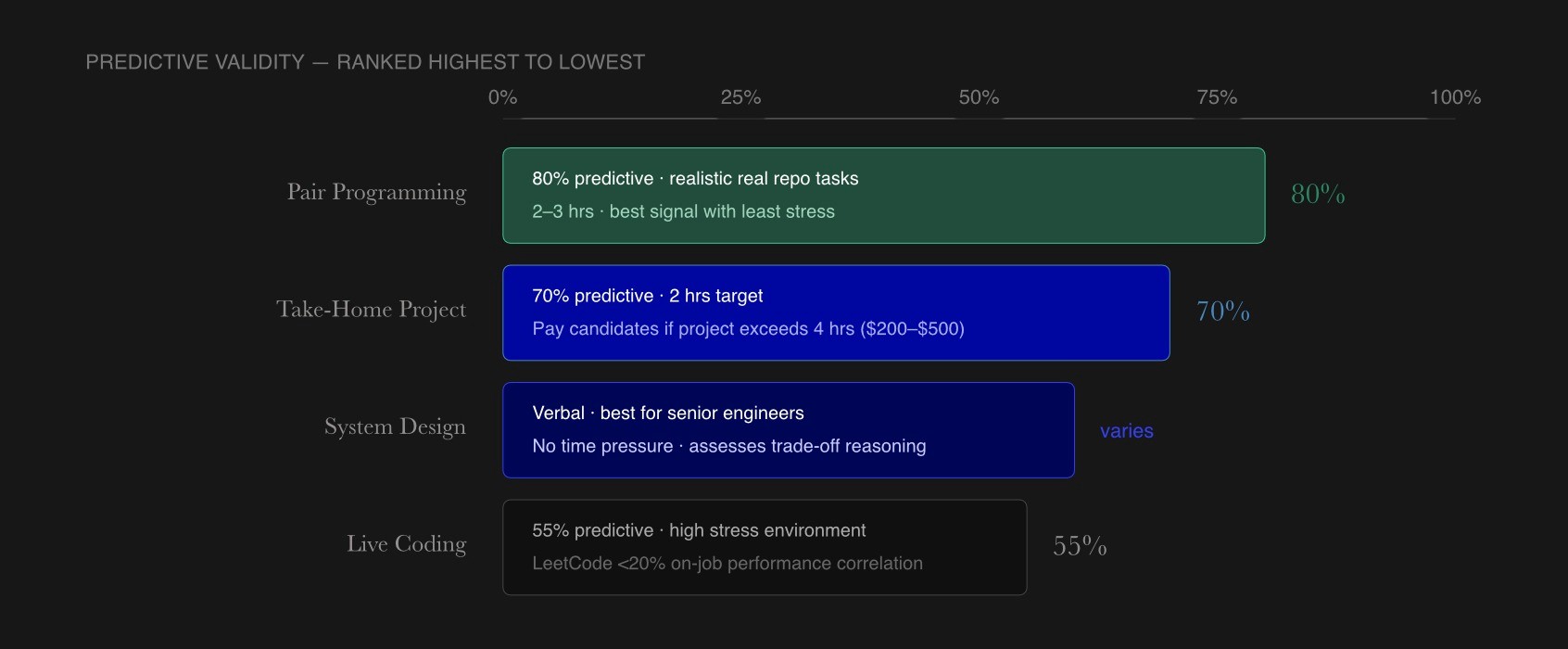
Avoid high-pressure whiteboard puzzles that do not resemble how engineers actually ship software. Meta’s internal 2025 study found LeetCode-style problems have less than 20% correlation with on-the-job performance.
Standardizing technical assessments with practical coding challenges helps to avoid bias in the hiring process. Software engineers need to have strong problem-solving abilities to tackle complex problems efficiently, which can be assessed through hypothetical scenarios or coding challenges during the interview process. Assess communication skills during technical interviews by observing how right candidates describe trade-offs, ask clarifying questions, and handle feedback. Effective communication skills are essential for software engineers to collaborate with team members and convey complex technical concepts to non-technical stakeholders.
For AI and machine learning roles, evaluation should include understanding of data quality (80% of ML time), experimentation, productionization (MLOps, Ray), agentic workflows, RAG optimization (chunking, evaluation), and GPU orchestration (T4 versus A100), not only academic algorithms.
Design Realistic Work Samples
Create short, focused exercises that mirror your company’s stack and challenges without requiring more than 2 to 3 hours of candidate time.
Extend a small existing codebase with authentication
Debug an intentionally broken Lambda function
Review a pull request for style and correctness
Offer alternatives such as pair programming sessions where candidates and interviewers work through real repository tasks together. Pay for take-home projects exceeding 4 hours ($200 to $500) to respect the best engineers who juggle multiple interviews and current jobs.
Use Structured Technical Rubrics
A technical rubric with defined levels (1 to 4) for categories reduces bias and creates consistency across interviewers.
Categories to assess:
Problem decomposition (identifies dependencies)
Code quality (follows standards like PEP8, tests greater than 80% coverage)
Collaboration (asks clarifying questions)
Learning orientation (“What recent ML paper have you implemented?”)
Industry studies show that standardized rubrics minimize interviewer bias during technical assessments. Train interviewers to calibrate on sample candidate responses. Include evidence of continuous learning and adaptability, especially for fast-moving areas like AI and cloud-native software development. Adaptability and continuous learning are crucial traits for software engineers, as they must be willing to learn new technologies and tools to keep up with the ever-evolving tech industry.
Assess Cultural Fit, Motivation, and Long-Term Potential
Assessing cultural fit is about alignment on values and working styles, not about hiring people who look or think exactly like the existing team, especially since McKinsey research indicates gender-diverse executive teams are 15% more likely to achieve financial outperformance.
Assessing behavioral skills using the “3 C’s” (Character, Competence, Chemistry) is important to evaluate cultural fit. Focus assessment on collaboration, ownership, feedback habits, and ethical standards.
Questions that reveal fit:
“Tell me about a time you handled conflict on a technical decision.”
“Describe a failure and what you learned from it.”
“How have you contributed to inclusive team environments?”
Probe for genuine interest in the company's mission, customers, and problem space. Great software engineering candidates demonstrate initiative by going the extra mile, such as asking about next steps in the hiring process and researching the company before interviews.
Experienced engineers often look for clear career progression, mentoring, and continuous learning support. Be ready to describe professional growth paths concretely. Inconsistent or vague answers about the work environment during interviews can cause strong candidates to drop out or sign elsewhere.
Signals Top Engineers Look For During Interviews
Flip the perspective to understand what other engineers evaluate before accepting an offer:
Code health and technical debt posture (ask about Sonar scores)
Clarity of product strategy and roadmap
Autonomy in decision making (can engineers deploy independently?)
How incidents are handled (post-mortem culture)
Communication between engineering, product, and design
Recommend that interviewers answer questions candidly, including known challenges. Authenticity builds trust and improves close rates with the best candidates.
Avoid Common Cultural Fit Pitfalls
Frequent mistakes that reduce diversity and hiring quality:
Equating cultural fit with “would I have coffee with this person” (reduces diversity by 25%)
Over-indexing on personal hobbies instead of behaviors that matter: reliability, initiative, and thought process
Using unstructured “gut feel” assessments
Use structured cultural fit questions and scorecards to keep evaluations focused on company values and working norms. Inclusive processes, such as diverse interview panels and standardized questions, improve both fairness and hiring outcomes for new hires.
Close, Onboard, and Retain the Engineers You Worked Hard to Hire
Hiring software engineers effectively does not end with an accepted offer. Retention data shows that early engineering attrition stems from poor closing and onboarding. Competitive compensation is essential to secure top talent in a high-demand market.
Fast, transparent communication from the final interview through offer signature increases the chance of winning the right software engineers with multiple options.
Closing best practices:
Present offers verbally first before sending written details
Explain equity and bonus structures carefully (4-year vest schedules, cliff periods)
Be prepared to negotiate reasonably on base salary (10 to 15% range) and remote work expectations
Highlight exciting projects, ownership opportunities, and continuous learning support, since these often matter more than small salary differences to great engineer candidates
A structured onboarding process is essential for helping new software engineers acclimate to their roles and the company culture. Effective onboarding includes laying out expectations for the new hires’ first few weeks and providing necessary training and resources. Cover the basics of a strong 30-60-90 day onboarding plan: assign a buddy in week one, provide clear initial goals in week two, and make documentation easy to find. Clear communication and ongoing feedback during the onboarding process are key to setting current employees up for success. Offering incentives and other benefits beyond offering competitive salaries helps retain the talent pool you have built.
Curated marketplaces like Fonzi can support ongoing hiring, but internal onboarding quality ultimately determines whether engineers stay and grow.
Measure and Continuously Improve Your Hiring Process
Simple metrics to track:
Time to hire (target less than 35 days)
Pass-through rates by stage
Offer acceptance rate (target 75%+)
New hire performance after six months
Candidate feedback NPS (target greater than 8)
Collect feedback from candidates and interviewers to identify bottlenecks, confusing stages, or misaligned expectations. Review your hiring rubric and technical interviews at least twice per year to keep them aligned with evolving technology stacks and product priorities. Experiment with small changes and measure impact before large-scale rollout. Many businesses that work closely with their team to provide feedback and iterate see sustained improvement in successful hire rates.
Conclusion
Hiring software engineers effectively requires more than posting a job description and moving quickly on resumes. Strong hiring outcomes usually come from a combination of clear role definition, thoughtful sourcing across multiple channels, structured evaluation of both technical and interpersonal skills, and a deliberate approach to assessing long-term team fit. Companies that consistently build strong engineering organizations tend to treat hiring as a repeatable operational system rather than a reactive process driven by urgent openings or last-minute decisions.
A practical next step is to audit your current hiring workflow and identify one or two specific improvements you can implement this quarter. That could mean refining your technical evaluation rubric, simplifying interview loops, improving job description clarity, or tightening communication between recruiters and engineering leaders. Small operational improvements often compound into major competitive advantages over time, especially in crowded AI and software hiring markets. Platforms like Fonzi support this approach by helping companies create more structured, signal-focused recruiting workflows that surface strong engineering talent faster while maintaining a high hiring bar.
FAQ
What is the best process for hiring software engineers?
How much does it cost to hire a software engineer, including recruiter fees and job boards?
Where do you find great software engineers beyond LinkedIn and job boards?
What do top software engineers look for in a company before accepting an offer?
How do I evaluate software engineering candidates without wasting everyone’s time?


