What Is a Pay Cut and When Does It Make Sense to Take One?
By
Liz Fujiwara
•

A pay cut is one of the most sensitive compensation decisions a company or candidate can face. For tech hiring managers, recruiters, and talent leaders, understanding pay cut meaning matters because salary reduction affects offer acceptance, retention, employee morale, and the credibility of the hiring process. Clear communication and consistent compensation practices are essential to maintaining trust and avoiding misunderstandings during hiring and employment.
Key Takeaways
A pay cut is a deliberate reduction in compensation that can apply to salary, bonuses, equity, wages, or employee benefits.
Taking a pay cut may reduce short-term income but can support work-life balance, job satisfaction, or long-term career growth, while employers may use wage reductions during downturns, restructuring, mergers, acquisitions, or budget pressure to avoid layoffs.
Candidates should weigh lower pay against equity, flexibility, skills, meaningful work, and promotion potential, and talent leaders should ensure transparent communication so employees and candidates can evaluate the tradeoff.
Pay Cut Meaning: What It Is and How It Works
Pay cut meaning is straightforward: a pay cut, also called a wage cut, is an agreed decrease in an employee’s total compensation. Pay cuts can be temporary or permanent, and are often implemented by companies during financial downturns to avoid layoffs or reduce operating expenses.
A salary reduction can affect more than base pay. In tech and AI roles, compensation often includes:
Base salary, hourly wages, commissions, or bonus targets
Equity refreshers, stock awards, or stock option value
Employer retirement contributions and other benefits
Employee benefits such as healthcare contributions, stipends, or paid time off
Reduced hours, which may produce less money even if the hourly rate stays the same
Pay cuts differ from normal salary adjustments. A raise, cost of living update, or market correction usually increases pay or preserves purchasing power. A pay cut means the employee loses part of the previously agreed value of the position.
Legal limits matter. An employer cannot reduce an employee’s hourly compensation below the established federal or state minimum wage. Employers also cannot retroactively reduce an employee’s salary; they must pay workers the previously agreed-upon wages for work already performed. The U.S. Department of Labor also notes that exempt employees must still meet salary basis requirements.
Common Situations Where Pay Cuts Happen
Pay cuts appear in voluntary and involuntary circumstances. In most situations, the practical question is whether the reduction protects the business, advances careers, or simply shifts costs onto employees.
Voluntary Pay Cuts for Career Growth and Change
Many professionals accept voluntary pay cuts for a career change, a new job, or a new role with better learning potential. Taking a pay cut can be a strategic decision when pursuing a job that offers greater career development opportunities, even if it means a temporary loss in salary.
Many employees accept pay cuts to change careers, as they may need to start at a lower salary in a new field despite having transferable skills. For instance, a QA engineer moving into backend engineering, or a marketing analyst moving into data analytics, may accept less money at first while building new skills.
In 2026, an example would be taking a pay cut to move from a Big Tech company to an early-stage AI startup, trading cash for equity and ownership. Candidates on curated marketplaces like Fonzi sometimes choose lower base pay at high-potential startups in exchange for equity, mentorship, and accelerated learning.
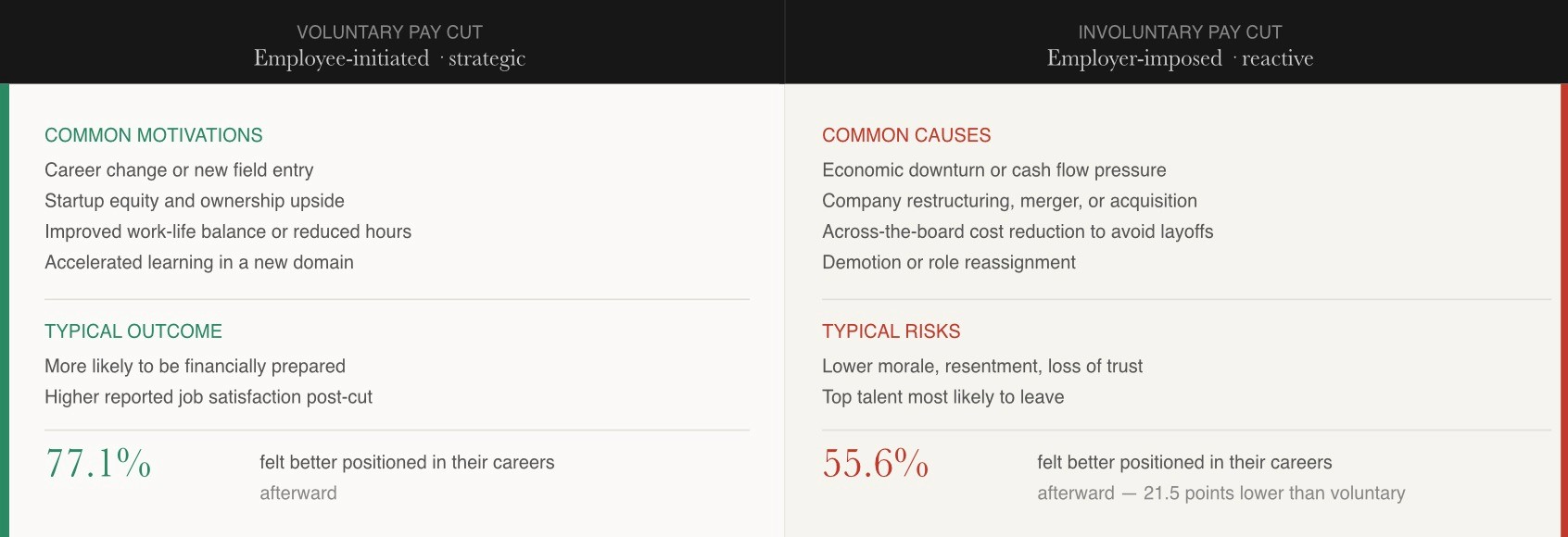
Employees who voluntarily take a pay cut often report higher job satisfaction and career advancement opportunities compared to those who experience involuntary cuts. Approximately 77.1% of employees who took a voluntary pay cut felt they were in a better position in their careers afterward, compared to 55.6% of those who took an involuntary cut.
Involuntary Pay Cuts Tied to Company Performance
Companies often reduce salaries across the board during economic downturns to avoid layoffs. Reducing salaries can act as a temporary fix to protect cash flow and improve financial stability if a company is in danger of closing. Organizational changes, mergers, or acquisitions may also lead to standardized, lower salary scales to align with new budgets.
There are consequences. Reduced pay often leads to lower employee morale, negatively impacting performance and productivity. Salary reductions frequently lead to feelings of resentment, demotivation, and a loss of trust in management. Top talent is the most likely to leave when pay is reduced, which can harm the firm’s long-term revenue. Highly skilled or specialized employees are more likely to seek employment elsewhere when faced with lower wages, risking a brain drain for the company.
In many jurisdictions, employers must discuss and seek agreement on pay changes, and the reduction cannot be applied retroactively. Employee pay cuts are legal, but employers must follow certain rules, such as providing advance notice to employees about the intended decrease in pay, which may need to be in writing in some states. Certain laws prohibit reducing employee wages based on discriminatory or retaliatory reasons, as protected by Title VII of the Civil Rights Act of 1964. In some cases, salary reductions may not apply to unionized employees, as they often have contracts that protect their pay, requiring renegotiation for any adjustments. In extreme cases, a massive pay cut imposed unilaterally may be considered “constructive dismissal,” allowing the employee to resign and qualify for unemployment benefits.
When Taking a Pay Cut Can Make Strategic Sense
Not all pay cuts are negative. The key is to compare short term income pressure against long term value, including skills, career paths, culture, and job satisfaction.
Challenging Work and Long Term Earning Potential
A lower salary can make sense when the new position offers stronger technical scope. A software engineer may leave a higher-paying job focused on maintenance for a new AI platform team that offers architecture ownership, production ML experience, and a clearer path to staff or principal compensation bands within three to five years.
Hiring leaders should be direct about the plan. Explain expected promotion timelines, salary recovery, equity assumptions, and how the organization evaluates performance. Candidates should expect specific milestones, not vague promises.
Work Life Balance and Non Monetary Benefits
Employees may choose to take a pay cut for improved work-life balance, such as accepting a job that allows for remote work or reduced hours. Non-monetary benefits, such as improved work-life balance and job fulfillment, can outweigh the financial drawbacks of a pay cut, leading to greater overall job satisfaction.
Other benefits can include flexible start times, additional vacation days, learning stipends, parental leave, sabbaticals, or fewer on-call hours. In high-growth engineering teams, these benefits can reduce burnout and improve retention.
Switching Industries or Functions
Switching industries or functions often requires accepting a lower salary for a period. Moving from fintech to healthcare AI, or from operations into data science, may mean the candidate does not earn the same amount immediately.
Taking a pay cut can sometimes lead to greater job satisfaction and career advancement in the long run, especially if the new role aligns better with personal passions. Hiring managers should support this transition with mentorship, training plans, and clear salary review criteria.
How Employers Should Evaluate and Communicate Pay Cuts
Pay cuts are high risk management decisions. They affect trust, employer brand, clients, and the future hiring pipeline, especially for engineering and AI teams.
Designing Fair and Transparent Pay Cut Policies
Pay cuts should be part of a broader workforce strategy, not an isolated budget reaction. Executives should take reductions first where possible, and the company should use consistent criteria such as level, role criticality, department, and performance.
Documentation should state whether the reduction is temporary or permanent, what conditions will restore prior pay, and how the employer will protect employees from unfair impact. HR, finance, and legal teams should review the plan before communication begins.
Communicating Pay Cuts to Current Teams and Candidates
Pay cuts can damage trust in leadership and create a toxic company culture if not managed transparently. Use all-hands meetings, written FAQs, and one-on-one manager conversations to explain why the company is reducing compensation, what expenses it is trying to reduce, and how long the period may last.
Recruiters should also address compensation history clearly with candidates. Future employers often use current or past compensation as a baseline to negotiate new salary offers, meaning a steep pay cut can depress lifetime earnings. If a new company cannot afford higher salaries today, it should explain equity, promotion timing, and benefits honestly.
Using Structured Evaluation Instead of Ad Hoc Decisions
A structured process reduces perceived favoritism. Talent leaders can use this checklist:
Model cash runway, operating expenses, and layoffs avoided.
Benchmark market salary for critical AI and engineering skills.
Review legal rules for wages, notice, minimum wage, and exempt status.
Measure retention risk by role, especially for specialized workers.
Collect candidate feedback from recruiting partners such as Fonzi to calibrate market expectations.
Financial and Career Tradeoffs: Framework for Individuals
Hiring managers and recruiters can share this framework with candidates weighing equity-versus-cash offers at startups. It is a consultative resource, not standalone personal finance advice.
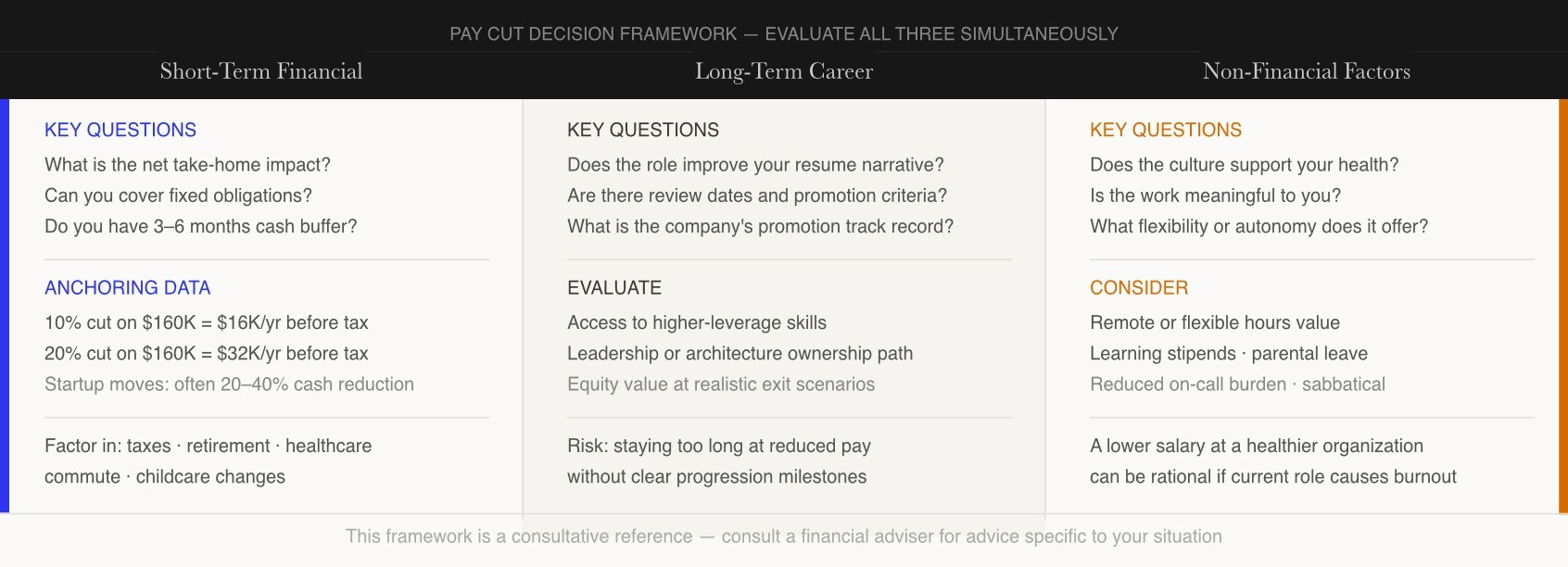
Short Term Financial Impact
The most direct effect of a pay cut is a reduction in take-home pay, which tightens personal budgets and limits savings. Employees may struggle to meet financial obligations due to pay cuts, threatening their financial security.
A 10 percent reduction on a $160,000 salary is $16,000 before tax. A 20 percent drop is $32,000 before tax. Candidates should calculate net income after taxes, retirement contributions, commuting, childcare, and healthcare changes.
Creating a new budget, cutting back on discretionary spending, and increasing contributions to a savings account can help financially prepare for a potential pay cut. Employees who voluntarily take a pay cut are more likely to be financially prepared compared to those who experience an involuntary pay cut. A 3- to 6-month cash buffer is a practical starting point before accepting voluntary wage cuts.
Long Term Career and Earnings Impact
Some pay cuts accelerate long-term income if they provide access to higher-leverage skills, leadership paths, stronger networks, or ownership. The candidate should evaluate the company’s growth potential, promotion record, and whether the new position improves the resume narrative for future careers.
The risk is staying too long at reduced compensation without progression. A good offer should include review dates, promotion criteria, and a realistic path back to higher salaries.
Non Financial Factors: Culture, Health, and Satisfaction
Culture, health, autonomy, and meaningful work have real value. A lower salary at a healthier organization can be rational if the current job involves chronic burnout, poor leadership, or misaligned values.
Negotiating for alternative benefits, such as additional vacation days or flexible working arrangements, can help mitigate the impact of a pay cut while enhancing overall job satisfaction.
Comparing Pay Cut Scenarios and Tradeoffs
This table is a quick reference for employees and hiring leaders. Each scenario should be evaluated with the same discipline used for any major compensation decision.
Scenario | Typical Pay Cut Size | Potential Benefits | Main Risks |
Switching to a startup | Often meaningful base salary reduction | Equity, ownership, faster learning | Equity may not pay out, income may stay lower |
Reducing hours for family or health | Often proportional to fewer hours | Better life balance and lower burnout | Lower savings and slower advancement |
Pivoting from a Big Tech enterprise engineering role to an early-stage AI infrastructure team | Can be steep, especially in cash pay | New skills, broader scope, valuable AI experience | Higher uncertainty and fewer mature benefits |
Company wide cuts | Often 10 to 12 percent in recent tech cycles | May avoid layoffs and protect runway | Morale drop, losing top talent, trust damage |
Conclusion
A pay cut is a significant decision that needs structured financial and career analysis, not gut instinct. In fast evolving fields like AI, accepting less money can be rational when it leads to stronger skills, better job satisfaction, and greater long term value.
Hiring managers and recruiters should communicate compensation tradeoffs clearly and support candidates with concrete information. Review your compensation frameworks, and if relevant, explore curated talent networks such as Fonzi for transparent market insight.
FAQ
What is a pay cut and how does it differ from a salary adjustment?
When does taking a pay cut make sense for your career?
How much of a pay cut is reasonable if I am switching roles, industries, or going to a startup?
How do I negotiate to minimize a pay cut when changing jobs?
What are the long term financial impacts of taking a salary decrease?